Final Study Guide - The Literature of Children and Adolescents
 Studied by 0 people
 Call Kai
 Learn
Learn Practice Test
 Spaced Repetition
 Match
Match Flashcards
 Knowt Play
1/121

There's no tags or description
Looks like no tags are added yet.
Name | Mastery | Learn | Test | Matching | Spaced | Call with Kai |
|---|
No analytics yet
Send a link to your students to track their progress
122 Terms
Theory of Mind
ability to attribute mental states to themselves and others
Capable of reading a story with multiple points of view, including stories with an “unreliable narrator”
Readers can be assumed to have more highly developed powers of empathy, and therefore to be capable of reading and caring about characters whose lives are very different from their own
Young people supposedly won’t read about characters younger than themselves, but in these longer books the mix of ages can be greater
Abstract thinking
Readers can be assumed to have the ability to think abstractly to some extent, and therefore to follow a narrative that proposes an alternate world or universe, with rules and laws of nature other than those known to us
Readers can be assumed to have a more sophisticated sense of time - of history and the future
Readers can be assumed to know more about the world, including some of the more intense and disturbing aspects of reality
Readers may not want illustrations but prefer to create their own mental pictures of characters and events
Social Learning Theory
Moral behavior is learned through reinforcement and modeling
Effective adult models of morality are warm and powerful and consistently model their values
Cognitive Developmental Theory
Children are active thinkers about social rules
Through sibling and peer interaction, children work out their first ideas about justice and fairness
Think of the animals on the farm; the rules and way of life they pass on to Wilbur
Middle childhood morality
Internalized “oughts and shoulds” of the latency period represents new cognitive advance and new capacity to understand emotions
8 yr old can turn on father for slightest moral infractions for sake of obeying the code
Kids chide parents for not following the rules and not attending church
Notion of “do as I say, not as I do” easily contested and latency-age kids recognize parental hypocrisy
Tendency for good and bad to take on absolute valence, allowing little room for grays
Kohlberg - Stages of Moral Understanding
Through clinical interviews Kohlberg presented a sample of 10-16 year old boys with hypothetical moral dilemmas and asked them what the main character should do and why
The way an individual reasons about dilemmas determines moral maturity, not the content of their response
Three levels, each consisting of 2 stages
Pre-conventional level
obedience and punishment orientation
instrumental purpose orientation
Stage 1 - Obedience and Punishment Orientation
Believes in a fixed set of rules
Authority figures
Morality is something that “big people say they must do”
Judge morality of action by its direct consequence
Punishment is to be avoided
“The last time, I got spanked; therefore, I won’t do it again”
Pro-stealing: “If you let your wife die, you’ll be blamed for not spending the money to help her. There’ll be an investigation of you and the druggist for your wife’s death.”
Stage 2 - Instrumental Purpose Orientation
Concrete understanding of different perspectives
Self-interests determine what is right
“What’s in it for me?”
Any concern for others is based on “You scratch my back, and I’ll scratch yours.”
Anti-stealing: “[Heinz] is running more risk than it’s worth [to save a wife who’s near death]”
Conventional Level
Good girl - nice boy
Maintaining social order
Stage 3 - Good girl - nice boy
Typical of adolescents and adults
Evaluate actions in terms of relationship to others
Live up to expectations of family and community
Pro-stealing: “No one will think you’re bad if you steal the drug, but your family will think you’re inhumane if you don’t. If you let your wife die, you’ll never be able to look anyone in the face again.”
Stage 4 - Maintaining social order
Societal laws
Important to obey rules to maintain a functioning society
Rules must be enforced in the same manner for everyone
Everyone has a personal duty to uphold the rules
Laws must be obeyed under all circumstances; otherwise, chaos would ensue
Anti-stealing: “Even if his wife’s dying, it’s still his duty to obey the law. If everyone starts breaking the law when in a jam, civilization would crumble”
Post-Conventional Level
Social Contract
Universal Ethical Principles
Stage 5 - Social Contract
Free and willing participation for the “Common Good”
Basis for a democratic gov’t
The greatest good for the greatest number of people
Pro-stealing: “the law against stealing wasn’t meant to violate a person’s right to life. If Heinz is prosecuted for stealing, the law needs to be reinterpreted to take into account situations in which it goes against people’s natural right to life.”
Stage 6 - Universal Ethical Principles
Moral behavior is defined by self-chosen principles of conscience
Laws are valid only in so far as they are grounded in justice
Principles respect each person’s worth and dignity
Considers what one would do if they were in the other’s shoes
Pro-stealing: “It doesn’t make sense to put respect for property above respect for life itself. [People] could live together without private property at all. [People] have a mutual duty to save one another from dying.”
Carol Gilligan’s take on Kohlberg
Kohlberg’s theory does not adequately represent morality of girls and women
Feminine morality emphasizes an “ethic of care”
Different not less valid
Studies have tested Gilligan’s claims
Females display reasoning at the same stage as males
Female approach = interpersonal concerns of caring and responsiveness are a real life reaction to a moral dilemma
Moral Identity
The degree to which morality is central to self-concept
Moral behavior is influenced by many factors besides cognition
Emotions (empathy, sympathy, guilt)
Temperament
Cultural experiences and intuitive beliefs
Moral identity
Pragmatic approach to morality (challenges to Kohlberg)
Each person makes moral judgments at varying levels of maturity, depending on the individual’s current context and motivations
Everyday moral judgments are practical tools that people use to achieve their goals
Middle childhood defined (6-11)
New responsibilities are introduced
School, work around (and sometimes outside of) the home, greater role in helping the family, etc
By 6, brain has reached 90% of its adult weight
Children will add 2-3 inches in height and 5 lbs in weight each year
Adolescence defined
Biological
Starts - puberty
Ends - with the maturation of physical processes and decline in growth
Social
Starts - increased focus on peer relationships, as opposed to family relationships
Ends - full attainment of adult status and privileges (entrance into adulthood)
“Adolescence begins in biology and ends in culture”
Development characterized by continuity and discontinuity
Phases of adolescence
Early adolescence (10-14)
Puberty and major bodily changes
Mid adolescence (14-16)
Cognitive changes and evolving personality
Start of dating
Sense of future possibilities
Late adolescence (16-21)
Transition to adulthood requires a range of adaptations
Adrenarche
sex hormones begin to rise long before physical changes are visible, typically between 6-8, when the adrenal glands on top of each kidney start to release increasing levels of adrenal androgens
By 10, levels of adrenal androgens have increased ten-fold and some children experience their first feelings of sexual attraction
Effect of Hormones
Elevated levels of testosterone: a social hormone that makes teens more concerned with how they’re perceived by others
elevated levels of oxytocin: increases empathy and trust to remember of our peer group, and aggression towards those who are “out” of the peer group
Elevated levels of cortisol: alert to environmental threats
Body growth
Growth spurt: the first outward sign of puberty is the rapid gain in height and weight
The cephalocaudal trend of infancy and childhood reverses during puberty
Legs grow faster than shoulders, trunk
Leads to gangly limbs of the teen
Bodily changes
Earlier maturation of girls compared to boys
Growth spurt generally two years earlier
Marked individual differences in timing
Girls: 9-15
Boys: 10-13.5
Early vs late maturation - boys
Early maturing boys
More popular, relaxed, good-natured, and generally poised
May be secondary to physical maturation and improved social status
Late maturing boys
Treated like younger children
Less athletic
More difficult adolescence
Early vs late maturation - girls
Seen as desirable step toward maturity
Poorer body image
Increased risk of eating problems
Increased behavioral difficulties
Not continuing education after high school
Joined older peer groups
More likely in co-ed schools
Authoritarian
Control is obtained through power without explanation
Authoritative
control is obtained through reasoning with a balance of warm contact and firm responses to violations
Permissive
Control is not required and deviations from expectations and rules are not responded to with negative consequences
Correlates of authoritarian parenting
Children tend to be:
Passive
Dependent
Conforming
Less self-assured
Less creative
Less socially adept
Lower psychological maturity
Lower self-esteem
Lower resourcefulness
Lower achievement
Social problems
Externalizing behavior
Higher risk for substance abuse, crime, and delinquency
Correlations of Authoritative Parenting
Family cohesiveness
Higher levels of academic achievement
Higher self-esteem
Greater cooperativeness
Psychological maturity
Resourcefulness
Reasoning ability
Empathy
Altruism
Lower rates of behavior problems
Correlates of Permissive Parenting
Children tend to be:
Lower in impulse control
More immature
Less self-reliant
Less socially responsible
Less independent
Lower academic achievement
Verbal and physical aggression (poor self-regulation)
Heavy drinking in adolescents
Early sexual behaviors
Parent-child relationships in middle childhood
Amount of time spent with parents declines with growing independence
Child rearing becomes easier for parents who established an authoritative style in the early years
Coregulation
Authoritative parenting in middle childhood predicts academic and social competence and reduced engagement in antisocial behavior in adolescence
Coregulation
parents maintain general oversight while letting children take charge of moment-by-moment decision making
Sibling relationships in middle childhood
Sibling rivalry increases
Parental comparisons between siblings can cause resentment
Many siblings continue to rely on each other for companionship, assistance, and emotional support
Parental encouragement of warm, considerate sibling ties is important
Adolescence: increase in autonomy
Emotional component
Relying on oneself than on parents
Behavioral component
Making independent decisions
Shift from family to peer interactions
Parent-child relationships are still important for helping teens develop autonomy and responsibility
Changes supporting increased autonomy
Puberty → psychological distancing from parents
Physical maturation → parents give teens more freedom and responsibility
cognitive development → solve problems and make decisions more effectively
Improved social reasoning → de-idealize parents, no longer bend to authority as easily
Parent-child relationship in adolescence
Quality of parent-child relationship is single most consistent predictor of mental health
Effective parenting strikes a balance between connection and separation
Authoritative parenting style
Fosters autonomy
Autonomy → self-reliance, achievement, positive work orientation, self-esteem, ease of separation
Parenting and positive outcomes for teens
Consistent parental monitoring of daily activities, through a cooperative relationship in which the adolescent willingly discloses information is linked to positive outcomes
Prevention of delinquency, reduction in sexual activity, improved school performance, and positive psychological wellbeing
Parents who are coercive or psychologically controlling interfere with development of autonomy
Outcomes include low self-esteem, depression, drug and alcohol use, and antisocial behavior
Reorganized relationship
Amount of time spent teens spend together with family declines by ~50% compared to middle childhood
Quality of parent-teen time is more important than quantity
Shared leisure activities
Family meal time
Drop in family time during teen years varies by culture
Sibling relationship in adolescence
As younger siblings become more self-sufficient, sibling influence declines
Teens invest less time in their siblings and more involved in friendships and romantic relationships
Siblings who establish a positive bond in childhood continue to display strong affection and caring
Linked to increased academic engagement, empathy and prosocial behavior
Warm, supportive parents and history of caring friendships → more positive sibling ties (and vice versa)
Fudge
He’s cute and kisses his mother to win her over
He does exactly what he wants. He’s not subject to the rules and conventions of social behavior
He’s a jester: “PEE-tah!”
Fudge doesn’t always know the difference between fantasy and reality
In the park he thinks he really can fly like a bird
At the movie theater, he reacts to the on-screen bear as if a real bear were actually in the room
Peter
Peter narrates the story
His voice is something of Alexander’s, the language of complaint. Unfairness is the big issue for him
We find some of Peter’s comments funny even though he isn’t trying to be funny
Peter feels unlucky, under appreciated, neglected to the point of being invisible to his parents (“Maybe I’m not their real son.”)
On the more positive side, Peter:
Sometimes enjoys the “grownup” responsibility he’s given by his mother (to offer his opinion, set an example for Fudge at the shoe store, the dentist, and elsewhere)
We first see Peter acting maturely in the way he introduces himself to his father’s clients and how he responds to the gift of a book he’s outgrown
He takes pride in the care he gives Dribble, his pet turtle
Peter has friends (esp Jimmy Fargo), and increasingly prefers their company to that of his family
Resilient - when Fudge ruins his poster, he moves past anger quickly and comes up with a new plan
Values his own thoughts and feelings - “But secretly, whenever I look at him, I think it. My brother, Fang Hatcher! Nobody can stop me from thinking. My mind is my own.”
Reconsiders his opinions, including those about Fudge
“I never considered refusing to open my mouth at the dentist’s office”
“Leave it to my brother to eat flowers! I wondered how they tested.”
Peter’s personal growth
At the ad agency, Peter notices that his little brother is growing up → “I never heard my brother say ‘Please’ before.”
When Fudge is in the hospital, Peter becomes emphatic → “Maybe he wasn’t such a bad little guy after all.”
Judy Blume as a satirist
Points out the limits of the culture of celebrity and consumerism/advertising. This is the world of Mad Men
Makes fun of the cluelessness of parents (Fudge’s father: “Eat it or wear it!”)
The mother sometimes seems more concerned with maintaining order than with doing what’s best for her children
Shows the tendency of parents to play one child against another
Adults do not have a monopoly on knowledge. Peter is sure he knows better than the mayor how mass transit could be improved
Wisdom of Judy Blume
Tells how to avoid getting mugged
Advises against smoking and talking to strangers
Connects failure of leaves to turn color in the fall to air pollution
Categories of youth behavioral and emotional disorders
Disruptive behavior disorders
Neurodevelopmental disorders
Anxiety disorders
affective/mood disorders
Eating disorders
Elimination disorders
Eating disorders
Elimination disorders
Adjustment disorders
Psychotic disorders
Disruptive behavior disorders
Oppositional defiant disorder - 3%
Conduct disorder - 1-10%, higher rate in adolescence and boys
Oppositional Defiant Disorder (ODD)
Frequent refusal to cooperate with requests
Arguments with parents, teachers, and peers
Blames others for actions that he/she has taken
Lies
Engages in sneaky actions
Conduct disorders
Most often seen in adolescent years
Breaks major rules
In childhood, highly aggressive
At all ages:
Steals
Uses weapons or threatens
Vandalism
Engages in truancy
High use of substances
Criminal activity
Sexually promiscuous
Neurodevelopmental disorders
ADHD - between 4-7% of children and adolescents
Specific Learning Disorders - varied estimates (15-20%)
Language disorders - about 3% of children
Autism Spectrum Disorders - about 1% worldwide; 1 in 44 children in the U.S.
Intellectual Disabilities - about 2%
ADHD
3 forms
combined type
primarily inattentive type
primarily hyperactive/impulsive type
Developmentally inappropriate levels of:
hyperactivity
impulsivity
inattentiveness
Functional impact on family, social life, and school life
Learning disorders
Functional impairments in specific academic subjects in the presence of generally average intellectual development
Specific reading disorder
Specific mathematics disorder
Specific disorder of written expression
Language disorders
Functional impairments in the comprehension of language and/or the ability to express ideas in spoken form
Impact on early learning and social interaction
Impact on school learning and school performance
Can be very persistent and have a major impact on social functioning
Autism spectrum disorders
Functional impairments in social communication and interests
Difficulty understanding nonverbal and verbal communication
Difficulty understanding social interactions
May have reduced interest in interacting with others
Repetitive behavior patterns based upon a restricted range of interests compared to others
Unusual interests when compared to others
Social impairments have major impact on relationships
Often associated with reduced intellectual development
Anxiety disorders
Separation anxiety disorder - 2-4%
Generalized Anxiety Disorder (GAD) - 3-6%
Specific Phobias - 3-4%
Social Phobia - 1-5%
Panic Disorder - 1-2%
Obsessive Compulsive Disorder (OCD) - 2-3%
Selective Mutism - 0.47-0.76%
Affective and mood disorders
Major Depressive Disorder (MDD) - <1%, 14-20%
Dysthymic Disorder - <1%-2%, 10-15%
Depressive Disorder not otherwise specified - 1%, 10%
Bipolar Disorder - rare in children; 10% in adolescents
The nature of mood disorders
Decreased energy
Decreased interest in activities and social interactions
Irritability
Low self-esteem
Easily discouraged
Thinking pessimistically about the self, the environment, and the future
Prone to suicidal thoughts and actions
Responding to a mental health condition
Recognize that a problem exists
Obtain an evaluation
Understand the nature of the problem
Obtain appropriate treatment
Gather the time, financial, and support resources for treatment
Alter responses that are contributing to the condition
Treatment methods
Individual treatments
Behavioral therapy
Cognitive Behavioral Therapy (CBT)
Psychodynamic therapies
Family therapy
Multicomponent therapies
Important role of parents in treatment
The coping cat protocol
instruction/orientation
Relaxation training
Cognitive training and restructuring
Exposure with support and rewards
F.E.A.R.
Formal operations
Increased flexibility in thinking
Increased capacities in abstract reasoning and attention
Increased interpersonal awareness and interest in social activities
Seeker of inconsistencies
Hypothetico-deductive reasoning
when faced with a problem, adolescents start a hypothesis from which they deduce logical, testable inferences
Begins with possibility and ends in reality
Propositional thought
ability to evaluate logic of propositions (verbal statements without needing concrete properties in front of them)
Ex: all men are tall. Sally is tall. Is Sally a man?
Plasticity
ability to change in response to the environment by modifying connections between brain regions
Peer pressure
Being around peers increases teens’ interests in rewards
Increased sensitivity to social exclusion
Effects of social media on emotions
Moderating effect of social success on risk-taking behaviors
Executive skills questionnaire
Consider your strengths
Do you need to use these skills often in school? If so, how do they help you?
Do they affect how you get things done in settings outside of school?
Consider your weaknesses
Do these make being a student challenging?
Do you have coping strategies to compensate for these weaknesses?
Distorted images
Imaginary audience: adolescents believe that they’re the focus of everyone else’s attention and concern
Personal Fable: certain of their imaginary audience, teens develop an inflated opinion of their own importance - they feel special and unique
Both images are rooted in perspective-taking, not egocentrism
Personal fables and limited experience
Experience is a great educator - adults have learned from mistakes, but teens have had less experiences and less opportunities to learn
Teens are more “here and now” - living in the present experience reduces their capacity to envision something going wrong
Smarter, but angrier teens?
Emotional and intellectual development don’t always go hand in hand
Arguing skills might be more advanced
Once escalated, there may be insufficient skills to regulate these feelings
Teens often perceive the world as “black and white”
Catastrophic thinking
Strong reactions to provocations or disappointment
Tendency to lash out at those who “can take it”
Decision making
Changes in the brain’s emotional/social network outpace the prefrontal cortex’s cognitive control network
Consequences for planning and decision making
Decision making involves:
Recognizing a range of options
Identifying pros and cons of each
Assessing likelihood of different outcomes
Evaluating one’s choice (did it meet goals?)
Learning from mistakes
The Phantom Tollbooth Themes
Education and learning as antidotes to juvenile boredom
Struggle of ignorance vs wisdom, nonsense vs logic
Value of art
The world of The Phantom Tollbooth
Movement to the suburbs
Averages
Quest stories (going out in search of something)
American identity
Humanities vs technology debate
Dr. Seuss
People began to feel that life was becoming too homogenized, too driven by averages and statistics, like, “the average family has 2.58 children”
Common autism myths
Children with autism are incapable of friendship or love
All people with autism have a special ability
Autism is caused by bad parenting
Autism is new
There is an autism epidemic
People with autism are cold and unempathetic
Autism spectrum disorder (ASD)
a complex developmental disorder caused by differences in the brain
Deficits in social communication and interaction
Restricted, repetitive, stereotyped behaviors, interests and activities
1 in 36 children
ASD
1 in 37 boys, 1 in 151 girls
No medical test or cure
Costs a family $60,000 a year
Occurs in all racial and ethnic groups
More common than childhood cancer, juvenile diabetes, and pediatric AIDS combined
Autism according to Kanner in 1943
A profound autistic withdrawal
An obsessive desire for the preservation of sameness
A good rote memory
An intelligent and pensive expression
Mutism or language without real communicative intent
Oversensitivity to stimuli
A skillful relationship to objects
DSM-5 Social/Communication Domain
Social interaction and communication domains condensed into one domain: social/communication deficits: all three of the following must be met:
Deficits in social-emotional reciprocity
Abnormal social approach, difficulties with back and forth conversations, reduced sharing of interests, emotions and affect
Deficits in nonverbal communicative behaviors
Facial expressions, gestures, eye contact, body language
Deficits in developing and maintaining relationships
Adjust behaviors to suit social context, difficulties in imaginative play, making friends, interest in others
DSM-5 restricted, repetitive patterns of behavior, interests or activities
Stereotypes or repetitive speech, motor movements or use of objects
Excessive adherence to routines, ritualized patterns of verbal or nonverbal behavior or excessive resistance to change
Highly restricted, fixated interests that are abnormal in intensity or focus
Hyper or hypo-reactivity to sensory input or unusual interest in sensory aspects of environment
Variations in ASD presentation
Core symptoms manifest differently across age groups
Presentation may differ in females
ASD symptoms may be missed more frequently in children from some cultural and socioeconomic groups
Individuals with lower IQ/language abilities present differently
“If you’ve met one person with autism, you’ve met one person with autism.” - Dr. Stephen Shore
Social (Pragmatic) Communication Disorder
Must have ALL of these social verbal and nonverbal communication deficits
Deficits in using communication for social purposes
Impairment in ability to adjust communication to context
Difficulties following conversation rules and telling stories
Difficulty making inferences or with ambiguous language (too literal)
Functional limitations in communication, social participation, school and work
Onset in early development
Not due to neurological or medical condition, ASD, intellectual disabilities, global developmental delay
Pragmatics
involves 3 major communication skills
Using language for different purposes
Greeting (ex: hello, goodbye)
Informing (ex: I’m going to get a cookie)
Demanding (ex: give me a cookie)
Promising (ex: I’m going to get you a cookie)
Requesting (ex: I would like a cookie, please)
Changing language according to the needs of a listener or situation
Talking differently to a baby than to an adult
Giving background info to an unfamiliar listener
Speaking differently in a classroom than on a playground
Following rules for conversations and storytelling
Taking turns in convo
Introducing topics of convo
Rephrasing when misunderstood
How to use verbal and nonverbal signals
How close to stand to someone when speaking
How to use facial expressions and eye contact
Diagnosing ASD
Comprehensive psychiatric evaluation
Autism Diagnostic Interview-Revised (ADI-R)
Language and Cognitive testing
Autism Diagnostic Observation Schedule (ADOS)
PEERS Lessons
Introduction and trading information
Two-way conversations
Electronic communication
Choosing appropriate friends
Appropriate use of humor
Starting and joining conversations
Exiting conversations
Good sportsmanship
Get-togethers
Handling arguments
Changing reputations
Handling teasing and embarrassing feedback
Handling physical bullying
Handling cyber bullying
Minimizing rumors and gossip
Does The Curious Incident of the Dog in the Night-Time accurately represent autism?
Christopher’s traits:
Significant difficulty communicating and interacting with people (ex: overly literal)
Difficulty interpreting gestures and facial expressions
Difficulty taking others’ perspectives
Formal speech, no social spontaneity/reciprocity
Restricted interests
Rocks or groans when overwhelmed
Hypersensitives to sound, smell and touch
Stereotypical representation
Christopher’s unique way of experiencing things
Focus on orderliness
Derives comfort from highly detailed information
“It was 1:12 a.m. when Father arrived at the police station. I did not see him until 1:28 a.m. but I knew he was there because I could hear him.”
emotional limitation: trouble reading faces and the emotions of others
Contrast with Milo of The Phantom Tollbooth
Theory of mind and need for order
Smarties task
“...when I was little I didn’t understand about other people having minds. And Julie said to Mother and Father that I would always find this very difficult. But I don’t find this difficult now.”
Need for Order
Regularity and predictability in his sentences
“I do this, then I do that…”
Emerging adulthood
New transitional period extending from the late teens to the mid-twenties
Phase of Emerging Adulthood
Feeling in between
Identity exploration
Self-focused
Instability
Possibilities
Emerging adulthood - then vs now
1950s
Average age of 1st marriage
Females: 20, Males, 23
Enroll in college immediately post high school: 14%
2000s
Average age of 1st marriage
Females: 26, Males: 28
Enroll in college immediately post high school: 66%
Facts of emerging adults
⅓ of 18-to-25 year olds move to a new residence every year
Just over ½ of 18-to-25 year olds return to their parents’ home for brief periods after first leaving
They go through an average of 7 jobs in their 20s, more job changes than in any other stretch
⅔ spend at least some time living with a romantic partner without being married
Most remain financially dependent on parents
Only 50% of U.S. young people who enroll in higher education have earned their Bachelor’s degree by 25
Reasons: wanting to travel, changing majors, working full/part time
A psychologist’s point of view
“It takes longer now to be self-sufficient. It takes more education now than in the past to get a good job,” says psychologist Jeffrey Arnett
This pushes milestones, such as marriage and career, back to the mid-to-late 20s and beyond
Arnett stresses, the key characteristic of emerging adulthood is that it’s a period of exploration and change: students explore possible directions in life and often experiment with different roles, trying them on until finding one that feels like the right “fit”
Cognitive changes
Continued development of prefrontal cortex and its connections with other brain regions
Specialization of a person’s interests/experiences leads to experience-dependent brain growth and refinement in specialized regions of cerebral cortex
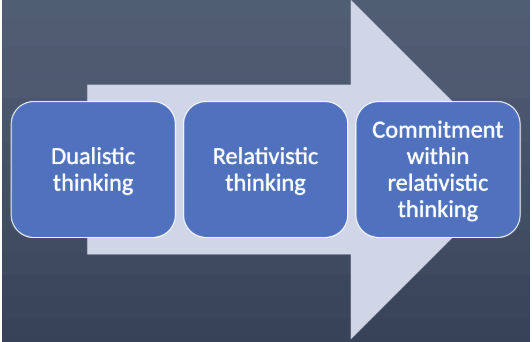
Postformal thought
Cognitive development beyond Piaget’s formal operational stage
College students make impressive strides in cognition
Epistemic cognition
Our reflections on how we arrived at facts, beliefs, and ideas
Epistemic means “of or about knowledge”
Emotional and social changes: love
Romantic ties typically last longer and become more emotionally intimate and committed
Nevertheless, among US college students, emotionally indifferent, uncommitted sexual encounters are widespread
In Western nations, cohabitation has become the preferred mode of entry into a committed relationship
Predictors of happy, lasting relationships
Partner similarity
Good communication
Secure internal working model of attachment
Emotional and social changes: work
Work experiences increasingly focus on preparation for adult work roles
“Dream”—career for men and both marriage and career for women
Relationships with mentors, along with quality of higher education, contribute to emerging adults’ realization of career goals
Identity achievement in the vocational realm tends to be more challenging for women
Ethnic minorities may face difficulties
Emotional and Social Changes: Worldview
Is this generation more narcissistic?
U.S. college students express both individualistic and relationship goals in their worldview
Community service
Strong pluralistic orientation and desire to address global problems
Compared with older people, they vote in fewer numbers
Seven vectors of development
Seven “vectors” of development during the college years
Each vector is a core developmental task of emerging adulthood
Development doesn’t necessarily proceed at the same pace in all seven areas at once
For example, someone may be further along on developing a sense of identity and purpose than on managing emotions, or vice-versa
Seven Vectors
Developing intellectual, social, and physical competence
Learning to manage emotions
Moving through autonomy toward interdependence
Developing mature interpersonal relationships
Establishing identity
Developing purpose
Developing integrity
 Note
Note  Flashcards (105)