Retina (Dr. Najeeb and UCL )
0.0(0)
Studied by 0 people View linked note
 Call Kai
 Learn
Learn Practice Test
 Spaced Repetition
 Match
Match Flashcards
 Knowt Play
Card Sorting
1/32

Earn XP
Description and Tags
Last updated 10:03 AM on 10/14/22
Name | Mastery | Learn | Test | Matching | Spaced | Call with Kai | Chat |
|---|
No analytics yet
Send a link to your students to track their progress
33 Terms
1
New cards
Microglia
________ are macrophages which are spread throughout retinal layers and remove cellular debris which have broken down.
2
New cards
Photoreceptor
________ and Bipolar cells have ability to produce graded potentials- these transfer to ganglion cells to produce action potentials.
3
New cards
Rods
________ are generally in periphery, Cones are generally in fovea.
4
New cards
Retinal
________ nerve fibre layer in retina are not myelinated as it is a reflective structure and would cause degradation of the image- → as soon as RNFL hits optic nerve, there is myelination from oligodendrocytes.
5
New cards
Muller cells
________ have foot plates which are a boundary between retina and vitreous (INNER LIMITING MEMBRANE)
6
New cards
Fovea
________ is point of sharpest visual acuity because.
7
New cards
RPE Contains
________ melanosomes and are held to each other by tight junctions.
8
New cards
Astrocytes
________ support neuronal structures, ganglion layer structures and capillary structures-
9
New cards
Cones
________ activate at different wavelengths of light, have 1: 1 connection with bipolar cells so can see more detail in better light settings.
10
New cards
Macula
________ depends on choroidocapiliary diffusion (avascular structure)
11
New cards
Choriocapillaries
________ are vascular circular sinusoids (capillary loops)
12
New cards
Spherule
________ is synaptic terminal.
13
New cards
Cods
________ has pedicule synaptic terminal.
14
New cards
RPE acts
________ as barrier between choriocapillaries and neuro- retina- choriocapillaries give nutrition to outer 5 layers (RPE to outer plexiform layer)
15
New cards
synaptic terminals
Both rods and cones have photoreceptive part facing towards outer retina and have ________ facing inner side of retina (towards bipolar cells)
16
New cards
Bipolar cells
________- multiple rods are connected to one ________ but only one ________ connects to one cone (in fovea)- these behave like dendrites.
17
New cards
Rods
________ and Cones use glutamate as neurotransmitter to bipolar cells> Bipolar cells also are glutaminergic to connect to ganglion cells> Ganglion cells are using glutaminergic to connect to optic tract.
18
New cards
Rods
________ contain rhodopsin on outer segment which has photoreceptive component.
19
New cards
Rods
________ at low lumination can give signals /sensitivity as multiple rods are connected to one bipolar cell, sum of their graded potentials allow action potential to fire from ganglion cell.
20
New cards
Photoreceptor and Bipolar cells have ability to produce graded potentials
these transfer to ganglion cells to produce action potentials
21
New cards
Ganglion cells are main output cells which connect to the optic disc
the current of electrical flow is radial (from outer retina to inner retina) flow is RBG
22
New cards
Horizontal cells connect between photoreceptors connecting laterally and are found in outer plexiform layer
these are usually inhibitory cells and are mediated by GABA
23
New cards
Muller cells originate between inner/outer plexiform later
they fixate rods and cones together through zona adherens (OUTER LIMITING MEMBRANE) and keep inter-photoreceptor fluid and matrix within the layer so doesnt escape beyond through to internal retina
24
New cards
RPE
acts as blood-retinal barrier between choroid
25
New cards
RPE acts as barrier between choriocapillaries and neuro-retina
choriocapillaries give nutrition to outer 5 layers (RPE to outer plexiform layer)
26
New cards
Cones activate at different wavelengths of light, have 1
1 connection with bipolar cells so can see more detail in better light settings
27
New cards
Ganglion cells
some cells have illumination qualities which can send signals independently to hypothalamus (supra-chiasmatic nucleus) via retino-hypothalamic pathway determines circadian rhythm and day/night time
28
New cards
Main visual pathway
Optic nerve -→ optic chiasm -→ lateral geniculate body -→ optic radiations -→ visual cortex
29
New cards
Accodomation/light/pupillary reflex
Optic nerve -→ optic chiasm -→ superior colliculus/pretectal nucleus (degree of illumination of light to midbrain) -→ edinger westphal nucleus -→ parasympathetic fibres to ciliary ganglion -→ ciliaris muscle and sphincter pupillae for light/accomodation reflex
30
New cards
Other pathway
Optic nerve -→ optic chiasm -→ SCN (hypothalamus) -→ control circadian rhythm (with pinneal gland)
31
New cards
1) Photoreceptor cells (Rods/Cones)
2) Epithelial cells
3) Glial cells
4) Neuronal Cells
5) Bipolar Cells
What are the 5 types of cells found in the neuroretina layers?
32
New cards
All nerve fibres/inner retina
What does the central retinal artery supply?
33
New cards
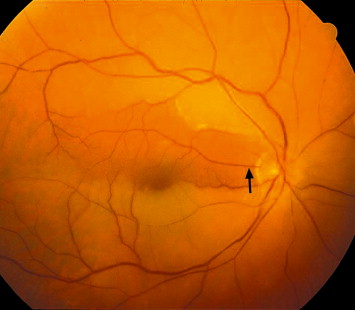
Present in 20% of the population, supplies the retina between macula and optic nerve, including fovea, so in case of CRAO, central vision will somewhat be preserved.
What is the function of the cilio-retinal artery?