Semiconductors & P-N Junctions
0.0(0)
Studied by 2 people Call Kai
 Learn
Learn Practice Test
 Spaced Repetition
 Match
Match Flashcards
 Knowt Play
Card Sorting
1/16

Earn XP
Description and Tags
Last updated 12:50 PM on 3/13/23
Name | Mastery | Learn | Test | Matching | Spaced | Call with Kai | Chat |
|---|
No analytics yet
Send a link to your students to track their progress
17 Terms
1
New cards
Do energy levels in different atoms have different energies?
Yes.
2
New cards
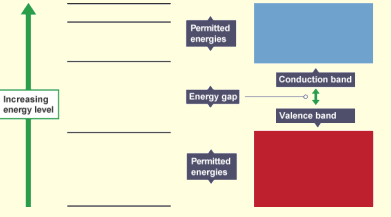
Many more slightly different energy levels come into existence to create…
A band of permitted energy levels.
3
New cards
What are the 2 highest energy bands, and which is the higher energy band?
Valence Band & the Conduction Band, the Conduction band being higher.
4
New cards
What happens to electrons in a solid?
They are held tightly in the valence band, but move freely in conduction band, meaning the solid conducts.
5
New cards
Using band theory, explain how the LED emits light?
* Voltage applied causes electrons to move towards the conduction band of a p-type towards the junction.
* Electrons drop from conduction to valence band.
* Photons emitted when electrons drops.
* Electrons drop from conduction to valence band.
* Photons emitted when electrons drops.
6
New cards
What is a conductor?
A material which allows the flow of electricity.
7
New cards
What is an insulator?
A material which doesn’t conduct electricity easily.
8
New cards
What is a semiconductor?
Materials which are insulators when pure, but will conduct an when impurity is added and/or in response to light, heat, voltage etc.
9
New cards
Give 3 examples of conductors, and their resistance?
Metals/Semi-Metals like Graphite, Antimony, & Arsenic - Low Resistance
10
New cards
Give 3 examples of insulators, and their resistance?
Plastic, Wood, Glass - High Resistance
11
New cards
Explain the band gap in a conductor?
There is no band gap between the valence & conduction bands.
12
New cards
Explain the band gap in a insulator?
There is a large energy gap between the bands. It’s so large that electrons almost never cross the gap and the solid never conducts.
13
New cards
In some metals the conduction and valence band partially overlap? What does this mean?
The electrons can move freely between the valence band & conduction band.
14
New cards
Explain the valence band in an insulator?
It is full, but their are no electrons in the conduction band.
15
New cards
What happens if you supply enough energy in an insulator?
The solid with conduct but often, large amounts of energy needed ends up destroying the solid
16
New cards
Give 3 examples of semiconductors, and their resistance?
Silicon, Germanium, Selenium
17
New cards