Animal Sci Exam 2
 Note
Note Call Kai
 Learn
Learn Practice Test
 Spaced Repetition
 Match
Match Flashcards
 Knowt Play
1/107

There's no tags or description
Looks like no tags are added yet.
Name | Mastery | Learn | Test | Matching | Spaced | Call with Kai | Chat |
|---|
No analytics yet
Send a link to your students to track their progress
108 Terms
duodenum, jejunum, and ileum.
the duodenum, the first part of the small intestine
Used by the body as lubricant and solvent for the body’s solid components
Water
psuedorumination in rabbit
Sicotrophie
Major carbohydrate found in plants- broken down by microbes and produce volatile fatty acids
Cellulose - 50% of energy needs
Bio and pancreatic secretions enter
Aquanda
Transported by lymphatic system, distributed by body
Fat
During a digestion trial a sow ate 5 lbs of feed twice a day that consisted of 14% protein. Trial lasted 10 days. During the trial excreted 215 lbs of feces that contained 3% protein.
How much feed did the sow eat? 100lbs (5+5= 10x10= 100)
What was nutrient intake? 14%
What was nutrient content in feces? 3%
What is the digestibility of protein? (14-3= 11 divided by 14= x100 = 78.6%)
Deglutition
Swallowing
Genetic code are made up of
DNA
Two types of bases- this base is composed of adenine and gumine
Purine
In protein manufacture the process of building RNA that is complementary to DNA
Transcription or translation
DNA replicaiton
Incomplete dominance
Gray
This type of trait is controlled by very few genes
Qualitative
Mating close relatives
Inbreeding
Passed down to next generation
Inheritability
Equal opportunity to perform
Contemporary group
Why is understanding nutrition important?
The cost of feed is 45 – 75% of the total cost of livestock production
• Swine 65-80%
• Layers 55%
• Broilers/Turkeys 65%
• Dairy 50-60%
• Feedlot 70%
• Sheep 50%
Use nutrients for
General health and well being
Physical abilities
Susceptibility to and ability to recover from disease
Genetic potential
Best feed
Soybean meal
Fats
Primary use- source of energy
2.25 times more energy than carbohydrates
Fat soluble vitamins (A,D,E,K)
Regulate body function
Vision
Blood clotting
Tissue Maintenance
Bone Development
Water soluble vitamins (C)
Metabolic regulation
Minerals
Inorganic constituents of bones and teeth
Supplmental mineral sources: salt, trace mineral salt, oyster shells, lime
Nutrient needs
Maintenance – maintaining body at constant weight
and temperature
Growth – process of adding tissues and body weight
Finishing – final feeding stage
Production – output of products
Work
Reproduction – lack of nutrition → causes delayed or abnormal estrous cycles
Feed analysis
Comprehensive Evaluation
Digestibility – degree to which a feedstuff can be simplified and absorbed
Nutrient composition
Productive value
Palatability
Balancing ration is very important, therefore knowledge of nutrient content is a must
Proximate Analysis
Proximate analysis is a set of chemical/analytical procedures to partition feedstuffs
Dry matter – know how much of each ingredient
Ash – mineral content of feedstuff
Crude protein – determined by Kjeldahl process (measures protein)
Average protein is 16% nitrogen (6.25) – crude measure of nutritional value
Ether extract (Fat) – extracted from sample by diethyl ether
Crude fiber (carbohydrate)
Nitrogen – free – extract (non-fiber carbohydrate)
Determined by an intrument called a Bomb Calorimeter
Calorimeter → Gross Energy
Expressed in Calories
Calorie defined as the amount of heat needed to raise the temperature of 1 gram of water 1º C
Digestibility (%) =
Nutrient intake – nutrient in feces X 100
Nutrient intake
Monogastric (non-ruminent)
Have one simple stomach
Ruminant
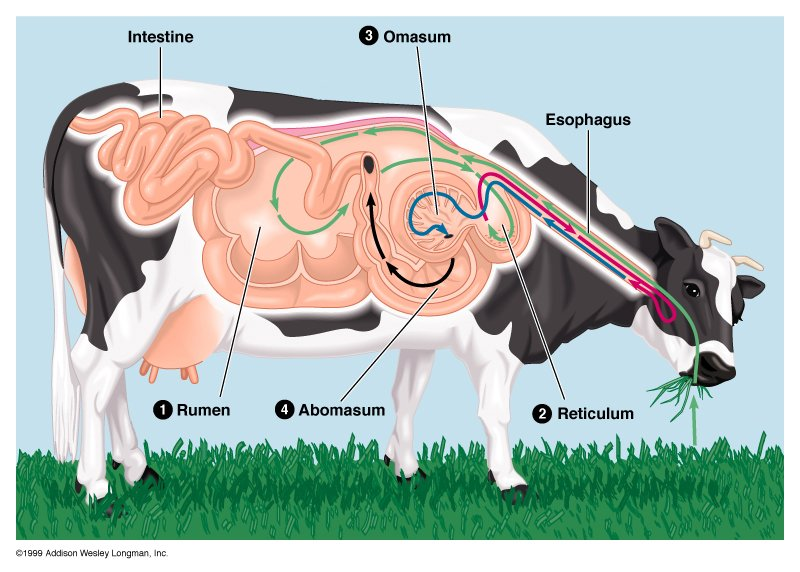
Complex stomachs
Multiple compartments located before true stomach
Which digests faster; meat or plant material?
It depends on the digestive system.
Carbohydrates digest first, protein next
Plant material is actually not broken down by the animal, but is digested by microbes in stomach
Prehension
Means used to bring food into an animal’s mouth
Peristalsis
Muscle contractions move food down the esophagus into the glandular stomach
In chickens the stomach is called
Proventriculus
In the cow the stomach is called
Abomasum
Small Intestine: Duodenum
bile and pancreatic secretion enter
in the form of a loop
main site for break down of food
Small intestine: Jejunum
several feet long
the absorption of the broken-down food occurs
Small intestine: Ileum
connects the small intestine to the large intestine
How are nutrients absorbed?
The small intestine is lined with microscopic villi which
absorb most nutrients
Coprophagy
Horse
Eructation
Belching to remove gas from the rumen via the esophagus
Cow
Red meats
Beef
Pork
Lamb
Poultry
Chicken
Turkey
Worldwide contribution of major meat species
Pig 36.40%
All poultry 35%
Beef and buffalo 21.80%
All others 6.80%
Meat etymology
In English, we have specialized terms for the meat of animals
that is different from the term for the animal itself.
Originated from the Norman conquest of England in 1066.
Meat from animals was served to French invaders and referred to
using its Norman French word for than animal
Pigs – porc (pork)
Cattle – boeuf (beef)
Sheep – mouton (mutton)
Calves – veau (veal)
Domesticated birds – poule (poultry)
Goats – chèvre (chevon)
Deer – venesoun (venison)
Meat = Muscle
Skeletal muscle
Heart, liver, kidney, tripe, sweetbreads
Cheek meat, ears, snouts, lips, tongue
Pigs feet, oxtail, bone marrow
Intestines
Meat science
Basic study of the unique characteristics of muscle and other animal tissues as they are transformed into meat
All facets of meat industry:
Genetics
Nutrition
Health
Welfare
Packers
Processing
Quality
Food safety
Meat Head terms: Finish
Fat on an animal, specifically subcutaneous fat over the ribeye/ loineye, deposited in the final months before harvest
Meat head terms: Carcass
the primary product of animal slaughter and dressing consisting of the skeleton with its attendant muscle, fat, and, for some species, skin
Meat head terms: Wholesale cut
cuts into which carcasses are subdivided, according to industry defined standards for where particular cuts are made Ex. Rib, Round, Chuck, Loin, Ham
Meat head terms: Primal cut
a wholesale cut trimmed to specific dimensions and fat thickness
Meat head terms: Retail cut
Cuts prepared for sale in a retail market
Ex. Ribeye steak, Bottom round roast, Arm roast
Grading: Beef
Quality grade – eating quality
Prime, Choice, Select, Standard
Yield grade – cutability