The judiciary
 Call Kai
 Learn
Learn Practice Test
 Spaced Repetition
 Match
Match Flashcards
 Knowt Play
1/8

There's no tags or description
Looks like no tags are added yet.
Name | Mastery | Learn | Test | Matching | Spaced | Call with Kai |
|---|
No analytics yet
Send a link to your students to track their progress
9 Terms
English court hierachy
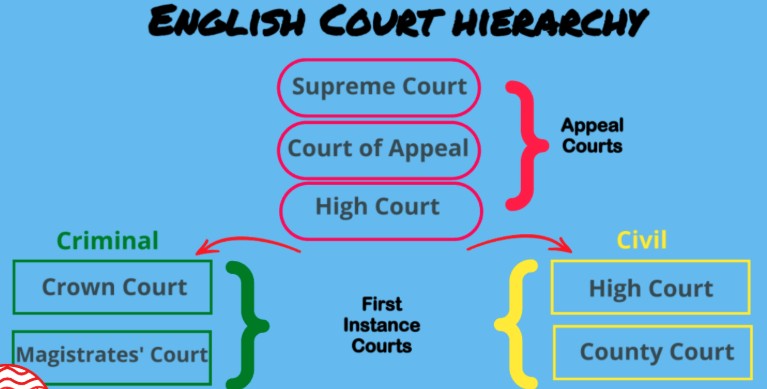
Inferior judges
They sit in courts below the high court. Includes cicuit judges, recorders and district judges.
District judges
They sit in the magistrates’ court and county court.
They are involved in pre-trial matters e.g. preparing for cases. They decide if the D should receive bail or stay in custody.
They hear criminal trials (sit alone). They decide facts and law, and sentence if found guilty. If found not guilty, the judge will let them go.
Circuit judges
They sit in the crown and county court.
They are involved in pre-trial matters e.g. preparing for cases. They decide if the D should receive bail or stay in custody.
They hear criminal trials (sit with a jury). They decide facts and law, and sentence if found guilty. If found not guilty, the judge will let them go.
Recorder judges
They sit in the crown and county court. They are part-time practising solicitors and barristers.
They are involved in pre-trial matters e.g. preparing for cases. They decide if the D should receive bail or stay in custody.
They hear criminal trials (sit with a jury). They decide facts and law, and sentence if found guilty. If found not guilty, the judge will let them go.
Superior judges
Includes justices of the Supreme Court, senior judges and high court judges.
High court judges
Sit in the crown and high court. For the crown court: they hear criminal trials (sit with a jury). It’s usually only the most serious criminal cases (e.g. murder). They decide facts and law, and sentence if guilty.
Senior judges
Sit in the court of appeal - the only hear appeals. Usually sit as a panel of 3. Decisions on points of law become precedents which the lower courts must follow.
Justices of the Supreme Court
They sit in the top court in the country (Supreme Court). They hear only appeals on points of law of great importance. Any decision becomes precedent. They must sit as an uneven panel (minimum 3) to hear a case. Usually sit as a panel of 5.