*Umich Environ 201- Benedict Midterm Lectures 1-3
 Call Kai
 Learn
Learn Practice Test
 Spaced Repetition
 Match
Match Flashcards
 Knowt Play
1/55

There's no tags or description
Looks like no tags are added yet.
Name | Mastery | Learn | Test | Matching | Spaced | Call with Kai |
|---|
No analytics yet
Send a link to your students to track their progress
56 Terms
opinion
a personal belief or judgement
environment
circumstances or conditions that surround an organism
Environmental Science
the systematic study of our environment and our place in it
fact
readily observable evidence
the relation between opinions and facts
facts inform opinions, opinions cannot change facts
bias
a particular tendency or inclination, especially one that prevents unprejudiced consideration of a question
____ people may fail to truly consider all facts
biased
science
a systematic process of learning about the world and testing out understanding of it
scientific method
a scientist makes an observation and asks questions of some phenomenon
theory
probable cause-and-effect relationships of the evidence that has been observed (evolution, climate change, relativity, the big bang)
law
indisputable principles that govern the universe (gravity, thermodynamics)
paradigm shift
a dramatic upheaval in thought that changes the dominant viewpoint
morals
an individual or society's distinction from right and wrong
ethics
a system of moral principles; criteria that help distinguish right from wrong
environmental ethics
the application of ethical standards to relationships between humans and nonhuman entities
ecological footprint
environmental impact of a person or population; the area of biologically productive land + water to supply raw resources & dispose/recycle waste
GDP
gross domestic product (how much we make)
GPI
genuine progress indicator (how happy we are)
Know the definitions, order, and steps in the scientific method
1. observation:
2. question:
3. hypothesis: a statement that tries to explain the question
4. predictions: specific statements that can be directly tested
5. test:
6. results: the test results either support or reject the hypothesis
What is "burden of evidence" as it relates to scientific advancement?
theories become validated as more and more evidence is gathered that supports the theory and
little evidence to contract the theory. Evidence that contradicts a well-established theory needs to be highly validated, and forms a paradigm shift.
• extraordinary claims require extraordinary evidence
Four major environmental management strategies we have employed in the past and today. How are they similar or different?
1. Domination of Nature: control nature to improve the human condition (early European Americans); nature needs to be
tamed and exists solely for our benefit.
• typically leads to deforestation, over-hunting, over-fishing, and resource depletion • tragedy of the commons
2. Altruistic Preservation: preservation of wilderness (Emerson, Thoreau, Muir) • example: national parks
3. Resource (utilitarian) Conservation: use of resources for the greatest good of the largest number over the longest time (Pinchot, Roosevelt);
• Pinchot: managing forests to produce for the service of mankind
• multiple use management: efficiency, equity, and sustainability in use of natural resources; limited concern for
economics, sociology, future need
• maximum sustained yield; may result in tragedy of the commons
4. Ecological Management: preservation of the integrity, stability, and beauty of the biotic community (Leopold) • retain functioning natural systems; focus on species interactions & sustainability
Conservation efforts in our forests mainly focus on creating a maximum sustained yield of: _______
a shared resource like lumber, soil, or peat moss.
What is the tragedy of the commons on a shared resource?
People/animals taking too much of a resource for themselves until the resource is depleted by overgrazing/ consumption
Are National Forests and National Parks conserved or preserved?
• National Forest Service: (conservation) managed by Dept. of Agriculture
• National Park System: (preservation) managed by Dept. of Interior
difference between a preservationist & conservationist management approach
preservation = preservation of wilderness (limited interaction!)
conservation = managing to produce for the service of humankind, could result in tragedy of commons
What are some key features of ecological management of natural areas?
1. Retain functioning natural systems
2. Focus on species interactions
3. Humans as part of ecosystem, not simply stewards
4.Thinking towards sustainability
What are ecological services?
- provide five good examples for a given environment.
definition: the many benefits to humans provided by the natural/healthy environment:
1. air quality regulation
2. climate regulation
3. water regulation
4. photosynthesis
5. nutrient cycling
6. pollination
species
(biological species concept) a population or group of populations -- members share characteristics
--can breed & produce fertile offspring
population
a group of individuals of a species that live in the same area
evolution
change over time
-- biological evolution: genetic change in populations over time
-- genetic changes lead to changes in appearance, function or behavior over generations
natural selection
traits that enhance survival and reproduction are passed on more frequently to future generations than those that do not
adaption
the process where, over time, characteristics (traits) that lead to better reproductive success become more prevalent in the population
mutations
accidental changes in DNA that may be passed on to the next generation; non-lethal mutations provide the genetic variation on which natural selection acts. Almost all mutations are neutral or bad, few "good"
phenotype
visible, expressed traits
genotype
genetic makeup of an organism
niche
an organism's use of resources & functional role in the community
(habitat use, food selection, role in energy and nutrient flow, interactions with other individuals)
specialists
species with narrow niches and specific needs; extremely good at what they do but are vulnerable to when their conditions change
generalists
-species with broad niches
-use a wide array of habitats and resources
-can live in many different places
allopatric speciation
species formation due to physical separation of populations; main mode of speciation; each population gets its own mutations, natural selection can speed the process
convergent evolution
unrelated species may acquire similar traits because they live in similar environments
coevolution
process in which 2 species evolve over time in response to each other; become locked in a duel of escalating adaptations (evolutionary arms race)
extinction
the disappearance of a species from earth
endemic species
Any species whose range is restricted to a limited geographical area!!! especially vulnerable to extinction (U.S. amphibians with small ranges; U.S. salamander species that live on the top of one mountain)
Be able to describe the four assumptions or criteria of Natural Selection. Four observations regarding genetic variation:
1. Overproduction: each species produces more offspring than what will survive to maturity
2. Variation: individuals in a population exhibit genetic variation
3. Limits on Population Growth: resource limitations will keep populations in check
4. Differential Reproductive Success: individuals with the most favorable traits are more likely to reproduce; results in competitive advantage
Which competition is more aggressive, intraspecific or interspecific? And why?
more aggressive --> interspecific competition (different species)
What is competitive exclusion? provide an example
competitive exclusion: one species excludes the other from using a competitive resource
- (zebra mussels in the
Great Lakes vs native fish)
What is the concept of species coexistence and please provide an example
• species coexistence: coexisting species' niche differ from each other in some way (example of natural selection; many different populations in one pond using species-specific resources)
What is artificial selection and how does it differ from natural selection?
- Provide examples
• natural selection: traits that enhance survival and reproduction are passed on more frequently to future generations
than those that do not (giraffe's necks & feeding on tall trees)
• artificial selection: the process of genetic selection under human direction (dog breeding)
What is the Anthropocene and how is it different from any other time in Earth's history?
-The proposed new epoch where humans are profoundly affecting extinction rates in a very negative way
-There have been 5 mass extinction in the earth's history→ losing 50-95% of species each time
-This is the first-time extinction is because of humans
Why would a species endemic to a single mountain range be more at risk of extinction than an organism that is a generalist and can live many different places?
-If you can live in more climates, you are better able to adapt to changes in the environment
-More genetic diversity
What are K-selected species and r-selected species? How do they differ?
K = carrying capacity
K-selected: produce fewer young, reproduce later in life, parental care over young, the young are density-dependent, very small but competitive species (humans, elephants)
R = colonizer
R-selected: produce many young, little or no parental care, young are density-independent, mature reproduce and die quickly
How can you tell if a species is density dependent or independent?
density dependent species have directly related mortality and population density rates
• density independent species' natality and mortality rates are unaffected by population density
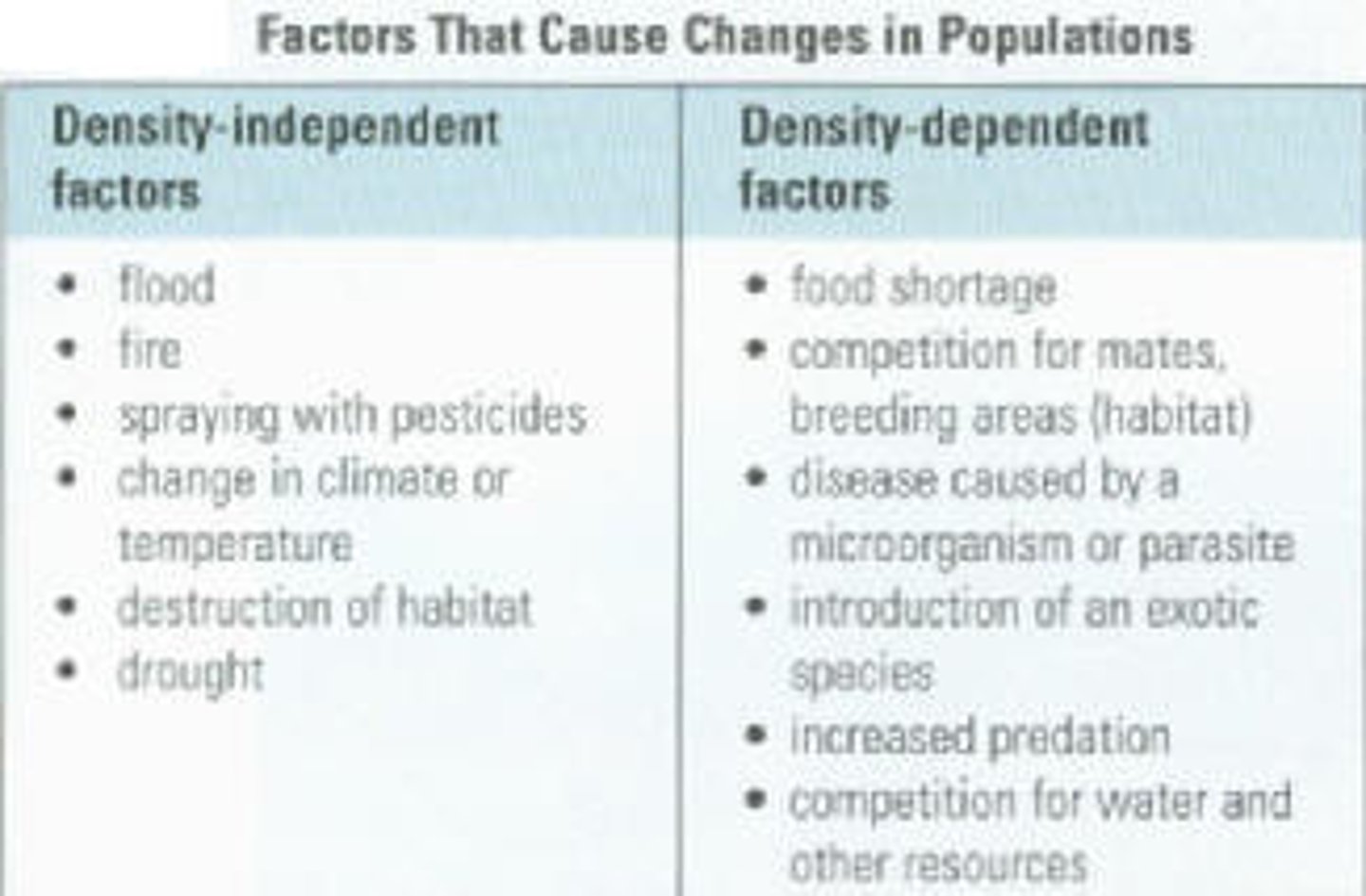
name the four factors that contribute to population change.
1. Natality: births
2. Mortality: deaths
3. Immigration: arrivals
Emigration: departures
Why do some species experience exponential growth? What types of species undergo this type of growth?
• Exponential growth occurs in nature with small populations, low competition, and/or ideal conditions.
What is carrying capacity and how is that influenced by limiting factors?
• carrying capacity: the maximum population size of a species that its environment can sustain
• limiting factors slow and stop exponential growth; many factors contribute to environmental resistance and
influence a population's growth rate and carrying capacity
What are some common limiting factors to populations?
- water
- space
- food
- predators
- disease

