Fisiología Molecular: T1
 Studied by 0 people
 Call Kai
 Learn
Learn Practice Test
 Spaced Repetition
 Match
Match Flashcards
 Knowt Play
1/24

There's no tags or description
Looks like no tags are added yet.
Name | Mastery | Learn | Test | Matching | Spaced | Call with Kai |
|---|
No analytics yet
Send a link to your students to track their progress
25 Terms
Meaning of “homeo” and “stasis”
Homeo: equal
Stasis: state
What is homeostasis?
It’s a property of cells, tissues, and organisms that allows the maintenance of the stability and constancy needed to function properly. It compensates the changes in the environment by the regulation of the metabolism.
If the homeostasis is broken…
You’re not healthy
What are three strategies to avoid breaking the homestasis by different species?
Avoidance: minimize internal variations using some behavioral escape mechanism that allows them to avoid environmental changes → example: birds migrating, bears invernating
temporal: hibernation
spatial: migration
Regulation: an environmental disturbance triggers compensatory actions that mantain a relatively constant internal environment (“homeo”) → example: seals mantain their temperature constant with their coat despite the outside Tª
Conformity: the internal environment of the animal changes parallel to external conditions (“poikilo”) → example: some frogs in winter stay frozen and when they melt in spring they are still alive
Differences between homeotherm and poikilotherm:
Homeotherm (endo): physiological mechanisms to regulate their body temepratures independently from ambient temperatures
mantains cte internal Tª
narrow range of Tª
Poikilotherm (ecto): varies Tª as a result of variation in the environmental Tª
cool-blooded animals
wide range of Tª
What are the possible sources of body heat for homeotherms?
shivering: muscles constractions → mechanical heat to the body core
vasoconstriction of peripheral vessels: less blood circulating → less heat loss
brown adipose tissue: catabolized to generate heat
Process of homestasis:
Stimulus: change in variable (imbalance)
Receptor detects change
Input: info sent a different pathway to control center
Output: info sent along a different pathway to the effector
Response of effector: the mechanism that has an effect on the variable and produces a response. The response is monitored continuosly by the sensor, that sends info to the control center (feedback loop)
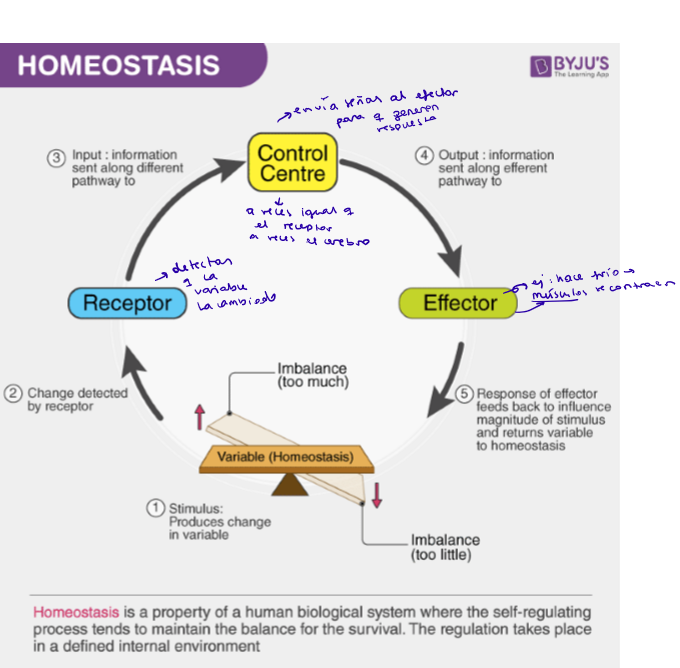
How does a negative feedback occur?
It occurs when a system’s output acts to reduce the processes that lead to the output of that system, resulting in less output. It allows systems to self-stabilize.
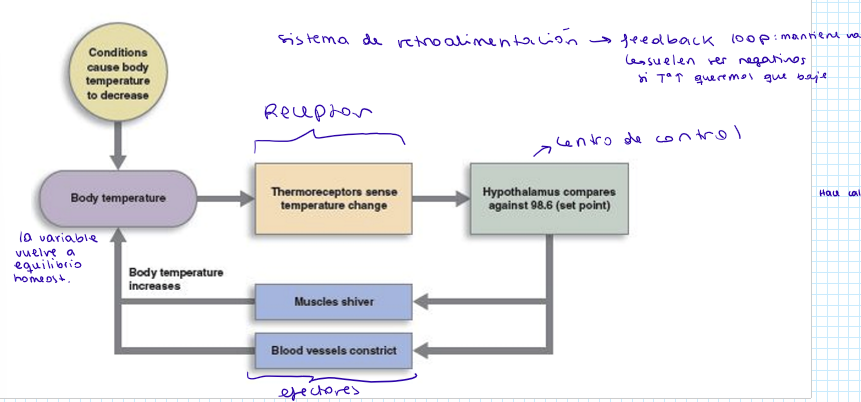
When do feedback loops occur?
They occur when a stimulus or change in the environment is present. The feedback loop will respond to keep systems functioning near an ideal level.
What are some examples of negative feedbacks?
Blood pressure
Body temperature
Glycemia
What are the different functions that the skin performs?
Protection: physical barrier
Thermoregulation: sweat glands, erector pili muscles (piel de gallina → pelos que se levantan y hacen de protección)
Camouflage
Sensation: receptors
How does the skin mantain homeostasis?
Thermoregulation: sweating, vasodilation/cosntriction, vellus hair
Barrier function
Water balance: prevents excessive water loss through evaporation
Sensory reception: detects changes in the environment and sends signals to the brain
What should the glucose concentration in blood be? In fasting and after feeding
Fasting: 3,9mM-5,6mM
After feeding: 7,8mM
What are the two hormones that control the glycemia homeostasis? Which organ regulates them?
Insulin: promotes the uptake of glucose from cells when the glucose level is raised.
Glucagon: increases the blood glucose level when it has been dropped too low.
Its regulation is controlled by the pancreas
The glycemia homeostasis is a — feedback loop. How does it work?
Negative
High blood glucose level (stimulus):
Receptor: pancreas
Control center: pancreas→ secretes insuline
Effector: liver (glucose → glycogen) and tissue cells
Response: blood glucose back to normal
Low blood glucose level:
Receptor: pancreas
Control center: pancreas→ secretes gluciagon
Effector: liver (glycogen → glucose)
Response: blood glucose rises back to normal
When the glycemia homeostatic system fails, what is the illnes called? + types
Diabetes:
Type 1: the pancreas can’t produce insuline (glucose → glycogen)
Type 2: insulin resistance, the organ effectors cant’t take all the necessary glucose, so the quantity of insuline has to be increased. On the long term, the pancreas starts to fail and can’t produce more insuline
Gestational diabetes: pregnant women, it can increase the probability to develope type 2
What is the blood preassure’s function?
It’s so that the blood can arrive to all the body.
The heart is the receptor. It sends the signal to the bulbo raquídeo, who sends signals to the blood vessels:
if high blood pressure:
cardiac rythim decresases + blood vessels dilatate → pressure will decrease
if low blood pressure:
cardiac rythim increases + blood vessels contract → blood pressure will increase
Blood pressure homestasis is a — loop
Negative
Neurons may also inhibit themselves in a — feedback loop
Negative
When a neuron stimulates the effector, it also stimulates a renshaw cell (an inhibitor neuron) that will inhibite the neuron
What is a positive feedback loop?
It is when the output of the system stimulates the system in such a way as to further increase the output. It always ends with counter-signaling that supresses the original stimulus.
In most cases harmul, but sometimes it contributes to normal function
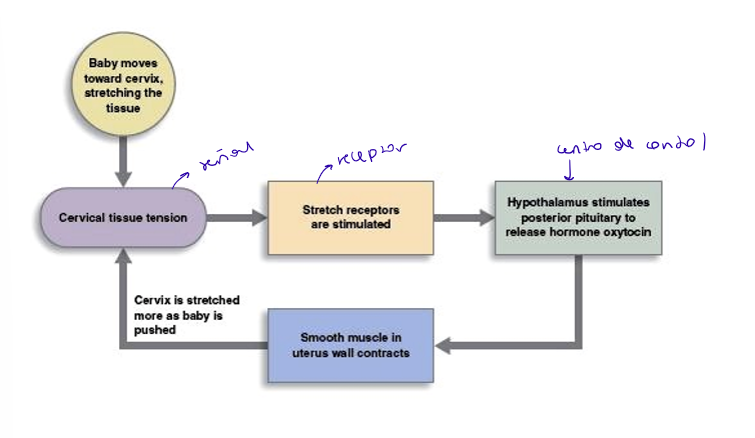
Chilbirth is a — feedback loop
+
El fetus hace presión sobre el cuello del útero (receptor)
La presión es la señal al cerebro
El cerebro es el centro de control que provocará que se libere oxitocina
La oxitocina provoca que el útero se contraiga y que haga más presión
+ presión + oxitocina
La señal acaba cuando se da el parto
Lactation is a — feedback loop
+
Estímulo: el bebé se amamanta
Receptor: receptores en la piel del pecho mandan impulso al cerebro
Centro de control: cerebro envía señal a la glándula mamaria
Efector: glándula mamaria libera oxitocina para que se eyecte la leche
Final: bebé deja de amamantar
La coagulación es un feedback loop —
Positivo
Cuando se rompe un vaso sanguíneo, se inicia loop donde se agregan plaquetas, que liberarán señales para que se adhieran más plaquetas hasta que el vaso esté reparado.
El ciclo menstrual es un feedback loop —
La primera parte: feedback loop positive
La segunda parte: feedback loop negativo
Una hemorragia provoca un feedback loop —
Positivo dañino
Si tenemos una hemorragia, se pierde sangre, por lo que baja la presión. El cuerpo entonces lo compensa aumentando el ritmo cardíaco, aumentado lel flujo de sangre para volver a recuperar la presión. Esto tiene efecto inverso, pq se pierde más sangre más rápido (loop)
 Note
Note  Flashcards (77)