Waves
 Call Kai
 Learn
Learn Practice Test
 Spaced Repetition
 Match
Match Flashcards
 Knowt Play
1/78

Earn XP
Description and Tags
Name | Mastery | Learn | Test | Matching | Spaced | Call with Kai | Chat |
|---|
No analytics yet
Send a link to your students to track their progress
79 Terms
amplitude
maximum displacement from equilibrium position
frequency
number of complete oscillations per unit time
period
time taken for one complete oscillation
wavelength
distance between one point on a wave and a point with the same phase on the next wave
longitudinal wave
where the oscillations of the molecules are parallel to the direction of energy transfer, producing compressions and rarefactions
transverse wave
oscillations of the molecules/fields are perpendicular to the direction of energy transfer
Explain how to determine the speed of sound using an experiment
a. Use a metre ruler to record the position of the microphone when signals are in antiphase
b. Move the microphone back until the signals are in antiphase again
c. Record new position of microphone and calculate distance moved by microphone – this is the wavelength
d. Repeat this and calculate a mean
e. Repeat steps a-d for a different frequency
f. Determine the frequency of the signal using f = 1/T where T is the time period shown on the oscilloscope
g. Plot a graph where the y-axis is the wavelength (m) and the x-axis is 1/frequency (s)
h. This will produce a straight line because c = λf can be rearranged to
i. λ=c x 1/f
ii. y=m x
iii. The gradient will therefore be a constant – the speed of sound m = c
i. Calculate the gradient of the line of best fit and determine the speed of sound
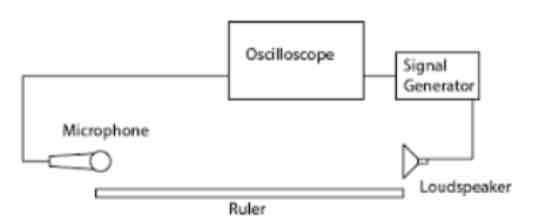
Explain how we ensure accuracy
Ensure the speaker is perpendicular to the ruler and the oscilloscope trace time base is set so that approximately 4 complete waves are observed on the oscilloscope (no higher as the % uncertainty will be higher if the time base is set to a higher setting - each division will be worth more so the resolution is lower. This will need to be adjusted throughout the experiment as for higher frequencies the time period is longer).
Explain why the ruler is appropriate instrument to measure length
The ruler is appropriate as its resolution is 1mm and the average reading will be no smaller than 10cm so this gives a % uncertainty of 0.05/100 x 100 = 0.05 % which is very low.
wavefront
the line/surface connecting points that have the same phase on adjacent waves
coherence
when two waves have a constant phase relationship and the same frequency
superposition
when two or more waves meet at a point the resulting displacement is equal to the vector sum of the individual displacements
interference
when two coherent waves meet at a point and undergo superposition – the resultant amplitude is equal to the vector sum of the individual amplitudes
constructive interference
when the resultant amplitude is maximum (as the waves meet in phase)
destructive interference
when the resultant amplitude is zero (as the waves meet pi out of phase)
Explain how an interference pattern is produced (eg. of bright and dark lines/loud and quiet regions)
a. waves spread out from source, meet at points in undergo superposition
b. When the waves meet in phase, with a path difference of n lambda, constructive interference occurs
c. This constitutes a maximum amplitude of oscillation and bright spot/loud sound
d. When the waves meet in antiphase/ 180 degrees out of phase, with a path difference of (n+1/2) lambda, destructive interference occurs
e. This constitutes zero amplitude of oscillation and there is a dark spot/no sound
phase
the fraction of the wave cycle that has been completed relative to the origin
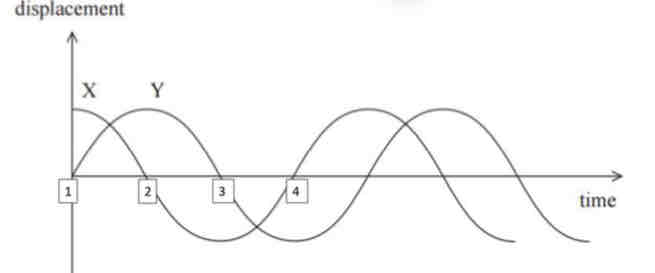
State the phase of waves X and Y at times 1, 2, 3, and 4
a. X phase = 90 degrees , y phase = O degrees
b. X phase = 180 degrees, y phase = 90 degrees
c. X phase = 270 degrees, y phase = 180 degrees
d. X phase = 360 degrees, y phase = 270 degrees
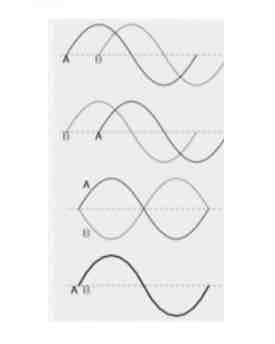
State the phase difference between wave A and B in these diagrams:
1) A is 90 degrees ahead of B
2) B is 90 degrees ahead of A
3) A and B are in antiphase: phase difference = 180 degrees
4) A and B are in phase: phase difference = 0 degrees
path difference
the difference in the distance travelled by two waves to a single point
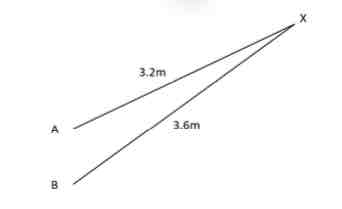
One wave leaves A and another wave leaves B. Calculate the path difference between the two waves when they arrive at X
Path difference = 3.6m – 3.2m = 0.4m
If the sound waves shown in the question 20 are coherent and have a wavelength of 0.8m, explain whether point x would be a loud sound or a quiet sound
a. Path difference = 0.4 = 0.8 / 2 = wavelength / 2
b. Therefore destructive interference would occur as the path difference is half a wavelength
c. Therefore this would be a position of zero amplitude: a quiet sound
State the relationship between path difference and phase difference:
Path difference= λ𝑥𝑝h𝑎𝑠𝑒𝑑𝑖𝑓𝑓𝑒𝑟𝑒𝑛𝑐𝑒 / 2π(ie. multiply the fractional difference of the cycle completed by the wavelength)
Explain how a standing wave is set up:
a. Two waves travelling in opposite directions
b. Of equal frequency and similar amplitude
c. Undergo superposition when they meet
d. Constructive interference produces antinodes – positions of maximum amplitude
e. Where waves meet in phase
f. Destructive interference produces nodes – positions of zero amplitude
g. Where waves meet in antiphase
node
positions of zero amplitude
antionode
position of maximum amplitude
State the conditions for a standing wave to be set up between a speaker and a wall
a. The emitted and reflected wave must have similar amplitudes in order to completely destructively interfere and produce nodes
b. So the wall should not absorb the wave
c. The distance between the speaker and wall must be a whole number of half wavelengths
d. There must not be multiple reflections from other parts of the room
State the difference between nodes in terms of wavelength
Distance between nodes = λ/2
State the distance between antinodes in terms of the wavelength
Distance between antinodes = λ/2
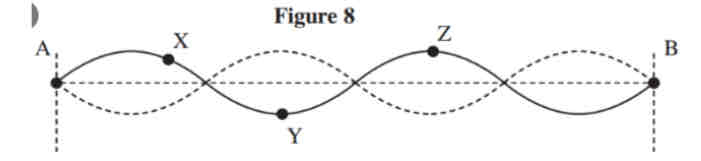
State the phase relationship between
a) points X and Y
b) points X and Z on the standing wave
X and Y are in antiphase: phase difference = 180 degrees or Pi radians
X and Z are in phase: phase difference is 0 degrees or radians
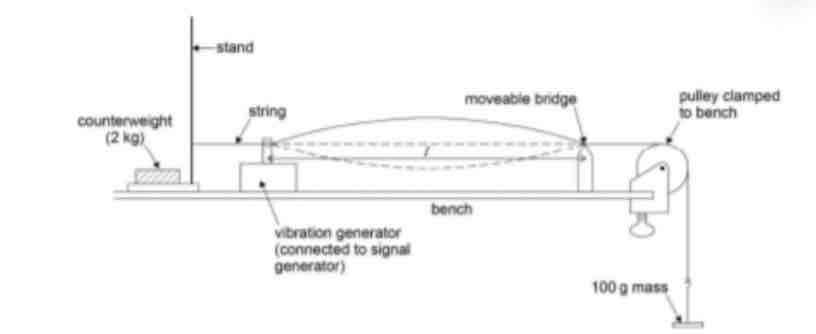
Describe how to use the apparatus in the diagram to determining the mass per unit length of a wire
a. Once a standing wave in the first harmonic has been set up:
b. Measure the distance between nodes of the first harmonic standing wave using a metre ruler.
c. Measure the mass attached to the end of the string using an electronic mass balance.
d. Measure the frequency of the wave on the signal generator (or, more accurate - by connecting the signal generator to an oscilloscope and determining the time period on the oscilloscope trace, then using frequency = 1/T.)
e. Change the tension in the wire by adding extra masses to the end of the wire
f. Adjust the signal generator frequency until the fundamental frequency standing wave is observed again, keeping the length the same
g. Determine the tension due to each value of the mass added by using T = mg where m is the mass and g is the acceleration due to gravity
h. Determine the frequency of each signal using f = 1/T where T is the time period.
i. Plot a graph where the y-axis is the frequency2 , f2 (Hz2) and the x-axis is the period T (s)
j. This will produce a straight line because 𝑓 = 1 𝑇 can be rearranged to 2𝑙 μ
a.f2=1 xT 4𝑙2μ
b.y=m x
c. The gradient will therefore be a constant – the speed of sound m = 1
k. Calculate the gradient of the line of best fit and rearrange the equation to find the mass per unit lengthasμ= 1
diffraction
the spreading out of wavefronts as a wave passes through a gap or around an obstacle
Huygen’s construction
each point on a wavefront acts as a source of secondary circular wavelets. The new wavefront is the surface tangential to the secondary wavelets.
Define each of the quantities in nλ = dsinθ
c. n is the order
d. λ is the wavelength of light
e. nλ = the path difference between the central order n=0 order and the nth order
f. d is the separation between the slits ( d= 1/N where N is the number of slits per m and d=10^-3/N where N is the number of slits per mm)
g. θ is the angle between the n=0 order and the nth order
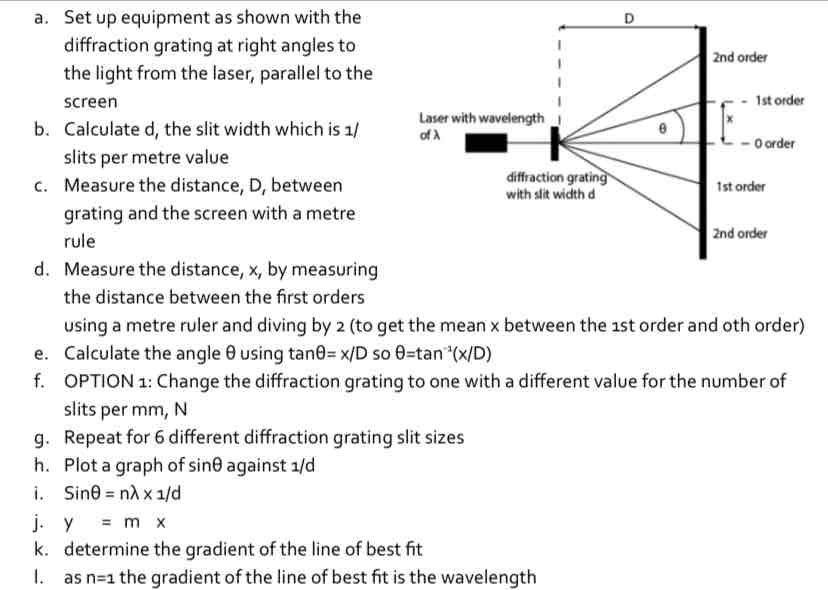
Explain how to determine the wavelength of laser light experimentally and graphically
Define the intensity of light in the wave model of light
a. Intensity is power/area
b. Intensity is proportional to the amplitude of the wave squared
photon
Packet of electromagnetic energy
Describe what is meant by the wave particle duality of light
a. Light exhibits wave behaviour (eg. diffraction, intereference, superposition, polarisation)
b. Light exhibits particle behaviour (eg. absorption and emission line spectra, photoelectric effect)
c. So light exhibits both wave and particle behaviour: it exhibits wave particle duality
work function
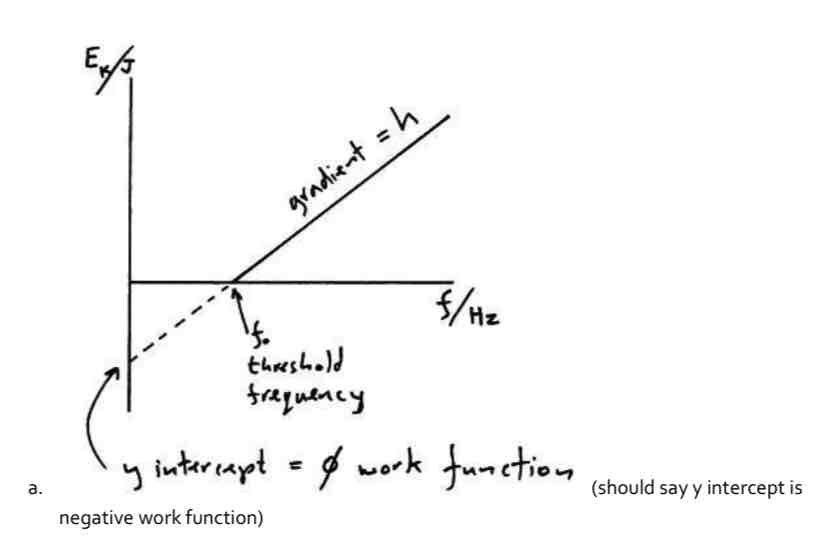
minimum energy required for electron to be released from the surface of a metal
threshold frequency
minimum photon frequency required for electron to be released from the surface of a metal (by absorbing the photon)
Explain why kinetic energy of electron is maximum kinetic energy
a. the work function is the minimum energy required for electron to be released,
b. thus in the equation hf = work function + ke max, the kinetic energy is the maximum possible kinetic energy.
c. Most electrons will have less kinetic energy than this as they lose more energy as they leave the surface of the metal.
Plot a graph of maximum kinetic energy of released electron against frequency of photon
Explain how the photoelectric effect indicates that light is a particle
a. It is observed in the photoelectric effect that only EM radiation above a certain threshold frequency will release electrons (no matter what the intensity)
b. So the energy of the photon, E=hf is proportional to frequency
c. The kinetic energy of the electron is only dependent on the frequency of the photon
d. In wave model energy is proportional to intensity, so in the wave model high intensity light of any frequency should emit electrons, and the energy of the electrons should depend on intensity – this is not observed
e. Instead, electrons are always released from surface of metal when energy of photon is larger than work function of metal
f. It is also observed in the photoelectric effect that electrons are emitted instantaneously from the metal
g. This indicates that energy is absorbed instantaneously –one photon is absorbed by one electron
h. However, in the wave model energy would be absorbed over time and not release electrons instantaneously
i. In the particle model, the higher the intensity, more photons would be absorbed each second and so there would be more electrons emitted per second – this is what is observed
Define the intensity of light in the particle model of light
a. Intensity = power / area = rate of energy transfer per second/area
b. Intensity = number of photons x energy of one photon/ time x area
c. I = Nhf/tA
d. So the intensity is directly proportional to the number of photons per second
State the effect on the maximum kinetic energy of photoelectrons emitted when the intensity of light increases
No effect
State the effect on the number of photoelectrons emitted per second when the intensity of light increases
The number of photoelectrons emitted per second increases in proportion with the intensity increase
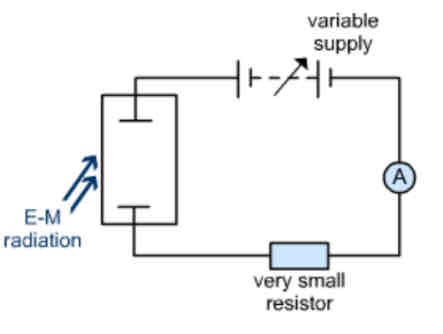
stopping potential
a. The minimum potential difference at which photoelectrons do not have enough kinetic energy to pass across the gap
b. Vs = KEmax/e
Draw a circuit diagram that we could use to determine the stopping potential
de Broglie wavelength
a. The wavelength of a particle that has a momentum
b. λ = h/p where λ is the de Broglie wavelength, h is the Planck’s constant, p is the momentum of the particle
energy level
The discrete allowed energy of an electron within an atom
Explain why energy levels of electrons in atoms are negative
a. A just free electron has zero energy
b. In order for the electron to move up energy levels to be released it must gain energy
Explain origin of line spectra (spectral lines/ emission lines) specific to certain elements at specific frequencies/wavelengths
a. Electrons exist in discrete energy levels
b. Electron within atom excited to higher energy level when: fast moving electron collides with
atom, transferring its kinetic energy or current is passed through OR gas is heated
c. The electron then falls back down to lower energy level
d. Emitting a photon with an energy E equal to the energy difference between the two electron levels
e. E=hf is the energy of the photon OR E = hc/λ is the energy of the photon
f. The photon is emitted with a specific frequency f = E/h where E is the energy difference
between the levels OR The photon is emitted with a specific wavelength λ = hc/E where E is theenergy difference between the levels
g. There are only a limited number of energy differences between levels and there only a corresponding limited number of frequencies/wavelengths emitted
h. Different elements have different energy differences between levels so produce different spectral lines
Explain origin of absorption spectra at specific frequencies/wavelengths
a. Electrons exist in discrete energy levels
b. Electron within atom (in atmosphere of sun) excited to higher energy level when it absorbs a photon
c. E=hf is the energy of the photon OR E = hc/λ is the energy of the photon
d. The photon absorbed must have a specific frequency f = E/h where E is the energy difference between the levels OR The photon absorbed must have a specific wavelength λ = hc/E where E is the energy difference between the levels
e. There are only a limited number of energy differences between levels and only a corresponding limited number of frequencies/wavelengths of photons absorbed
f. Different elements have different energy differences between levels so produce different absorption lines at specific frequencies
Explain why the pulse length must be less than the time taken for the pulse to return and explain the condition placed on the time between pulses
a. The pulse length is the time that the pulse lasts for. This must be less than the time taken for the pulse to return after being reflected so that the reflected pulse does not overlap with the emitted pulse.
b. The time between each pulse must be long enough that the reflected pulse does not overlap with the emitted pulse.
Explain how the pulse-echo technique can be used to determine the speed of a moving object
a. A pulse is sent out. It reflects off a boundary to an object with a different density.
b. If the object is moving then the reflected ultrasound will have a shifted frequency/wavelength due to the Doppler effect
c. If the object is moving towards the receiver then the frequency will increase, if the object is moving away from the receiver the frequency will decrease
d. The greater the shift in frequency the greater the speed of the object
refraction
a. Refraction is the change in direction of a wavefront as it changes speed due to a change in the density of the medium that it is travelling in
refractive index
Refractive index, n = c/v – this is the ratio of the speed of light in a vacuum to the speed of light in the medium
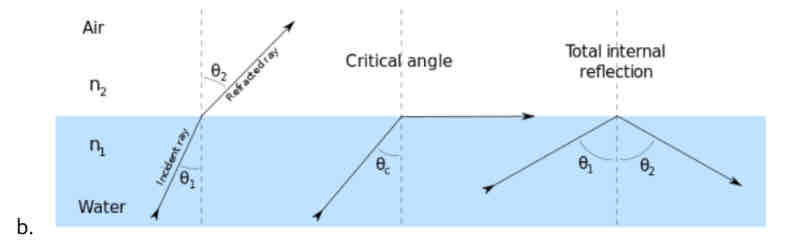
critical angle
The angle of incidence in the denser medium at which the angle of refraction is 90 degrees in the less dense medium: sin c = 1/n
Describe the condition for total internal reflection to occur
Total internal reflection will occur when the angle of incidence is larger than the critical angle
Principal focus (focal point)
the point on the principal axis where rays parallel to the principal axis (from a very distant object) will converge
Focal length
the distance between the centre of the lens and the principal focus (is negative for diverging lenses and positive for converging lenses)
Image distance, v
the distance between the image and the centre of the lens (is negative for virtual images and positive for real images)
Object distance, u
the distance between the object and the centre of the lens
Magnification
v/u or image height/object height (no unit)
Diverging lens
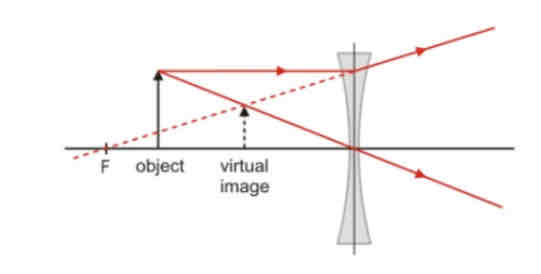
a lens that causes rays to diverge after refraction – has a negative focal length
Power
1/ focal length . units = D (dioptres)
Virtual image
an image formed from the apparent divergence of rays from an object. Cannot be projected on a screen
Real image
an image formed when real rays of light converge to form the image. Can be projected on a screen
Construct a ray diagram for a diverging lens with the object placed just before the focal length
Construct a ray diagram for a converging lens with the object at half the focal length
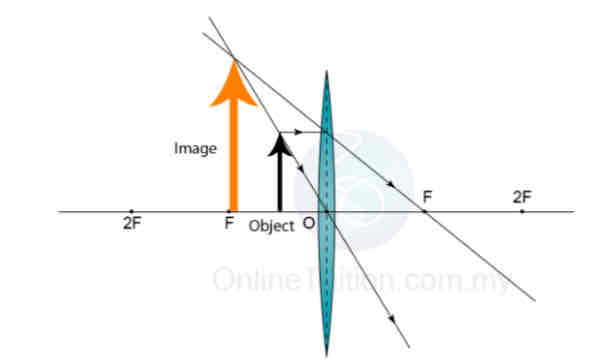
Construct a ray diagram for a converging lens with the object at twice the focal length
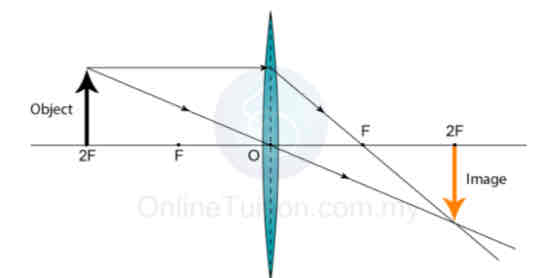
Explain how to estimate the focal length of a converging lens
Pass parallel rays of light from a distant object through the lens and move a screen behind the lens until the image is focussed. The distance between the lens and the focussed image is an estimate of the focal length
Explain how to determine the focal length of a lens accurately
a. Place an object (eg. lamp behind cut out shape) on a ruler, 10cm in front of a lens in a lens holder and in front of a screen
b. Move the screen until an image is focused on the screen
c. Record the positions of the screen, lens and object
d. Calculate image distance, v = lens distance – screen distance, and object distance = lens distance – object distance
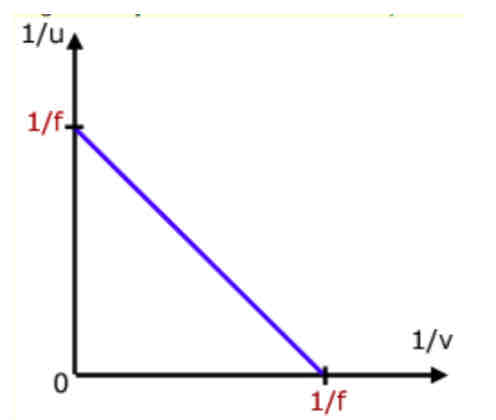
e. Repeat steps 1-4 for five different object distances, u
f. Plot a graph of 1/u against 1/v
h. 1/u=-1/v+1/f
i. y=mx+c
j. the gradient should be -1
k. determine the x and y intercepts
l. f = 1/ x intercept and f = 1/y intercept
m. take average of the f values
When would the rays from an object converge at the focal point?
a. Only when the incident rays are parallel to the principle axis
b. This happens when the object is at an infinite distance from the lens
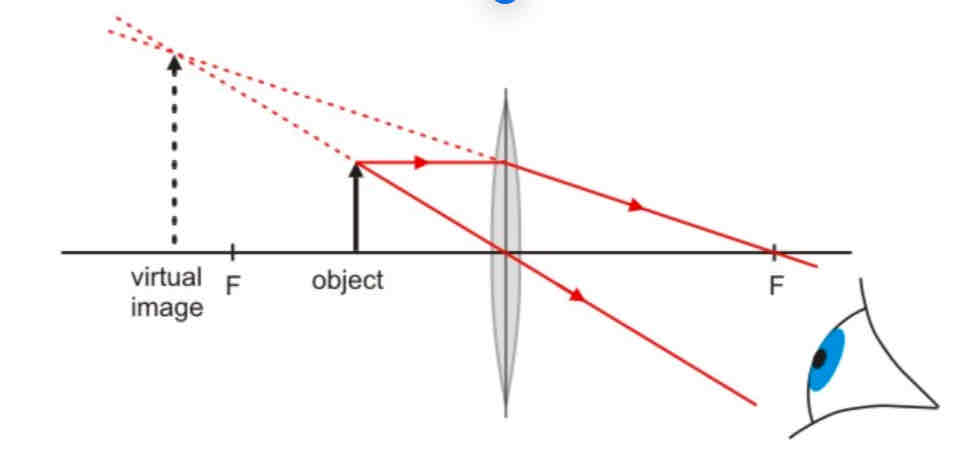
What happens if an object is placed closer to a converging lens than the focal point?
a. When the object distance is less than the focal length for a comverging lens, a virtual image is formed behind the lens
b. This is because the rays of light diverge after the lens
c. Causing virtual rays to converge on the same side of the lens at the object
d. These cannot be projected onto a screen
e. The lens is behaving as a magnifying glass
Draw a ray diagram for a magnifying glass
Descibe the situations when a virtual image may form from a real object placed in front of the lens
a. All images of real objects made by diverging lenses are virtual
b. Images formed by objects placed closer than the focal point for a converging lens
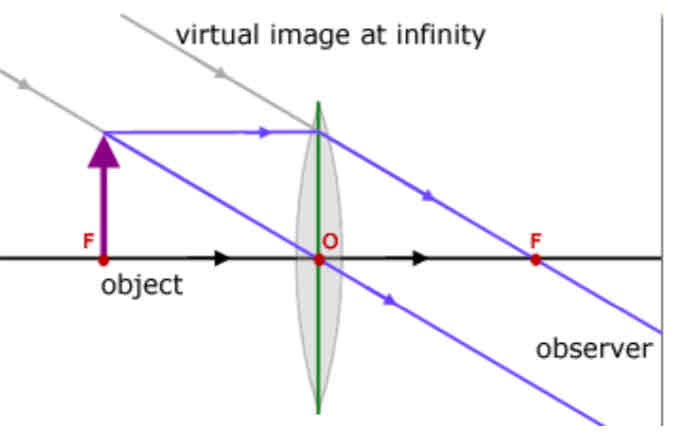
Explain why a converging lens will not produce an image when the object is placed at the focal point
a. If image distance = focal length, u = f, then 1/f = 1/u + 1/v becomes:
b. 1/u=1/u+1/v
c. so1/v=0
d. so image distance, v would be infinite – there is no image formed
e. this is because one ray passes through the focal point on the right hand side of the lens
f. and another ray passes through the centre of the lens
g. these rays (and all others) are parallel, and therefore do not converge
h. nor do they diverge, so a virtual image cannot be made either