Kinetic Molecular Theory, Intermolecular Forces, and Properties of Liquids and Solids''
 Studied by 0 people
 Call with Kai
 Learn
Learn Practice Test
 Spaced Repetition
 Match
Match Flashcards
 Knowt Play
1/34

There's no tags or description
Looks like no tags are added yet.
Name | Mastery | Learn | Test | Matching | Spaced | Call with Kai |
|---|
No analytics yet
Send a link to your students to track their progress
35 Terms
Kinetic molecular theory of matter
This theory provides an overview of the microscopic properties of molecules or atoms and their interactions
Kinetic molecular theory of matter
It describes the microscopic properties of matter and how they translate to the state and other properties of matter
Small particles
Matter is composed of ________ we call atoms.
attractive forces
The molecules interact with one another through ______. The strength of these forces is related to the distance between the particles.
Random
Molecules are always in constant _______ motion. describe which type of motion is this and fill in the blank.
Temperature
It is the measurement of the average kinetic energy of the molecules of a substance.
Intermolecular forces
These are the attractive forces between molecules and are known as?
Small
If the interaction between two molecules is stronger, what will be their distance from each other?
Liquids
This phase of matter have intermediate intermolecular forces.
Intermediate intermolecular forces
This makes liquid particles farther from one another compared to those in solids. Suggest which type of intermolecular forces is the correct type in terms of its phase of matter (liquid).
Strong intermolecular forces
Solids due to this type of intermolecular forces, have restricted motion. Which of the following types of intermolecular forces is correct.
Restricted motion
Solids, due to their strong molecular forces have what type of motion?
Weak intermolecular forces
Gases have particles that are very apart from one another due to what type of intermolecular force?
very far apart from one another
Gases have particles that are __________ due to weak intermolecular forces.
Temperature
It is the measure of the average kinetic energy.
Intermolecular forces
These are attractive forces present in between molecules.
Intermolecular forces
The four main types of this type of forces are
1. London dispersion forces
Dipole-dipole forces,
Ion-dipole forces
and hydrogen bonding forces.
London Dispersion Forces
The weakest type of IMFA and are present in between all electrically neutral molecules. (This force is also present regardless of type, polarity, molar mass).
Fritz London.
London Dispersion Forces is named after what German-American physicist?
Dipole Dipole interactions
This type of force exists between the partially positive end of one dipole molecule and the partially negative end of another dipole molecule
Van der Waals Forces of Attraction
London dispersion forces and dipole-dipole forces are collectively known as?
Ion-ion interaction
It is the interaction between two oppositely charged particles.
Ion-ion interactions
This type of IMFA is also known as ionic bonds.
Ion-Dipole interactions
This type of interaction is responsible for the dissolution of most ionic solids in polar solvents.
Hydrogen bonding
An attractive force that exists when hydrogen is bonded to the most electronegative atoms, namely F, O, or N.
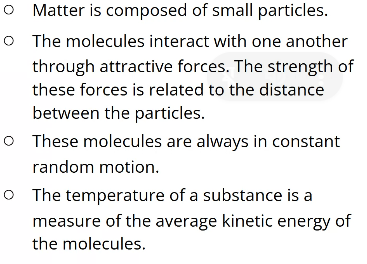
The kinetic molecular theory
This theory states all of the proponents on the image.
Intermolecular forces of attraction
The forces between molecules, also known as?
London dispersion forces
A type of IMFA present in all substances, regardless of type, polarity, molar mass, and the like.
London dispersion forces
It is also the weakest type of IMFA, and its occurrence is attributed to the fact that all substances, even the nonpolar ones, exhibit dipole moments momentarily.
Dipole moment
It is the product of charge and the distance between the charges in a molecule.
Polar compounds
Which of the following type of compounds have a net dipole moment?
nonpolar compounds
Which of the following type of compounds have no net dipole moment?
dipole-dipole forces (DDF)
which type of IMFA exists only for polar substances?
Hydrogen Bonding
A special type of DDF exhibited only by compounds wherein a hydrogen atom is directly bonded to N, O, and F.
higher boiling point and melting point, higher viscosity, higher surface tension, and lower vapor pressure.
Across compounds of relatively the same molar mass, stronger IMFA generally entails a…? (pick the correct phrase continuing the sentence).
 Note
Note  Flashcards (58)