ACC 255 CHP 1 Review and HW
 View linked note
 Call Kai
 Learn
Learn Practice Test
 Spaced Repetition
 Match
Match Flashcards
 Knowt Play
 Podcast
1/32

There's no tags or description
Looks like no tags are added yet.
Name | Mastery | Learn | Test | Matching | Spaced | Call with Kai | Chat |
|---|
No analytics yet
Send a link to your students to track their progress
33 Terms
Assets
The resources of a company such as cash, supplies, equipment, and buildings. To identify an asset, ask yourself what resources would the company own that they would use up.
Liabilities
The amounts owed to creditors such as owing a bank suppliers, employees, utility companies, and the government(taxes). Liabilities can usually be identified by the word “payable” such as “accounts payable” or “salaries payable”.
Stockholders’ Equity
Represents the owners’ claims to resources. These claims arise from two primary sources. Contributions by the owners themselves and net resources generated by company operations
Revenues
The amounts recognized when the company sells products or provides services to customers.
Expenses
The costs of providing products and services and other business activities during the current period.
The Financial Statements
The Income Statement
The Statement of Stockholders’ Equity
The Balance Sheet
Statement of Cash Flows

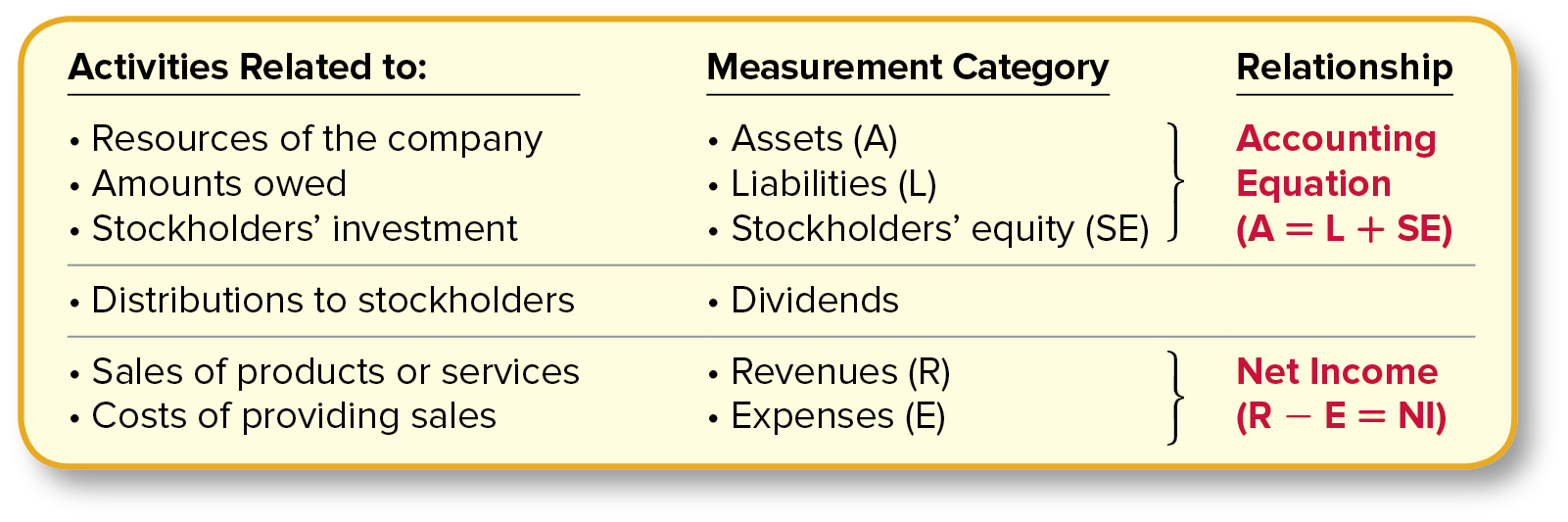
Net Income Equation
Revenues (R) - Expenses (E) = Net Income (NI)
The Accounting Equation
Assets (Resources) = Liabilities (Creditors Claims) + Stockholders’ Equity (Owners’ Claims)

Net Income VS Accounting Equation
Net Income refers to the profit of a company after all expenses have been deducted from revenues, whereas the Accounting Equation reflects the relationship between a company's assets, liabilities, and equity, ensuring that the balance sheet remains in equilibrium.
Stockholders’ Equity Equation
Stockholders’ Equity = Common Stock + Retained Earnings or
Stockholders’ Equity = Total Assets - Total Liabilities
Common Stock Equation
Beginning Common Stock + New Issuances = Ending Common Stock
Retained Earnings Equation
Beginning Retained Earnings + Net Income - Dividends = Ending Retained Earnings
Change in Cash Equation
Change in Cash = Operating Cash Flows + Investing Cash Flows + Financing Cash Flows
The Income Statement
A financial statement that reports the company’s revenues and expenses over an interval of time. It shows whether the company was able to generate enough revenue during the period to cover the expenses of running the business. → The income statement compares revenues and expenses for the current period to assess the company’s ability to generate a profit from running its operations.
You can identify (most of the time) what goes in the income statement because the accounts/amounts will say “revenue” or “expenses”
In the top part, we are putting anything that is revenue. So sales, service revenue, and/or interest revenue
In the bottom part, we are putting expenses. So anything that has the term expense, such as salaries expense, rent expense, delivery expense.
The income statement must be done first because we need to plug in the net income/ net loss into the statement of stockholders equity.
The Statement of Stockholders’ Equity
A financial statement that summarizes the changes in stockholders’ equity over an interval of time. Stockholders’ equity arises from two primary sources→ common stock and retained earnings. The statement of stockholders equity reports information related to changes in common stock and retained earnings each period. The change in retained earnings equal net income less dividends for the period
Cash is a DISTRIBUTION of net income of stockholders’ equity
Common stock is contributed capitol and retained earnings are earned capitol→ this is what is happening in the common stock column → sometimes common stock will be issued throughout the year and sometimes it will not
Retained earnings is net income - dividends paid out for the life of the company
If there is no beginning balance in retained earnings that means it if the first year of a company’s operations
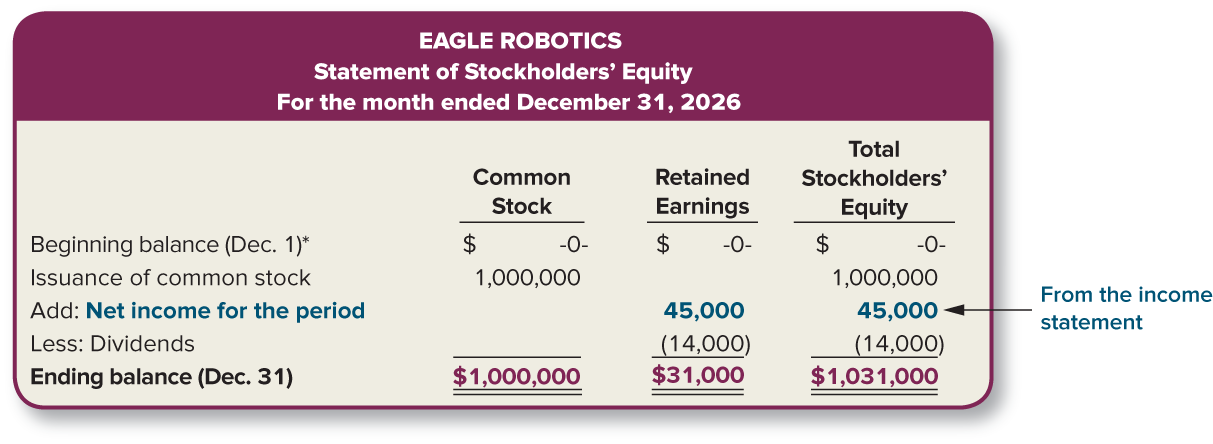
Statement of Retained Earnings
The middle column of the statement of stockholders’ equity. In practice, companies don’t report retained earnings in a separate statement from common stock, so thats why we demonstrate the statement of stockholders equity. It is useful to see that this column highlights how net income from the income statement links to total stockholders’ equity by adding to the balance of retained earnings
The Balance Sheet
A financial statement that presents the financial position of the company on a particular date. The financial position of a company is summarized by the accounting equation
The left side of the sheet is all of the assets such as cash, supplies, equipment, and buildings → The way to identify an asset is to go through the list and think about what resources a company would own that it would use up
The right top side of the sheet is liabilities such as accounts payable and salaries payable → liabilities can usually be identified by the word “payable” which is an amount due to others
Accounts payable, is an amount that the company owes to vendors that are outside the company
Salaries payable, are amounts that are due to employees that have worked but have not been paid what they are owed
The right bottom side section is stockholders equity and retained earnings → The total assets MUST EQUAL total liabilities and stockholders equity
You are taking the total common stock and total retained earnings from the statement of stockholders equity

Sales of products or services classification
Revenues
Owners claims to resources classification
Stockholders equity
Distribution to stockholders classification
Dividends
Costs of selling products or services classification
Expenses
Resources of a company classification
Assets
Creditors claims to resources classification
Liabilities
Cost of rent account title
Rent expense
Interest earned on savings account title
Interest revenue
Cash payments to stockholders account title
Dividends
Amounts owed to suppliers account title
Accounts payable
Shares of ownership sold to investors account title
Common stock
Sales of services to customers account title
Service revenue
The change in retained earnings due to net income and dividends
Statement of stockholders equity
Amount of cash received from borrowing money from a local bank
Statement of cash flows
Revenue from sales to customers during the year
Income statement
Total amounts owed to workers at the end of the year
Balance sheet