module 1
0.0(0)
Studied by 0 people View linked note
 Call Kai
 Learn
Learn Practice Test
 Spaced Repetition
 Match
Match Flashcards
 Knowt Play
Card Sorting
1/93

Last updated 3:39 AM on 9/10/22
Name | Mastery | Learn | Test | Matching | Spaced | Call with Kai |
|---|
No analytics yet
Send a link to your students to track their progress
94 Terms
1
New cards
what are prokaryotic cells? (definition)
not containing a nucleus or any other membrane-bound organelles
2
New cards
features of prokaryotic cells:
• no nucleus
• most have cell wall
• unicellular
• bacteria and archaea
• cell membrane, vacuole, cytoplasm, ribosomes
• simple cell
• no membrane bound organelles
• plasma membrane
• DNA (circular strands)
• most have cell wall
• unicellular
• bacteria and archaea
• cell membrane, vacuole, cytoplasm, ribosomes
• simple cell
• no membrane bound organelles
• plasma membrane
• DNA (circular strands)
3
New cards
what are eukaryotic cells? (definition)
containing membrane-bound organelles; nucleus
4
New cards
features of eukaryotic cells:
• nucleus
• some have cell wall
• multicellular and unicellular
• complex cell
• protists, plants, animal, fungi
• cytoplasm, nucleus, ribosomes, golgi bodies, vacuole, nucleolus, smooth and rough ER, mitochondria, chloroplast, lysosomes
• DNA (linear strands)
• some have cell wall
• multicellular and unicellular
• complex cell
• protists, plants, animal, fungi
• cytoplasm, nucleus, ribosomes, golgi bodies, vacuole, nucleolus, smooth and rough ER, mitochondria, chloroplast, lysosomes
• DNA (linear strands)
5
New cards
list types of prokaryotes:
bacteria + archaea
6
New cards
list types of eukaryotes:
protists, plants, animals + fungi
7
New cards
what is magnification?
the act of enlarging something to see detail
8
New cards
what is resolution?
the clarity + ability to see fine detail
9
New cards
what is a light microscope?
• light from mirror is reflected through specimen into lens • observe living cells
• cheaper, colour
• simple prep
• small and portable
• cheaper, colour
• simple prep
• small and portable
10
New cards
what is an electron microscope?
• use beams of electron, focused by electric and magnetic fields, to form images
• higher magnification and resolution
• expensive
• b&w
• dead specimen
• expert prep
• higher magnification and resolution
• expensive
• b&w
• dead specimen
• expert prep
11
New cards
formula of magnification : ( eyepiece lens has a magnification of 10X and the objective lens has a magnification of 40X )
eyepiece lens x objective lens 10 x 40 = 400X
12
New cards
what is an organelle?
• an internal structure that has a specific job inside the cell
• most of the cells organelles are in cytoplasm
• some are membrane bound ( eukaryotic cells )
• most of the cells organelles are in cytoplasm
• some are membrane bound ( eukaryotic cells )
13
New cards
nucleus ( features, LM/EM, pro/eu + function )
• roughly spherical, ofter a dark centre usually the biggest • LM + EM • eukaryotic • control centre, sends messages to other organelles
14
New cards
cell membrane ( features, LM/EM, pro/eu + function )
• look for where the cytoplasm ends (can’t see it) • LM + EM • eukaryotic + prokaryotic ( aka plasma membrane ) • controls what enters / exit cell
15
New cards
cell wall ( features, LM/EM, pro/eu + function )
• thicker structure, often straight edge. • LM + EM
• prokaryotic + eukaryotic ( plants + fungi ) • protect cell, gives cell shape and supports it
• prokaryotic + eukaryotic ( plants + fungi ) • protect cell, gives cell shape and supports it
16
New cards
cytoplasm ( features, LM/EM, pro/eu + function )
• everything that’s left, contained within cell membrane
• LM + EM
• prokaryotic (aka nucleoplasm) + eukaryotic
• contains water that dissolves substances for reaction • shape / supports cells
• LM + EM
• prokaryotic (aka nucleoplasm) + eukaryotic
• contains water that dissolves substances for reaction • shape / supports cells
17
New cards
vacuole ( features, LM/EM, pro/eu + function )
• clear/white (empty space), large object in plant, animal = tiny
• LM + EM
• eukaryotic
• contains water, supports the cell
• LM + EM
• eukaryotic
• contains water, supports the cell
18
New cards
chloroplast ( features, LM/EM, pro/eu + function )
• black dots, darker lines. lines = length, larger, oval
• LM + EM
• eukaryotic
• photosynthesis
• LM + EM
• eukaryotic
• photosynthesis
19
New cards
mitochondria ( features, LM/EM, pro/eu + function )
• lines go across smaller than
• EM
• eukaryotic
• cellular respiration (release energy)
• EM
• eukaryotic
• cellular respiration (release energy)
20
New cards
endoplasmic reticulum ( features, LM/EM, pro/eu + function )
• tunnels, ‘room’ attached + usually next to nucleus
• EM
• eukaryotic
• provides channels for chemicals / messages to travel
• EM
• eukaryotic
• provides channels for chemicals / messages to travel
21
New cards
ribosome ( features, LM/EM, pro/eu + function )
• dots located in cell or attached to ER
• EM
• prokaryotic + eukaryotic
• makes protein
• EM
• prokaryotic + eukaryotic
• makes protein
22
New cards
golgi apparatus ( features, LM/EM, pro/eu + function )
• flat sacs, semicircular shape (membrane bound)
• EM
• eukaryotic
• contains digestive enzymes, destroy foreign protein
• EM
• eukaryotic
• contains digestive enzymes, destroy foreign protein
23
New cards
lysome ( features, LM/EM, pro/eu + function )
• circular
• EM
• eukaryotic
• digestion + waste removal
• EM
• eukaryotic
• digestion + waste removal
24
New cards
cilia ( features, LM/EM, pro/eu + function )
• rhythmic wave, hair like structure that’s extended outwards
• LM + EM
• eukaryotic + prokaryotic
• rhythmic, waving or beating motion; keep airways clear of mucus / dirt
• LM + EM
• eukaryotic + prokaryotic
• rhythmic, waving or beating motion; keep airways clear of mucus / dirt
25
New cards
flagella ( features, LM/EM, pro/eu + function )
• tail-like structure
• LM + EM
• prokaryotic eukaryotic
• enables motion
• LM + EM
• prokaryotic eukaryotic
• enables motion
26
New cards
what is the fluid mosaic model?
a selectively permeable barrier rather than a closed wall or open gate
27
New cards
what molecules need the help of a protein channel?
large, polar molecules such as glucose
28
New cards
are phosphate heads hydrophilic or hydrophobic?
hydrophilic ♥︎
29
New cards
are lipid tails hydrophilic or hydrophobic?
hydrophobic X
30
New cards
formula of respiration:
glucose + oxygen ---> carbon dioxide + water + ATP
(cellular energy )
(cellular energy )
31
New cards
what are peripheral proteins?
• can be attached to ends of integral proteins, or not.
• helps with transport/communication
• helps with transport/communication
32
New cards
what does polar and non-polar mean?
polar : electrons not evenly distributed, one side more + or -- charged
non-polar : electrons evenly distributed so molecule evenly charged across surface
non-polar : electrons evenly distributed so molecule evenly charged across surface
33
New cards
role of cholesterol in cell membrane:
holds phospholipids together so they don’t separate too far, let unwanted substances in, or compact too tightly restricting movement across membrane
34
New cards
role of glycoprotein:
• involved with cell recognition and immune response. • acts as receptor for hormones, help stabilise structure
35
New cards
role of glycolipid:
• acts as surface receptor and helps stabilise the membrane
36
New cards
what do both glycolipids and glycoprotein contain?
a glycocalyx (short carbohydrate chain)
37
New cards
what is the phospholipid bilayer?
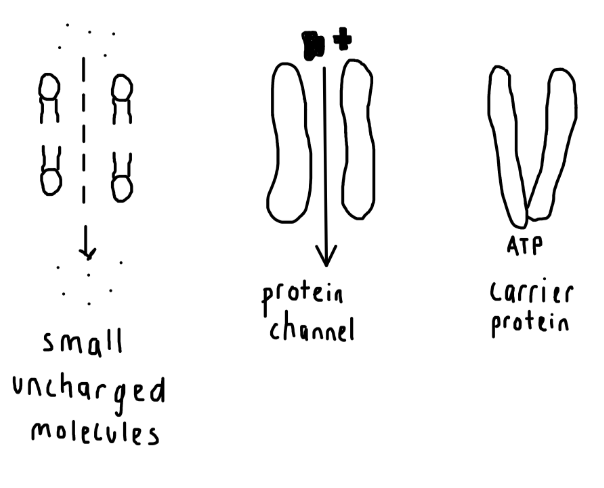
main structure of membrane, allows small, lipid soluble molecules, uncharged to pass through simple diffusion
38
New cards
what is the protein receptor site?
allows other proteins to attach such as enzymes, antigens or chemicals like hormones
39
New cards
what is the protein channel?
pores filled with water which acts as channels for water soluble ions to pass through membrane by facilitated diffusion
40
New cards
what are the carrier protein?
can change shape to move certain substances which are too large to move by facilitated diffusion e.g. glucose - too big (active transport ATP energy)
41
New cards
are phosphate molecules polar or non-polar?
polar - it has a slight charge
42
New cards
are lipid tails polar or non-polar?
non-polar - it has no charge
43
New cards
role of integral proteins:
to transport large molecules across cell membrane
44
New cards
what is diffusion?
movement of particles from region of high concentration to region of low concentration until equilibrium is reached
45
New cards
what happens at equilibrium?
there is no net movement of particles in either direction
46
New cards
does diffusion require input of energy?
no
47
New cards
when does diffusion occur faster?
with higher temperatures + steeper concentration gradient
48
New cards
what molecules diffuse easily across cell membrane?
small, uncharged molecules ( O2 and CO2 )
49
New cards
what does facilitated diffusion allow?
larger molecules and small electrically charged ions to diffuse across cell membrane aided by carrier protein and protein channel
50
New cards
what molecules can go through each?
1. small uncharged molecules - O2 + CO2 ( cell membrane ) 2. large polar molecules - glucose ( protein channel ) 3. sugar + amino acids ( carrier proteins
51
New cards
what is osmosis?
movement of water molecules from a high concentration of water to a low concentration of water, through selectively permeable membrane
52
New cards
what is active transport?
movement of molecules from low concentration to high concentration through selectively permeable membrane
53
New cards
what is hypotonic?
solute concentration surrounding the cell is lower than inside the cell
54
New cards
what is isotonic?
solute concentration surrounding the cell is equal to inside the cell
55
New cards
what is hypertonic?
solute concentration surrounding the cell is higher than inside the cell
56
New cards
what is passive movement?
• movement down the concentration gradient
• no energy needed
• high concentration
• from higher concentration to lower concentration
• no energy needed
• high concentration
• from higher concentration to lower concentration
57
New cards
what is endocytosis?
• large particle is moved into cell, • cell membrane can change shape to surround the particle and engulfs it • moves large molecules that can't cross cell membrane into a cell
58
New cards
what is exocytosis?
• substances are transported to external environment of cell. • a membrane bound vesicle moves to cell membrane, fuses then releases its contents to exterior of cell • vesicle membrane becomes part of cell membrane
59
New cards
what is phagocytosis?
when a solid particle is engulfed by cell membrane
60
New cards
what is pinocytosis?
• engulfing fluid substances by cell membrane • cell membrane engulfs a drop of extracellular fluid same ways as phagocytosis
61
New cards
formula for the magnification of cells:
I = A x M , A = I ÷ M , M = I ÷ A
62
New cards
formula for surface area (1cm cube)
1 x 1 x 6 = 6cm2
63
New cards
formula for volume (1cm cube)
1 x 1 x 1 = 1cm3
64
New cards
what is light energy?
• absorbed by the green pigment ( chlorophyll ) in plants, some protists and bacteria in a process called photosynthesis
• organisms that use light energy to make their own ‘food’ are called autotrophs
• autotrophic organisms can utilise light energy from the sun by absorbing it in chloroplast and converting it into glucose ( chemical energy ), in the process of photosynthesis
• organisms that use light energy to make their own ‘food’ are called autotrophs
• autotrophic organisms can utilise light energy from the sun by absorbing it in chloroplast and converting it into glucose ( chemical energy ), in the process of photosynthesis
65
New cards
what is chemical energy?
• organic substances such as carbohydrates, lipids and proteins can be broken down to release energy by animals, some protists, fungi and some bacteria
• organisms that rely on taking in high-energy organic molecules as a source of energy are called heterotrophs
• heterotrophic organisms rely completely on chemical energy from consuming organisms containing glucose, in the process of cellular respiration
• organisms that rely on taking in high-energy organic molecules as a source of energy are called heterotrophs
• heterotrophic organisms rely completely on chemical energy from consuming organisms containing glucose, in the process of cellular respiration
66
New cards
difference between autotrophs and heterotrophs?
Auto : ‘self feeder’
Make their own food
Carries out photosynthesis
Energy from sun converts to glucose e.g. plants, algae food
Heter : ‘different types of feeding
Cannot make their own food
Consumes other organisms.
Gets energy from other organisms
e.g. animals, single-celled organism
Make their own food
Carries out photosynthesis
Energy from sun converts to glucose e.g. plants, algae food
Heter : ‘different types of feeding
Cannot make their own food
Consumes other organisms.
Gets energy from other organisms
e.g. animals, single-celled organism
67
New cards
what do autotrophs and heterotrophs require?
• autotrophs require gases, simple nutrients and ions and water
• heterotrophs require gases, complex molecules and water
• heterotrophs require gases, complex molecules and water
68
New cards
formula of photosynthesis:
carbon dioxide + water ---> glucose. + oxygen
69
New cards
where does photosynthesis occur?
in the chloroplast
70
New cards
what does photosynthesis do?
it uses light energy ( from sun, water, carbon dioxide ) to synthesis organic compounds ( glucose + oxygen )
71
New cards
does photosynthesis occur in autotrophs or heterotrophs?
autotrophs e.g. plants, algae + bacteria
72
New cards
where does cellular respiration occur?
different locations in the cytosol and mitochondria
73
New cards
what does cellular respiration do?
converts high-energy compounds ( glucose ) to ‘lower’ energy compounds
74
New cards
does cellular respiration occur in autotrophs or heterotrophs?
in both, it occurs in every living thing
75
New cards
role of enzymes in cells:
proteins that catalyse biochemical reactions, this allows them to be carried out at a sufficient rate to support living cells
76
New cards
what is metabolism?
sum of all chemical reactions occurring within a living organism
77
New cards
role of catalyst chemical substances:
• speed up chemical reactions • are unchanged at time of reaction and can be reused
78
New cards
what is activation energy?
minimum amount of energy required to a start reaction
79
New cards
how do enzymes speed up reactions?
• by lowering activation energy required for reaction • it combines reactants and holds them in a way that makes reactions more likely to occur
80
New cards
properties of enzymes:
• protein molecules are highly folded to create particular chemical shape
• surface of enzyme with specific shape is active site
• reactants ( substrates ) in chemical reactions temporarily bind and substrate-enzyme complex is formed and reaction proceeds
• products of reaction are released from active site of enzyme
• enzyme is unchanged and available for same process to occur
• surface of enzyme with specific shape is active site
• reactants ( substrates ) in chemical reactions temporarily bind and substrate-enzyme complex is formed and reaction proceeds
• products of reaction are released from active site of enzyme
• enzyme is unchanged and available for same process to occur
81
New cards
what are the models of enzymes?
lock and key model + induced fit
82
New cards
what is the lock and key model?
thought that the active site is rigid and small substrate molecule is reciprocally shaped and fits exactly into active site
83
New cards
what is the induced fit model?
suggests the binding of substrate to active site of enzyme induces the enzyme to alter its shape slightly to fit more tightly around substrate
84
New cards
what are the factors affecting enzyme activity?
temperature, pH levels and substrate concentration
85
New cards
effect of temperature on enzymes:
• function best at body temperature of organism they occur in
• rate of reaction increases until temperature is reached and at this point enzyme activity is at max level
• high temp can make protein structure bend and flex resulting in the active site changing shape
• heat causes enzyme to denature, change of structure in molecule is irreversible
• cold causes change of shape that is sometimes reversible
• rate of reaction increases until temperature is reached and at this point enzyme activity is at max level
• high temp can make protein structure bend and flex resulting in the active site changing shape
• heat causes enzyme to denature, change of structure in molecule is irreversible
• cold causes change of shape that is sometimes reversible
86
New cards
effect of pH levels on enzymes:
• each enzyme has its own pH range which it functions most efficiently
• extreme pH levels cause enzyme to denature
• most enzymes function near neutral
• protein digesting enzymes pepsin and renin function best in low pH ( high acidity )
• extreme pH levels cause enzyme to denature
• most enzymes function near neutral
• protein digesting enzymes pepsin and renin function best in low pH ( high acidity )
87
New cards
effect of substrate concentration on enzymes:
• rate of enzyme-controlled reaction is affected by concentration of the substrate
• higher substrate concentration = greater rate of enzyme reaction, until all available enzymes are used to catalyse reaction (saturation point)
• higher substrate concentration = greater rate of enzyme reaction, until all available enzymes are used to catalyse reaction (saturation point)
88
New cards
what is rennin?
aka chymosin a protein digesting enzyme that curdles milk by transforming caesogin into insoluble caesin
89
New cards
what is catalyse?
process which substance speeds up chemical reaction without being consumed or altered in process
90
New cards
what do amino acids form?
proteins
91
New cards
what is catabolic?
when one substrate is broken apart
92
New cards
what is anabolic?
when substrates join together
93
New cards
what is intracellular?
located or occurring within a cell
94
New cards
what is intercellular?
located or occurring between cells