Transport across cell membranes 3.2.3
 Call Kai
 Learn
Learn Practice Test
 Spaced Repetition
 Match
Match Flashcards
 Knowt Play
1/10

Earn XP
Description and Tags
Name | Mastery | Learn | Test | Matching | Spaced | Call with Kai | Chat |
|---|
No analytics yet
Send a link to your students to track their progress
11 Terms
Roles of cell membranes
Cell surface membranes act as a barrier between a cell and its environment, controlling what enters and exits the cell. Membranes around organelles act as a barrier to the cytoplasm, dividing the cell into different compartments (compartmentalisation). Both membranes are partially permeable.
Fluid-mosaic model
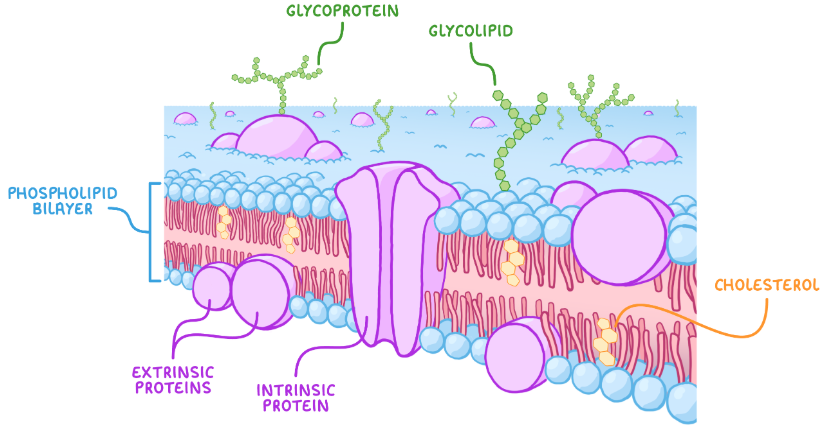
The phospholipid bilayer prevents water-soluble substances passing through but allows lipid-soluble substances through.
Cholesterol bind to the phospholipid fatty acid tails, causing them to pack closer together, reducing the fluidity of the membrane.
Intrinsic (integral) proteins are embedded through both sides of the phospholipid bilayer. These include channel and carrier proteins which transport large molecules and ions across the membrane.
Extrinsic (peripheral) proteins are only present on one side of the phospholipid bilayer. They support the membrane and may be involved in cell signalling.
Glycoproteins consist of intrinsic proteins attached to carbohydrates. Glycolipids consist of lipids attached to carbohydrates. Both are involved in adhesion, cell recognition and cell signalling.
Simple diffusion
The net movement of small, non-polar molecules (e.g. oxygen and carbon dioxide) from an area of higher concentration to an area of lower concentration down the concentration gradient until equilibrium is reached in a passive process directly through the membrane.
Facilitated diffusion
Large, polar molecules can cross the cell membrane with the aid of a protein:
Carrier proteins mainly transport large molecules. When a large molecule attached to a carrier protein, the protein changes shape, releasing the molecule of the opposite side of the membrane.
Channel proteins mainly transport ions across the membrane by forming pores/channels in the cell membrane which ions can travel through.
Factors affecting the rate of diffusion
Temperature
Concentration gradient
Thickness of the membrane
Surface area
Carrier/channel protein frequency
Osmosis
The diffusion of water molecules across a partially permeable membrane from an area of higher water potential to an area of lower water potential until equilibrium is reached.
Factors affecting the rate of osmosis
Temperature
Water potential gradient
Thickness of the membrane
Surface area
Active transport
The movement of particles from an area of lower concentration to an area of higher concentration. Energy in the form of ATP from respiration is required, as particles move against the concentration gradient.
A molecule or ion binds to a carrier protein. ATP also binds to the carrier protein, undergoing hydrolysis to produce ADP and Pi, this causes the carrier protein to change shape, releasing the molecule on the opposite side of the membrane.
Factors affecting active transport
Temperature (kinetic energy and also increases rate of respiration)
Thickness of the membrane
Number of carrier proteins
Rate of respiration (more ATP available)
Co-transport
Co-transporters are carrier proteins that can bind to two molecules at once, using the concentration gradient of one to move the other against its own.
Co-transport of sodium and glucose
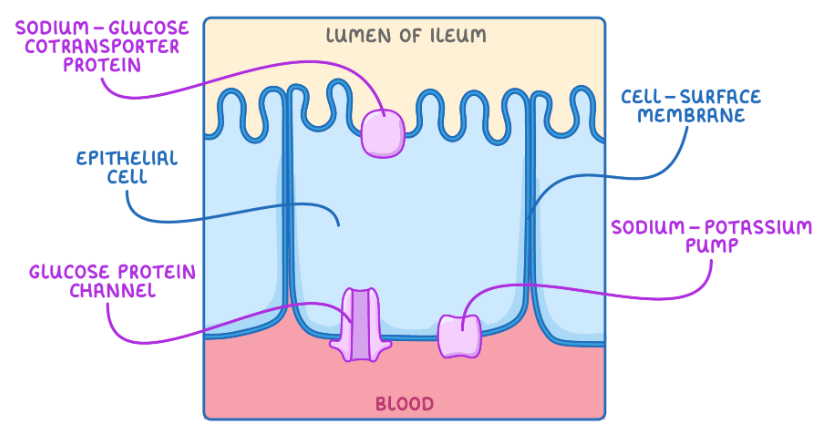
Sodium ions are actively transported out of epithelial cells into the blood by a sodium-potassium pump (this simultaneously brings potassium in). This creates a concentration gradient because there is now a lower concentration of Na+ in the lumen of the ileum than the epithelial cells. Na+ diffuses from lumen to Ecells down the concentration gradient through a sodium-glucose co-transporter, also bringing glucose with it (against its own concentration gradient). This creates a higher concentration of glucose in the Ecells than the blood, so glucose diffuses into the blood via facilitated diffusion (channel protein).