psych learning module (3.7a, 3.7b, 3.8a, 3.8b, 3.9)
 Studied by 0 people
 Call with Kai
 Learn
Learn Practice Test
 Spaced Repetition
 Match
Match Flashcards
 Knowt Play
1/68

There's no tags or description
Looks like no tags are added yet.
Name | Mastery | Learn | Test | Matching | Spaced | Call with Kai |
|---|
No analytics yet
Send a link to your students to track their progress
69 Terms
behavioral perspective
examines how observable behaviors are learned and reinforced through interactions with the environment
adaptability
our capacity to learn new behaviors that can help us cope with our changing world
learning
the process of acquiring through experience new and relatively enduring information or behaviors
association
mind naturally connects events that occur in sequence
learning associations feed habitual behaviors
habituation
decreasing responsiveness with repeated stimulation; as infants gain familiarity with repeated exposure to a stimulus, their interest wanes and they look away sooner
what happens when repeated stimulation produces waning responsiveness
non-associative learning; occurs when organisms grow accustomed to and exhibit diminished response to a repeated stimulus (aka getting used to something over time)
associative learning
learning that certain events occur together; the events may be two stimuli (as in classical conditioning) or a response and its consequence (as in operant conditioning)
process of learning in which individuals form connections between events that occur together (includes classical and operant conditioning)
classical conditioning
learn to associate two stimuli and thus to anticipate events
a type of learning in which we link two or more stimuli
illustrated with Pavlov’s classic experiment, the first stimulus (a tone) comes to elicit behavior (drooling) in anticipation of the second stimulus (food)
learning method where we associate two stimuli, leading to anticipation of events
stimulus
any event or situation that evokes a response
respondent behavior
associate stimuli that we do not control, and we respond automatically
cognitive learning
the acquisition of mental information, whether by observing events, by watching others, or through language
observational learning
a form of cognitive learning, lets us learn from others’ experiences
behaviorism
the view that psychology should be an objective science that studies behavior without reference to mental processes
neutral stimuli (NS)
in classical conditioning, a stimulus that elicits no response before conditioning
unconditioned stimulus (UCS)
in classical conditioning, a stimulus that unconditionally — naturally and automatically — triggers an unconditioned response UCR)
stimulus that naturally and automatically triggers a response without learning
unconditioned response (UCS)
in classical conditioning, an unlearned, naturally occurring response (such as salivation) to an unconditioned stimulus (UCS) (such as food in the mouth)
natural and automatic reaction to a stimulus without prior learning or conditioning
conditioned stimulus
in classical conditioning, an originally neutral stimulus that, after association with an unconditioned stimulus (UCS), comes to trigger a conditioned response (CR)
previously neutral stimulus that, after repeatedly paired with unconditioned stimulus, evokes a conditioned response
conditioned response (CR)
in classical conditioning, a learned response to a previously neutral (but now conditioned) stimulus (CS)
learned response that occurs when conditioned stimulus is presented, resulting from association with unconditioned stimulus
acquisition
in classical conditioning, the initial stage, when one links a neutral stimulus and an unconditioned stimulus so that the neutral stimulus begins triggering the conditioned response. In operant conditioning, the strengthening of a reinforced response
the initial learning of an association
higher order conditioning
a procedure in which the conditioned stimulus in one conditioning experience is paired with a new neutral stimulus, creating a second (often weaker) conditioned stimulus
for example, an animal that has learned that a tone predicts food might then learn that a light predicts the tone and begin responding to the light alone (aka second-order conditioning.)
process where a previously conditioned stimulus is used to create further associations with new neutral stimuli, resulting in these stimuli also eliciting a conditioned response
counterconditioning
changing a learned response to something more preferable by pairing it with a different experience
ex: reversing a phobia, like baby Peter
extinction
in classical conditioning, the diminishing of a conditioned response when an unconditioned stimulus does not follow a conditioned stimulus (in operant conditioning, when a response is no longer reinforced)
process where a conditioned response weakens and eventually disappears when the conditioned stimulus is repeatedly presented without the unconditioned stimulus
spontaneous recovery
the reappearance, after a pause, of a weakened conditioned response
reappearance of a previously extinguished condition after a rest period, suggesting that extinction does not erase association, but temporarily suppresses it
classical generalization
(also called stimulus generalization) in classical conditioning, the tendency, once a response has been conditioned, for stimuli similar to the conditioned stimulus to elicit similar responses (in operant conditioning, when responses learned in one situation occur in other, similar situations)
tendency to response to stimuli that are similar to the conditioned stimulus, as a result of the conditioning process
classical discrimination
in classical conditioning, the learned ability to distinguish between a conditioned stimulus and other stimuli that have not been associated with a conditioned stimulus (in operant conditioning, the ability to distinguish responses that are reinforced from similar responses that are not reinforced)
ability to differentiate between similar stimuli and respond differently to them, learned through the conditioning process
conditioning impacts on health
drug cravings, food cravings, immune responses
Watson’s (1913) idea
human emotions and behaviors, though biologically influenced, are mainly a bundle of conditioned responses
little albert experiment
“Little Albert” feared loud noises but not white rats. Watson and Rayner presented a white rat and, as Little Albert reached to touch it, struck a hammer against a steel bar just behind his head. After seven repeats of seeing the rat and hearing the frightening noise, Albert burst into tears at the mere sight of the rat. Five days later, he reportedly generalized this startled fear reaction to the sight of a rabbit, a dog, and even a furry coat.
example of how fears are often conditioned
preparedness
a biological predisposition to learn associations, such as between taste and nausea, that have survival value
innate tendency of organisms to quickly learn associations between certain stimuli and responses that are relevant to their survival (such as fear or danger)
taste aversion response
learned association between the taste of a particular food and feeling sick, often occurring after only one pairing
example of one trial conditioning
one trial conditioning
single pairing of stimulus (ex oysters) and response (ex illness) will be enough to create an association, and your new aversion won’t be strengthened by further pairings
learning that happens quickly after just one pairing of two things
operant conditioning
learn to associate a response (our behavior) and its consequence; we (and other animals) learn to repeat acts that are followed by good results
type of learning in which behavior is strengthened or weakened by consequences such as reinforcement or punishment
ex: BF Skinner’s pigeon experiment
operant behaviors
behavior that operates on the environment, producing a consequence
law of effect
Thorndike’s principle that behaviors followed by favorable (or reinforcing) consequences become more likely, and that behaviors followed by unfavorable (or punishing) consequences become less likely
behaviors followed by favorable outcomes are more likely to be repeated, while behaviors followed by unfavorable outcomes are less likely to be repeated
operant chamber aka skinner box
in operant conditioning research, a chamber (also known as a Skinner box) containing a bar or key that an animal can manipulate to obtain a food or water reinforcer; attached devices record the animal’s rate of bar pressing or key pecking
reinforcement
in operant conditioning, any event that strengthens the behavior it follows
any consequence that increases the likelihood of a behavior occurring again in the future
shaping
an operant conditioning procedure in which reinforcers guide behavior toward closer and closer approximations of the desired behavior
gradually reinforcing a desirable stimulus after a behavior to decrease the likelihood of that behavior happening in the future
reinforcement discrimination
in operant conditioning, ability to distinguish between different stimuli and respond appropriately based on the presence or absence of reinforcement
reinforcement generalization
in operant conditioning, the tendency to respond similarly to different stimuli that are associated with the same reinforcement
discriminative stimulus
in operant conditioning, a stimulus that elicits a response after association with reinforcement (in contrast to related stimuli not associated with reinforcement)
positive reinforcement
increasing behaviors by presenting a pleasurable stimulus; a positive reinforcer is any stimulus that, when presented after a response, strengthens the response
presenting a desirable stimulus after a behavior to increase the likelihood of that behavior occurring in the future
negative reinforcement
increasing behaviors by stopping or reducing an aversive stimulus; a negative reinforcer is any stimulus that, when removed after a response, strengthens the response. (negative reinforcement is not punishment)
removing an aversice stimulus after a behavior to increase the likelihood of that behavior occurring in the future
primary reinforces/reinforcement
an innately reinforcing stimulus, such as one that satisfies a biological need
things we naturally like and need for survival (ex food, water, shelter)
conditioned reinforcers/secondary reinforcement
a stimulus that gains its reinforcing power through its association with a primary reinforcer
things we learn to like because they are connected to primary reinforcers or other things we like (ex money, praise)
immediate reinforcers
offer immediate payback
delayed reinforcers
require the ability to delay gratification
reinforcement schedule
a pattern that defines how often a desired response will be reinforced
continuous reinforcement schedule
reinforcing the desired response every time it occurs
partial (intermittent) reinforcement schedule
reinforcing a response only part of the time; results in slower acquisition of a response but much greater resistance to extinction than does continuous reinforcement
fixed ratio schedule
in operant conditioning, a reinforcement schedule that reinforces a response only after a specified number of responses
variable ratio schedule
in operant conditioning, a reinforcement schedule that reinforces a response after an unpredictable number of responses
fixed interval schedule
in operant conditioning, a reinforcement schedule that reinforces a response only after a specified time has elapsed
variable interval schedule
in operant conditioning, a reinforcement schedule that reinforces a response at unpredictable time intervals
punishment
an event that tends to decrease the behavior that it follows
any consequence that decreases the likelihood of a behavior occurring in the future
positive punishment
adding aversive stimuli after a behavior to decrease the likelihood of that behavior occurring in the future
negative punishment
removing a desirable stimulus after a behavior to decrease the likelihood of that behavior occurring in the future
negatives to physical punishment
punished behavior is suppressed, not forgotten
physical punishment does not replace the unwanted behavior
punishment teaches discrimination among situations
punishment can teach fear
physical punishment may increase aggression by modeling violence as a way to cope with problems
instinctive drift
the tendency of learned behavior to gradually revert to biologically predisposed pattern
animals reverting to their natural instincts instead of learning new behaviors through training (operant conditioning)
superstitious behavior
accidental reinforcement of behaviors, leading to the belief that those behaviors are causing desired outcomes, even when they are not
classical vs operant conditioning
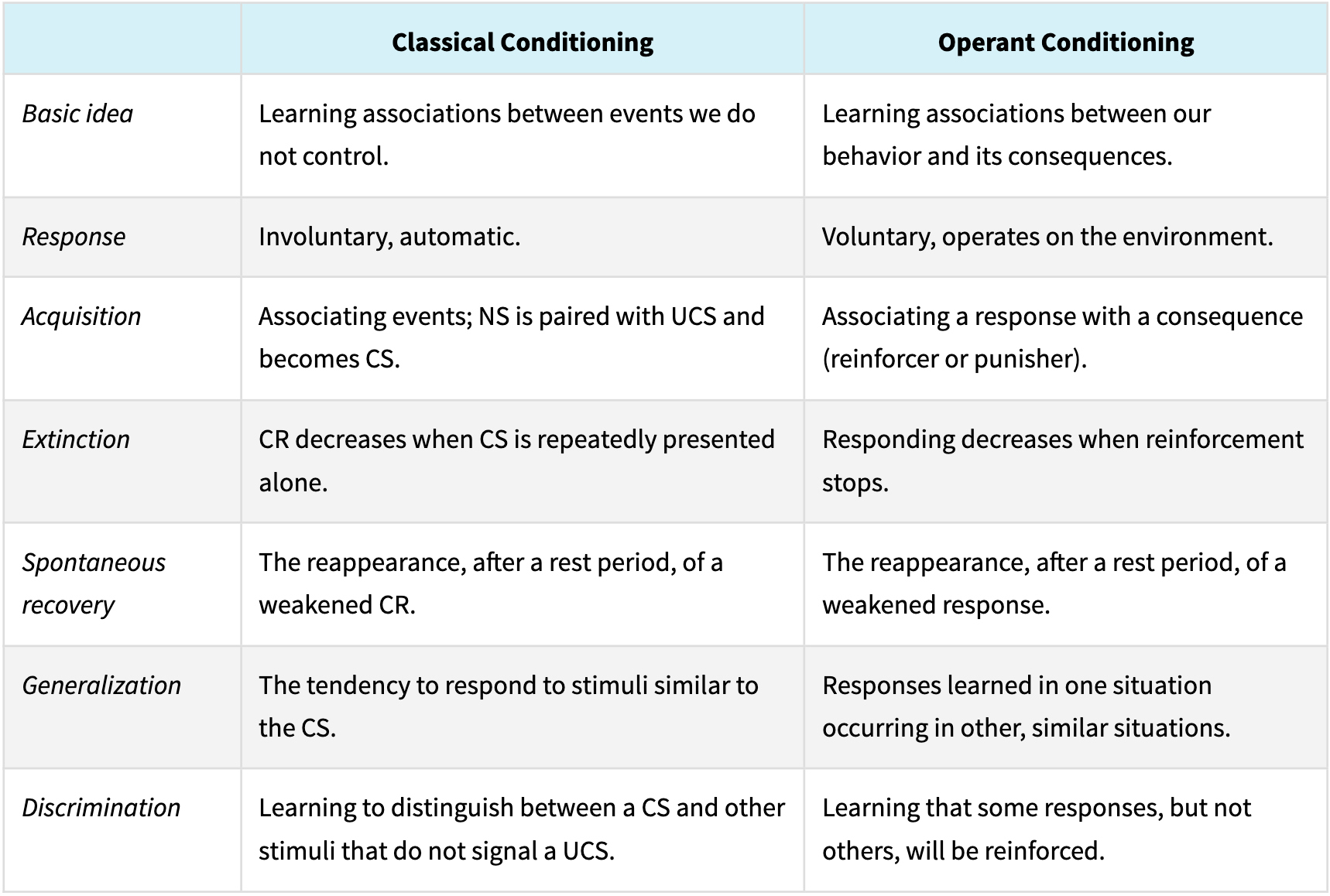
operant conditioning uses
teachers guide student’s behaviors
coaches build players’ skills and self-esteem
ai developed with reinforcement shows limits of human learning
parents support desired behaviors and prevent undesired behaviors
operant conditioning for self goals
state realistic goals, plan how to work for toward goal, monitor frequency of desired behaviors, reinforce desired behaviors, reduce rewards as behaviors become habitual
cognitive map
a mental representation of the layout of one’s environment (ex: after exploring a maze, rats act as if they have learned a cognitive map of it)
latent learning
learning that occurs but is not apparent until there is an incentive to demonstrate it
insight learning
solving problems through sudden insight; contrasts with strategy-based solutions
observational learning/social learning
learning by observing others
modeling
the process of observing and imitating a specific behavior
mirror neurons
neurons that some scientists believe fire when we perform certain actions or observe another doing so; the brain’s mirroring of another’s action may enable imitation and empathy
prosocial behaviors
positive, constructive, helpful behavior; the opposite of antisocial behavior
antisocial behaviors
negative, destructive, harmful behavior; the opposite of prosocial behavior
 Note
Note  Flashcards (22)