Lesson 02 - duration
 Call Kai
 Learn
Learn Practice Test
 Spaced Repetition
 Match
Match Flashcards
 Knowt Play
1/6

There's no tags or description
Looks like no tags are added yet.
Name | Mastery | Learn | Test | Matching | Spaced | Call with Kai |
|---|
No analytics yet
Send a link to your students to track their progress
7 Terms
define capacity
the amount of information that can be held in a memory store
define duration
the length of time information can be held in a memory store
define coding
the format in which information is stored, may involve converting incoming information
define the sensory register
the memory stores for each of our five senses
capacity is huge (millions of receptors)
information lasts for a very short amount of time (less than half a second)
describe sperling’s experiment investigating sensory registers
participants saw a grid of digits and letters for 50 milliseconds. they were asked to write down 12 items or told they would hear a tone after and to write down the row indicated. when asked to report their whole thing their recall was poorer (on average 5 items were recalled, about 42%) than when asked to report one row only (3 items recalled, 75%)
this is because they were less likely they were to recall it all due to the overload of information. this suggests the information has decayed before it could all be written down, indicating a short duration
describe peterson and peterson 1959 experiment on duration of STM
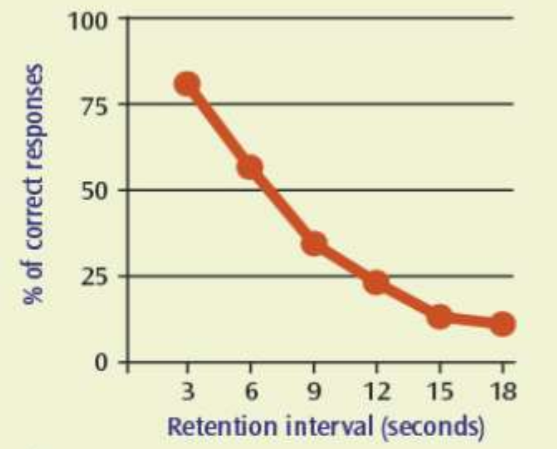
24 participants were each given a consonant syllable/trigram such as YCG to remember. they were also given a 3-digit number (apart from the first trial). participants counted backwards from this number until told to stop. this prevents an mental rehearsal of the syllable (which would increase the duration of STM). on each trial participants were told to stop counting after varying periods of time and were asked to recall the consonant syllable
as the time period increased the percentage of correct responses decreased. the graph shows how more participants (around 78%) were able to recall the consonant syllable after a shorter period of time (here 3 seconds). at the halfway mark, at 9 seconds, only around 30% of responses were correct, demonstrating how this proportion dropped rapidly in the 6 second period. at 18 seconds, around 3-12% of responses were correct. this graph demonstrates the short duration of short term memory, as fresher information is more easily recalled
STM has a duration of up to 18 seconds, unless information is rehearsed
describe bahrick 1975 experiment on duration of LTM
392 american participants ages between 7 and 74
used high school yearbooks
conducted a photo recognition test - 50 photos, participants asked to pick out people they know in high school
free recall test - participants asked to recall all the names of their graduating class
participants tested within 15 years of graduation - 90% accurate
participants tested after 48 years - 70% accurate
for the free recall test, after 15 years they were 60% accurate, after 48 years they were 30% accurate
long term memory can last up to a lifetime
extraneous variables:
how recently they have/whether they have contacted them since high school
how well they knew them at school
quality of photos
how common their names are

