Optoprep Part 1 - Lids / Lashes / Lacrimal system
 Studied by 0 people
 Call Kai
 Learn
Learn Practice Test
 Spaced Repetition
 Match
Match Flashcards
 Knowt Play
1/61

There's no tags or description
Looks like no tags are added yet.
Name | Mastery | Learn | Test | Matching | Spaced | Call with Kai |
|---|
No analytics yet
Send a link to your students to track their progress
62 Terms
A 64-year-old male is seen at your office for a comprehensive eye exam. Upon evaluation, you note a small nevus on his lower eyelid margin. When asked, he reports that it has increased in size over the last two months. Biomicroscopy reveals even pigmentation and symmetrical, distinct borders with slight elevation. What is your immediate treatment plan?
Refer to dermatology for biopsy
What BEST describes the actions of the lacrimal system that occur when the eyes close during a blink?
Horizontal canaliculi are shortened/lengthened
puncta moves medially/temporally
lacrimal sac expands/collapses
Horizontal canaliculi are shortened, puncta moves medially, and lacrimal sac expands
An 81-year-old female reports that her eye has been watering more frequently over the past month. You decide to administer the primary Jones dye test (Jones I). After 5 minutes, the application of a cotton-tipped applicator to the inferior turbinate reveals the presence of dye in the area. Taking this into consideration, what is the MOST likely cause of the patient's epiphora complaint?
Hypersecretion of tears
A 34-year-old patient presents to your office with a chief complaint of redness and irritation of his eyelids; he also complaints that his eyelashes occasionally stick together. Upon biomicroscopy, you notice hyperemic and greasy eyelid margins with soft scales scattered along the eyelids and eyelashes. What is the MOST likely diagnosis of this patient's symptoms?
Seborrheic blepharitis
Tear volume in a normal, healthy, young adult measures approximately between which values?
6.0 - 8.0 microliters
You decide to perform the Schirmer 1 test (without anesthetic) on your 23-year-old patient with symptoms of dry eye. After a period of 5 minutes, which of the following values indicates the threshold in which any measurement below this is considered abnormal?
10 mm
Kerantocoma
A 53-year-old male complains of pain, irritation, watering, and foreign body sensation of his left eye. Upon slit lamp examination, you notice several eyelashes emanating from the meibomian glands that are turned inward toward the globe. What is this condition known as?
Distichiasis
What is the average period of time an adult eyelash continues to grow?
2 months
You notice a palpable, flat lesion of the skin that is approximately 0.75 cm in diameter on the left upper eyelid of your 73-year-old male patient. What is the proper dermatological term for this type of lesion?
Plaque
Which systemic disease is MOST commonly associated with the presence of a positive Cogan's lid twitch sign?
Myasthenia gravis
Trichiasis is an inward turning of one or more eyelashes towards the globe. What is the MOST common cause of trichiasis?
Chronic blepharitis
The ocular condition in which redundant upper lid skin is present, in association with skin laxity and loss of muscle tone, is known as?
Dermatochalasis
Actinic keratosis
Retraction or lagging of the upper eyelid while the globe is in downward gaze is referred to as?
Von Graefe's sign
An abnormally high positioned upper eyelid crease is indicative of which type of eyelid ptosis?
Aponeurotic
What is the MOST common form of an acquired entropion?
Involutional
Numerous reports have suggested that increased tear film osmolarity is a key factor in dry eye. Tear osmolarity increases in most dry eye sub-types due to which processes?
Loss of tear stability induces an increased evaporation rate, leading to increased osmolarity
Your 31-year-old female patient presents with complaints of drooping upper eyelids and irritation that occurs with contact lens wear. Upon slit-lamp evaluation, you evert her eyelids and notice that she has 4+ giant papillary conjunctivitis (GPC). Eyelid ptosis that occurs as a result of severe GPC can be classified as which type of blepharoptosis?
Mechanical
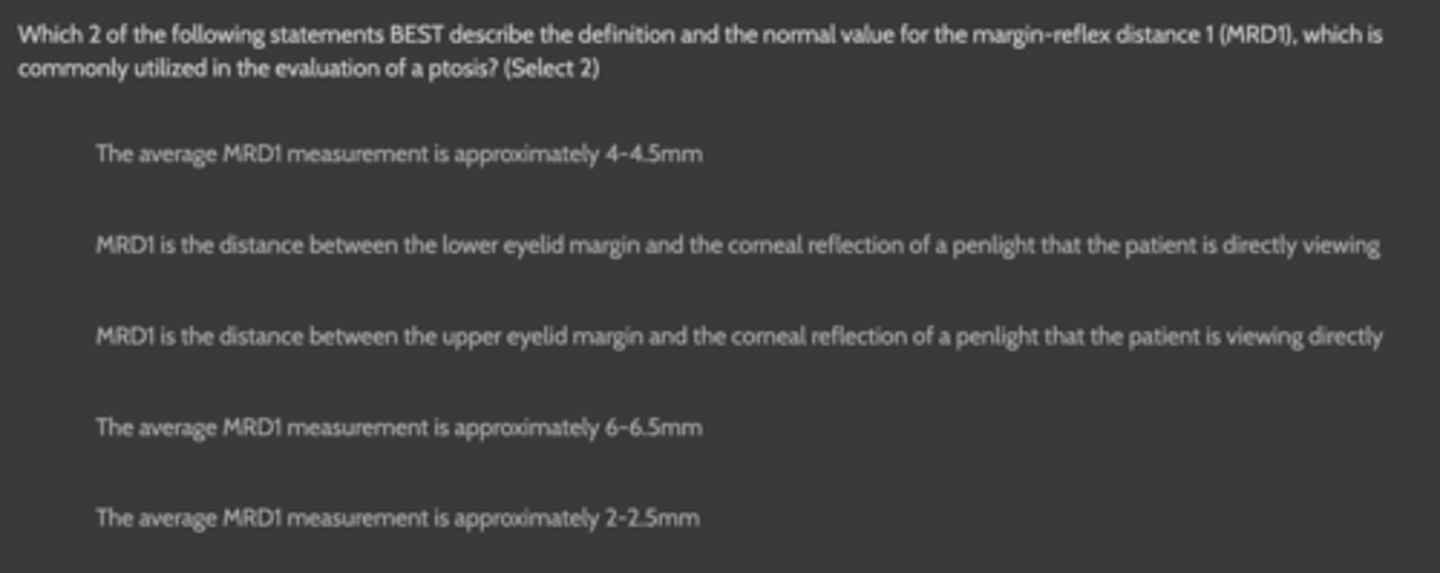
The average MRD1 measurement is approximately 4-4.5mm
MRD1 is the distance between the upper eyelid margin and the corneal reflection of a penlight that the patient is viewing directly
Which specific test can differentiate aqueous tear deficiency from meibomian gland dysfunction (MGD)?
Schirmer I test
Which type of gland accurately describes the meibomian glands?
Sebaceous glands
Which cranial nerves are responsible for opening and closing the eye?
The oculomotor nerve (CN III) opens the eye and the facial nerve (CN VII) closes the eye
An infection of the subcutaneous tissue anterior to the orbital septum is known as which ocular condition?
Preseptal cellulitis
Reflexive blinking is primarily caused by which of the following actions?
Stimulation/Inhibition of Orbicularis/Muller's
&
Stimulation/Inhibition of levator palpebrae superioris
Stimulation of the Orbicularis Muscle and inhibition of the levator palpebrae superioris
Contraction of the orbicularis oculi aids in movement of tears through the lacrimal canaliculi and nasolacrimal drainage system via the action of which section of the muscle?
Muscle of Horner
The fibers of the muscle of Horner come from the lacrimal crest and encircle the lacrimal canaliculi. This assists the flow of tears into the nasolacrimal drainage system when the orbicularis oculi contracts to close the eye.
An eyelid ptosis can be caused by dysfunction or damage to which muscle?
Superior tarsal muscle (muscle of Muller)
Dry eyes can cause blurred vision, stinging, and foreign body sensation. Typically, how do the tears in people with dry eyes compare to those with normal eyes?
Higher pH than normal

Uniformity of color within the lesion
What term describes the abnormal loss of eyelashes?
Madarosis
You are measuring the palpebral fissure height in a patient who reports drooping of his upper eyelid. What BEST describes the normal positioning of the upper and lower eyelids in comparison to the limbus?
The upper lid normally rests about 2mm below the upper limbus, and the lower lid rests about 1mm above the lower limbus
Herpes zoster is a virus that generally affects only one side of the body. A zoster lesion observed on the tip of the nose signals the development of ocular involvement roughly 75% of the time. What is the name of this sign?
Hutchinson sign
Which 3 muscles of the face are responsible for retraction of the eyelids? (Select 3)
Levator palpebrae superioris
Muller's
Frontalis
You are evaluating the function of the levator muscle in a patient with a suspected myogenic ptosis. What is the average upper eyelid excursion measurement in normal patients?
15 mm

Punctae → caniculi → lacrimal sac → nasolacrimal duct → inferior meatus
A common cause of epiphora in infants is due to a small membrane that covers over which ocular structure?
The valve of Hasner
Oral acyclovir is most effective for patients presenting with ocular findings associated with herpes zoster if administered within which time period following the onset of the disease?
72 hours
Dacryocystitis refers to inflammation or infection of which structure of the eye?
Lacrimal sac
A 43-year-old female patient presents to your office concerned about the fact that she constantly seems to have styes on her eyelids and her eyes are continually red and irritated. Biomicroscopy reveals meibomitis and blepharitis, along with lid telangiectasia and a TBUT of 4 seconds for each eye. She also reports that her cheeks, nose, forehead and chin are easily flushed, especially when exposed to heat or cool temperatures. Given the above findings, what is your tentative diagnosis?
Rosacea
Chronic blepharitis, if left untreated, can cause which lid structural changes to the anterior segment of the eye?
Madarosis
Developmental failure of the levator palpebrae superioris
Weakness of which extraocular muscle is MOST commonly associated with a simple congenital eyelid ptosis?
Superior rectus
Which systemic disorder is MOST commonly associated with the presence of yellow, soft, raised, plaque-like lesions that generally occur in the medial canthal region of the eyelid?
Hyperlipidemia
What is the MOST common causative organism of angular blepharitis?
Moraxella Lacunata
Your patient reports constant epiphora of her right eye. You wish to determine if there is a blockage of her tear drainage system, so you decide to perform lacrimal irrigation. During the procedure, the plunger of the cannula is depressed with great difficulty, and the fluid is regurgitated through the puncta that you are irrigating. What is the CORRECT interpretation of these findings?
If there is blockage, is it distal or proximal to the common caniculus
There is a blockage that is proximal to the common caniculus
When evaluating the function of the levator muscle, it is important to negate the action of which facial muscle?
Frontalis
The superior palpebral levator muscle is primarily responsible for retraction of the upper eyelid. Which structure acts as a fulcrum to change the anteroposterior direction of the muscle to superoinferior as it approaches the eyelid?
Superior transverse ligament (Whitnall's ligament)
The lymphatic system serves many important roles in the human body. The lateral portion of the eyelid lymphatics drain into which structures?
The pre-auricular lymph node (PAL)
Your 21-year-old female patient reports that her upper eyelid has been intermittently twitching for the past 2 weeks. She states that these symptoms started as she began studying for her finals. What is the MOST likely diagnosis of this ocular condition?
Eyelid myokymia
Which 2 glands are considered accessory lacrimal glands, producing a small portion of the aqueous component of the tears? (Select 2)
Glands of Krause & Wolfring
Which type of sebaceous glands of the eyelid secretes sebum into the hair follicle coating the shaft of the eyelash?
Glands of Zeis
Which 3 bones make up the floor of the orbit?
Palatine, Maxillary & Zygomatic
Complete fusion or partial fusion of the upper and lower eyelids is referred to as?
Ankyloblepharon
Dacryoadenitis refers to inflammation or infection of which of the following ocular structures?
Lacrimal Gland
The tear film layer in a normal, healthy, young adult measures approximately how thick?
3.0 micrometers
A 22-year-old female patient presents with a unilateral scaly, itchy rash on her right upper eyelid. She has no other associated ocular signs or symptoms. What MOST likely causes her symptoms?
Contact dermatitis
Vitamin A deficiency can lead to a reduction of the number of goblet cells in the conjunctiva. This can subsequently decrease production of which component of the tear film?
Mucous portion of the tear film
Patients with which type of entropion are NOT considered good surgical candidates?
spastic entropion
Your 67-year-old Asian female patient returns to your office for the third time in the past year with a bump in the same location on her left upper eyelid. You had previously diagnosed her with a chalazion; however, due to its recurrent nature, you send her out for a tissue biopsy. Which eyelid lesion are you MOST concerned about?
Sebaceous cell carcinoma
Xerophthalmia is a dry eye condition associated with a deficiency of which vitamins?
Vitamin A
What is the proper term for a congenital absence of the punctal opening/orifice?
Punctal atresia
Meibomian glands are categorized as which type of glands?
Holocrine
 Note
Note  Flashcards (52)