PSY100 Chapter Five
0.0(0)
 Studied by 2 people
 Call Kai
 Learn
Learn Practice Test
 Spaced Repetition
 Match
Match Flashcards
 Knowt Play
Card Sorting
1/136

Earn XP
Description and Tags
Last updated 8:12 PM on 4/14/23
Name | Mastery | Learn | Test | Matching | Spaced | Call with Kai |
|---|
No analytics yet
Send a link to your students to track their progress
137 Terms
1
New cards
What is the simple definition of conciousness?
A sensory awareness of the body, a sense of self, and awareness of one’s environment.
2
New cards
How isn't a fetus having consciousness not a good example of it?
It is suggested that in utero a fetus displays consciousness having the ability to perceive pain, react to touch, smell, and sound, and respond to external stimuli with facial expressions
At birth, the newborn displays consciousness by being awake,
exhibiting sensory awareness, and by processing memorized mental representations. A newborn is also able to differentiate between self and nonself, express emotions, and show signs of shared feelings.
However, while newborn infants display features and characteristics of what may be referred to as basic consciousness, the majority of thalamocortical connections (connections between the cortex and the thalamus) are not yet fully connected and thus do not adequately reflect the higher consciousness that will develop in the coming months and years of life
At birth, the newborn displays consciousness by being awake,
exhibiting sensory awareness, and by processing memorized mental representations. A newborn is also able to differentiate between self and nonself, express emotions, and show signs of shared feelings.
However, while newborn infants display features and characteristics of what may be referred to as basic consciousness, the majority of thalamocortical connections (connections between the cortex and the thalamus) are not yet fully connected and thus do not adequately reflect the higher consciousness that will develop in the coming months and years of life
3
New cards
What is consciousness? Give an example.
Refers to our awareness of our own thoughts, feelings, and sensations. Consciousness is everything you experience. It is the awareness of the music you love to listen to, the taste and flavour of your favourite dessert, the pain you feel when you stub your
toe, the love you experience for your partner or child, and your awareness of the inevitable end of your life and the life of anyone else that could come at any moment
toe, the love you experience for your partner or child, and your awareness of the inevitable end of your life and the life of anyone else that could come at any moment
4
New cards
What is qualia?
The way it feels to experience mental states
5
New cards
Give an example of consciousness using a movie
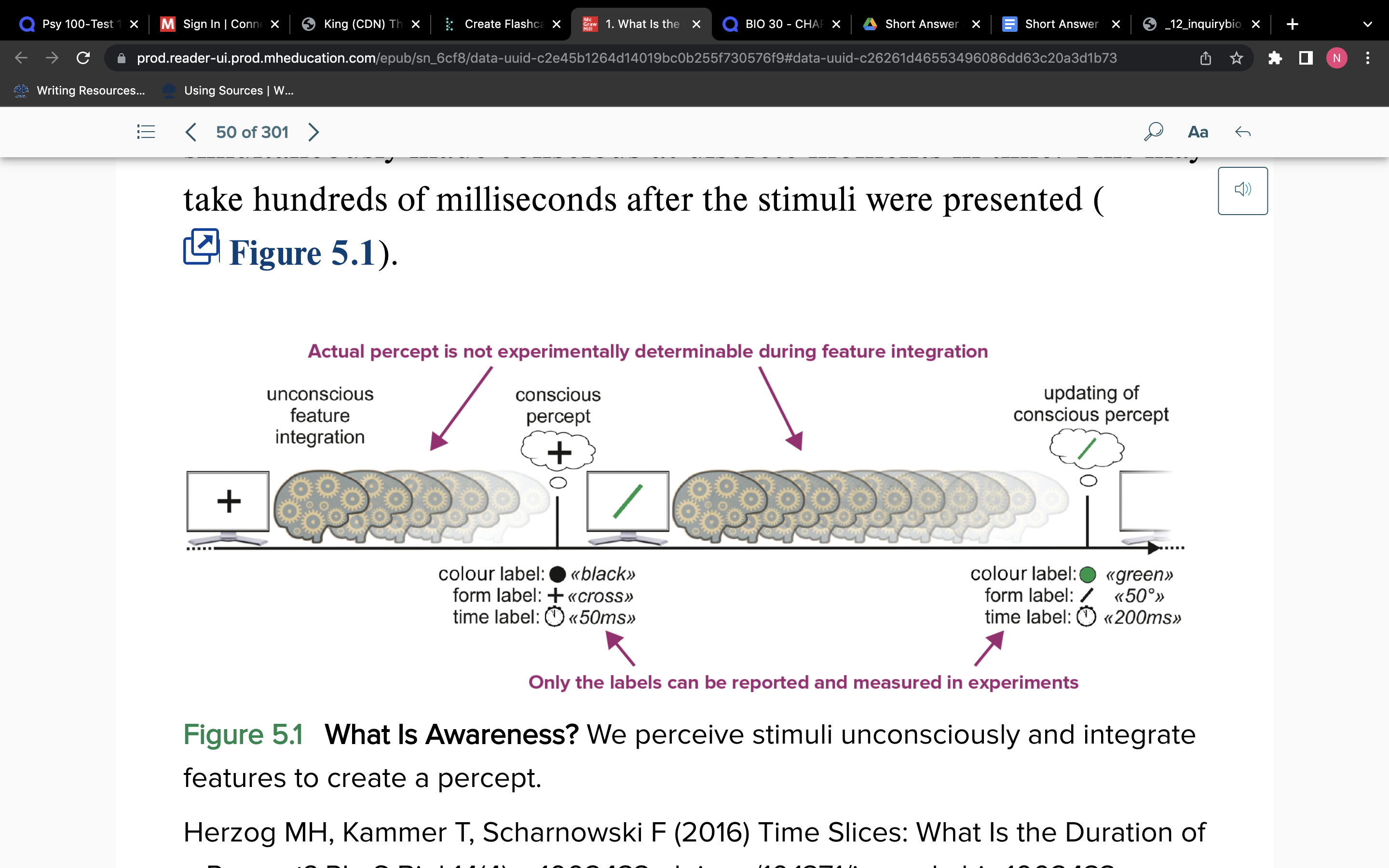
You have multiple parts to consciousness like multiple screenshots of a movie
6
New cards
What is the first and second part of consciousness?
Awareness
- The subjective state of being conscious of what's going on
Arousal
- Being physiologically engaged with your environment
- The subjective state of being conscious of what's going on
Arousal
- Being physiologically engaged with your environment
7
New cards
Instead of being in the prefrontal cortex, where do scientists think consciousness is?
Global brain workspace A variety of brain spaces working together to produce the subjectivity of consciousness
8
New cards
What is arousal determined by?
Reticular activating system
A network of structures including the brain stem, medulla, and thalamus that are involved in the experience of arousal and engagement with the environment.
A network of structures including the brain stem, medulla, and thalamus that are involved in the experience of arousal and engagement with the environment.
9
New cards
While we perceive the world as constant and seamless, our consciousness is actually made up _________
Discrete perceptions, much like a movie appears continuous even though it is made up of separate frames.
Object features (such as colour) and temporal features are unconsciously processed and, when complete, all features are simultaneously made conscious at discrete moments in time. This may take hundreds of milliseconds after the stimuli were presented
Object features (such as colour) and temporal features are unconsciously processed and, when complete, all features are simultaneously made conscious at discrete moments in time. This may take hundreds of milliseconds after the stimuli were presented
10
New cards
What William James say about conciousness?
William James described the mind as a stream of consciousness, a continuous flow of changing sensations, images, thoughts, and feelings
The content of our awareness changes from moment to moment.
Information moves rapidly in and out of consciousness. Our minds can race from one topic to the next—from the person approaching us to our physical state today to the café where we will have lunch to our strategy for the test tomorrow.
The content of our awareness changes from moment to moment.
Information moves rapidly in and out of consciousness. Our minds can race from one topic to the next—from the person approaching us to our physical state today to the café where we will have lunch to our strategy for the test tomorrow.
11
New cards
What does metacognition mean?
Describe the processes by which we think about thinking.
This term includes our awareness of the fringe elements
of the conscious stream. When we read a text, for instance, the difficulty or ease with which we comprehend what is written can influence how we feel about what we have read. When written text is easy to read, we are more likely to think that what we are reading is true and accurate
This term includes our awareness of the fringe elements
of the conscious stream. When we read a text, for instance, the difficulty or ease with which we comprehend what is written can influence how we feel about what we have read. When written text is easy to read, we are more likely to think that what we are reading is true and accurate
12
New cards
What does on the “fringe” of the stream of consciousness mean?
This fringe includes all of the thoughts and feelings that we have about our thoughts. We are aware not only of those things that take centre stage in our mental life, those shiny fish in the stream of
consciousness, but also of all the thoughts and feelings that surround those fish.
consciousness, but also of all the thoughts and feelings that surround those fish.
13
New cards
What does arousal refer to?
Arousal refers to the ways that awareness is regulated:
If we are in danger, we might need to be on “high alert,” but if we are in a safe environment with no immediate demands, we can relax, and our arousal may be quite low.
If we are in danger, we might need to be on “high alert,” but if we are in a safe environment with no immediate demands, we can relax, and our arousal may be quite low.
14
New cards
What is theory of mind?
Refers to individuals’ understanding that they and others think, feel, perceive, and have private experiences
Theory of mind is essential to many valuable social capacities, such as empathy and sympathy
Theory of mind is essential to many valuable social capacities, such as empathy and sympathy
15
New cards
What's the difference between children with autism and children without?
In studies, children and adolescents with autism spectrum disorder show lower activation in areas of the brain that are usually active when typically developing individuals think about social information
16
New cards
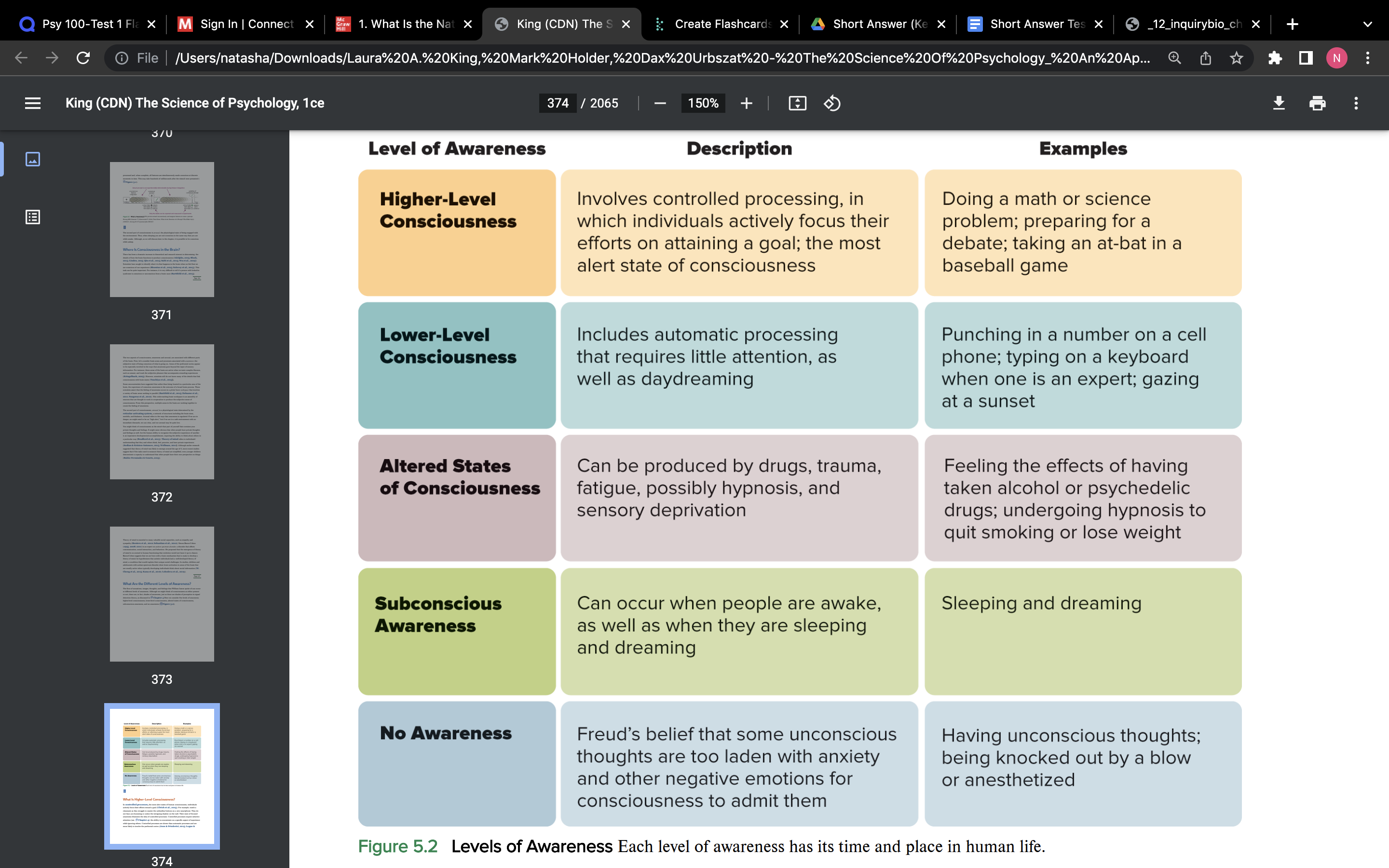
What are the 5 levels of awareness?
Higher-level consciousness
Lower-level consciousness
Altered states of consciousness
Subconscious awareness
No awareness
Lower-level consciousness
Altered states of consciousness
Subconscious awareness
No awareness
17
New cards
What is higher-level consciousness?
In controlled processes, the most alert states of human consciousness, individuals actively focus their efforts toward a goal. For example, watch a classmate as they struggle to master the unfamiliar buttons on a new smartphone. They do not hear you humming or notice the intriguing shadow on the wall. Their state of focused awareness illustrates the idea of controlled processes
18
New cards
What do controlled processes require?
Selective attention: the ability to concentrate on a specific aspect of experience while ignoring others. (Chapter 4)
19
New cards
What is the difference between controlled processes and automatic processes?
Controlled processes are slower than automatic processes and are
more likely to involve the prefrontal cortex Often after we have practiced an activity a great deal, we no longer have to think about it while doing it. It becomes automatic and faster.
more likely to involve the prefrontal cortex Often after we have practiced an activity a great deal, we no longer have to think about it while doing it. It becomes automatic and faster.
20
New cards
What is a key aspected of controlled processes?
Executive function refers to higher-order, complex cognitive processes, including thinking, planning, and problem solving.
These cognitive processes are linked to the functioning of the brain’s prefrontal cortex
These cognitive processes are linked to the functioning of the brain’s prefrontal cortex
21
New cards
What is cognitive control?
The ability to maintain attention by reducing interfering thoughts and being cognitively flexible.
An aspect of executive function, cognitive control, is the person’s capacity to harness consciousness, to focus in on specific thoughts while ignoring others.
An aspect of executive function, cognitive control, is the person’s capacity to harness consciousness, to focus in on specific thoughts while ignoring others.
22
New cards
What Is Lower-Level Consciousness?
Beneath the level of controlled processes are other levels of conscious awareness. Lower levels of awareness include automatic processes and daydreaming.
23
New cards
What are automatic processes? Example.
Automatic processes are states of consciousness that require little attention and do not interfere with other ongoing activities. Automatic processes require less conscious effort than controlled processes.
ex. A few weeks after acquiring their smartphone, your classmate sends a text message while they are in the middle of a conversation with you. They do not have to concentrate on the keys and hardly seem aware of the device as they continue to talk to you while finishing lunch. Using their phone has reached the point of automatic processing
ex. A few weeks after acquiring their smartphone, your classmate sends a text message while they are in the middle of a conversation with you. They do not have to concentrate on the keys and hardly seem aware of the device as they continue to talk to you while finishing lunch. Using their phone has reached the point of automatic processing
24
New cards
Are you still conscious of automatic processes?
Yes.
ex. Your classmate pushed the right buttons, so at some level they apparently were aware of what they were doing. This kind of automatic behaviour suggests that we can be aware of stimuli on some level without paying attention to them. Think of a musician who has played a particular piece of music so often they can perform the actions with little conscious effort or attention, and can think about or concentrate on something entirely different without disturbing their performance. Or consider how much conscious thought you use to ride your bike after years of riding as compared to the amount of attention required when you were first learning how to ride.
ex. Your classmate pushed the right buttons, so at some level they apparently were aware of what they were doing. This kind of automatic behaviour suggests that we can be aware of stimuli on some level without paying attention to them. Think of a musician who has played a particular piece of music so often they can perform the actions with little conscious effort or attention, and can think about or concentrate on something entirely different without disturbing their performance. Or consider how much conscious thought you use to ride your bike after years of riding as compared to the amount of attention required when you were first learning how to ride.
25
New cards
What is daydreaming?
Another state of consciousness that involves a low level of conscious effort is daydreaming, which lies between active consciousness and dreaming while asleep.
It is a little like dreaming while we are awake.
Daydreams usually begin spontaneously when we are doing something that requires less than our full attention.
It is a little like dreaming while we are awake.
Daydreams usually begin spontaneously when we are doing something that requires less than our full attention.
26
New cards
What are the pros and cons of daydreaming?
Daydreams can remind us of important things ahead. Daydreaming keeps our minds active while helping us to cope, create, and fantasize. When our mind wanders, it often wanders to the future.
However, the negative aspects of not having our attention rooted in the present moment can sometimes lead to poor performance and excessive worry.
However, the negative aspects of not having our attention rooted in the present moment can sometimes lead to poor performance and excessive worry.
27
New cards
What Are Altered States of Consciousness?
Altered states of consciousness or awareness are mental states that are noticeably different from normal awareness. Altered states of consciousness can range from losing one’s sense of self consciousness to hallucinating. Such states can be produced by trauma, fever, fatigue, sensory deprivation, meditation, hypnosis, and psychological disorders. Drug use can also induce altered states of consciousness, as we will consider later in this chapter.
28
New cards
What is waking subconscious awareness? What's an example?
When we are awake, processes are going on just below the surface of our awareness
For example, while we are grappling with a problem, the solution may pop into our head. Such insights can occur when a subconscious connection between ideas is so strong that it rises into awareness.
Has it ever happened to you that your friend asks you the name of an actor in a movie you saw together the week before and you’re certain you know the answer, but it just doesn’t come to you? Then, a couple of hours later, when you are doing the dishes or some other mundane activity, the answer occurs to you, essentially revealing itself to your consciousness.
For example, while we are grappling with a problem, the solution may pop into our head. Such insights can occur when a subconscious connection between ideas is so strong that it rises into awareness.
Has it ever happened to you that your friend asks you the name of an actor in a movie you saw together the week before and you’re certain you know the answer, but it just doesn’t come to you? Then, a couple of hours later, when you are doing the dishes or some other mundane activity, the answer occurs to you, essentially revealing itself to your consciousness.
29
New cards
What is incubation?
Incubation refers to the subconscious processing that leads to a solution after a break from conscious thought about the problem. The phenomenon of incubation is interesting because it suggests that even as you have stopped actively thinking about a problem, on some level your brain is still working on finding a solution. Interestingly, successful incubation requires that we first expend effort thinking carefully about the problem
30
New cards
What does incubation suggest?
This suggests that although subconscious processing can ultimately lead to a solution, it first requires that the appropriate information be thoughtfully considered. What we do while we
are incubating can influence the creativity of our problem solving. One study showed that people who took a break and enjoyed humorous videos produced more creative solutions to problems, compared to those who worked continuously or who were shown sad videos instead
are incubating can influence the creativity of our problem solving. One study showed that people who took a break and enjoyed humorous videos produced more creative solutions to problems, compared to those who worked continuously or who were shown sad videos instead
31
New cards
Can subconscious information processing also can occur simultaneously in a distributed manner along many parallel tracks?
Yes.
ex. For example, when you look at a dog running down the street,
you are consciously aware of the event but not of your subconscious processing of the object’s identity (a dog), its colour (black), and its movement (fast).
ex. For example, when you look at a dog running down the street,
you are consciously aware of the event but not of your subconscious processing of the object’s identity (a dog), its colour (black), and its movement (fast).
32
New cards
Can conscious information processing also can occur simultaneously in a distributed manner along many parallel tracks?
No.
Conscious processing occurs in sequence and is typically slower than subconscious processing.
Conscious processing occurs in sequence and is typically slower than subconscious processing.
33
New cards
Can various levels of awareness often work together?
You rely on controlled processing when memorizing material for class, but later the answers on a test just pop into your head as a result of automatic or subconscious processing.
But as many students have experienced, stress, anxiety, fatigue, intoxication, anger, fear, humiliation, or a host of other potential
factors can hinder recall at certain times, such as when you just can’t remember the answer to a question on a test until after you hand in your paper and it comes to you as you are exiting the class.
But as many students have experienced, stress, anxiety, fatigue, intoxication, anger, fear, humiliation, or a host of other potential
factors can hinder recall at certain times, such as when you just can’t remember the answer to a question on a test until after you hand in your paper and it comes to you as you are exiting the class.
34
New cards
Is sleep the absence of conciousness?
No.
When we sleep and dream, our level of awareness is lower than when we daydream. But sleep and dreams are not the absence of consciousness rather, they are low levels of consciousness.
When we sleep and dream, our level of awareness is lower than when we daydream. But sleep and dreams are not the absence of consciousness rather, they are low levels of consciousness.
35
New cards
What is unconscious thought, according to Sigmund Freud?
A reservoir of unacceptable wishes, feelings, and thoughts that are beyond conscious awareness. In other words, Freud’s interpretation viewed the unconscious as a storehouse for vile, animalistic impulses and our deepest, darkest desires. So we shouldn't act on our impulses.
36
New cards
What is sleep?
We can define sleep as a natural state of rest for the body and mind that involves the reversible loss of consciousness.
37
New cards
What are the biological rhythms of sleep?
Periodic physiological fluctuations in the body. We are unaware
of most biological rhythms, such as the rise and fall of hormones and accelerated and decelerated cycles of brain activity, but they can influence our behaviour.
of most biological rhythms, such as the rise and fall of hormones and accelerated and decelerated cycles of brain activity, but they can influence our behaviour.
38
New cards
What are biological rhythms controlled by?
Biological clocks, which include daily, annual, and seasonal cycles, like those involving the migration of birds and the hibernation of bears, as well as 24-hour cycles, like the sleep/wake cycle and temperature changes in the human body.
39
New cards
What are circadian rhythms?
Circadian rhythms are daily behavioural or physiological cycles. Daily circadian rhythms involve the sleep/wake cycle, body temperature, blood pressure, and blood-sugar level
ex. Body temperature fluctuates about 1.7 degrees Celsius during a 24-hour day, peaking in the afternoon and dropping to its lowest point between 2 a.m. and 5 p.m.
ex. Body temperature fluctuates about 1.7 degrees Celsius during a 24-hour day, peaking in the afternoon and dropping to its lowest point between 2 a.m. and 5 p.m.
40
New cards
The body monitors the change of temp from day to night with the _____?
Suprachiasmatic nucleus (SCN):
A small brain structure that uses input from the retina to synchronize its own rhythm with the daily cycle of light and dark
A small brain structure that uses input from the retina to synchronize its own rhythm with the daily cycle of light and dark
41
New cards
What does the SCN do?
The SCN sends information to the hypothalamus and pineal
gland to regulate daily rhythms, such as temperature, hunger, and the release of hormones such as melatonin.
The SCN also communicates with the reticular
formation to regulate daily rhythms of sleep and wakefulness.
The SCN is guided by the information it receives from the retina to tell us it is time to go to sleep. Many individuals who are totally blind experience lifelong sleeping problems because their retinas cannot detect light.
gland to regulate daily rhythms, such as temperature, hunger, and the release of hormones such as melatonin.
The SCN also communicates with the reticular
formation to regulate daily rhythms of sleep and wakefulness.
The SCN is guided by the information it receives from the retina to tell us it is time to go to sleep. Many individuals who are totally blind experience lifelong sleeping problems because their retinas cannot detect light.
42
New cards
Is the SCN the only biological clock for regulating circadian rhythms?
No.
A number of biological clocks seem to be involved in regulating circadian rhythms, but the SCN is critical.
A number of biological clocks seem to be involved in regulating circadian rhythms, but the SCN is critical.
43
New cards
How do you desynchronize a biological clock?
If you fly from Vancouver to Toronto and then go to bed at 11 p.m. Eastern time, you may have trouble falling asleep because your body is still on West Coast time.
Even if you sleep for 8 hours that night, you may have a hard time waking up at 7 a.m. Eastern time, because your body thinks it is 4 a.m. If you stay in Toronto for several days, your body will adjust to this new schedule. The jet lag you experience when you fly from Vancouver to Toronto occurs because your body time is out of phase, or synchronization, with clock time
Even if you sleep for 8 hours that night, you may have a hard time waking up at 7 a.m. Eastern time, because your body thinks it is 4 a.m. If you stay in Toronto for several days, your body will adjust to this new schedule. The jet lag you experience when you fly from Vancouver to Toronto occurs because your body time is out of phase, or synchronization, with clock time
44
New cards
How does jetlag scientifically work?
The jet lag you experience when you fly from Vancouver to Toronto occurs because your body time is out of phase, or synchronization, with clock time.
Jet lag is the result of two or more body rhythms being out of
sync. You usually go to bed when your body temperature begins to drop, but in your new location, you might be trying to go to sleep when it is rising. In the morning, your adrenal glands release large doses of the hormone cortisol to help you wake up. In your new
geographic time zone, the glands may be releasing this chemical just as you are getting ready for bed at night.
Jet lag is the result of two or more body rhythms being out of
sync. You usually go to bed when your body temperature begins to drop, but in your new location, you might be trying to go to sleep when it is rising. In the morning, your adrenal glands release large doses of the hormone cortisol to help you wake up. In your new
geographic time zone, the glands may be releasing this chemical just as you are getting ready for bed at night.
45
New cards
How do circadian rhythms get desynchronized?
Circadian rhythms may also become desynchronized when shift workers change their work hours.
A number of near accidents in air travel have been associated with pilots who have not yet become synchronized to their new shifts and are not working as efficiently as usual.
Shift-work problems most often affect night-shift workers who
never fully adjust to sleeping in the daytime after they get off work. Not only might these individuals struggle to stay awake at work, but they may face a heightened risk of illness, gastrointestinal disorders, obesity, impaired immune system functioning, and greater
vulnerability to addiction.
A number of near accidents in air travel have been associated with pilots who have not yet become synchronized to their new shifts and are not working as efficiently as usual.
Shift-work problems most often affect night-shift workers who
never fully adjust to sleeping in the daytime after they get off work. Not only might these individuals struggle to stay awake at work, but they may face a heightened risk of illness, gastrointestinal disorders, obesity, impaired immune system functioning, and greater
vulnerability to addiction.
46
New cards
How do we reset the biological clock?
With regard to jet lag, if you take a transoceanic flight and arrive at your destination during the day, it is a good idea to spend as much time as possible outside in the daylight.
Bright light during the day, especially in the morning, increases wakefulness, whereas bright light at night delays sleep. In a few days, jet lag typically resolves.
Another common treatment for jet lag is taking melatonin supplements. Melatonin, a hormone that increases at night in humans, can help reduce jet lag by advancing the circadian clock.
Bright light during the day, especially in the morning, increases wakefulness, whereas bright light at night delays sleep. In a few days, jet lag typically resolves.
Another common treatment for jet lag is taking melatonin supplements. Melatonin, a hormone that increases at night in humans, can help reduce jet lag by advancing the circadian clock.
47
New cards
What is the first possibility why we might need sleep from an evolutionary point of you?
First, from an evolutionary perspective, sleep may have developed because animals needed to protect themselves at
night. The idea is that it makes sense for animals to be inactive when it is dark, because nocturnal inactivity helps them to avoid both becoming other animals’ prey and injuring themselves due to poor visibility.
In most contemporary human cultures, people who are home asleep before midnight each night are less likely to be victims of violent crime than those who are out from the hours of midnight to 3 a.m.
night. The idea is that it makes sense for animals to be inactive when it is dark, because nocturnal inactivity helps them to avoid both becoming other animals’ prey and injuring themselves due to poor visibility.
In most contemporary human cultures, people who are home asleep before midnight each night are less likely to be victims of violent crime than those who are out from the hours of midnight to 3 a.m.
48
New cards
What is another possibility of why we might need sleep?
A second possibility is that sleep allows us to conserve energy.
Spending a large chunk of any day sleeping allows animals to conserve their calories, especially when food is scarce. For some animals, moreover, the search for food and water is easier and safer when the sun is up. When it is dark, it is adaptive for these animals to save their energy. Animals that are likely to serve as someone else’s food sleep the least of all.
Spending a large chunk of any day sleeping allows animals to conserve their calories, especially when food is scarce. For some animals, moreover, the search for food and water is easier and safer when the sun is up. When it is dark, it is adaptive for these animals to save their energy. Animals that are likely to serve as someone else’s food sleep the least of all.
49
New cards
What is the third explanation of why we might need sleep?
A third explanation for the need for sleep is that sleep is restorative. Scientists have proposed that sleep restores, replenishes, and
rebuilds the brain and body, which the day’s waking activities can wear out. This idea fits with the feeling of being tired before we go to sleep and restored when we wake up.
rebuilds the brain and body, which the day’s waking activities can wear out. This idea fits with the feeling of being tired before we go to sleep and restored when we wake up.
50
New cards
Explain why sleep is restorative.
In support of the theory of a restorative function of sleep, many of the body’s cells show increased production and reduced breakdown of proteins during deep sleep. Protein molecules are the building blocks needed for cell growth and for repair of damage from factors such as stress. Sleep deprivation can affect the body much like stress itself. Sleep deprivation may negatively impact both physical and cognitive performance.
Ex. think about your exhaustion and desire to sleep after an intense tennis match or after finals week.
Ex. think about your exhaustion and desire to sleep after an intense tennis match or after finals week.
51
New cards
What is another explanation of why we need sleep?
Another explanation for the need for sleep centres on the role of sleep in brain plasticity. Recall from Chapter 3 that the plasticity of the brain refers to its capacity to change in response to experience.
52
New cards
Does sleep play an important role in the ways that experiences influence the brain, especially in how sleep affects synaptic connections?
Yes.
If sleep affects connections in the brain, we might expect it to play a role in consolidating memories, and research supports that conclusion. During sleep, memories are pulled together, resulting in the retention of specific information, skills, learned associations, and emotional experiences
If sleep affects connections in the brain, we might expect it to play a role in consolidating memories, and research supports that conclusion. During sleep, memories are pulled together, resulting in the retention of specific information, skills, learned associations, and emotional experiences
53
New cards
Why does sleep improve memory?
One possible explanation is that during sleep the cerebral cortex is free to conduct activities that strengthen memory associations, so that memories formed during recent waking hours can be integrated into long-term memory storage. Lost sleep often results in lost memories.
If you are thinking about studying all night for your
next test, you might want to think again. Sleep can enhance your memory.
If you are thinking about studying all night for your
next test, you might want to think again. Sleep can enhance your memory.
54
New cards
What is a final explanation on why we need sleep?
A final explanation for the need for sleep is that this is when dreaming takes place and, as we will discuss shortly, dreaming may have evolved to increase our chances of survival by allowing us to rehearse strategies to deal with life-threatening situations.
55
New cards
What are the effects of chronic sleep deprivation?
Lack of sleep is stressful and has an impact on the brain, as well as on the rest of the body. The sleep-deprived brain cannot operate at the same level of complexity as the well-rested
brain. Sleep deprivation decreases brain activity in the thalamus and the prefrontal cortex. The thalamus is crucial to receiving and responding to sensory information, and the prefrontal cortex is the brain area associated with thinking and planning. The tired brain must compensate by using different pathways or alternative neural networks when thinking.
brain. Sleep deprivation decreases brain activity in the thalamus and the prefrontal cortex. The thalamus is crucial to receiving and responding to sensory information, and the prefrontal cortex is the brain area associated with thinking and planning. The tired brain must compensate by using different pathways or alternative neural networks when thinking.
56
New cards
What is fatal familial insomnia (FFI)?
This disorder, caused by a genetic mutation, involves a
progressive inability to sleep. Over time, the person sleeps less and
less, becomes agitated, engages in strange motor movements, and is confused. The individual may hallucinate and enact dreams.
progressive inability to sleep. Over time, the person sleeps less and
less, becomes agitated, engages in strange motor movements, and is confused. The individual may hallucinate and enact dreams.
57
New cards
What brain part takes enormous damage?
Thalamus
58
New cards
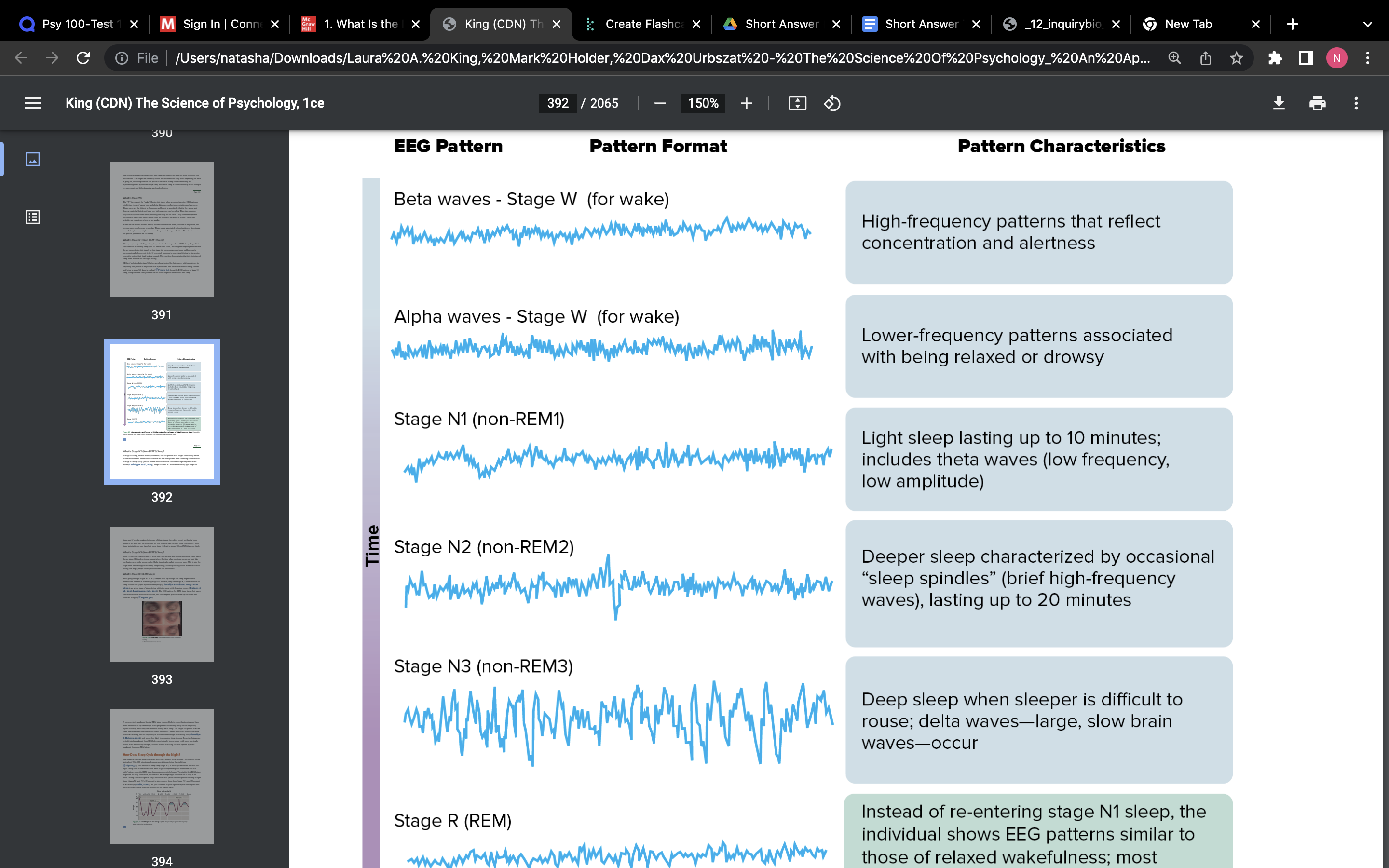
What are the stages of sleep?
- Stage W
- Stage N1 (Non-REM1)
- Stage N2 (Non-REM2)
- Stage N3 (Non-REM3)
- Stage R (REM) Sleep?
- Stage N1 (Non-REM1)
- Stage N2 (Non-REM2)
- Stage N3 (Non-REM3)
- Stage R (REM) Sleep?
59
New cards
What is stage W?
The “W” here stands for “wake.” During this stage, when a person is awake, EEG patterns exhibit two types of waves: beta and alpha.
60
New cards
What are beta waves?
Beta waves reflect concentration and alertness.
These waves are the highest in frequency and lowest in amplitude—that is, they go up and down a great deal but do not have very high peaks or very low ebbs. They also are more desynchronous than other waves, meaning that they do not form a very consistent pattern. Inconsistent patterning makes sense given the extensive variation in sensory input and activities we experience when we are awake.
These waves are the highest in frequency and lowest in amplitude—that is, they go up and down a great deal but do not have very high peaks or very low ebbs. They also are more desynchronous than other waves, meaning that they do not form a very consistent pattern. Inconsistent patterning makes sense given the extensive variation in sensory input and activities we experience when we are awake.
61
New cards
What are alpha waves?
When we are relaxed but still awake, our brain waves slow down, increase in amplitude, and become more synchronous, or regular. These waves, associated with relaxation or drowsiness, are called alpha waves. Alpha waves are also present during meditation. These brain waves are present just before we fall asleep.
62
New cards
What is Stage N1 (Non-REM1) sleep? Do they experience movement?
When people are just falling asleep, they enter the first stage of non-REM sleep. Stage N1 is characterized by drowsy sleep (the “N” refers to to “non,” meaning that rapid eye movements do not occur during this stage).
In this stage, the person may experience sudden muscle movements called myoclonic jerks
In this stage, the person may experience sudden muscle movements called myoclonic jerks
63
New cards
What are myoclonic jerks?
If you watch someone in your class fighting to stay awake,
you might notice their head jerking upward. This reaction demonstrates that this first stage of sleep often involves the feeling of falling.
you might notice their head jerking upward. This reaction demonstrates that this first stage of sleep often involves the feeling of falling.
64
New cards
What waves happen in stage N1?
Theta waves, which are slower in frequency and greater in amplitude than alpha waves.
The difference between being relaxed and being in stage N1 sleep is gradual.
The difference between being relaxed and being in stage N1 sleep is gradual.
65
New cards
What is stage N2 (Non-REM2) sleep? What happens? What waves do they have?
In stage N2 sleep, muscle activity decreases, and the person is no longer consciously aware of the environment. Theta waves continue but are interspersed with a defining characteristic of stage N2 sleep: sleep spindles.
66
New cards
What are sleep spindles?
These involve a sudden increase in high-frequency wave
bursts.
bursts.
67
New cards
Do most people know they are in N1 or N2 stage of sleep?
No.
Despite that you may think you had very little sleep last night, you may have had more sleep (at least in stages N1 and N2) than you think.
Despite that you may think you had very little sleep last night, you may have had more sleep (at least in stages N1 and N2) than you think.
68
New cards
What is stage N3 (Non-REM3) sleep? What waves do they have?
Delta waves, the slowest and highest-amplitude brain waves during sleep.
69
New cards
What is delta sleep?
Delta sleep is our deepest sleep, the time when our brain waves are least like our brain waves while we are awake. This is also the stage when bedwetting (in children), sleepwalking, and sleep talking occur. When awakened during this stage, people usually are confused and disoriented.
70
New cards
What is another name for delta sleep?
Delta sleep is also called slow-wave sleep.
71
New cards
What is R (REM) stage sleep?
N1 to N3 go in cycles until they enter stage R, a different form of
sleep called REM (rapid eye movement) sleep.
REM sleep is an active stage of sleep during which the most vivid dreaming occurs. The EEG pattern for REM sleep shows fast waves
similar to those of relaxed wakefulness, and the sleeper’s eyeballs move up and down and from left to right
sleep called REM (rapid eye movement) sleep.
REM sleep is an active stage of sleep during which the most vivid dreaming occurs. The EEG pattern for REM sleep shows fast waves
similar to those of relaxed wakefulness, and the sleeper’s eyeballs move up and down and from left to right
72
New cards
What stage do you sleep the most in?
REM sleep
The longer the period of REM sleep, the more likely the person will report dreaming. Dreams also occur during slow-wave or non-REM sleep, but the frequency of dreams in these stages is relatively low, and we are less likely to remember these dreams.
The longer the period of REM sleep, the more likely the person will report dreaming. Dreams also occur during slow-wave or non-REM sleep, but the frequency of dreams in these stages is relatively low, and we are less likely to remember these dreams.
73
New cards
How does sleep cycle through the night?
The stages of sleep we have considered make up a normal cycle of sleep. One of these cycles lasts about 90 to 100 minutes and recurs several times during the night. The amount of deep sleep (stage N3) is much greater in the first half of a night’s sleep than in the second half. Most stage R sleep takes place toward the end of a night’s sleep, when the REM stage becomes progressively longer.
The night’s first REM stage might last for only 10 minutes, but the final REM stage might continue for as long as an hour. During a normal night of sleep, individuals will spend about 60 percent of sleep in light sleep (stages N1 and N2), 20 percent in slow-wave or deep sleep (stage N3), and 20 percent in REM sleep. So, you can think of your night’s sleep as starting out with deep sleep and ending with the big show of the night’s REM.
The night’s first REM stage might last for only 10 minutes, but the final REM stage might continue for as long as an hour. During a normal night of sleep, individuals will spend about 60 percent of sleep in light sleep (stages N1 and N2), 20 percent in slow-wave or deep sleep (stage N3), and 20 percent in REM sleep. So, you can think of your night’s sleep as starting out with deep sleep and ending with the big show of the night’s REM.
74
New cards
Where are the sleep stages associated with distinct patterns of neurotransmitter activity? What does it do and what does damage to it cause?
Reticular formation, the core of the brain stem
- It is for arousal and sleep
- Death or coma
- It is for arousal and sleep
- Death or coma
75
New cards
What are the three important neurotransmitters in sleep?
Serotonin, norepinephrine, and acetylcholine
76
New cards
Explain the neurotransmitter sequence in the brain when sleeping.
As sleep begins, the levels of neurotransmitters sent to the forebrain from the reticular formation start dropping, and they continue to fall until they reach their lowest levels during the deepest sleep stage—stage N3. REM sleep (stage R) is initiated by a rise in acetylcholine, which activates the cerebral cortex while the rest of the brain remains relatively inactive.
Recall that acetylcholine is the neurotransmitter that typically gets our bodies moving. REM sleep ends when there is a rise in serotonin and norepinephrine, which increase the level of forebrain activity nearly to the awakened state.
Without an alarm or other disturbances, you are most likely to wake up just after an REM period. If you do not wake up then, the level of the neurotransmitters falls again, and you enter another sleep cycle.
Recall that acetylcholine is the neurotransmitter that typically gets our bodies moving. REM sleep ends when there is a rise in serotonin and norepinephrine, which increase the level of forebrain activity nearly to the awakened state.
Without an alarm or other disturbances, you are most likely to wake up just after an REM period. If you do not wake up then, the level of the neurotransmitters falls again, and you enter another sleep cycle.
77
New cards
Who has a higher W stage?
Adults
Rather, adolescents’ biological clocks undergo a shift as they get older, delaying their period of wakefulness by about an hour. A delay in the nightly release of the sleep-inducing hormone melatonin seems to underlie this shift. Melatonin is secreted at about 9:30
p.m. in younger adolescents and approximately an hour later in older adolescents
Rather, adolescents’ biological clocks undergo a shift as they get older, delaying their period of wakefulness by about an hour. A delay in the nightly release of the sleep-inducing hormone melatonin seems to underlie this shift. Melatonin is secreted at about 9:30
p.m. in younger adolescents and approximately an hour later in older adolescents
78
New cards
What is social jet lag?
Social jet lag means that even without travelling, a person’s sleep clock can be desynchronized. Social jet lag is associated with poorer academic performance for adolescents
79
New cards
What about sleep patterns with age?
When you are 40-60 you sleep earlier, when you are in uni you sleep later than highschool
80
New cards
How is lack of sleep linked to disease?
Neurons that control sleep interact closely with the immune system. As anyone who has had the flu knows, infectious diseases make us
sleepy.
sleepy.
81
New cards
Why do infectious diseases make us sleepy?
The probable reason is that chemicals called cytokines, produced by the body’s cells while we are fighting an infection, are powerfully sleep-inducing. Sleep may help the body conserve energy and other resources it needs to overcome infection Essentially, lack of sleep is stressful and affects the body just as stressful experiences do
82
New cards
How do sleep disorder affect people with mental illness?
Sleep problems afflict most people who have psychological disorders, including those with depression.
Individuals with depression often awaken in the early hours of the morning and cannot get back to sleep, and they typically spend less time in delta-wave or deep sleep than do individuals who are not depressed.
Individuals with depression often awaken in the early hours of the morning and cannot get back to sleep, and they typically spend less time in delta-wave or deep sleep than do individuals who are not depressed.
83
New cards
What are the major sleep disorders?
The major sleep disorders include insomnia, sleepwalking and sleep talking, nightmares and night terrors, narcolepsy, and sleep apnea.
84
New cards
What is insomnia?
Insomnia can involve a problem falling asleep, waking up during the night, or waking up too early
85
New cards
Who is insomnia more common in?
Insomnia is more common among women, older adults, and those with diabetes.
86
New cards
How to treat insomnia?
For short-term insomnia, most physicians prescribe sleeping pills. However, most sleeping pills stop working after several weeks of being taken nightly, and their long-term use can interfere with good sleep.
Mild insomnia often can be reduced by simply practising good sleep habits, such as always going to bed at the same time, even on weekends, and sleeping in a dark, quiet place.
In more serious cases, researchers are experimenting with light therapy, melatonin supplements, and other ways to alter circadian cycles.
Behavioural changes (such as avoiding naps and caffeine and setting an alarm in the morning) can help insomniacs increase their sleep time and awaken less frequently in the night. Other good sleep hygiene includes not eating, drinking alcohol, smoking, or exercising
within 2 hours before going to bed. However, keep in mind that exercise during the day can improve sleep for those who experience insomnia
Mild insomnia often can be reduced by simply practising good sleep habits, such as always going to bed at the same time, even on weekends, and sleeping in a dark, quiet place.
In more serious cases, researchers are experimenting with light therapy, melatonin supplements, and other ways to alter circadian cycles.
Behavioural changes (such as avoiding naps and caffeine and setting an alarm in the morning) can help insomniacs increase their sleep time and awaken less frequently in the night. Other good sleep hygiene includes not eating, drinking alcohol, smoking, or exercising
within 2 hours before going to bed. However, keep in mind that exercise during the day can improve sleep for those who experience insomnia
87
New cards
What is somnambulism?
The formal term for sleepwalking, which occurs during the deepest stages of sleep. For many years, experts believed that somnambulists were acting out their dreams. However, somnambulism takes place during stages N2 and N3, usually early in the night, when a person is unlikely to be dreaming
88
New cards
Who is more likely to sleepwalk?
When individuals are sleep deprived or when they have been drinking alcohol.
89
New cards
What is sleep talking?
Somniloquy.
If you interrogate sleep talkers, can you find out what they did, for instance, last Thursday night? Probably not.
Although sleep talkers will converse with you and make fairly coherent statements, they are soundly asleep. Thus, even if a sleep talker mumbles a response to your question, do not count on its accuracy.
If you interrogate sleep talkers, can you find out what they did, for instance, last Thursday night? Probably not.
Although sleep talkers will converse with you and make fairly coherent statements, they are soundly asleep. Thus, even if a sleep talker mumbles a response to your question, do not count on its accuracy.
90
New cards
What is nightmare?
A nightmare is a frightening dream that awakens a dreamer from REM sleep.
* The nightmare’s content invariably involves danger—the dreamer is chased, robbed, or thrown off a cliff.
\
Nightmares are common; most of us have had them, especially as young children. Reported frequency of nightmares or worsening nightmares are often associated with an increase in life stressors such as the loss of a job, the death of a loved one, or conflicts with others.
* The nightmare’s content invariably involves danger—the dreamer is chased, robbed, or thrown off a cliff.
\
Nightmares are common; most of us have had them, especially as young children. Reported frequency of nightmares or worsening nightmares are often associated with an increase in life stressors such as the loss of a job, the death of a loved one, or conflicts with others.
91
New cards
What are night terrors?
Night terrors are sudden arousal from sleep and intense fear.
Night terrors are accompanied by a number of physiological reactions, such as rapid heart rate and breathing, loud screams, heavy perspiration, and movement.
Night terrors, which peak at 5 to 7 years of age, are less common than nightmares, and unlike nightmares, they occur during slow-wave stage N3 (non-REM) sleep.
One indication of whether you have experienced a night terror or a nightmare is your recollection of the event. Details of nightmares, but not night terrors, are often recalled after waking up.
Night terrors are accompanied by a number of physiological reactions, such as rapid heart rate and breathing, loud screams, heavy perspiration, and movement.
Night terrors, which peak at 5 to 7 years of age, are less common than nightmares, and unlike nightmares, they occur during slow-wave stage N3 (non-REM) sleep.
One indication of whether you have experienced a night terror or a nightmare is your recollection of the event. Details of nightmares, but not night terrors, are often recalled after waking up.
92
New cards
What is nacrolepsy?
The disorder narcolepsy involves the sudden, overpowering urge to sleep. This urge is so uncontrollable that the person may fall asleep while talking or standing up.
Narcoleptics immediately enter REM sleep rather than progressing through the first four sleep stages.
Individuals with narcolepsy are often very tired during the day. Narcolepsy can be triggered by extreme emotional reactions, such as surprise, laughter, excitement, or anger. The disorder appears to involve problems with particular neurons in the hypothalamus and may have an autoimmune component. The impact of narcolepsy can range from social awkwardness to danger as people with narcolepsy experience their sleep attacks during sex or scuba diving.
MOST DANGEROUS
Narcoleptics immediately enter REM sleep rather than progressing through the first four sleep stages.
Individuals with narcolepsy are often very tired during the day. Narcolepsy can be triggered by extreme emotional reactions, such as surprise, laughter, excitement, or anger. The disorder appears to involve problems with particular neurons in the hypothalamus and may have an autoimmune component. The impact of narcolepsy can range from social awkwardness to danger as people with narcolepsy experience their sleep attacks during sex or scuba diving.
MOST DANGEROUS
93
New cards
What is sleep apnea?
Sleep apnea is a sleep disorder in which individuals stop breathing because the windpipe fails to open or because brain processes involved in respiration fail to work properly. People with sleep apnea experience numerous brief awakenings during the night so that they can breathe better, although they usually are not aware of their awakened state. During the day, these people may feel sleepy because they were deprived of sleep at night. A common sign of sleep apnea is loud snoring, punctuated by silence (the apnea).
94
New cards
What is SIDS and why is it the leading common?
Sleep apnea may also be a factor in sudden infant death syndrome (SIDS), the unexpected sleep-related death of an infant less than 1 year old. SIDS is typically confirmed with an autopsy that reveals no specific cause of death. It is common for infants to have short pauses in their breathing during sleep, but for some infants frequent sleep apnea may be a sign of problems in regulating arousal
95
New cards
What did Freud say about dreams?
Sigmund Freud put great stock in dreams as a key to our unconscious minds. He believed that dreams (even nightmares) symbolize unconscious wishes and that analyses of dream symbols could uncover our hidden desires. Freud distinguished between a dream’s manifest content and its latent content.
96
New cards
What is manifest content?
The dream’s surface content, which contains dream symbols that disguise the dream’s true meaning;
97
New cards
What is latent content?
The dream’s hidden content, its unconscious—and true—meaning.
For example, if a person had a dream about riding on a train and talking with a friend, the train ride would be the dream’s manifest content. The manifest content is simply the dream itself. The latent content is the dream’s deeper true meaning.
For example, if a person had a dream about riding on a train and talking with a friend, the train ride would be the dream’s manifest content. The manifest content is simply the dream itself. The latent content is the dream’s deeper true meaning.
98
New cards
How do manifest and latent content play into each other?
Freud thought that this manifest content expresses a wish in disguised form. To get to the latent or true meaning of the dream, the person would have to analyze the dream images. In our example, the dreamer would be asked to think of all the things that come to mind when the person thinks of a train, the friend, and so forth. By following these associations to the objects in the manifest content, the latent content of the dream could be brought to light. For
example, if in your dream where you are riding a train and talking to your friend the train went through a tunnel, Freud might suggest that the train represents the phallus and the tunnel the vagina and that the dream’s latent meaning is that you wish to have sexual relations with the friend you were talking to on the train.
example, if in your dream where you are riding a train and talking to your friend the train went through a tunnel, Freud might suggest that the train represents the phallus and the tunnel the vagina and that the dream’s latent meaning is that you wish to have sexual relations with the friend you were talking to on the train.
99
New cards
Why do many of us believe that our dreams are very peculiar?
The probable reason is that we are likely to remember our most vividly bizarre dreams and to forget those dreams that are more mundane. Memory is tied to emotional intensity; we tend to remember the things that generate the most intense emotional experiences. Thus, we are more likely to remember nightmares that evoke great fear, or flying dreams that evoke great joy. Dreams of common events are not well remembered compared to dreams that are about unusual events or occurrences. Thus, we never realize how commonplace most dreams are. Although some aspects of dreams are unusual, dreams often are no more bizarre than a typical fairy tale, TV show episode, or movie plot. However, dreams do generally contain more negative emotion than everyday life; and certainly some unlikely characters, including dead people, sometimes show up in dreams.
100
New cards
What is the cognitive theory of dreaming?
Proposes that we can understand dreaming by applying the same cognitive concepts we use in studying the waking mind. The theory states that dreams are essentially subconscious cognitive processing, arguing that there is continuity between waking thought and dreams.
Dreaming involves information processing and memory. Indeed, thinking during dreams appears to be very similar to thinking in waking life.
Dreaming involves information processing and memory. Indeed, thinking during dreams appears to be very similar to thinking in waking life.
 Note
Note  Flashcards (25)