Forest Succession
 Call Kai
 Learn
Learn Practice Test
 Spaced Repetition
 Match
Match Flashcards
 Knowt Play
1/80

There's no tags or description
Looks like no tags are added yet.
Name | Mastery | Learn | Test | Matching | Spaced | Call with Kai |
|---|
No analytics yet
Send a link to your students to track their progress
81 Terms
What is ecological forestry
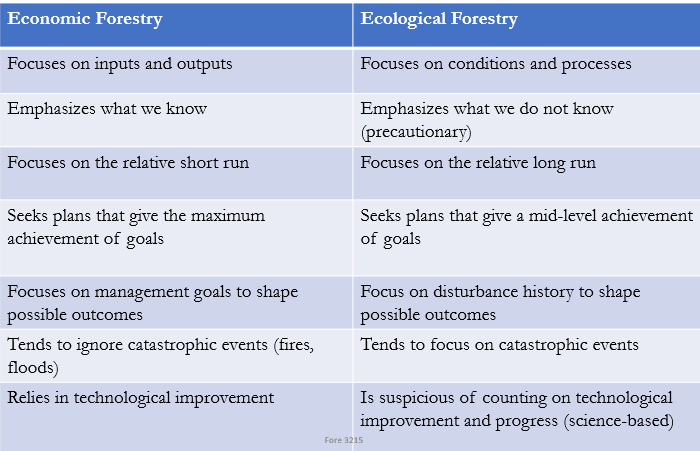
Analyzes forest resources from the standpoint of conserving native biodiversity and ecological productivity, it follows natural disturbance patterns and processes as a guide
Emulating disturbance process and their effects
Define Disturbance
Any relative discrete event in time the disrupts ecosystem, community, or population structure through changes in the physical environment (niches)
Examples of ecological forestry
Selecting silvicultural systems: even aged stands vs uneven
Selecting rotation age and desire age class
Selecting the spatial pattern of harvests
Natural Range of Variability is used to
distinguish disturbance patterns and their effects
Its an ecological guide
Selecting a time frame for estimating NRV is difficult and often limited by information and past landscape patterns
How to measure ecological forestry (5) and definitions
1. Indicator Species - status of a functional group of species, key habitat, and early warning of anticipated stressors to ecological integrity
Indicator Keystone Species - Effects on other ecological processes greater than predicted (woodpecker creating cavity habitat)
Ecological Engineer - Species alter habitat, modify availability of energy that affect others (beavers, dams)
Umbrella Species - Large land requirements and multiple habitats, needs overlap other species (ex. deer)
Link Species - Play critical roles in the transfer of matter and energy across trophic levels OR provide critical link to energy transfer in complex food webs (ex. prairie dogs in grasslands)
What is Economic Forestry
Analyze forest resources from the standpoint of maximizing their net benefit to humans
Macroeconomics - employment and income as a measure of benefit
Net present value as the main factor in decision making
Estimating the cost of alternative measures to promote biodiversity
Economic VS Ecologic Forestry
What is Social Forestry
Analyze forest resources from the standpoint of sustaining the well being of people, communities, and society
What is adaptive management?
Addresses the uncertainties of sustainability: test the well designed alternatives to find “best” solutions
What is the biggest disturbance to forests in Canada
Insects
What is forest succession?
It a concept including
Disturbance and intrinsic factors
Forest dynamics
Regeneration / replacement
Functionality or desired state (ecological / economic)
In terms of long term analysis and planning, society recognizes… (3)
Having future forests for economic and ecological reasons is a goal
Today’s harvest and management affects forest outputs in the distant future
Long term analysis and planning is the main approach to quantitatively demonstrate how this relationship will shape future forests
Ethical practices for forest planners (4)
Distinguish between policy making and analysis to clearly separate and identify the facts and values
Document your work and recognize the accuracy and confidence of data and methods of analysis
Persistently try to ensure that decision makers are affected constituencies know all significant consequences of their choices
Pay special attention to actions and policies that are likely to permanently damage the productive capacity of soil and water resources
What is Forest Management (broad definition)
The application of a wide range of scientific, economic, and social principles to administer forest areas under best approaches that includes “succession theory”
Define Regulation
How to change or convert the existing forest over time into the target or desired forest
Define Scheduling
Conveys output schedules, cash revenues, other benefits, workloads, and costs
What is Revisiting Succession?
The changes in an ecological community following a disturbance
Impact in biomass, productivity, diversity, niche breadth, habitat
Narrowly defined: The change in species composition and canopy layer
What are pioneers in succession, what do they do?
Pioneers occupy the newly created space, available resources
Over time they create a new environment for late successional species
As pioneers die, the late successional species dominate and form an equilibrium between biotic and environment (climax)
What are the challenges to determine succession mechanisms?
Succession is an incredibly long process
Repeated measurements are needed to identify the mechanisms
There may be minor, non stand replacing disturbances such as grazing animals, insect pathogens, wind and ice
Species interaction, colonization potential
What are the known mechanisms for succession?
Facilitation to create favorable environment (light, temp, moisture, shelter)
Competition for resources
What are the 3 succession models and definitions?
Facilitation (Model 1) - Assumes only certain “early successional” species are able to colonize the site immediately after a disturbance
Tolerance (Model 2) - Successive species are more shade tolerant than the ones in the canopy
Inhibition (Model 3) - Once earlier colonists secure the space and/or other resources, they inhibit the invasion of subsequent colonists or suppress the growth of those already present
(last two assume arriving species may be able to colonize)
Factors with Facilitation (+)
Disturbance
Open space, resources released (some)
Early occupants modify environment to make it LESS suitable for early species to colonize, and MORE suitable for late succession species
Growth of late succession species, eventually excludes early succession species
Continues until resident species no longer facilitates invasion of new species
Climax community
Factors with Tolerance (+, -)
Any species that arrive can establish themselves
Early occupants (modify environment to make it LESS suitable for the early succession species, but has LITTLE effect on late succession species
Later successional species grow to maturity, while over time early species are eliminated
Continues until climax community is reached
Factors with Inhibition (-)
Any species that arrive can establish themselves
Early occupants (modify environment to make it LESS suitable for BOTH early and late succession species
As long as early species exist they inhibit recruitment
When early species are displaced, recruitment of other species occurs
Continues until climax community is reached
What are the differences between model 1-2 and model 3
Model 1 and 2
Colonists are losers when competing with later species. Latter grow up and shade or otherwise deprive the former of resources
Model 3
Early species are displaced by local disturbances caused by physical extremes or natural enemies such as herbivores, parasites, or pathogens
What are the site factors influencing fire (4)
Landscape composition
Site conditions )parent material, topography, soils)
Climate
Pre-fire stand compositions
Factors influencing post disturbance regeneration (4)
Availability of reproductive propagules (regional species pool)
Species reproductive traits
Regeneration microsites
Microenvironment
Factors influencing ongoing stand development (4)
Species tolerance and longevity
Ongoing regeneration
Composition, herbivory
Secondary disturbances
Effects of disturbances on communities (4)
System resets
Modifies resources available
Modifies competition
Influence community composition and dynamics
What factors are included in the intermediate disturbance hypothesis (3) and definitions
Low disturbance frequency - species diversity is expected to be low because competitively dominant species exclude competitively inferior species
High disturbance frequency - Species diversity predicted to be low because only “weedy” species that quickly colonize and reach maturity are able to survive
Intermediate disturbance frequency - Expected mix of colonizers and competitors co-exist
Define stand dynamics
The study of changes in forest stand structure with time, including stand behavior during and after disturbance
Includes physical and biological forces that shape forests
Define cohorts
A group of trees starting as a result of a single disturbance
How to identify age classes, what isn’t a good indicator of age alone?
Profile of the top of stands to determine age distribution
Diameter alone not a good indicator of age
What are the 4 crown classes and definitions
Dominant - crown extends above the general level of canopy, receiving full light above and partially on sides, larger than average
Co-dominant - crowns are generally level, full light on top, little on sides
Intermediate - shorter than former two, crown reach general level of canopy, receive some full light on top, NONE on sides
Overtopped - trees with crowns below canopy, no direct sunlight (suppressed)
Associations with Even Aged/ Single Cohort Stand
Range of all ages of trees is narrow in the cohort
Common in nature or man made
Growth in height is most critical factor in competition. “race to the sky"
Associations with Even Aged Stratified Mixture
Same principle as even aged stand, but more than one species is present
Different species represented by advance regeneration, sprouts, new seedlings or combination of all three start off together
Crown layers develop because of differential height growth of species, shade tolerance, root depth, etc
Associations with Two - Aged / Double Cohort Stand
May arise naturally by fire
Can be pure or mixed species
Certain regeneration harvest cuts (leave trees) can lead to this type of stand
Associations with Uneven - Aged / Multi-cohort Stands
Small gaps, caused by cutting or destructive events give rise to new cohorts
Natural stands most commonly exist in places where soil moisture limits the habitat to one species
Associations of Mixed, Uneven - Aged / Multi-cohort Stands
Arise from a history of partially effective or patchy lethal disturbance
All stages of stand development likely to be going on at once
Mixtures of age classes, cohorts, fragments of stratified mixtures are all possible
Mat be the result of “high - grading”
What are the 4 stages of stand development
Stand initiation stage
Young stage
Mature stage
old growth stage for natural forests (or regeneration by clearcutting/non clearcutting for a plantation)
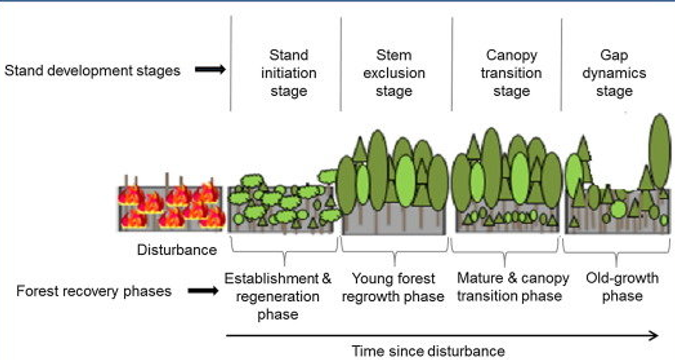
Info on Stand Initiation (Reorganization) Stage
After a lethal disturbance creates vacant growing space, trees that establish do not fully occupy the growing space
Additional plants fill in the gaps, lasting 10 or more years
Biodiversity is very high (perhaps the highest)
Info on Stem Inclusion Phase
After a time, growing space is occupied, crowns close, canopy is formed and elevated to do dying of lower branches
Weaker trees die
Rapid leaf area accumulation occurs
Economic or financial rotation of even aged crops usually occurs
Heavy shade, biodiversity is (probably) at its lowest
Info on Understory Re-initiation (transition) stage
Previously successful trees are lost by pests or damage and crowns do not fully close again
Gaps created are filled by new plants, often slow growing shade tolerant species
Total biomass declines from its peak from former phase
Forest floor veg reappears
Medium shade
Info on Old Growth (steady state) phase
Fewer than half of trees in original cohort remain, on or more new age classes compose parts of the top canopy
May continue past the death of the last original trees, likely to be unbalanced. Production gains = losses to death/decay
Biomass remains fairly constant
Overstory trees die in irregular fashion
What are the (6) phases of a forest succession cycle, and when is silvicultural prescriptions?
Cohort establishment
Canopy closure phase
Stem exclusion phase
Mature phase
Old-growth phase
Gap phase- This is where silvicultural prescriptions occur, at the end of the forest’s life
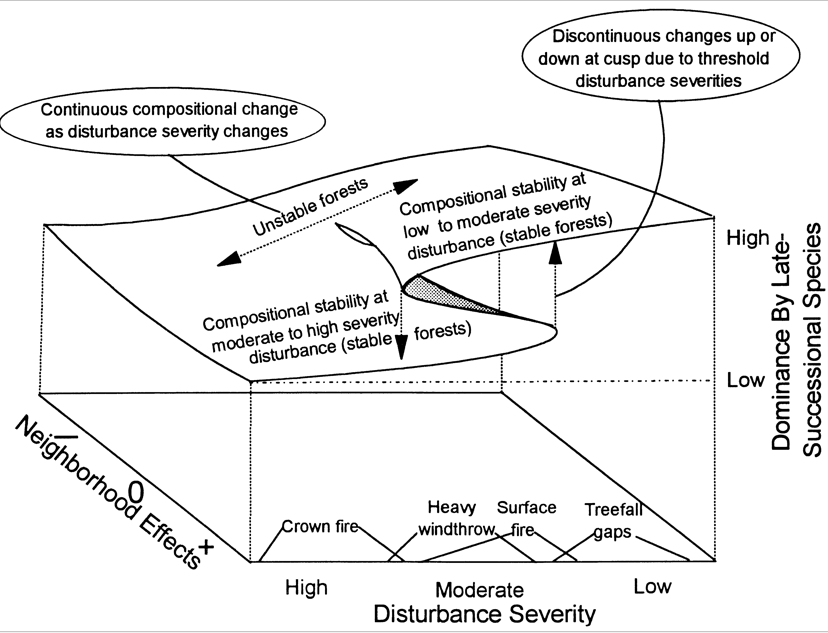
What are neighborhood effects?
any process mediated by canopy trees that affect the replacement probability by the same or other species at the time of canopy mortality
What are the (3) types of neighborhood effects
Positive neighborhood effects - processes that promote self replacement
Negative Neighborhood deter self replacement
Neutral effects neither favor nor disfavor self replacement
Types of neighborhood effects/ disturbances (2)
Overstory - understory effects (positive or negative) - operate by influencing the species composition of seedlings and sapling underneath canopy trees. May influence the second generation tree species
Disturbance activated effects, operate mainly in forests perpetuated by intense fire where seedlings are mostly killed at the same time as the canopy trees, serotinous seed rain and sprouting as a result
(3) types of disturbance intensities and definition
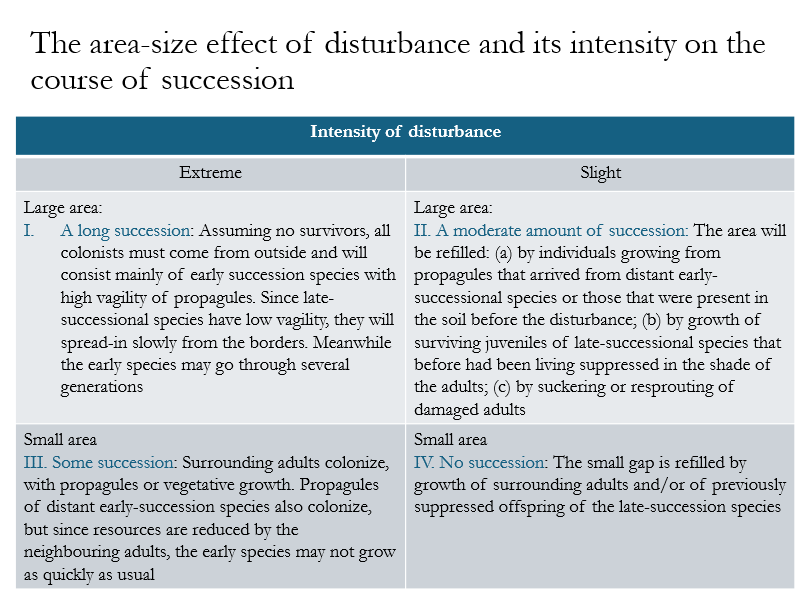
Low severity disturbance - kill small parts of either the overstory and or understory
Moderate severity disturbance - Kills most of one forest layer, either the understory with its advanced regeneration and or seedbank or the overstory while leaving the other layer mostly intact
High severity disturbance - kill both the understory and overstory (ex. fires)
Why is disturbance intensity and frequency important?
Repeated disturbances of low to moderate intensity may act as a major disturbance
Case study: Kibale National park, Uganda history
Contains a wide variety of different habitats, many endangered species and fragile habitats
Two major indigenous tribes inhabit the area and depend on the natural resources. Parks are of increasing importance due to illegal logging in many African countries
Large areas that were converted to farmland are now tall grasslands, making up 1/3rd of the park
case study hypothesis, and their results (4)
Seed rain is higher beneath isolated trees than grasslands. This was proven true. Grass height did not have a significant effect on seed counts
Seed rain is higher under tall trees than short or mid size trees. This was proven true. Possibly because tall trees provide protection to seeds
Seed rain is negatively correlated with distance from forest edge. This was proven false. No significant differences were found with edge vs interior
Seed rain would increase beneath trees producing fleshy fruits. This was proved true. 4 of 5 fruited trees were found to have higher seed cohorts, possibly because they attract animals.
Case study methods
150m x 250 m tract of land with one long edge along intact forest
Seed traps placed at 13 random locations at least 1m from any nearby tree crowns
Seed rain was described in terms of density and species richness
case study result discussion
Managing anthropogenic disturbance to make natural regeneration faster/ easier
More cost effective to rely on natural processes for restoration
Establishing plantations of resilient or adapted trees can help with restoration
Case study limitations of Uganda
Does not share the same habitat as Canada
Legislation is very different
Study design could be modified for Canadian issues, but needs funding
How/where to apply this knowledge in Canada (5)
Mining reclamation
Oil and gas
Forest harvesting
account for edge effect and seed proximity when planning industrial activities
Agriculture
Info/Life cycles of Mountain Pine Beetle
Most of their life cycle is underneath tree bark
Adults can fly. Long distance dispersal potential
Females use pheromones to attract beetles to a certain tree
Historically, beetles have been controlled by cold winters, with global warming creating more ideal conditions
Range is west, in all of BC and most of Alberta
need to rank pictures on most shade tolerant boreal forests on exam***
know your tree species and know your sites***
competition, which is favored (red pine)
Trees impacted by Pine Beetle
Lodgepole pine is the primary, but jack pine, ponderosa pine, whitebark pine, western white pine, and limber pine can be affected.
Trees that are larger (>20) and older (>60) are targeted
Tree dynamics post infestation
Healthy trees produce a thick resin
Infected trees will die from the beetle feeding on phloem and introducing blue stain fungi
Two years after the tree dies the needles will turn red, and after 3-6 years the needles fall off and the tree gets a grey appearance
Dead trees eventually fall and become downed coarse woody debris
MPB as a disturbance
Beetles only really target the overstory as a disturbance
Considered low to medium severity and help maintain a viable stand structure
Dead mature trees opens up the canopy and increase growth for neighboring plants and understory growth
MPB as a high severity disturbance
Recently attacks have been increasing to a high severity and frequency
They are starting to target younger trees if older is not available
Severe outbreaks can cause up to 90% mortality of tree basal area
Regeneration is primarily controlled by pre stand conditions
What is the relation to MPB and fire?
MPB creates a lot of dead trees, increasing ignition risks (especially with trees in the red needle stage) which facilitates stand replacing
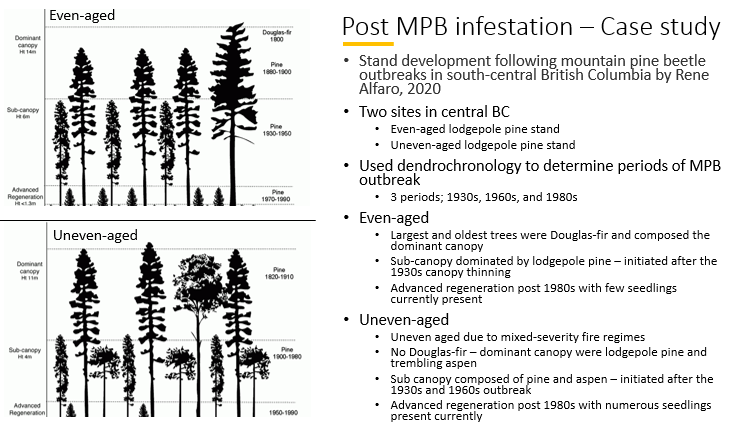
Stand Development following MPB in BC even aged forests
How will climate change affect MPB
It is difficult to predict, but…
Increase MPB populations due to warmer winters
Encourage eastward spread into the boreal forest
Decrease host tree resistance, due to increased stress from drought
Likely increase frequency and severity of outbreaks
What are the management strategies of MPB
Detection through aerial surveys
Removal of infected trees (cutting or burning)
Restrict transportation of pine material from BC
The mountain pine beetle program
What are the (5) results of the Mountain Pine Beetle Program
No practical ways of using remote sensing for early detection
Beetle infested trees must be removed quickly and properly disposed of
Vulnerable trees should be harvested first
pheromone baiting can control the endemic population levels
Direct control is impractical with very large beetle populations
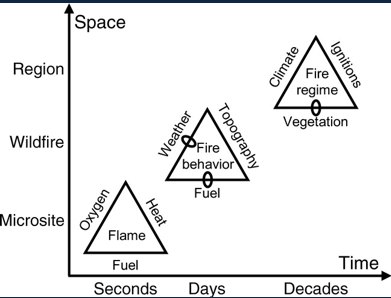
Spatiotemporal fire regimes
What is the fire cycle in central boreal forests
Approximately 100 years from 1921-2008
Changes spatially, longer for stands closer to water bodies, in the south, and brunisols
Intermediate to east and west boreal forests supporting climatic top down control
What is brunisols
A type of soil found in forested regions that are poorly developed. They are considered transition soils
Does a post fire stand have the same species composition as the prefire stand?
Yes, based on direct regeneration hypothesis
Direct Regeneration in Boreal Forests
Species specific post fire regeneration density is proportional to its pre fire basal area
A pure post fire aspen stand may be expected when the pre fire stand has > 20% aspen
Drivers of forest
Propagule availability and substrates —> Species specific pre-fire basal area
Competitive ability —> Fire variability within a burn
Understand competition interactions
losers and winners
Interactions among species, some collaborate
Red oak
for the first ten hears they don’t grow in height, they put energy into roots

