Physical Science for Teachers Exam #2
 Call Kai
 Learn
Learn Practice Test
 Spaced Repetition
 Match
Match Flashcards
 Knowt Play
1/69

There's no tags or description
Looks like no tags are added yet.
Name | Mastery | Learn | Test | Matching | Spaced | Call with Kai |
|---|
No analytics yet
Send a link to your students to track their progress
70 Terms
What are waves?
●Waves are disturbances that transfer energy from place to place.
●Many waves require a medium to travel on or through. (Air, Water, Solids)
●Waves DO NOT move matter! Waves ONLY move energy.
Mechanical Waves
●Any wave that does require a medium is called a mechanical wave.
●Two types of mechanical waves are transverse waves and longitudinal
Transverse Waves
●Transverse waves move the medium at right angles to the direction in which the wave moves
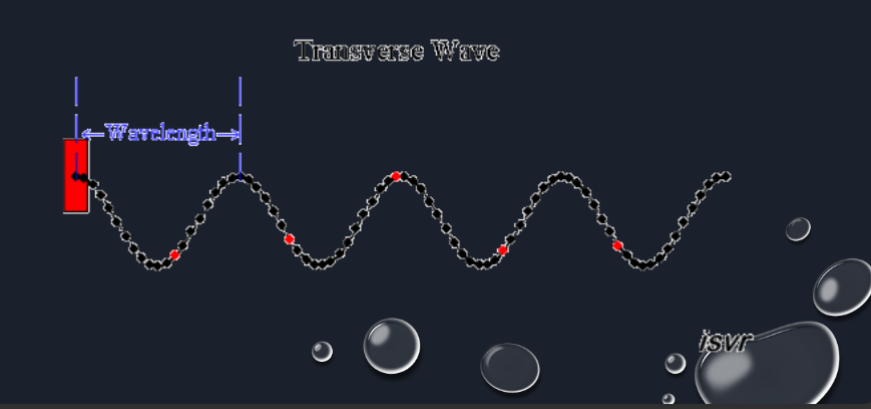
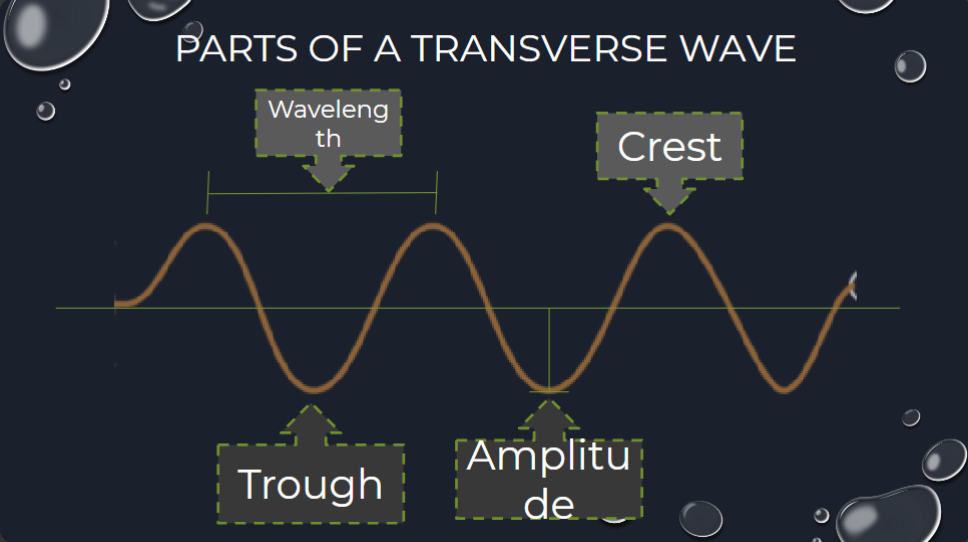
What are the four parts of a transverse wave?
Wavelength, crest, trough, amplitude
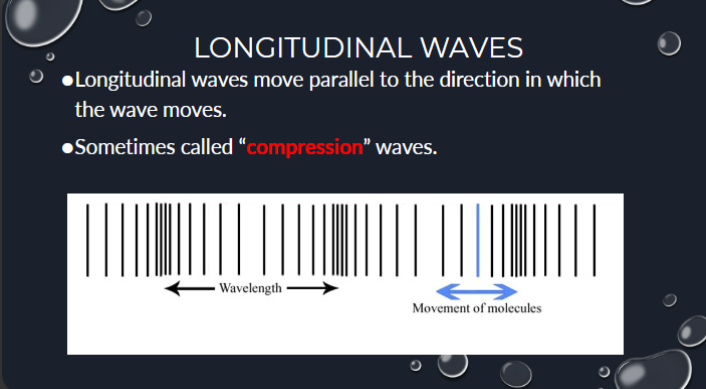
Longitudinal Waves
●Longitudinal waves move parallel to the direction in which the wave moves.
●Sometimes called “compression” waves
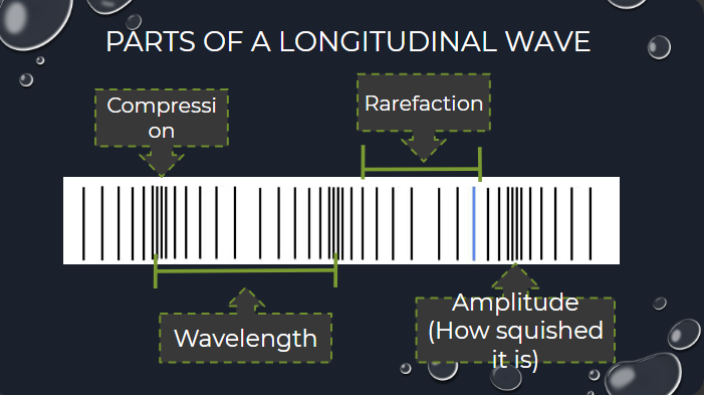
Parts of a Longitudinal Wave
Compression, wavelength, rarefaction, Amplitude (how squished it is)
Properties of a wave (amplitude)
●The amplitude of a transverse wave is the maximum distance the medium moves up
and down from its rest position.
●The amplitude of a longitudinal wave is the measure of how compressed the compression is.
○Dense compressions = high amplitude
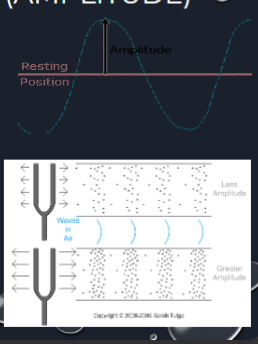
Low vs. High Amplitude
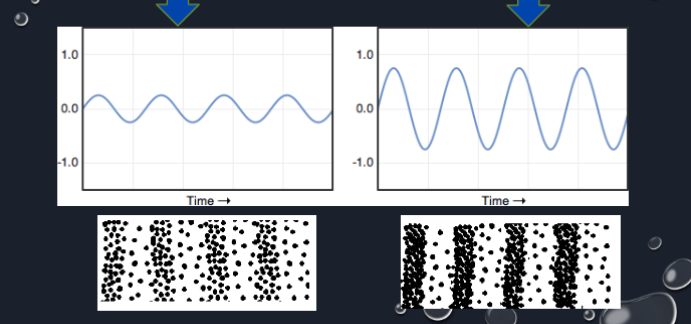
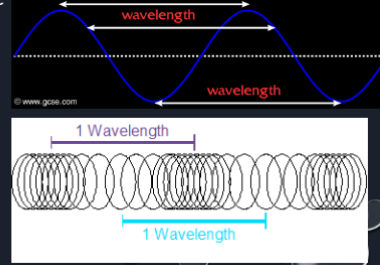
PROPERTIES OF A WAVES (WAVELENGTH)
●Transverse wave = Distance from crest to crest or trough to trough.
●Longitudinal wave = Distance from compression to compression or rarefaction to rarefaction
PROPERTIES OF A WAVES (FREQUENCY)
●The amount of complete waves that pass a certain point in a certain amount of time. (usually seconds)
○ Is determined by wavelength and wave speed.
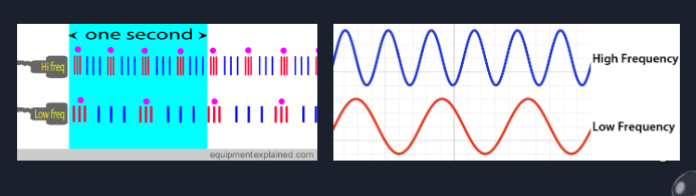
PROPERTIES OF A WAVES (FREQUENCY)
• Frequency is measured in a unit called hertz (Hz)
• Hertz is named after Heinrich Hertz, the German scientist who discovered radio waves
in the 1880’s.
Magnetism
Magnetism occurs because of electrons and how they travel around the nucleus of the atom. The spinning electrons form tiny magnetic forces. If the electrons in an object spin the same direction, you will get a magnetic force.
Magnetism is the force of attraction or repulsion between magnetic poles.
Moving Electrons
Electrons (e-)
The atoms within most materials have paired up electrons spinning in opposite directions so the magnetic field that is created by one is cancelled out by the other.
Some materials like iron, nickel, and colbalt have a single electron or pair of electrons that spin in the same direction creating a magnetic field or a small atomic magnet.
Magnets
A magnet has two ends called poles (dipoles), where the magnetic force is the strongest.
No matter how many times a magnet is broken, each piece always has a north pole and a south pole.
There is no such thing as a monopole.
Electricity
a fundamental form of energy that can occur naturally (ex. lightning) or is produced (ex. generator) and that is expressed in terms of the movement and interaction of electrons.
Electricity Starts with Atoms
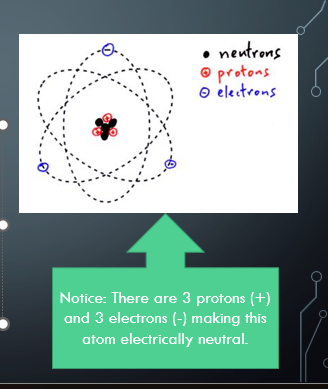
Atoms contain protons with a positive charge (+), electrons with a negative charge (-), and neutrons with no charge.
Electricity occurs from the differences in charges.
Insulators
Insulators are materials that do not allow electrons to easily move from place to place.
Examples: Rubber, Plastic, Wood, Skin
Conductors
Conductors are materials that do allow electrons to move easily from place to place.
Examples: Copper, Aluminum, Water
Electric Force
A force is a push or a pull caused by electric charges.
An electric force is the attraction or repulsion like and unlike charges have for each other.
Opposites attract!
Electric Field
An electric field is the area around an electric force where the charge can be felt.
The electric field gets stronger as you get closer to the source of the electric force.
Static Cling
When two objects – such as your hair and the balloon – rub together, one loses some of its electrons to the other.
One object will become positively charged.
One object will become negatively charged.
Then, opposite charges are attracted to each other.
Electric Discharge
Electric Discharge is the rapid movement of excess charge from one object to another.
Lightning happens due to an electrical imbalance between the storm clouds and the ground. They can also happen within the clouds.
Electric Current
Electric current is a steady continuous flow of electricity.
Unlike electric discharge which is a short burst of electricity
Electric current will only flow through an electric circuit.
Electricity in a circuit behaves much like water in a closed system.
Amperes (Amps)
Amps is the unit given to the measurement of the rate of flow of electric current.
The greater the electrical flow, the greater the amperage.
Voltage
Voltage is the measure of the amount of electrical potential energy.
The stronger the electrical “push” the larger the voltage.
Resistance
Resistance is the measure of how difficult it is for electricity to flow through a material.
They slow the flow of electrons
Resistance is measured in a unit called OHMS.
The amount of electrical resistance is dependent on 4 things:
The type of material
The length of a conductor
The width of the conductor
The initial Voltage
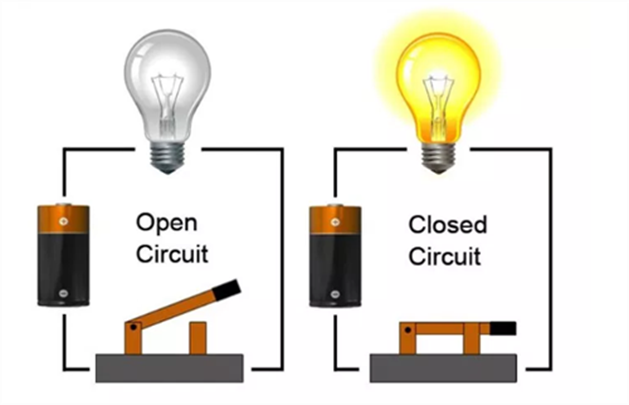
Circuit
A circuit is a closed conducting loop.
An electric current is only able to flow through a closed system.
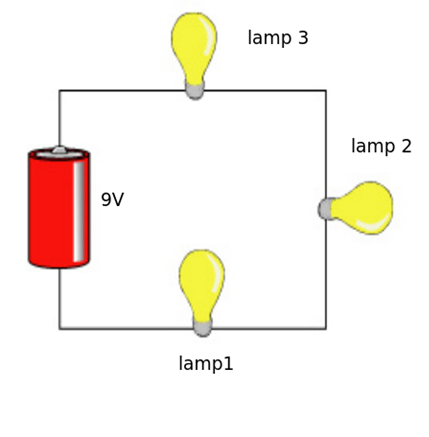
Series Circuits
A series circuit has only one path for the electric current to follow.
When any part of the electrical path is broken, electricity will no longer flow.
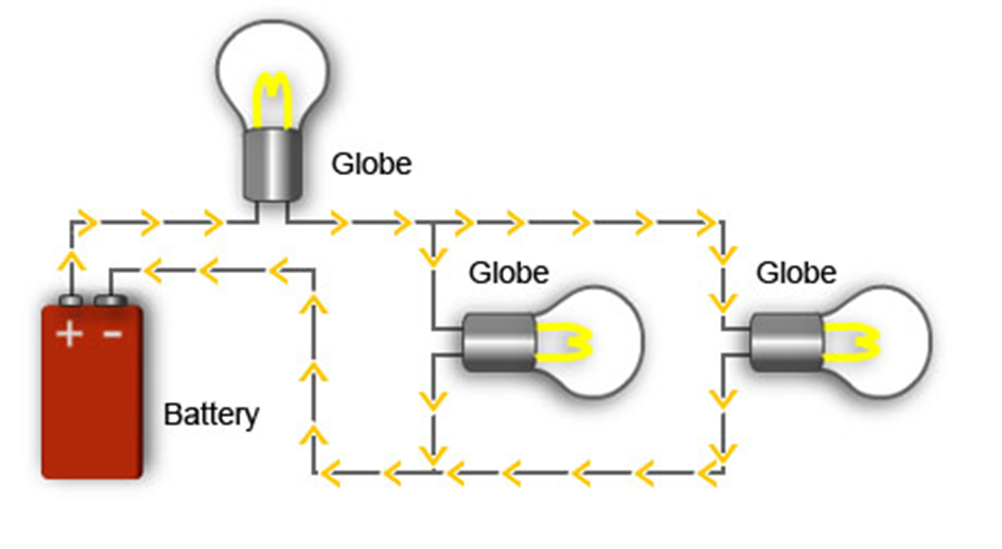
Parallel Circuits
A circuit that provides more than one path for electricity to follow.
Houses, schools, etc. are wired using parallel circuits.
Fuses and Breakers
Fuses and breakers limit the amount of electricity flowing through a circuit.
Electrons
Protons and Neutrons are fixed in the nucleus of the atom and cannot be moved.
However, electrons are able to move from atom to atom.
Electric Power
The rate at which electrical energy is converted into other forms of energy.
Electrical power is measured in Watts.
What is Sound?
Sound is vibration.
Sound travels in the form of longitudinal waves through different mediums.
It is a mechanical wave so it requires a medium.
How Sound Travels
The longitudinal waves of sound travel as compressions of air caused by the vibration of air.
Sounds in Solids, Liquids, and Gasses
Sound waves require a medium
Sound travels through solids, liquids, and gasses.
Sound travels fastest when molecules of the medium are closer together.
Sound cannot travel in the vacuum of space because the molecules are too far apart.
The Speed of Sound
The speed of sound depends on the density, elasticity, and temperature of the medium the sound travels through.
Elasticity is the ability of a material to bounce back after being disturbed. (The molecules of a solid return to their original position quickly after a disturbance)
Why does sound travel slower in cold air vs. warm air?
The colder the molecules of a substance, the slower those molecules move. Cold air molecules move slowly and do not return to their original position (elasticity) as quickly as warm air molecules.
The Speed of Sound (and Density)
Sound travels faster through objects that are denser, which is why sound travels better through a solid than a liquid.
Sound travels better in a liquid than through air.
Properties of Sound (Intensity)
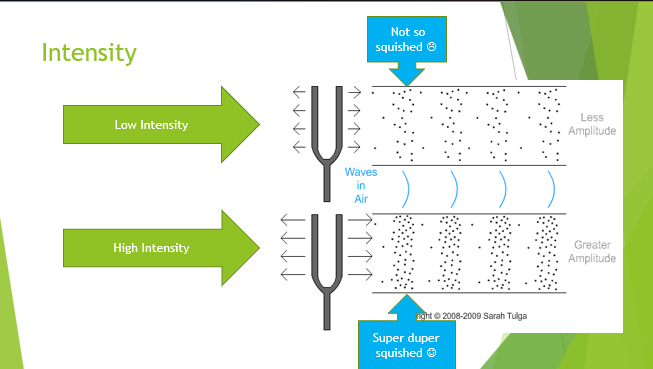
The volume of a sound depends on its INTENSITY.
The INTENSITY of a sound is the amount of energy a wave carries.
The closer you are the source of sound the greater the INTENSITY.
Low vs. High Intensity
Properties of Sound (Intensity) pt. 2
The loudness of sounds is measured in Decibels (dB).
The decibel scale is logarithmic. Each jump in 10 dB equals a 10 fold increase in the volume of a sound.
50 dB = 10 times louder than 40 dB
As the amplitude of the sound wave increases, the intensity of the sound increases.
Properties of Sound
The pitch of a sound is the human perception of the frequency of a sound.
Sounds with low pitch have a low frequency
Sounds with a high pitch have a high frequency
Pitch
The length of an instrument affects the pitch of the sound that comes out of the instrument. (Shorter instrument, higher pitch)
The same is true for finger placements on an instrument. Covering holes in the instrument makes the vibrating column of air shorter or longer.
The Doppler Effect
The Doppler effect is the change in frequency of a wave as its source moves in relation to the observer.
As a sound source moves toward you, the waves are squished creating a higher pitch.
As the sound source moves away from you, the waves are stretched creating a lower pitch.
Frequencies
Every material or object has a particular set of frequencies at which it vibrates.
When a material or object is made to vibrate at its natural frequency it is called resonance.
Quality of Sound (Acoustics)
Acoustics is the study of how sounds interact with each other and the environment.
Certain acoustical environments help eliminate destructive interference.
Other acoustical environments create an environment with little or no reflection of sound waves.
Reverberation and Echo
Reverberation is the reflection of sound waves.
Objects reflect sound differently depending on their shapes
When a sound reflection is repeated, it is called an echo.
Practical Uses of Reverberation
Echolocation is the use of reflected sound waves to determine distances to locate objects.
Bats, dolphins, and whales use echolocation to find their food.
Bats can use frequencies up to 100,000 Hz (humans can hear up to 20,000 Hz)
Sonar uses the reflection of sound waves to locate objects under water.
Objects of different densities reflect sound waves differently.
A picture created by a device that uses reflected sound to create that picture is called a sonogram.
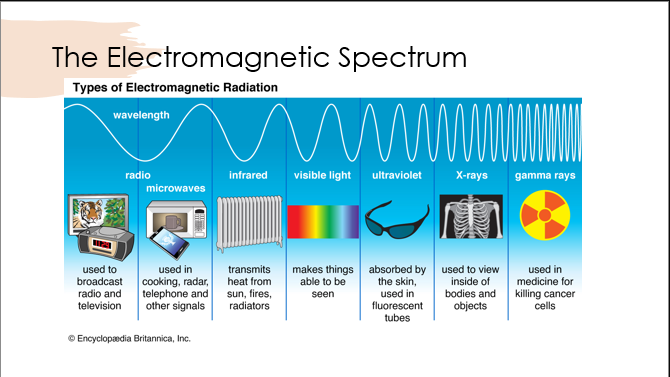
The Electromagnetic Spectrum
The Electromagnetic Spectrum - Waves
Electromagnetic waves have two parts
-electric part
-magnetic part
Electromagnetic waves can be described by their frequency (number of waves in a specific amount of time)
Radio waves have the lowest frequency
Gamma waves have the highest frequency
All electromagnetic waves travel at the speed of light (300,000 km/s in a vacuum)
Light from the sun takes about 8 minutes to reach the earth.
Electromagnetic waves do not need a medium to travel through.
Radio Waves - #1 on Spectrum
Radio waves have the longest wavelength in the EM spectrum.
They are useful for transmitting radio and television broadcasts.
Microwaves - #2 on Spectrum
These have a shorter wavelength and a higher frequency than radio waves.
Cell phones and microwaves use this type of EM radiation.
Infrared Waves - #3 on Spectrum
Have wavelengths shorter than radio and microwaves.
This type of radiation can be felt in the form of heat (the more heat something has the more infrared radiation it emits).
Remote controls use infrared radiation and certain cameras have the ability to capture this type of radiation and turn it into a “thermogram.”
Visible Light - #4 on Spectrum
The only portion of the EM spectrum that can be seen by humans.
Each color has its own unique wavelength
It is a very small portion of the entire spectrum.
Ultraviolet Waves (The Good) - #5 on Spectrum
Have wavelengths just shorter than visible light
Enable your body to create Vitamin D
Used to disinfect food and air
Ultraviolet Waves (The Bad) - #5 on Spectrum
Shorter wavelength and higher energy UV rays (Cause of sunburn and skin cancer)
Ozone layer absorbs the majority of these
CFC’s (chlorofluorocarbons) break down the ozone layer allowing more harmful UV light to reach the earth.
X-Rays - #6 on Spectrum
Have a shorter wavelength and carry more energy than UV light.
Have enough energy to pass through most types of matter depending on the density (which is why it is useful for medical imaging)
Large doses can be dangerous by mutating DNA
Gamma Rays - #7 on Spectrum
The highest energy wave and shortest wavelength in the EM spectrum
Have the highest penetrating power and can travel through most materials
Given off by nuclear reactions that can quickly damage human body and cause cancer (Chernobyl)
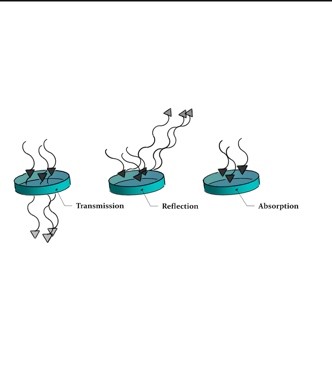
When Light Strikes an Object
Light can be TRANSMITTED or pass through an object.
Light can be REFLECTED or bounce off an object.
Light can be ABSORBED in which the light energy is “taken in” (usually transfers into thermal/kinetic energy)
How Light Passes Through
The amount of light that passes through an object depends on what type of object it is.
Transparent – All light passes through (window, glasses)
Translucent – Some light passes through (sunglasses, tissue paper)
Opaque – No light passes through (brick, metal)
Reflection
Two Types: Diffuse and Specular
Diffuse Reflection
When light strikes an object and bounces off in all different directions.
Typically occurs when light strikes a bumpy, rough, or unsmooth surface.
Specular Reflection
When light waves bounce off an object at a predictable angle.
Typically occurs on flat smooth surfaces like mirrors or still water.
Refraction
When light bends as the wave changes speed as it enters or exits a new medium.
Light and Color
Light is responsible for the presence of COLOR. Without light there is no color.
Try going into a dark room and identifying the colors of different objects.
White light is made of all the colors of the rainbow.
We can use a prism to show this.
The color of different objects is determined by the wavelengths of light that the object reflects and absorbs.
Three Types of Mirrors
Plane, Concave, and Convex
Plane Mirror
A flat reflective surface that produces a image upright and of the same size.
Concave Mirror
A reflective surface that curves inward like the inside of a bowl.
Reflects light to a focal point.
Thinner in the center and causes the light to diverge.
Sometimes used in eyeglasses
Convex Mirror
A mirror with a reflective surface that curves outward like the outside of a bow.
Reflects light outward and gives an image smaller than the actual object
Electrons
Protons and Neutrons are fixed in the nucleus of the atom and cannot be moved.
However, electrons are able to move from atom to atom.

