LIGN 113 Midterm Study Guide: Acoustics and Hearing
 Studied by 0 people
 Call with Kai
 Learn
Learn Practice Test
 Spaced Repetition
 Match
Match Flashcards
 Knowt Play
1/96

There's no tags or description
Looks like no tags are added yet.
Name | Mastery | Learn | Test | Matching | Spaced | Call with Kai |
|---|
No analytics yet
Send a link to your students to track their progress
97 Terms
Sound
sound is compression and rarefaction in a medium
Compression
reduction in volume/size of a sound wave due to applied force, when the air molecules are bouncing around a lot and in high pressure
Rarefaction
decrease in density where particles are spread apart, when the air molecules are spread out and there's low pressure
Frequency (pitch)
number of complete wave cycles that pass a point in a certain period of time (low frequency = low pitch, high frequency = high pitch)
Oralism
the system of teaching Deaf people to communicate by the use of speech and lip-reading rather than sign language; discourages any use of sign language and other forms of manual communication; thought to better help deaf individuals integrate into the broader hearing community; "We should focus on restoring hearing and helping Deaf people interact with hearing people using spoken language" (outgrowth of the oral language approach to deaf education)
Language deprivation
lack of exposure and opportunity to develop language, particularly during the critical period of childhood language acquisition
Why can't sound exist in a vacuum?
Sound cannot exist in a vacuum because it requires a medium, something that it can travel in (air or water), without it there is no sound.
If a tree falls in the forest and nobody's around to hear it, acoustically, is it likely to make a sound?
Acoustically, the tree's impact will make a sound as it disrupts the air particles in the surrounding environment.
What are some of the problematic phrasings and framings commonly used in hearing science which are felt to be objectionable by many in Deaf culture?
One of the common framings is that hearing loss (at least for hearing individuals) feels like a loss that can be fixed and be brought back. "Deafness is a disorder and disability which can sometimes be cured" - this is not always the case. Another statement is the idea that hearing sciences aim to fix hearing whenever possible (hearing sciences aims to better understand hearing and the connected processes).
How can oralist traditions within hearing science inadvertently lead to language deprivation?
Oralist traditions force Deaf people away from the Deaf community and away from signed language as it is believed that by teaching signed language, the Deaf individual will be unable to engage in spoken language, which is sometimes considered the 'goal' for restoring hearing to these communities. Essentially, those with oralist views want to make Deaf people as functionally similar to hearing people as they can be. If a child has little exposure to signed language while 'waiting to be able to speak and hear,' they're being language deprived, which can possible cause social, emotional, cognitive, and linguistic harm.
Why do some Deaf people object to surgical hearing interventions like cochlear implants?
Financial, temporal, physical and medical costs (CI surgery is extremely invasive), and emotional and social costs are some of the reasons why Deaf communities may object to surgical hearing inventions.
What is the benefit of simultaneously teaching Deaf children to sign, even as they (or their parents) attempt to restore some sense of sound?
There are no downsides in teaching sign language to Deaf children! Bilingualism is a benefit in itself as it opens doors for the child. There are studies that show teaching signed language can improve outcomes for Deaf children who later learn spoken languages (as it helps preserve options for later spoken language use).
Transduction
A process by which one kind of signal, energy, or stimulus is converted into another form. examples are thermometers, speakers, microphones.
energy is often lost or distorted so transduction isnt perfect
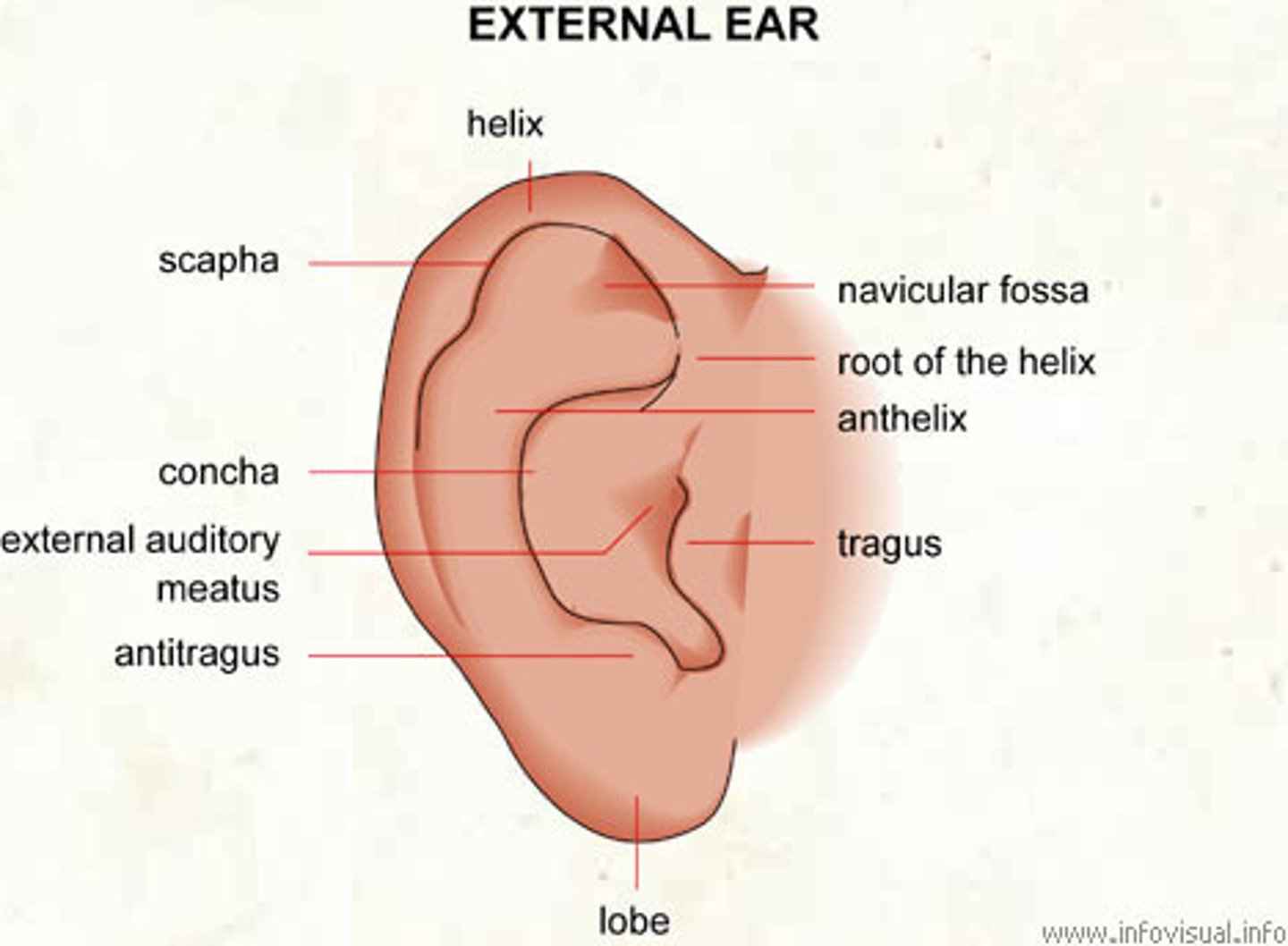
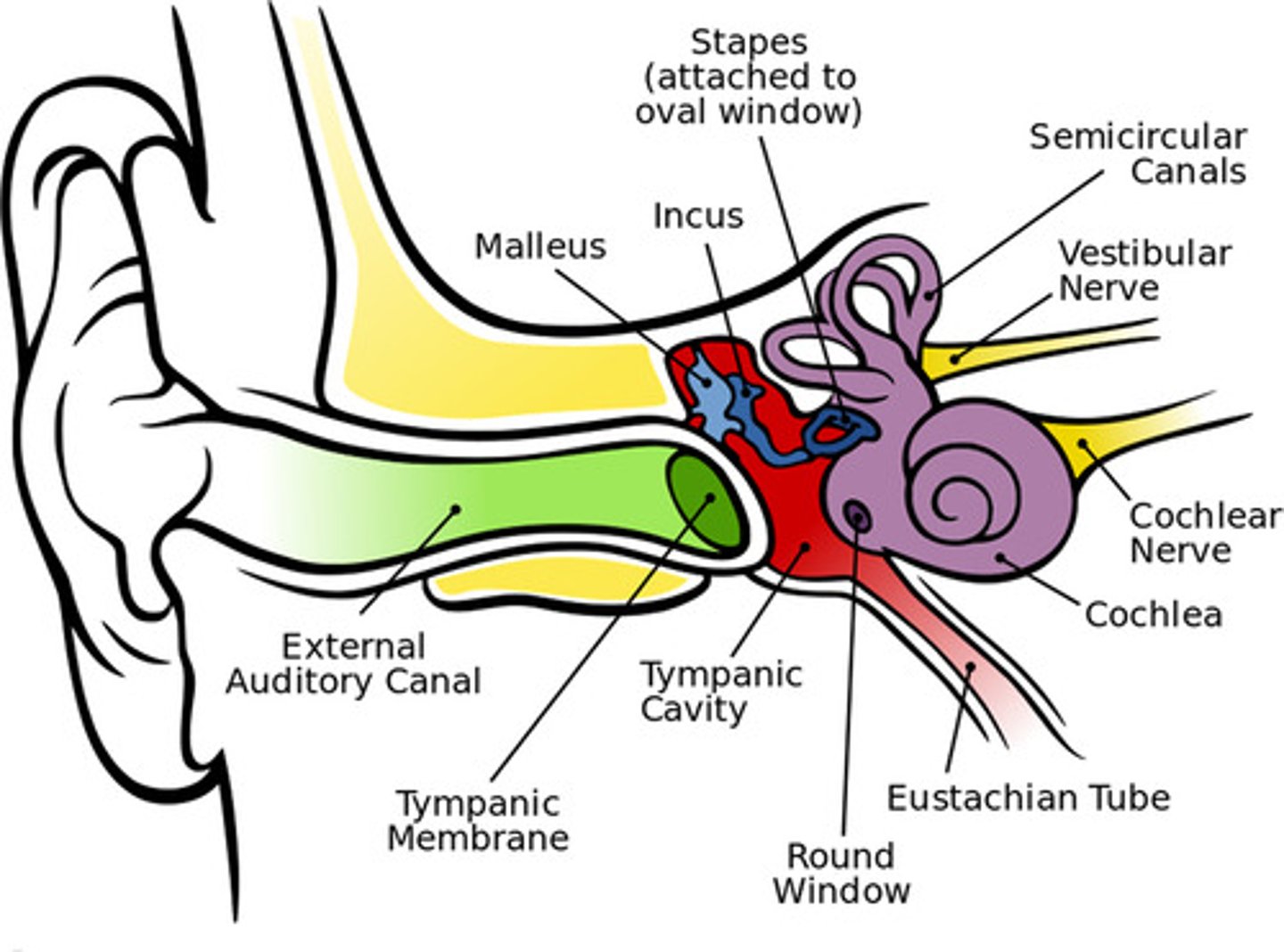
Pinna/Auricle
Exterior, mostly cartilaginous structure. main functions:
- protect the ear canal against the elements
- collect and funnel sound waves into ear canal
-not all animals have a fixed pinna like humans do
-localization
-amplifies sounds
Ear Canal
Long tube for air to travel into the skull.
- contains portion with hairs and cerumen glands; other section is bony.
- mostly for protective purposes.
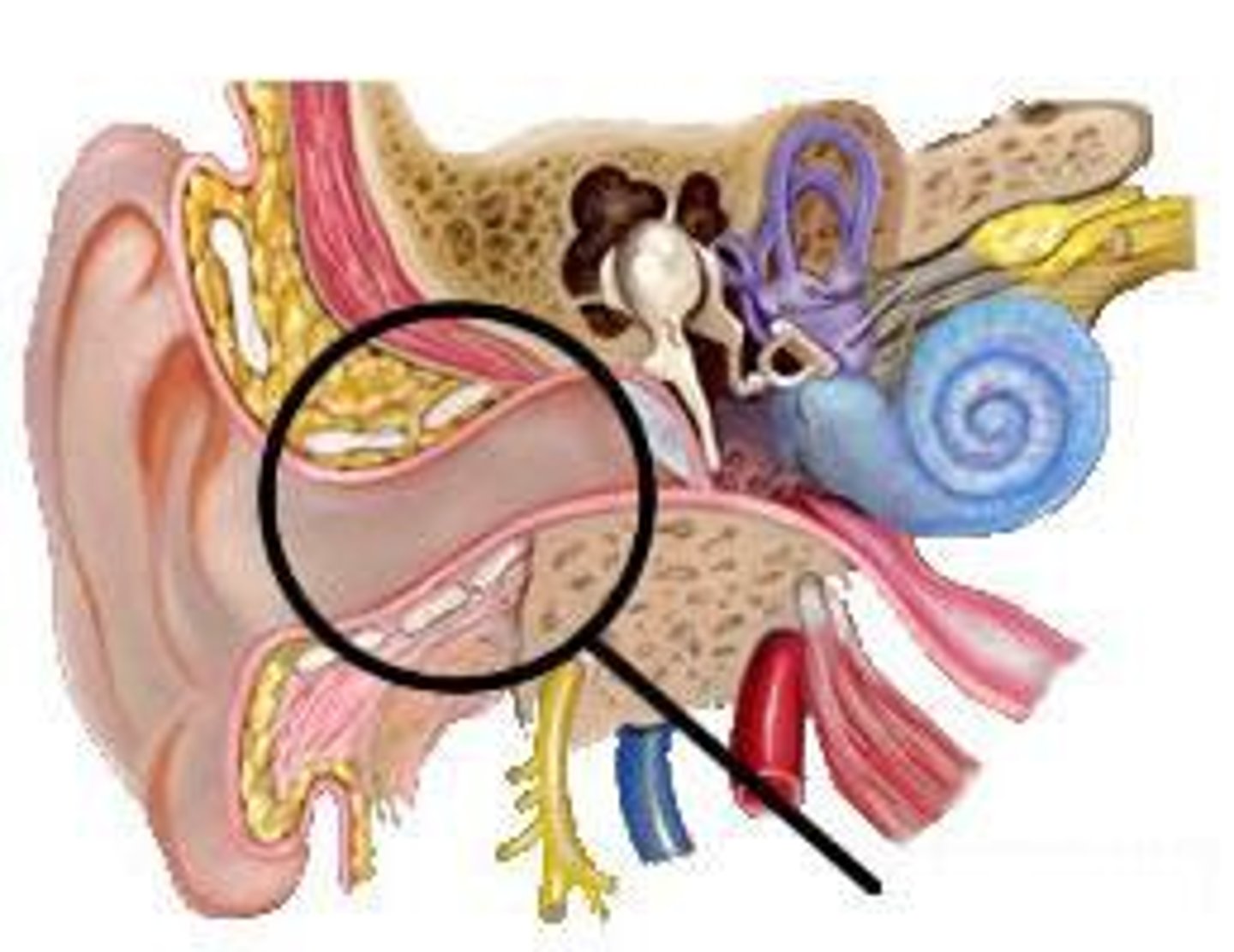
Cerumen (earwax)
Lubricates, cleans, and protects the ear canal; can help prevent infections and fungal growth.
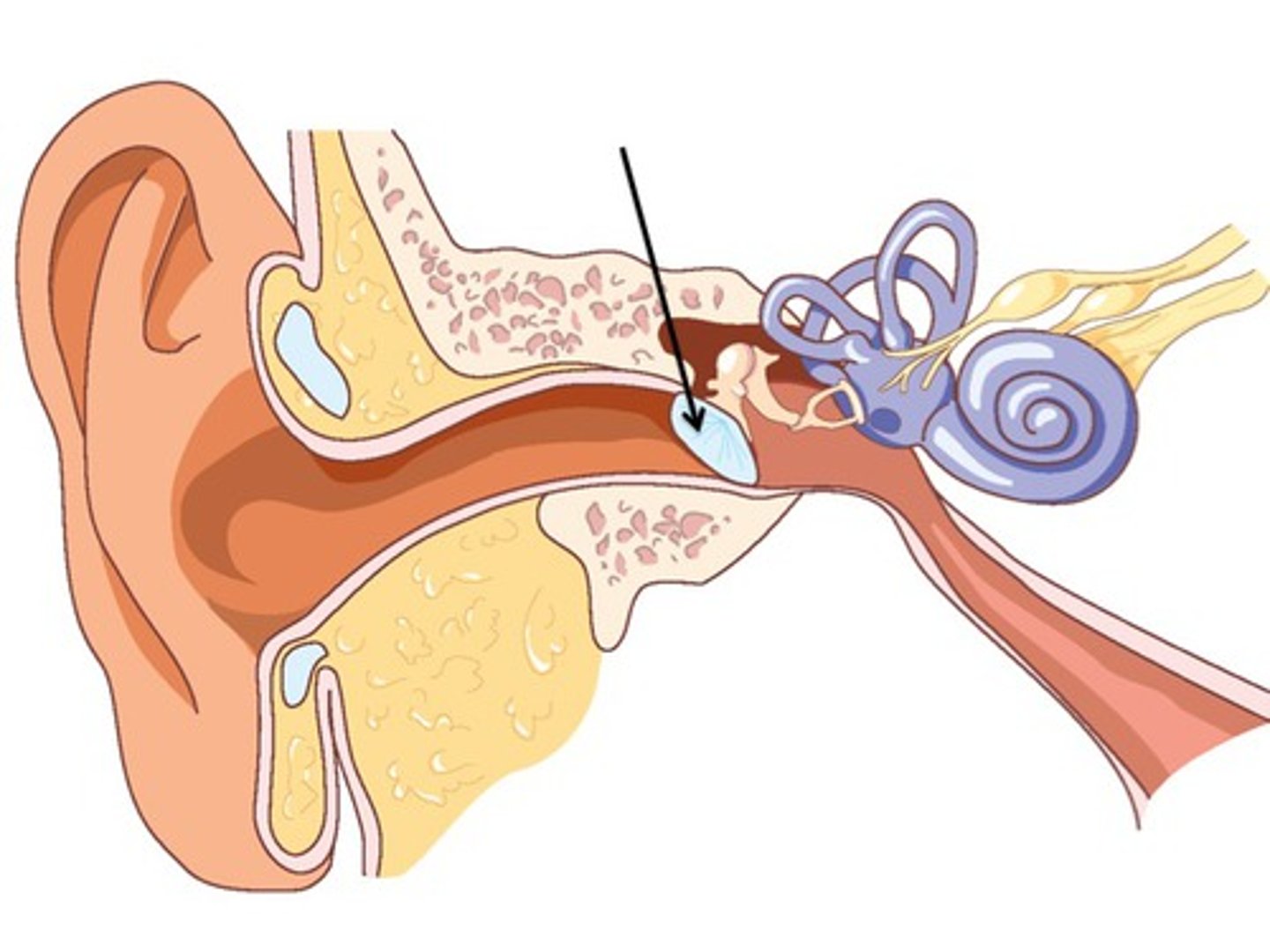
Tympanic Membrane (eardrum)
Partially transparent drum structure that blocks water and debris from entering the middle ear; captures sound vibrations and transmits them into the ossicular chain.
-forms a seal
Malleus (hammer)
First and largest of the middle ear ossicles; attached to tympanic membrane.
Incus (anvil)
Second of the three middle ear ossicles; connected with malleus.
Stapes (stirrup)
Third and smallest of the middle ear ossicles; the bottom is attached to the oval window at the entrance to the inner ear.
Ossicular Chain
Group of the malleus, incus, and stapes that are suspended by ligaments and muscles.
they articulate with each other to transduce mechanical vibrations from the tympanic membrane to the inner ear.
what is the function of the ossicular chain?
1. promotes acoustic reflex (our reaction to sound)
2. amplifies acoustic signal
3. matches air and fluid
4. protects cochlea
Eustachian Tubes
Bony and cartilaginous structure that serves to regulate pressure inside the middle ear.
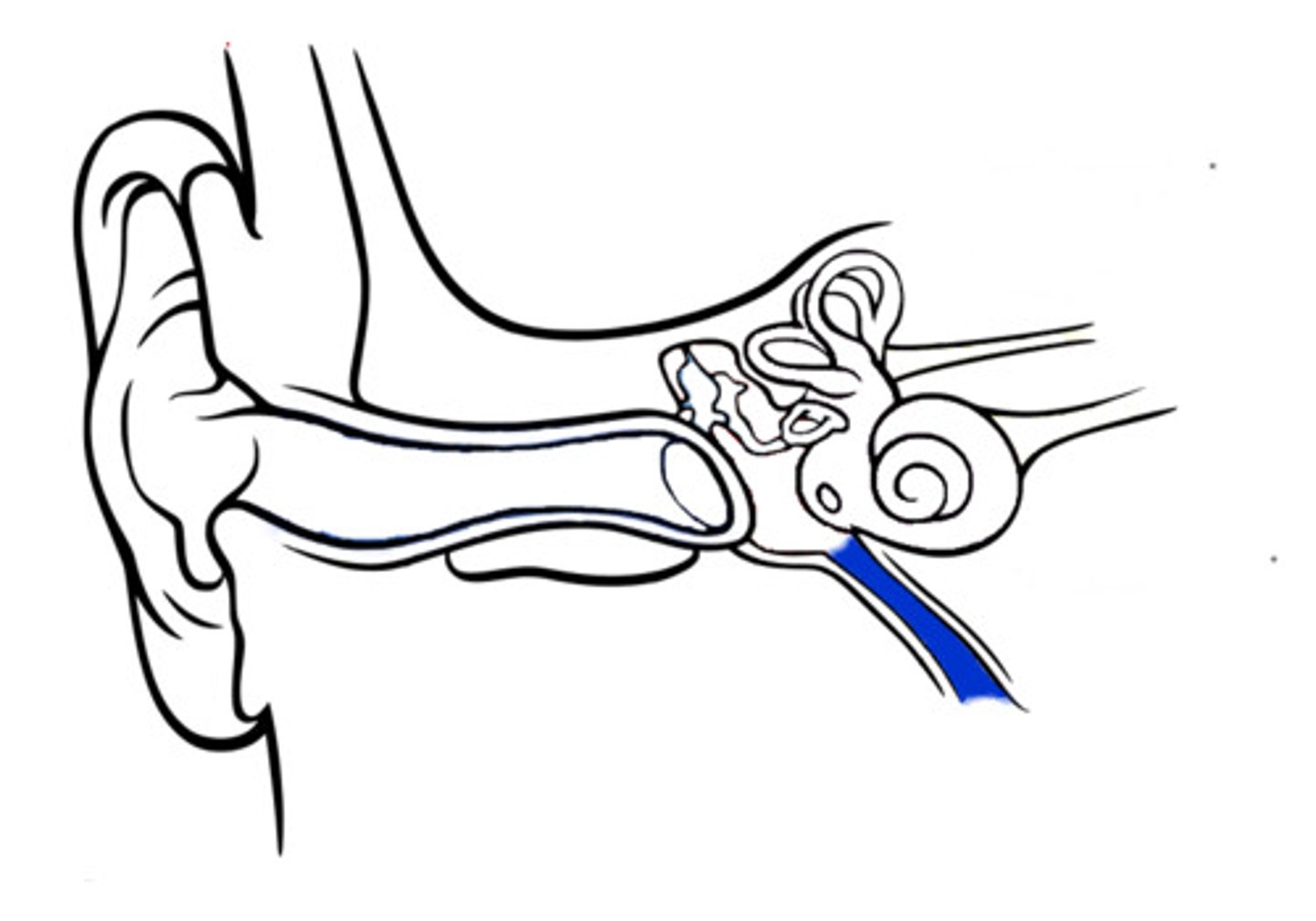
Chorda Tympani Nerve
Branch-like nerve running through the ossicular chain; carries tongue sensation
Stapedius Muscle
Small middle ear muscle that connects to the stapes; contracts in response to loud sounds (greater than 80 dB).
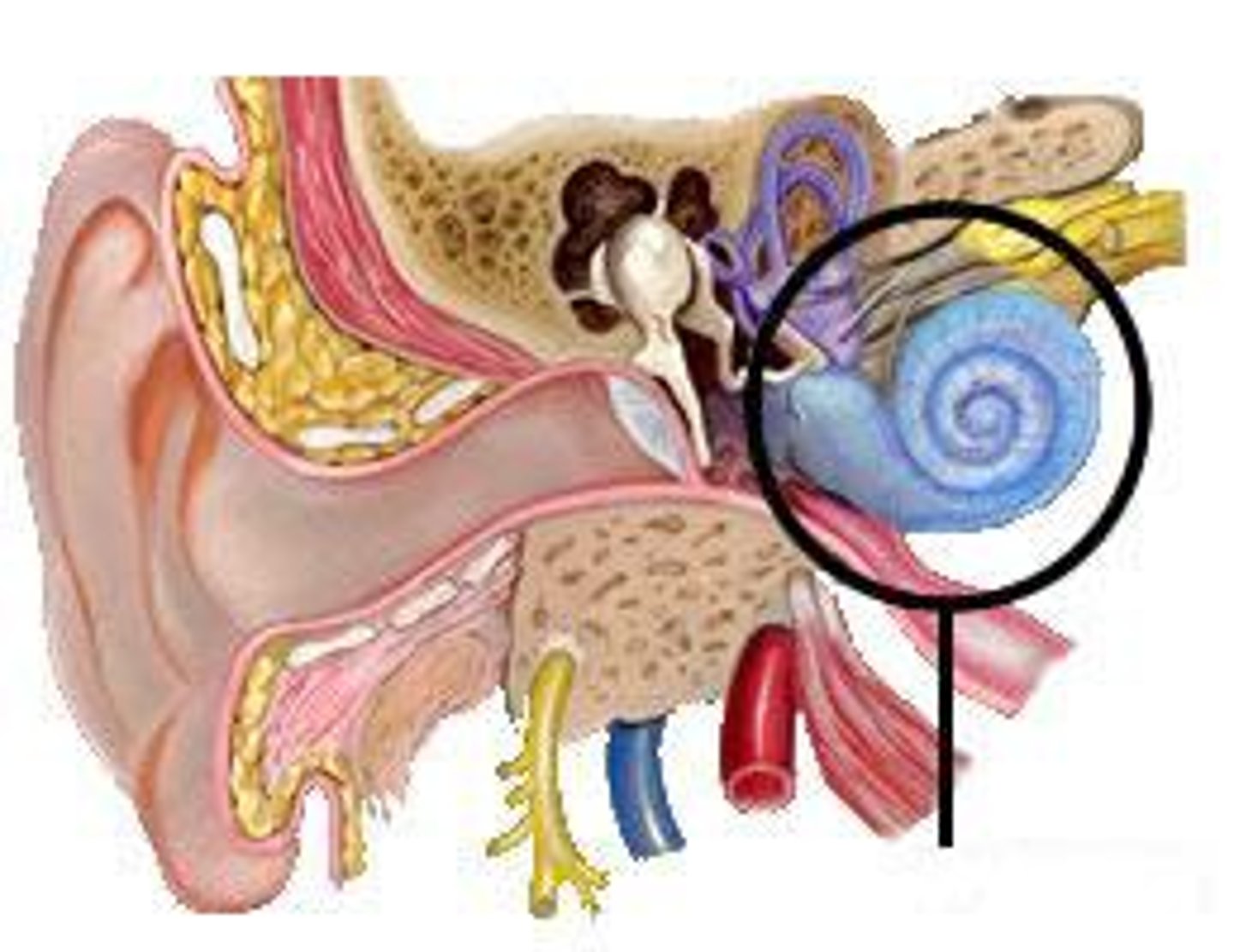
Cochlea
Coiled tube (of about ~35mm) involved in the process of converting sound waves into neural impulses that the brain can interpret into 'sounds;' has a 'base,' which is the widest part, and an 'apex,' the narrowest part.
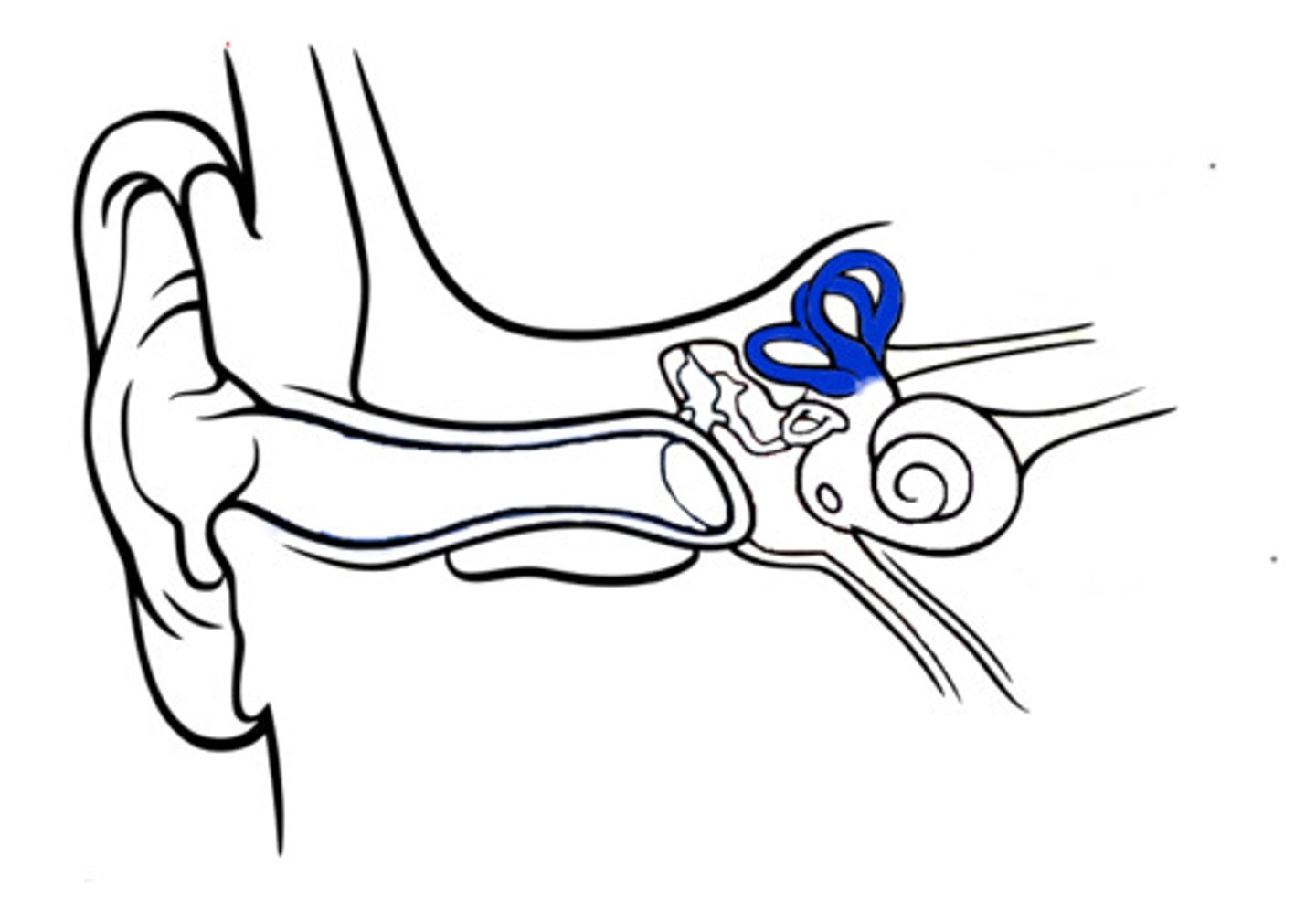
Vestibular System
Dedicated to balance and orientation; includes three semicircular canals; filled with fluid and a method of detecting movement of that fluid.
Semicircular Canals
Posterior, lateral, and anterior canals; detect angular accelerations during head movements; contain equilibrium receptors that respond to rotational head movements.
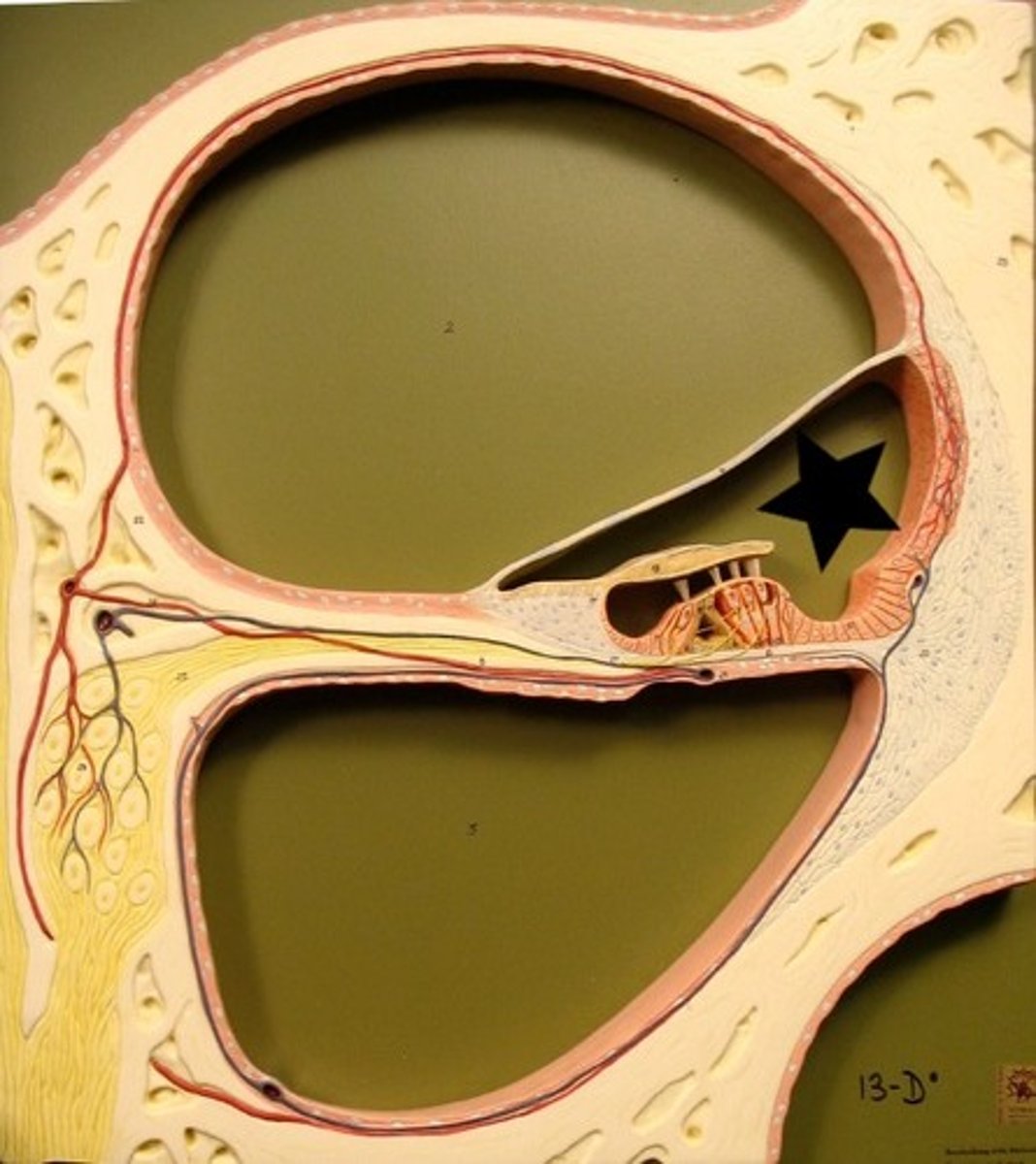
Scala Media
Small triangular-shaped part of the membranous labyrinth; filled with endolymph fluid; separates scala tympani and scala vestibuli; houses the organ of corti
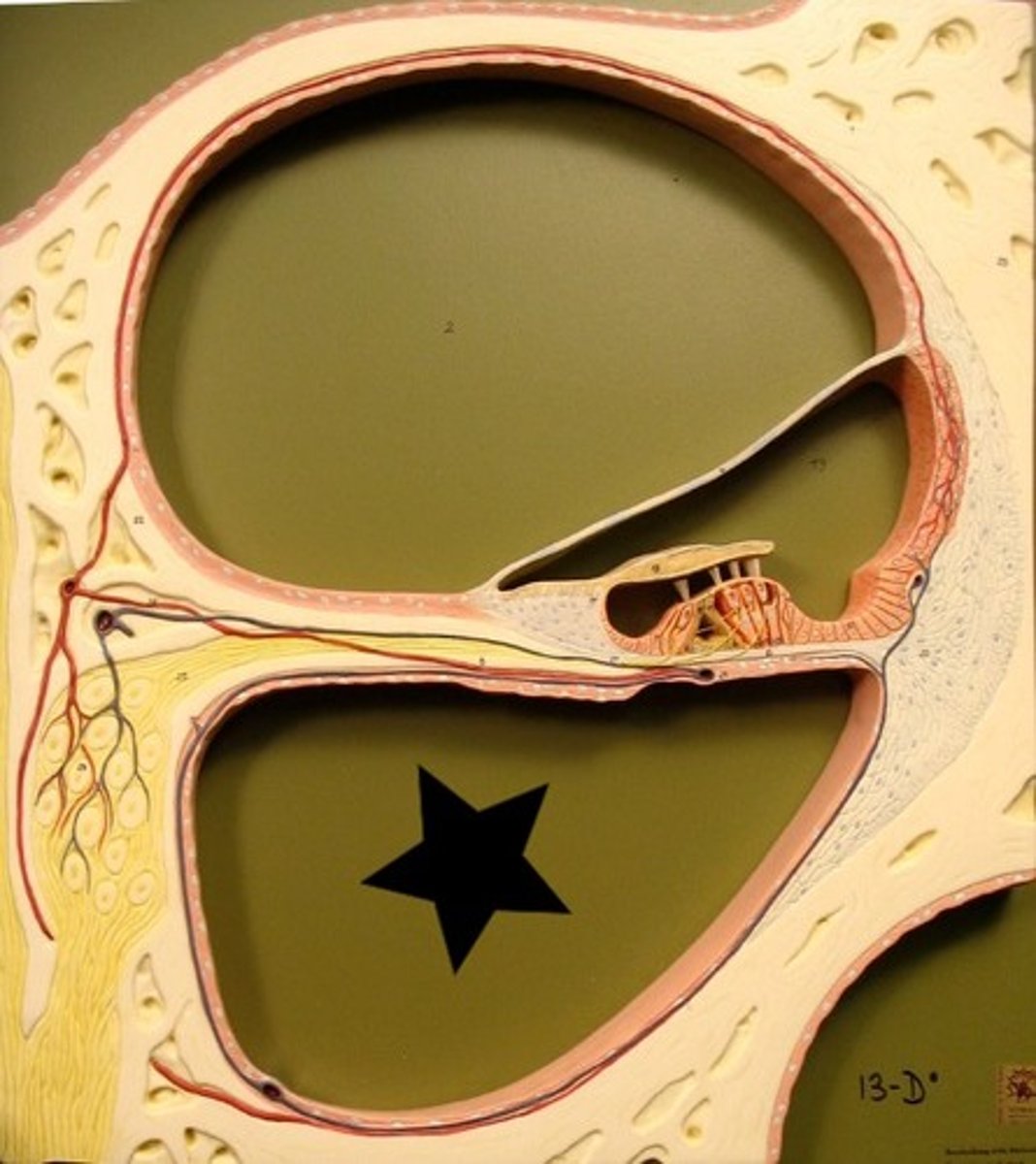
Scala Tympani
One of the three chambers in the cochlea filled with perilymph fluid; functions to conduct and dissipate sound waves within the inner ear (receives sound wave's energy, transmits it through the liquid, and then releases it back into the middle ear through the round window, damping the sound).
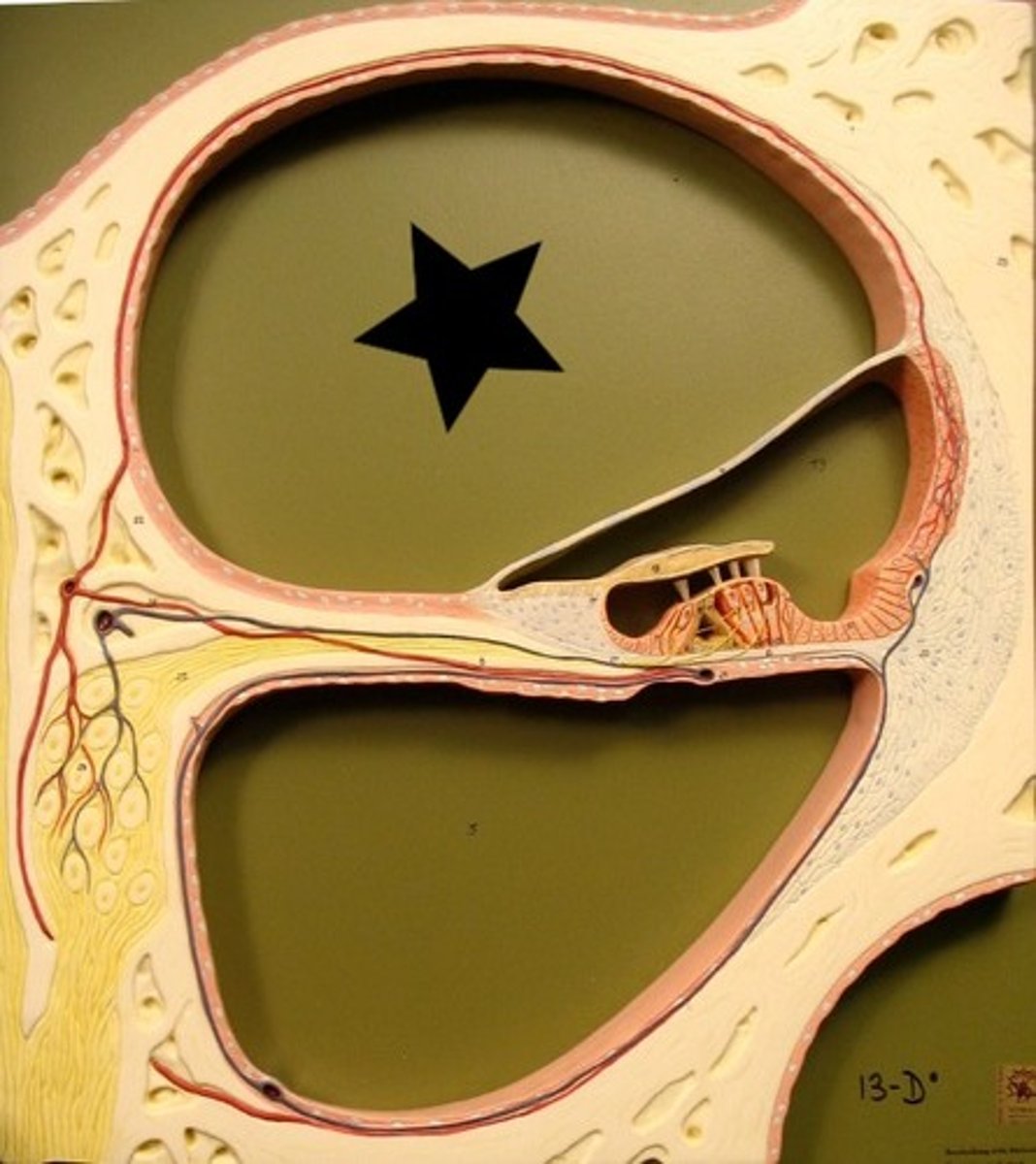
Scala Vestibuli
Third chamber in the cochlea also filled with perilymph fluid; primary function is to transmit sound waves from oval window to the scala media and then to scala tympani (they meet at the helicotrema).
Round Window
Membrane-covered round-shaped opening between middle ear and cochlea (scala tympani); allows for vibrations to enter the fluid-filled cochlea through reciprocal action with the oval window.
Oval Window
Opening into the cochlea (scala vestibuli) to which the stapes footplate is attached; normal route for transmissions of vibrations to the inner ear.
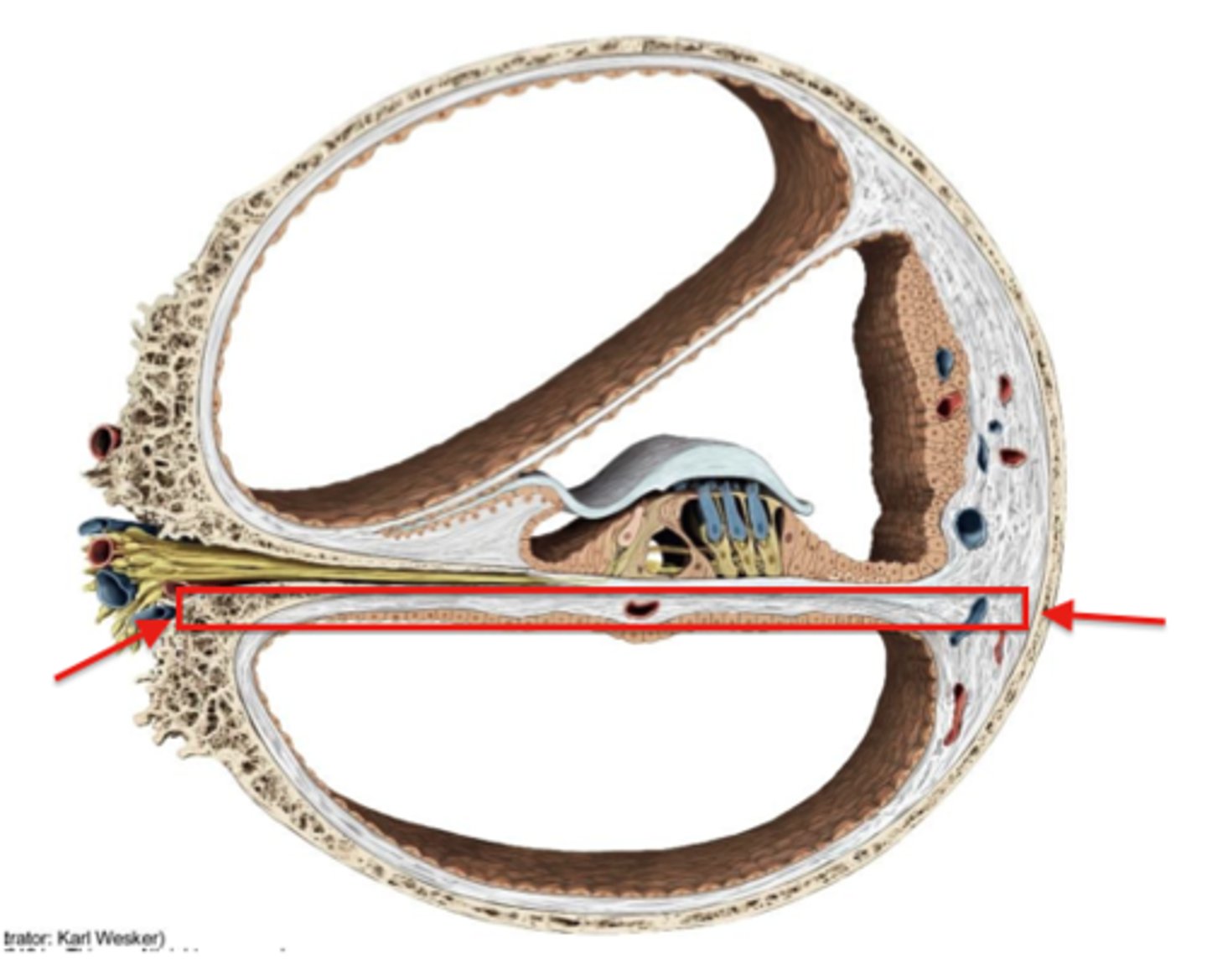
Basilar Membrane
Base of the organ of corti
- the surface from which sound is able to deflect
- stiffer at the base, more flexible at the apex
- vibrates in different places depending on frequency input.
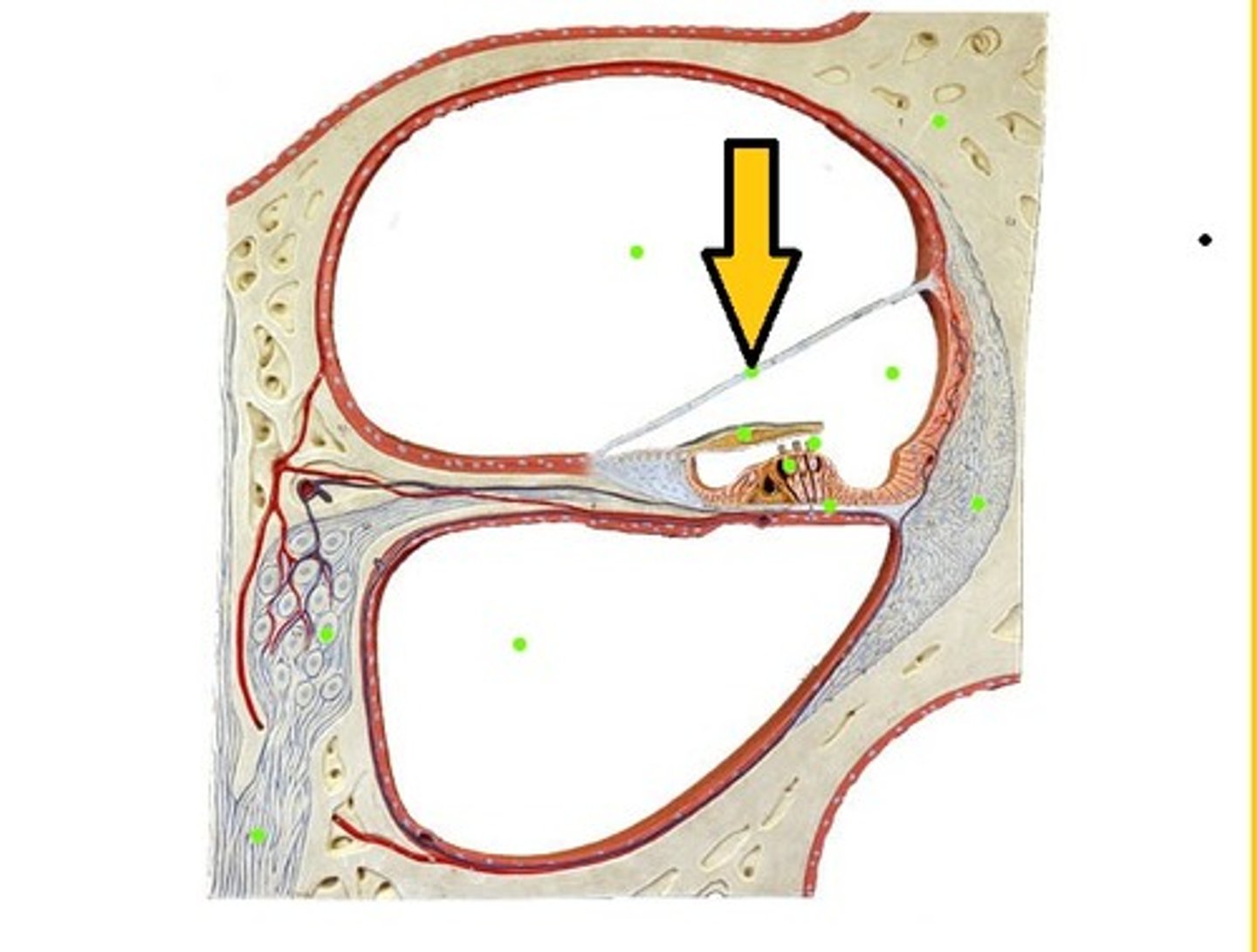
Reissner's Membrane
Surface of the membranous labyrinth (scala media) in the cochlea that separates scala media from scala vestibuli.
The Organ of Corti
The sensory organ within the cochlea that contains hair cells and is responsible for converting sound vibrations into neural signals.
purpose is to amplify sound further, transduce sound from kinetic to electric energy, and transmit that energy to the brain.
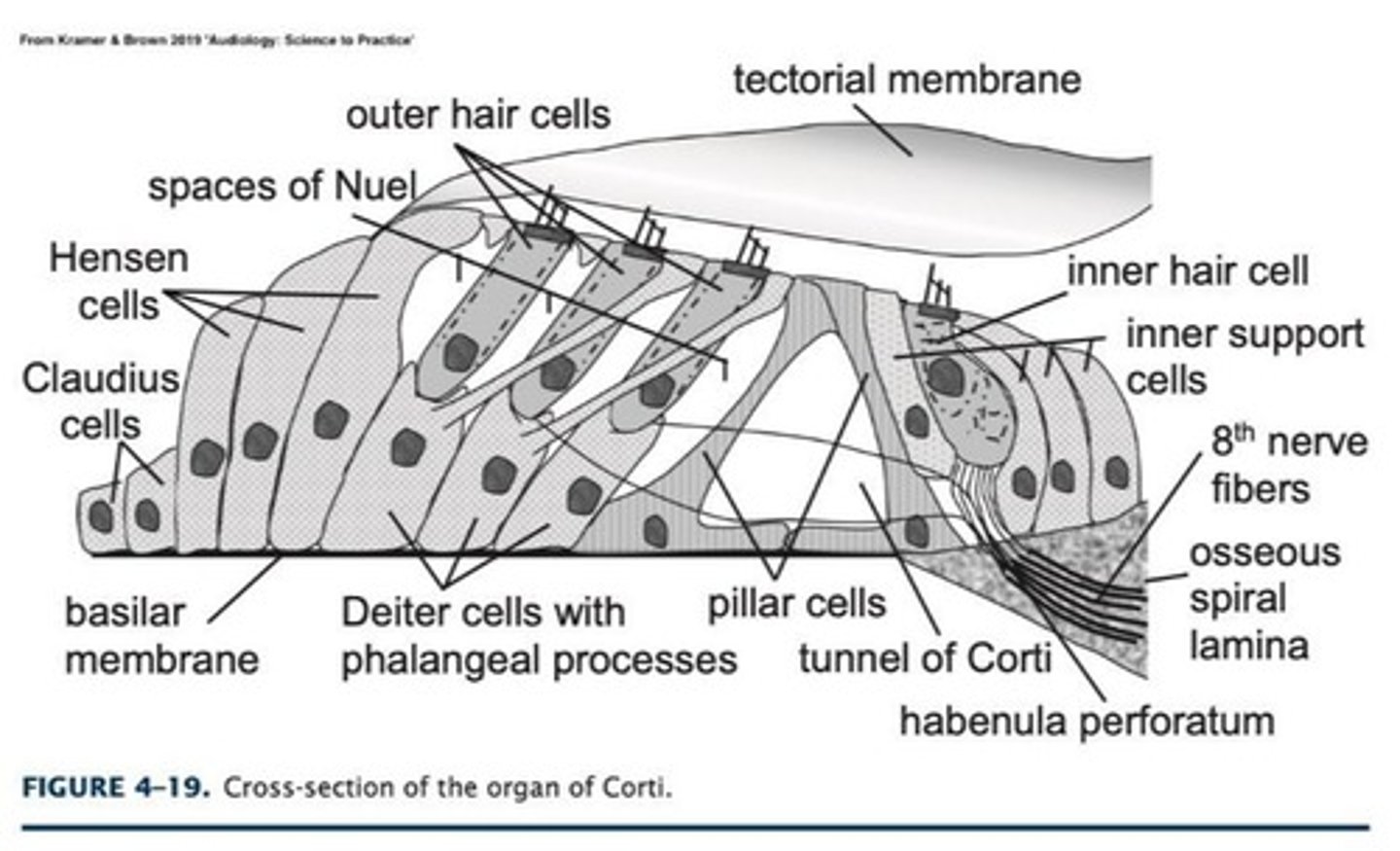
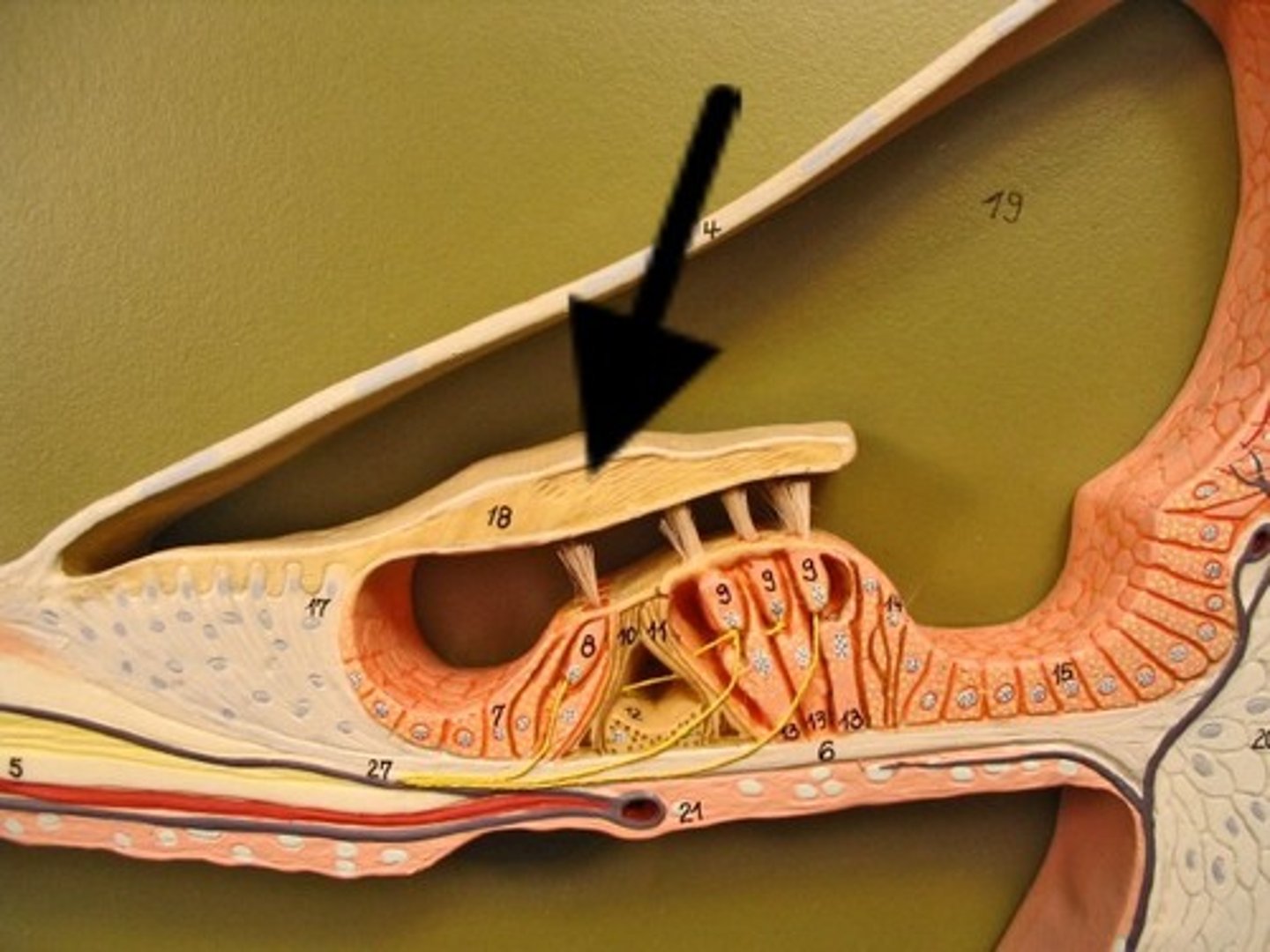
Tectorial Membrane
Thin membrane in the organ of Corti;
seems to play a role in frequency.
outer hair tips are inside the tectorial membrane
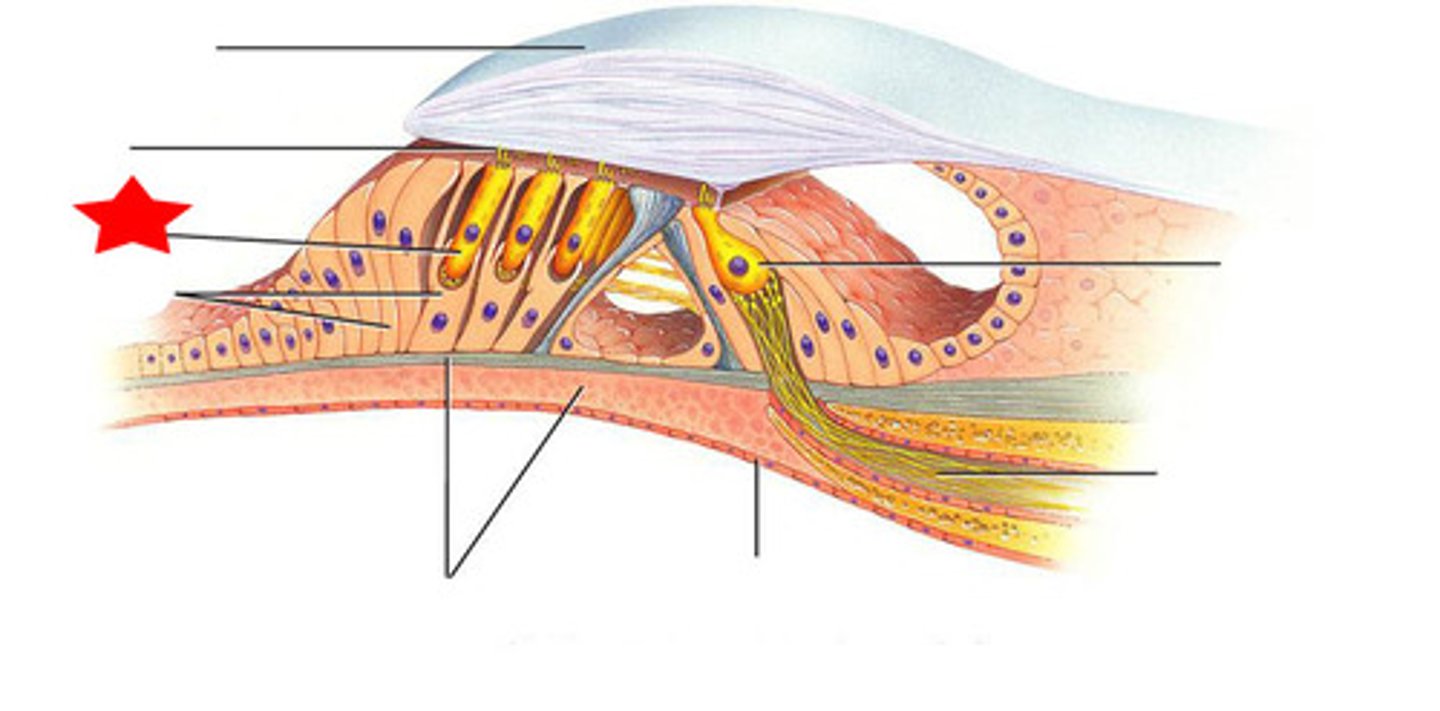
Outer Hair Cells
Help amplify motion of the basilar membrane; cell's length shifts in harmony with the sound; preferentially amplifies quiet sounds; form the 'cochlear amplifier'.
Inner Hair Cells
Transduce vibration into electric potential;
turn basilar membrane vibrations into nerve signals; directly connected to the nervous system; removal of inner hair cells = total loss of sound sensation/hearing.
The Stria Vascularis
Highly vascularized system of cells along the outer wall of the scala media in the cochlea that maintains ionic charge of the endolymph; produces endolymph.
The Spiral Ganglion
Collection of cell bodies of different auditory neurons; connects to the cochlear nerve.
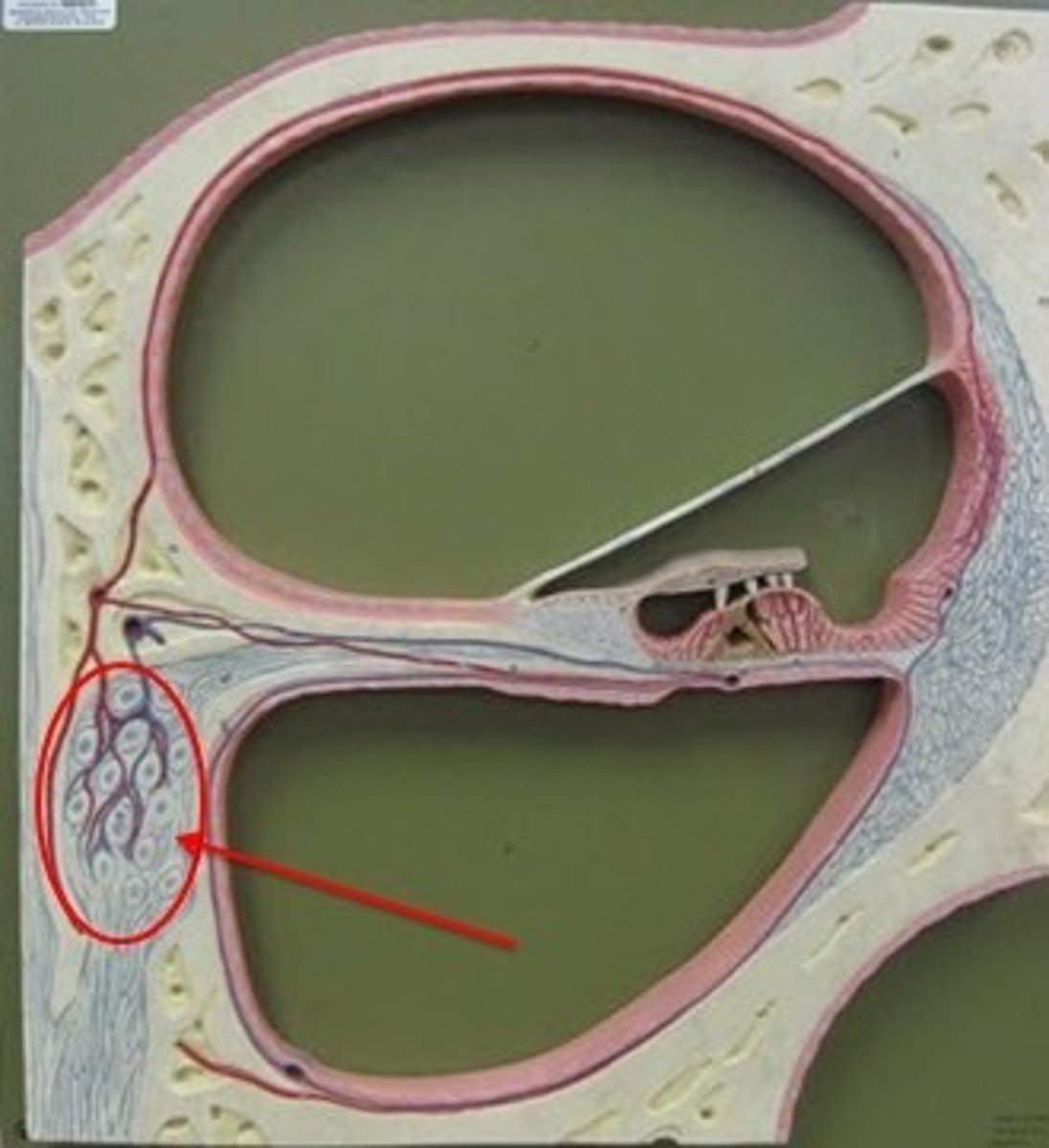
The Cochlear Nerve
Portion of the 8th cranial nerve consisting of nerve fibers from the cochlea; carries sound information from the cochlea's spiral ganglion to the brainstem.
The 8th Cranial Nerve/Vestibulocochlear Nerve
Sensory nerve made up of the cochlear and vestibular; connects to the pons and runs from the sensory receptors in the internal ear to the brainstem nuclei.
Bony Labyrinth
A complex system of interconnecting cavities in the inner ear that houses the cochlea, vestibule, and semicircular canals.
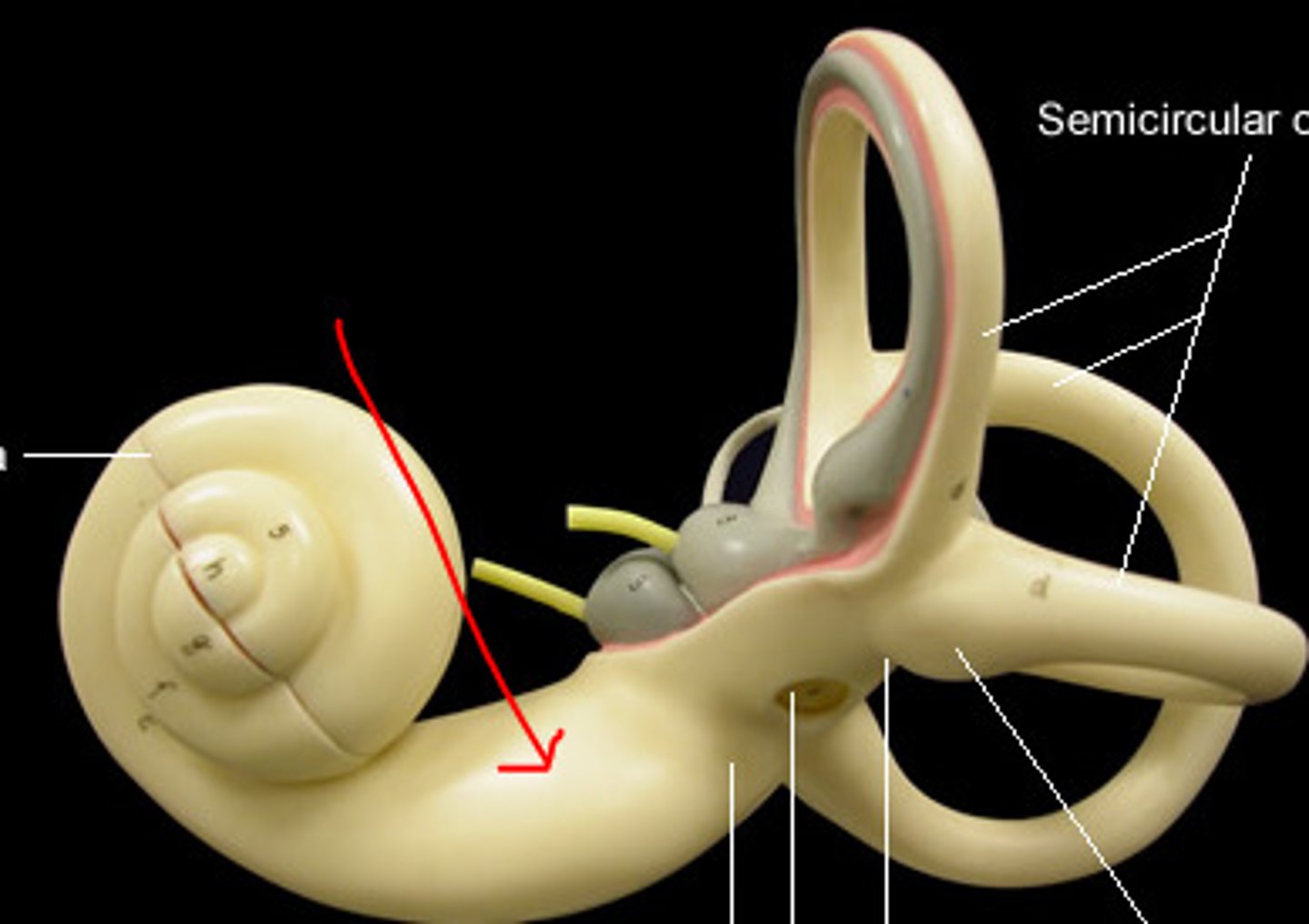
Cochlear Nerve vs 8th Nerve
The cochlear nerve is a part of the 8th cranial nerve that specifically carries auditory information.
Size of Adult Human Cochlea
Roughly 35 mm in length.
Acoustic Reflex
Tightening of the stapedius and tensor tympani muscles that dampens the vibration of the ossicles.
Impedance Matching and Amplification
Shrinking from tympanic membrane to stapes increases force and improves transduction.
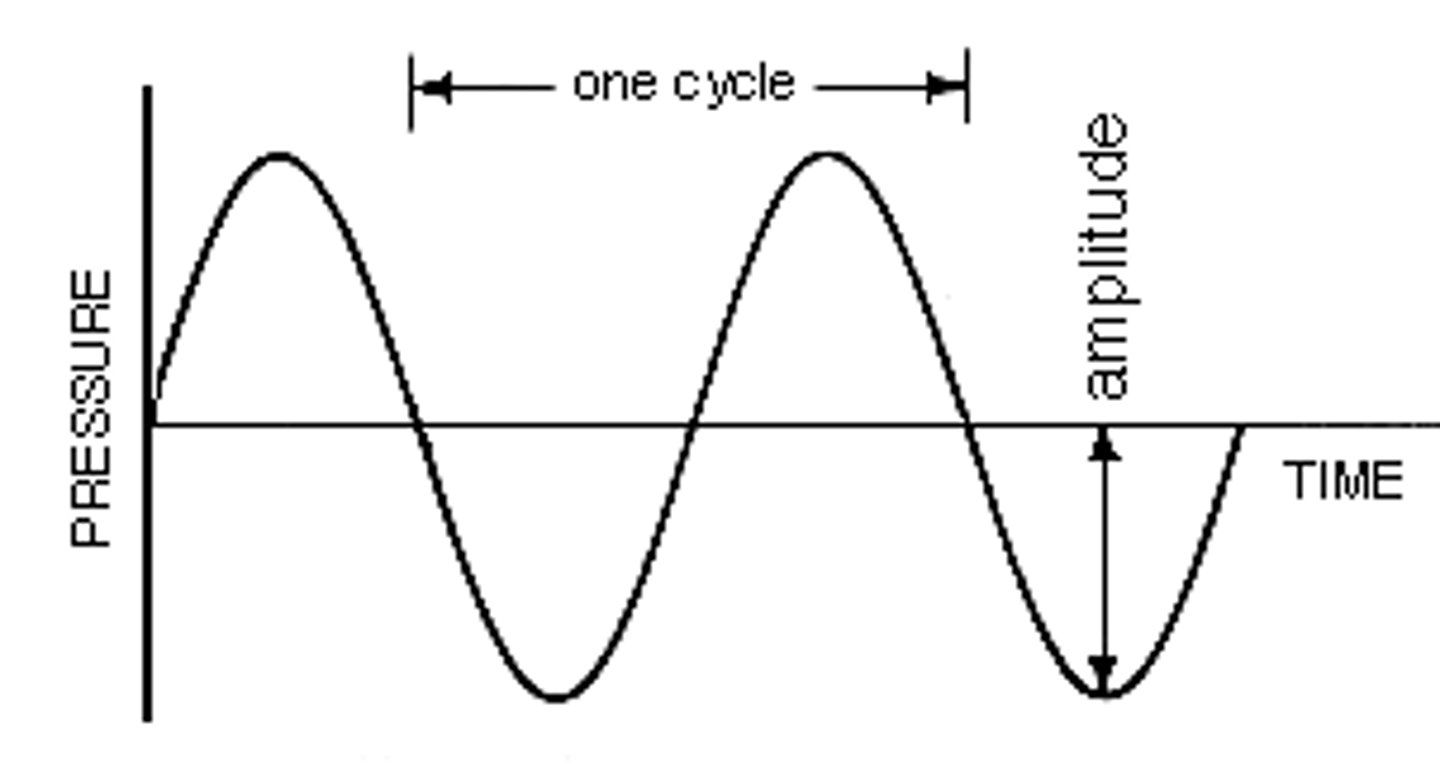
Duration
How long a sound lasts in milliseconds
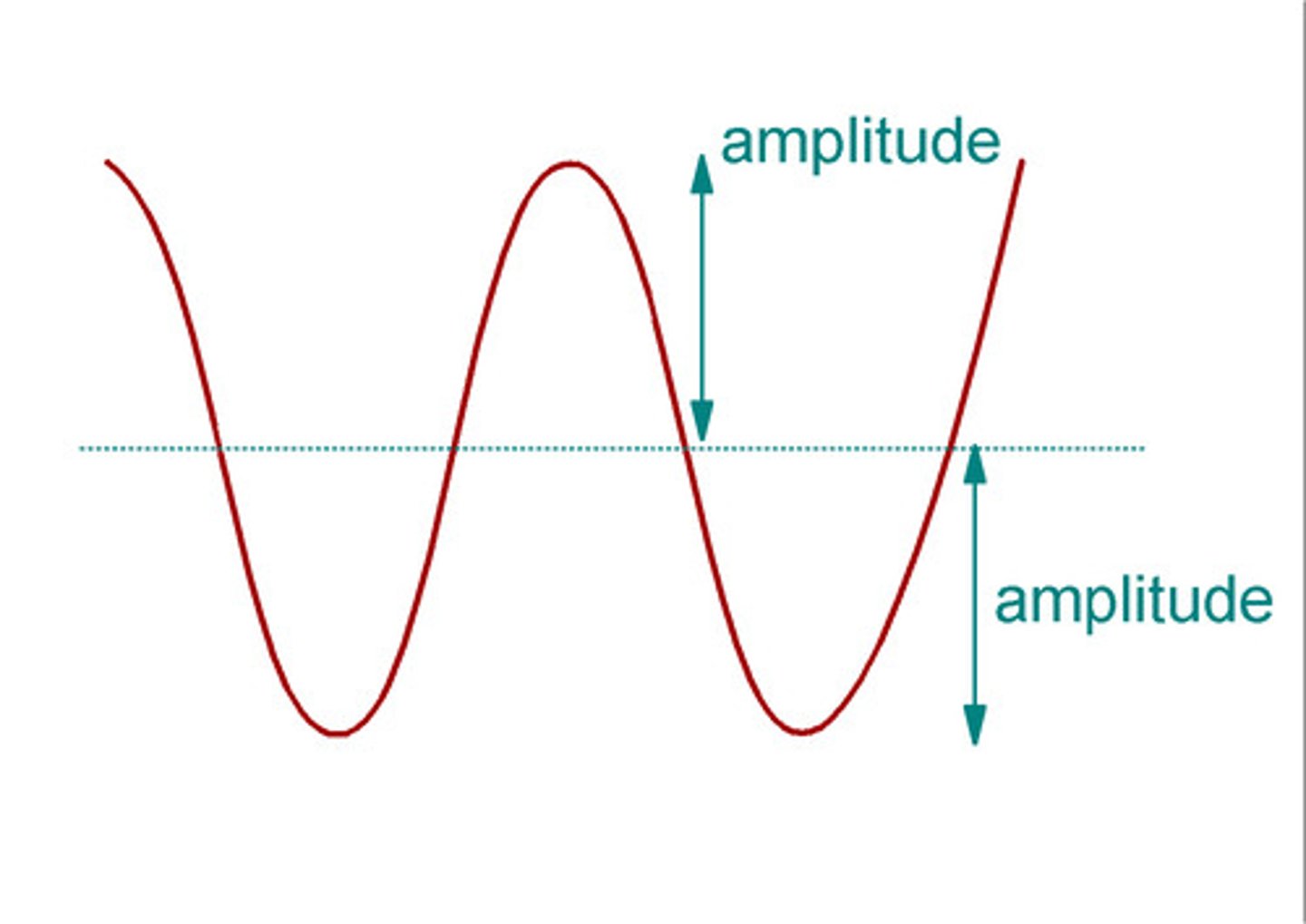
Amplitude
How powerful the sound is in decibels (dB)
high amplitude = loud noise
Period
How long does a single cycle take.
Frequency
How often does the sound cycle in Hertz
cycles per second
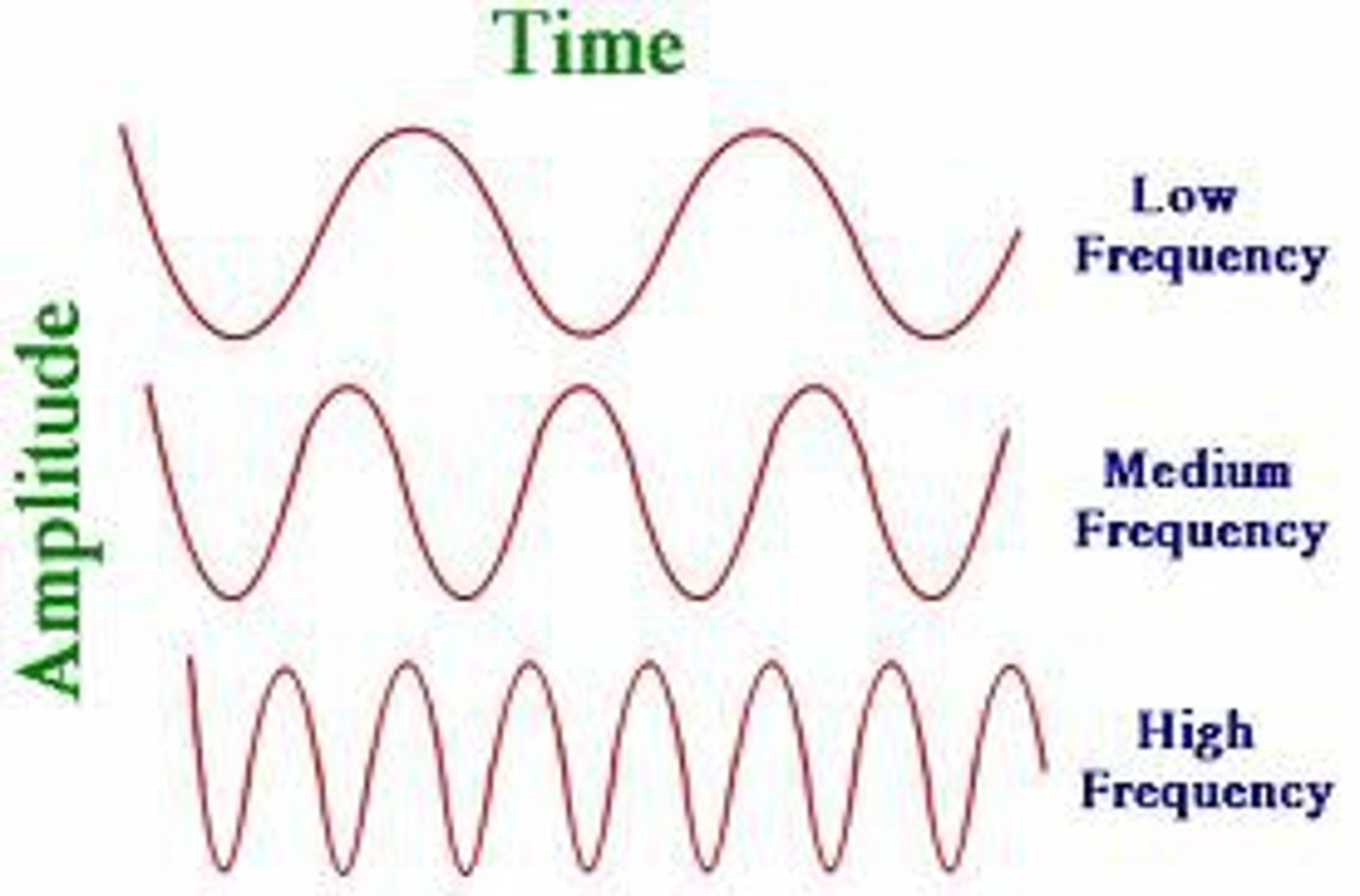
frequency formula
f= 1/t
f= frequency (Hz)
t= period (s)
greater period =
lower frequency
Pitch is the perceptual correlate of ____
frequency
Loudness is the perceptual correlate of ____
amplitude
Wavelength (λ)
How far can a wave travel in a single cycle; physical distance between peaks; calculating wavelength requires two pieces of information: how fast sound is moving (~343 meters per second) and how often, per second, the sound cycles (the frequency).
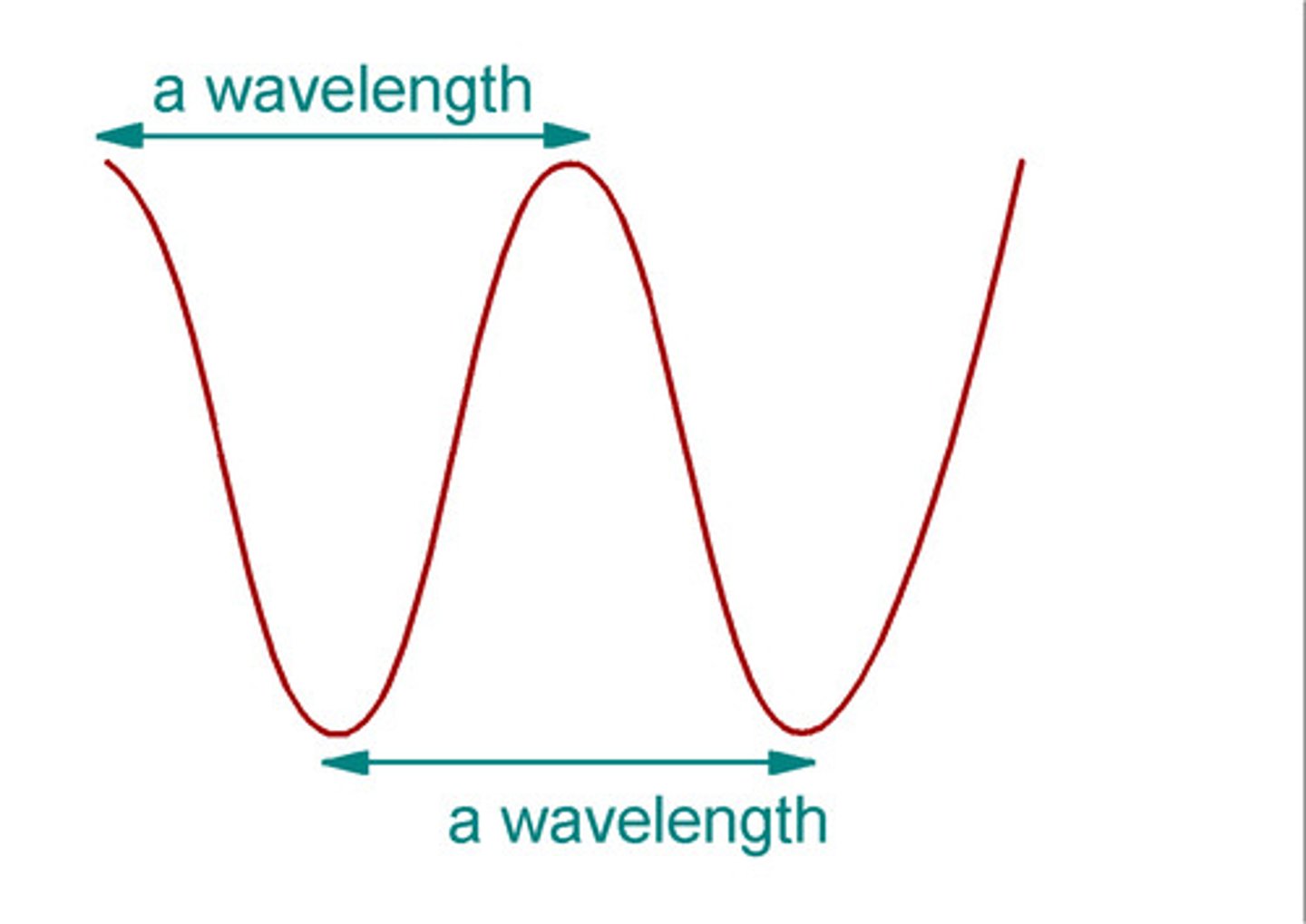
wavelength formula
λ= c/f
λ= wavelength
c= Speed of Sound in Air (343 m/s for this class)
f= frequency in Hz
lower frequencies have _ wavelengths
longer
Which fundamental properties of sound are related, and which change independently of one another?
Amplitude and Duration are not related to any other element.
Nor to each other.
Period, Frequency, and Wavelength are all related
Sinusoidal Sound
repeats, has a period, is a pure frequency that displays as a single pure tone
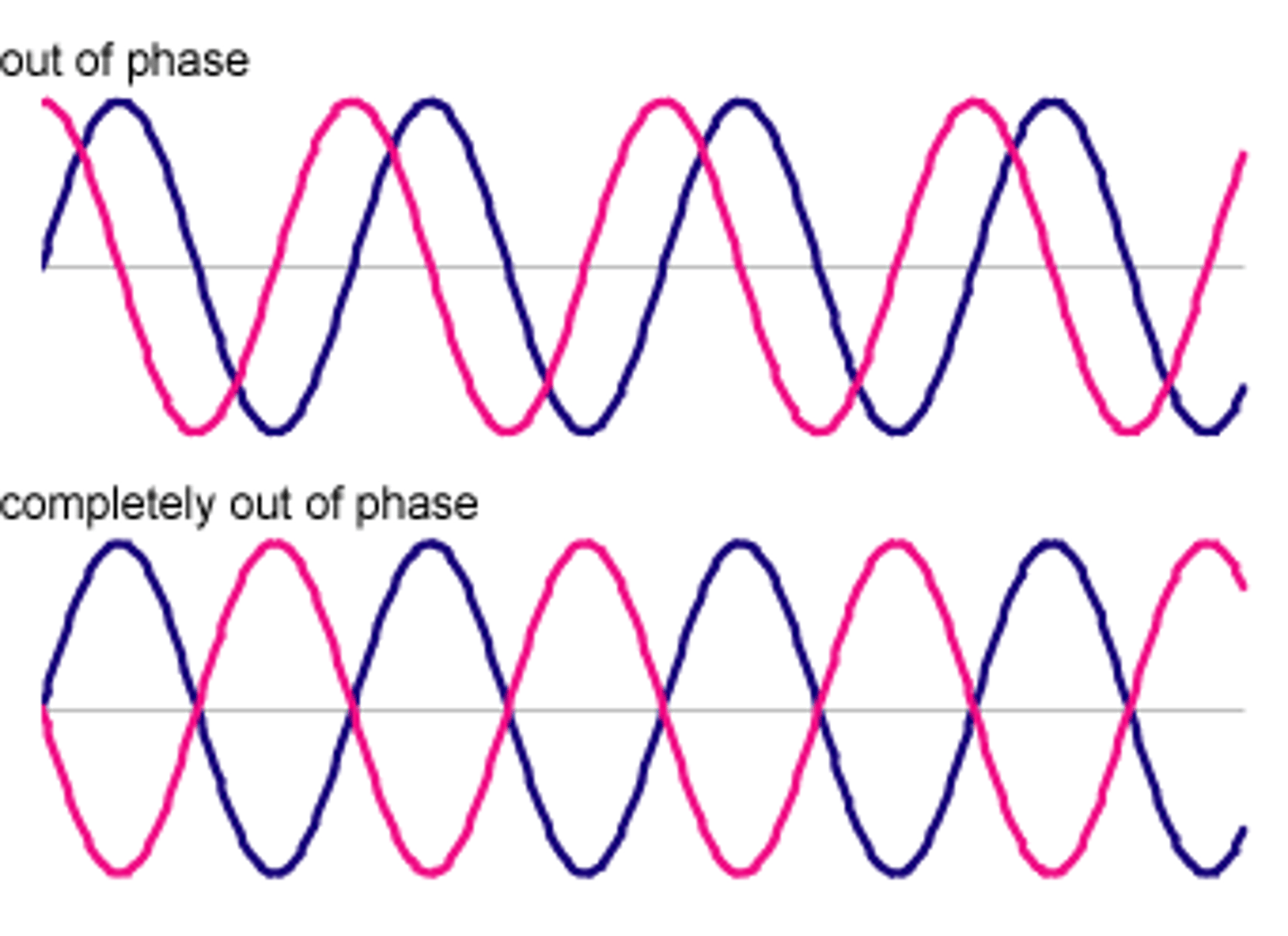
Phase
The point of the cycle in which a sound 'starts'
We measure phase in Degrees (°)
0° is the base, and is the same as 360°
180° is the exact opposite phase from 0°
Hertz
Unit of measurement for frequency.
Meters
Unit of measurement for wavelength.
Pascal (Pa)
Unit of measurement for amplitude; equivalent to Newtons per square meter.
Why don't we use Pascal to measure and discuss amplitudes in daily life?
Using Pascal to discuss sound would involve dealing with large or tiny numbers, which are less intuitive and harder to relate to our daily experience of sound.
Decibels (dB)
Unit of measurement for amplitude.
Seconds
Unit of measurement for frequency; related to sampling rate.
Degrees
Unit of measurement for phase.
Complex Sounds
Sounds which are made up of more than one component frequency; also, aperiodic sounds which aren't naturally derived from specific frequencies.
Sine-Wave Addition
The process of combining sine waves to create complex sounds.
interference
Multiple signals are 'interfering' with one another when they collide and affect one another
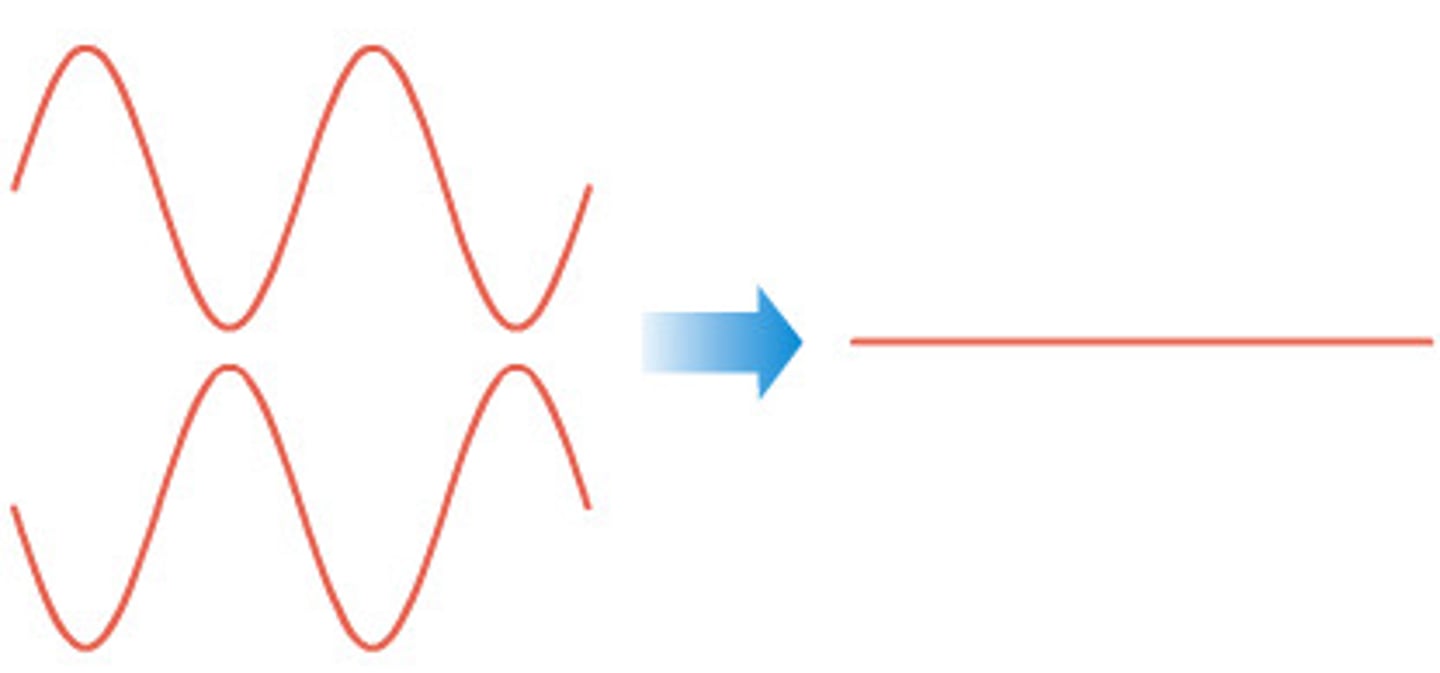
Phase Cancellation
Another way to think about destructive interference that arises due to differences in phase.
Why does phase cancellation work?
The amplitude of the combined wave becomes zero, effectively resulting in no sound.
How do we find the frequencies and phases of components of a complex wave?
1. Using spectra or spectrograms
2. Using a Fourier Transform lets us understand the component frequencies and their phases
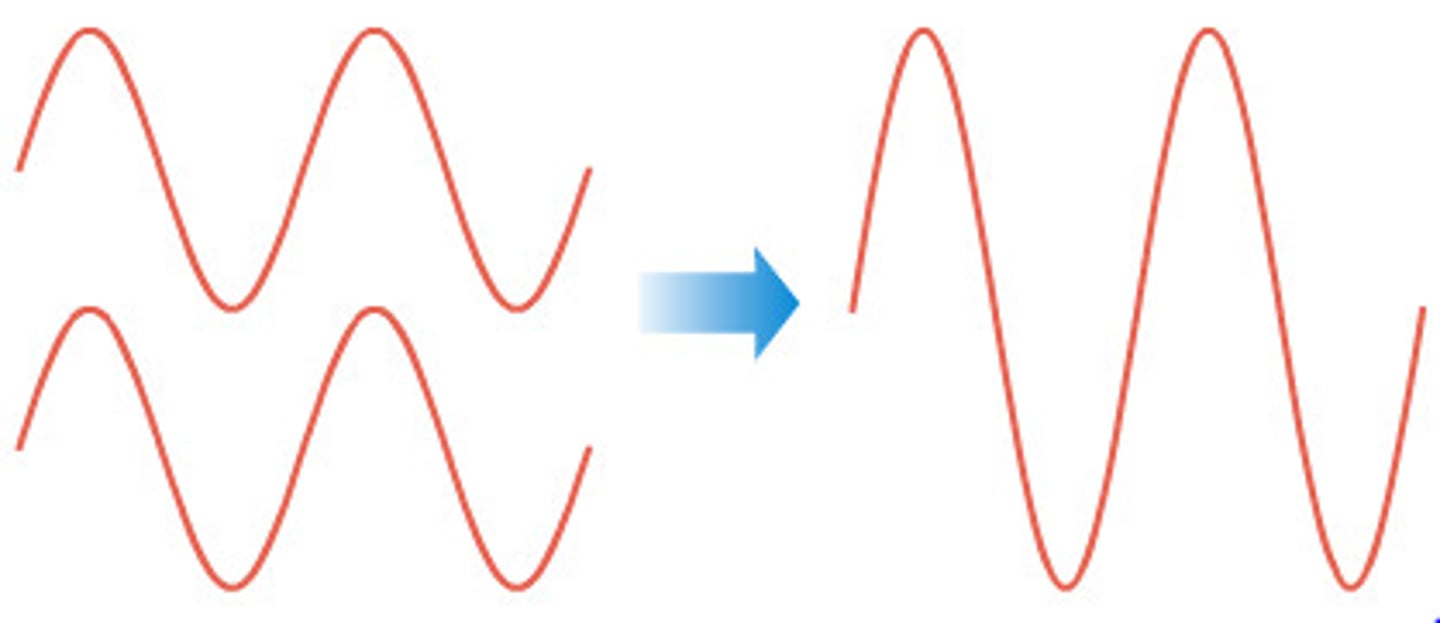
Constructive Interference
When multiple waves combine in such a way that they become stronger
Destructive Interference
When multiple waves combine in such a way that they become weaker
wave form
a horizontal cut through the wave showing peaks and valleys over time
spectral slice (FFT)
using a mathematical process called fourier transform which breaks a signal down into its component frequencies at a certain time
FFT= fast fourier transform
Fourier Transform (and FFT)
Mathematical relationship showing that any complex sound is a predictable combination of different pure tones; the cochlea does something similar to the FFT.
Spectrogram
Graphic output of a spectrograph displaying frequencies (y-axis) as a function of time (x-axis); intensity can be represented by the darkness of the displayed frequencies.
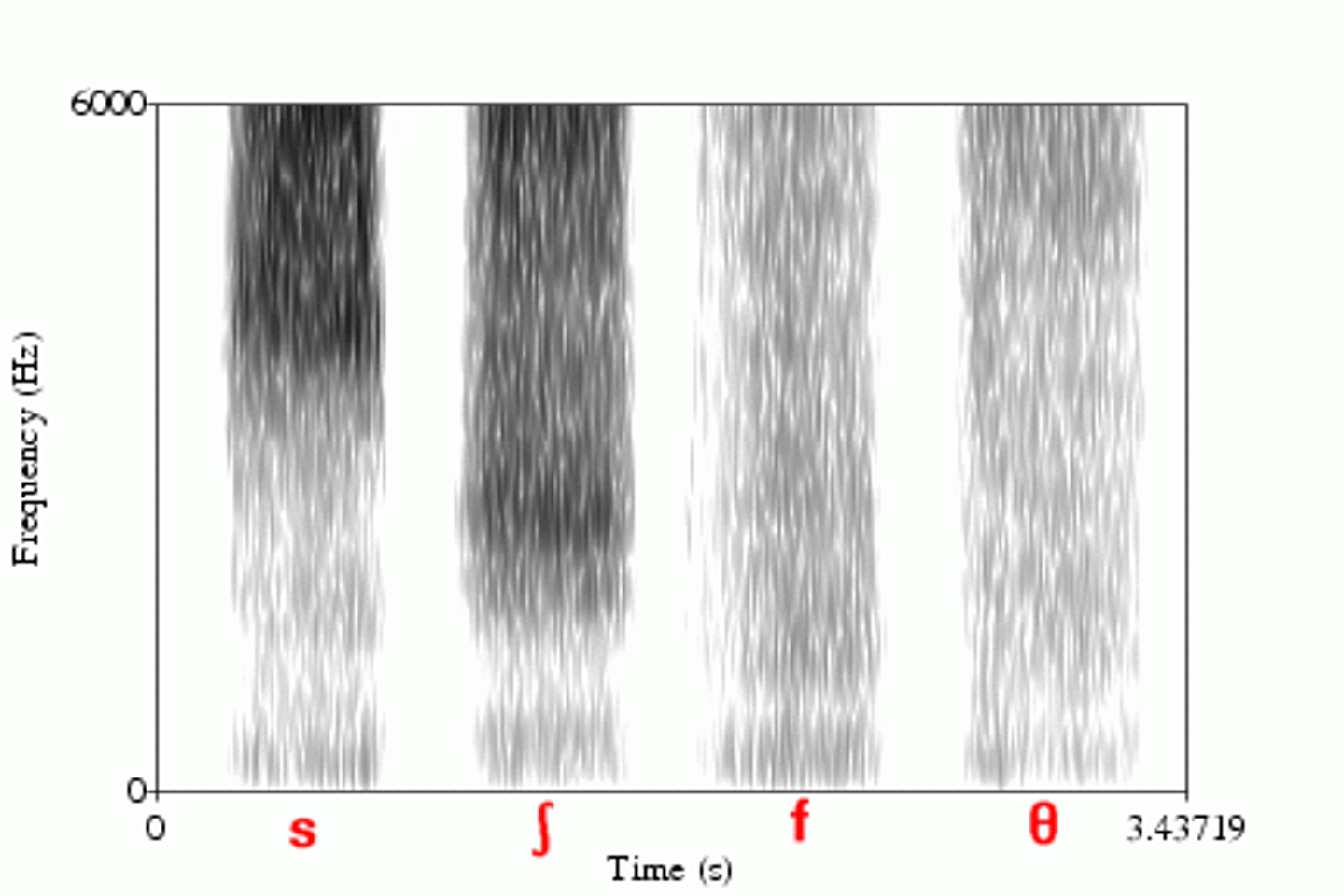
Why would we say that the basilar membrane acts like a fourier transform?
The basilar membrane inside the cochlea in the inner ear acts like a biological Fourier transform because it breaks down complex sounds into their individual frequency components — just like the Fourier transform does mathematically
Which basic characteristics of sound are humans sensitive to through hearing?
amplitude (loudness), frequency (pitch), and duration
Why do constructive and destructive interference happen in sound? Answer from the 'compression and rarefaction' perspective.
In constructive interference, the compressions and rarefactions line up in such a way that they add together, creating higher pressures and louder sounds.
In destructive interference, the compressions and rarefactions are opposite each other, which leads to them canceling out, resulting in reduced or no sound.
What's the relationship between fourier spectra and spectrograms?
fourier spectra: like a picture of all the frequencies in a sound taken at once
spectrograms: over time
High Pass Filter
Lets anything higher than a frequency pass through and blocks anything lower.
Low Pass Filter
Lets anything lower than a frequency pass through and blocks anything higher.
Band Pass Filter
Lets anything within a band through.
Band Stop / Band Reject / Notch Filter
Removes the band and any frequencies within the band.
Root-Mean-Square (RMS) Amplitude
Eliminates asymmetry between up and down; takes the mean amplitude for sound overall (captures that sounds varyin amplitude a lot).
Why does the distance from the source matter for amplitude measurement?
because distant sounds are quieter
What are the relative levels of risk for different amplitudes of sound? E.g. What's 'safe', 'safe for a limited time', and 'never safe'?
>0.36 Pascal long term
200 Pascal is possible but extremely painful
140dB highest tolerable sound with pain
85dB causes hearing damage over long term exposure
dB HL
HL= hearing loss
A measure of sound intensity calculated differently for each frequency, related to human perception of different frequencies' amplitudes.
dB SPL
Sound Pressure Level, which can be calculated from Pascal.
Explain what a microphone and speaker do, in terms of transduction from one type of signal to another? What is the input? What is the output?
transduces air pressure patterns into electrical patterns
Why do we have to quantize sound to capture it with computers?
computers can only work with discrete values, while sound is inherently analog (continuous in both time and amplitude).
Quantization/Sampling
The process of measuring a sound wave multiple times and storing those measurements, which involves analog to digital conversion.
 Note
Note  Flashcards (22)