Application of reproduction and genetics
0.0(0)
 Studied by 1 person
 Call Kai
 Learn
Learn Practice Test
 Spaced Repetition
 Match
Match Flashcards
 Knowt Play
Card Sorting
1/116

There's no tags or description
Looks like no tags are added yet.
Last updated 4:56 PM on 5/15/23
Name | Mastery | Learn | Test | Matching | Spaced | Call with Kai |
|---|
No analytics yet
Send a link to your students to track their progress
117 Terms
1
New cards
Define human genome project
the sequencing of the nucleotides in the human genome to identify all the genes present and which chromosome each gene is on (gene loci)
2
New cards
Define sanger sequencing
original method used to sequence the human genome
3
New cards
Define electrophoresis
method that separated the DNA fragments on the basis of their size, by their migration rate through a gel
4
New cards
Define centromeres and telomeres
the 10% of the human genome that wasn’t investigated (non-coding)
5
New cards
Define genetic profiling
study of an individual’s unique non-coding DNA, the STRs (short tandem repeats)
6
New cards
Define STR
short tandem repeats → sequences of bases in introns that repeat up to 100 times
7
New cards
Define PCR
* polymerase chain reaction
* uses semi-conservative replication of DNA from samples to amplify the mass of DNA present **without changing the sequence**
* uses semi-conservative replication of DNA from samples to amplify the mass of DNA present **without changing the sequence**
8
New cards
Define primer
a strand of DNA that pairs to a longer DNA strand, making a double-stranded section, to which DNA polymerase can attach to prior to replication
9
New cards
Define probe
* a short section of DNA that is labelled with a fluorescent or radioactive marker
* used to identify the position of the complementary base sequence
* used to identify the position of the complementary base sequence
10
New cards
Define restriction enzymes
bacterial enzymes that cut the sugar-phosphate backbone of DNA at specific nucleotide sequences
11
New cards
Define sticky end
the unpaired bases that protrude from a length of DNA when a staggered cut is made by a restriction enzyme → readily base pairs with a complementary strand
12
New cards
Define introns
non-coding sections of DNA, removed post-transcription so do not contribute to the sequence of bases in mRNA
13
New cards
Define reverse transcriptase
an enzyme derived from a retrovirus that catalyses the synthesis of cDNA from RNA template strands
14
New cards
Define vector
a virus or plasmid used as a vehicle for carrying foreign genetic material into a target cell
15
New cards
Define plasmid
small circular loop of self-replicating, double-stranded DNA in bacteria
16
New cards
Define marker genes
additional genes included in the transfer of genes into plasmids that can identify if the desired gene has been taken up by the plasmids (e.g. antibiotic resistance)
17
New cards
Define clone
population of genetically identical cells or organisms formed from a single cell or parent
18
New cards
Define gene therapy
treatment of genetic disease by replacing defective allele with an allele cloned from a healthy individual
19
New cards
Define germ line therapy
when the corrective gene is inserted into the ‘germ line cells’ (cells that replicate to form daughter cells)
20
New cards
Define somatic cell therapy
when corrective gene is inserted into body cells in affected tissues meaning corrective gene is not inherited by daughter cells
21
New cards
Define liposomes
hollow phospholipid spheres that can be used to transfer molecules, such as genetic material, into cells
22
New cards
Define stem cells
unspecialised cells that can develop and differentiate into many different types of cell
23
New cards
Define totipotent cells
cells that retain the ability to differentiate into every cell type within an organism
24
New cards
What were the aims of the Human Genome Project?
* identify all genes in the human genome and identify which chromosome each is on
* determine sequence of the 3 billion base pairs in human DNA and store this information in data bases
* improve tools for data analysis
* transfer related technologies to private sector to develop medical innovation
* address ethical, legal and social issues that arise from the project
* determine sequence of the 3 billion base pairs in human DNA and store this information in data bases
* improve tools for data analysis
* transfer related technologies to private sector to develop medical innovation
* address ethical, legal and social issues that arise from the project
25
New cards
What were the main findings of the the Human Genome Project?
* humans have about 20500 genes → fewer than expected
* more repeated segments of DNA than expected
* less than 7% of families of proteins were specific to vertebrates → highlights close relationship between all living organisms
* more repeated segments of DNA than expected
* less than 7% of families of proteins were specific to vertebrates → highlights close relationship between all living organisms
26
New cards
What is NGS?
* next generation sequencing
* used to collectively refer to new rapid sequencing techniques that could sequence an entire genome in a couple of hours
* used to collectively refer to new rapid sequencing techniques that could sequence an entire genome in a couple of hours
27
New cards
What is the 100K genome project?
used NGS to sequence 100 000 genomes from NHS patients with cancer/rare diseases and their family members
28
New cards
What are the aims of the 100K genome project?
* create ethical, transparent programme based on consent
* set up genomic service for NHS to benefit patients
* enable medical + scientific discovery
* develop a UK genomics industry
* set up genomic service for NHS to benefit patients
* enable medical + scientific discovery
* develop a UK genomics industry
29
New cards
What are the ethical concerns for the human genome and 100K genome projects?
* **ownership of genetic information** → base sequence is property of individual so safeguards put in place to prevent misuse
* if predisposed to certain disease, insurance premiums may be higher or may not be given access to life insurance
* if DNA suggests particular ancestry → social discrimination
* no company should make financial profit using DNA sequence without permission
* **identification of allele sequences →** DNA can be scanned for sequences correlated with future health problems
* may not want to know
* if same conditions could affect close relatives, do relatives have right to know about information?
* **genetic screening useful in association with genetic counselling →** if history of genetic defect, family can consult genetic counsellor for advice about possibility of them or their children having defect.
* Advice based on:
* who in family has condition
* whether parents are closely related
* frequency of relative gene in general population
* if genetic counsellor has DNA sequence then advice more significant
* **screening of embryos made during in vitro fertilisation →** screen for presence of alleles for diseases such as cystic fibrosis and Huntington’s
* choice made to use only healthy embryo
* **embryo screening to select particular characteristics** → sporting ability/good looks
* not yet able to do but if we can in future need to decide whether, how and by whom these decisions are made by
* **parents might have their children screened for diseases →** would have genetic property of child
* does parent have a right to this knowledge?
* suggests child’s DNA is property of parent
* **storage and security of genomic data** → could be hacked
* if predisposed to certain disease, insurance premiums may be higher or may not be given access to life insurance
* if DNA suggests particular ancestry → social discrimination
* no company should make financial profit using DNA sequence without permission
* **identification of allele sequences →** DNA can be scanned for sequences correlated with future health problems
* may not want to know
* if same conditions could affect close relatives, do relatives have right to know about information?
* **genetic screening useful in association with genetic counselling →** if history of genetic defect, family can consult genetic counsellor for advice about possibility of them or their children having defect.
* Advice based on:
* who in family has condition
* whether parents are closely related
* frequency of relative gene in general population
* if genetic counsellor has DNA sequence then advice more significant
* **screening of embryos made during in vitro fertilisation →** screen for presence of alleles for diseases such as cystic fibrosis and Huntington’s
* choice made to use only healthy embryo
* **embryo screening to select particular characteristics** → sporting ability/good looks
* not yet able to do but if we can in future need to decide whether, how and by whom these decisions are made by
* **parents might have their children screened for diseases →** would have genetic property of child
* does parent have a right to this knowledge?
* suggests child’s DNA is property of parent
* **storage and security of genomic data** → could be hacked
30
New cards
Why have genomes from non-human organisms been sequenced?
* can drawn conclusions about evolutionary relationships
* provide true phylogenetic classification
* comparisons indicate to conservation scientists which species need particular protection
* provide true phylogenetic classification
* comparisons indicate to conservation scientists which species need particular protection
31
New cards
What are the 2 main ways that malaria transmission can be prevented?
* killing the vector → Anopheles mosquito
* killing the parasite → Plasmodium
* killing the parasite → Plasmodium
32
New cards
How is the DNA sequencing of the Anopheles mosquito useful in preventing the spread of malaria?
* genome used to try develop chemicals that prevent mosquitoes transmitting malaria
* CRISPR-Cas9 wrote in gene that synthesised antibodies against Plasmodium
* lab tests showed that this was effective in genetically modified mosquitoes
* CRISPR-Cas9 wrote in gene that synthesised antibodies against Plasmodium
* lab tests showed that this was effective in genetically modified mosquitoes
33
New cards
How is DNA sequencing of Plasmodium useful in preventing the spread of malaria?
knowledge of genome will enable scientists to develop more effective drugs
34
New cards
How much of a person’s genetic profile is unique?
0\.1%
35
New cards
Why is a genetic profile not the same as a DNA sequence?
it only represents non-coding portions of DNA
36
New cards
Which techniques are used to obtain a genetic profile?
* PCR → makes large numbers of copies of DNA fragments
* gel electrophoresis → separates the DNA fragments based on size
* gel electrophoresis → separates the DNA fragments based on size
37
New cards
What is required for the polymerase chain reaction to take place?
* DNA sample dissolved in buffer and mixed with:
* Taq polymerase
* DNA polymerase from bacteria that live in hot springs
* optimum temperature is 80°C
* nucleotides containing the 4 DNA bases
* short single-stranded pieces of DNA (6 - 25 bases long)
* complementary to the start of the DNA strand and bind to it, signalling taq polymerase to start replication
* rapid temperature change required
* happens in thermocycler
* Taq polymerase
* DNA polymerase from bacteria that live in hot springs
* optimum temperature is 80°C
* nucleotides containing the 4 DNA bases
* short single-stranded pieces of DNA (6 - 25 bases long)
* complementary to the start of the DNA strand and bind to it, signalling taq polymerase to start replication
* rapid temperature change required
* happens in thermocycler
38
New cards
What are the steps of the polymerase chain reaction?
* original ‘target’ DNA heated to 95°C → separated into 2 single strands
* solution cooled to 55°C → cool enough for primers to anneal to complementary base sequences on single strands of DNA
* solution heated to 70°C and taq polymerase adds complementary nucleotides, catalysing formation of complementary strand
* elongation/extension phase
* 2 complementary strands produced for the 2 single stranded DNA → process starts again but with 2 DNA strands instead of 1
* repeats until sufficient amplification reached
* solution cooled to 55°C → cool enough for primers to anneal to complementary base sequences on single strands of DNA
* solution heated to 70°C and taq polymerase adds complementary nucleotides, catalysing formation of complementary strand
* elongation/extension phase
* 2 complementary strands produced for the 2 single stranded DNA → process starts again but with 2 DNA strands instead of 1
* repeats until sufficient amplification reached
39
New cards
What are the limitations of the polymerase chain reaction?
* contamination
* DNA that enters system accidentally can be amplified
* could be air-borne, come from the experimenter or from contaminated reagents
* most commonly from using same apparatus twice
* error rate
* DNA polymerase may insert wrong nucleotide
* taq polymerase unable to proofread
* DNA fragment size
* most efficient for DNA 1000-3000 base pairs long because taq polymerase can’t proofread
* if lower temperature, higher pH and a proofreading polymerase added in addition to taq polymerase, length of 40 000 base pairs can be generated → human genes much longer than this
* sensitivity to inhibitors
* molecules in sample may act as inhibitors of pcr
* phenolics
* humic acids
* haem breakdown products that bind with Mg²⁺ → needed by DNA polymerase to function
* traditional blue dye in denim
* limits on amplification
* after 20 cycles, pcr slows down, increase becomes linear and then plateaus because:
* reagent concentrations become limiting
* enzyme denatures after repeated heating
* DNA in high concentrations causes single stranded molecules to base pair with each other
* DNA that enters system accidentally can be amplified
* could be air-borne, come from the experimenter or from contaminated reagents
* most commonly from using same apparatus twice
* error rate
* DNA polymerase may insert wrong nucleotide
* taq polymerase unable to proofread
* DNA fragment size
* most efficient for DNA 1000-3000 base pairs long because taq polymerase can’t proofread
* if lower temperature, higher pH and a proofreading polymerase added in addition to taq polymerase, length of 40 000 base pairs can be generated → human genes much longer than this
* sensitivity to inhibitors
* molecules in sample may act as inhibitors of pcr
* phenolics
* humic acids
* haem breakdown products that bind with Mg²⁺ → needed by DNA polymerase to function
* traditional blue dye in denim
* limits on amplification
* after 20 cycles, pcr slows down, increase becomes linear and then plateaus because:
* reagent concentrations become limiting
* enzyme denatures after repeated heating
* DNA in high concentrations causes single stranded molecules to base pair with each other
40
New cards
What are the steps in gel electrophoresis?
* DNA extracted and cut into fragments of varying sizes by restriction endonucleases
* DNA samples loaded into well at one end of gel
* voltage applied across the gel → phosphate groups of DNA backbone negatively charged so fragments attracted to anode
* if fragments of known length (DNA ladder) are separated on same gel at same time, length of fragments under test can be estimated
* electrophoresis trough covered with nylon membrane → picks up DNA fragments (Southern blotting)
* radioactive/luminescent DNA probes (contain sequences complementary to STRs) attach by base pairing to specific parts of fragment
* unbound probes washed off
* film sensitive to x-rays/wavelengths given off by luminescent probe placed over Southern blot overnight
* film exposed and autoradiograph reveals banding pattern
* dark bands show position of probe and therefore repeated sequences
* this pattern is the genetic profile
* DNA samples loaded into well at one end of gel
* voltage applied across the gel → phosphate groups of DNA backbone negatively charged so fragments attracted to anode
* if fragments of known length (DNA ladder) are separated on same gel at same time, length of fragments under test can be estimated
* electrophoresis trough covered with nylon membrane → picks up DNA fragments (Southern blotting)
* radioactive/luminescent DNA probes (contain sequences complementary to STRs) attach by base pairing to specific parts of fragment
* unbound probes washed off
* film sensitive to x-rays/wavelengths given off by luminescent probe placed over Southern blot overnight
* film exposed and autoradiograph reveals banding pattern
* dark bands show position of probe and therefore repeated sequences
* this pattern is the genetic profile
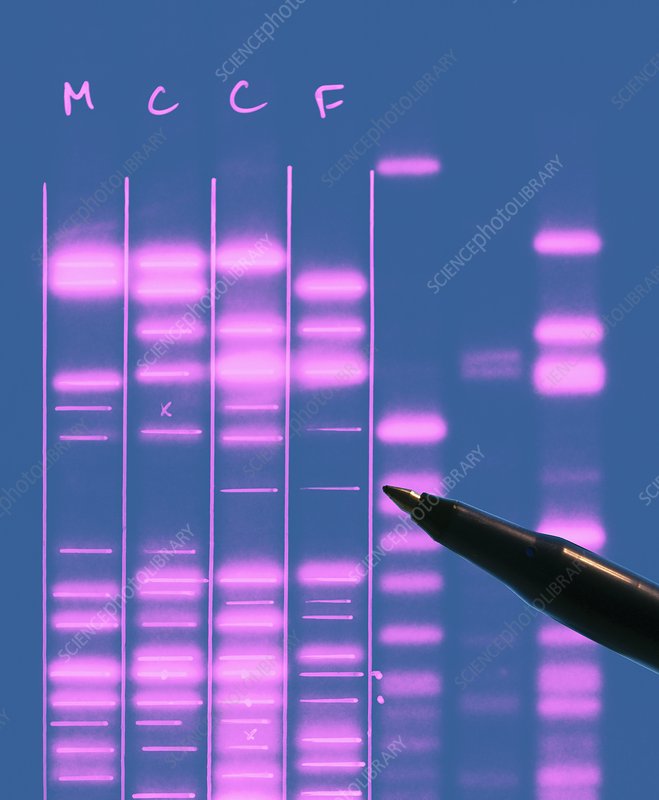
41
New cards
What can DNA profiling be used to test for?
* paternity
* DNA from white blood cell used to construct DNA profiles
* Any bands that child and mother share were inherited from her
* remaining bands inherited from father
* if they don’t match, then not the father
* if they do match, high possibility he is but not absolute proof
* twins
* monozygotic (identical) twins have exactly the same bands
* dizygotic twins (fraternal) don’t
* can be used to identify which kind of twins babies are
* siblings
* adopted people may want to confirm alleged biological siblings are blood relatives
* if they are, on average, half their gene will be identical
* immigration
* some visa applications depend on proof of relatedness
* forensic uses
* identify and rule out suspects
* phylogenetic studies
* profiles of members of different taxa can be compared to determine whether they’ve been classified suitably and how close they are genetically
* DNA from white blood cell used to construct DNA profiles
* Any bands that child and mother share were inherited from her
* remaining bands inherited from father
* if they don’t match, then not the father
* if they do match, high possibility he is but not absolute proof
* twins
* monozygotic (identical) twins have exactly the same bands
* dizygotic twins (fraternal) don’t
* can be used to identify which kind of twins babies are
* siblings
* adopted people may want to confirm alleged biological siblings are blood relatives
* if they are, on average, half their gene will be identical
* immigration
* some visa applications depend on proof of relatedness
* forensic uses
* identify and rule out suspects
* phylogenetic studies
* profiles of members of different taxa can be compared to determine whether they’ve been classified suitably and how close they are genetically
42
New cards
What are the advantages of DNA profiling?
* non- invasive
* mouth swabs, urine or hair instead of blood
* can be used on samples that would be too small for blood testing
* has reversed wrongful convictions
* can rule out non-matches of DNA samples
* exonerate people who were falsely accused
* efforts are being made to store genetic material from people around the world, before isolated groups are intermixed and lost
* mouth swabs, urine or hair instead of blood
* can be used on samples that would be too small for blood testing
* has reversed wrongful convictions
* can rule out non-matches of DNA samples
* exonerate people who were falsely accused
* efforts are being made to store genetic material from people around the world, before isolated groups are intermixed and lost
43
New cards
What are the disadvantages of DNA profiling?
* violation of right to privacy and civil liberties
* DNA profile held in computer databases
* may be hacked or misused
* individuals may suffer a loss of privacy
* offer probabilities, not absolutes
* with a given number of sample in a database, may be a 1 in a million chance that an apparent match correctly identifies someone
* access to and use of data must be highly regulated
* could be used by insurers to deny coverage and claims
* prospective employers could avoid hiring those with certain traits or risks of certain diseases
* private information (e.g. gender reassignment) could be made public without consent
* could cause wrongful convictions if:
* used inappropriately to influence judges and juries → especially is lack understanding of significance of results
* errors may occur in procedure
* people conducting tests might not be trustworthy
* DNA evidence is planted at crime scene
* DNA profile held in computer databases
* may be hacked or misused
* individuals may suffer a loss of privacy
* offer probabilities, not absolutes
* with a given number of sample in a database, may be a 1 in a million chance that an apparent match correctly identifies someone
* access to and use of data must be highly regulated
* could be used by insurers to deny coverage and claims
* prospective employers could avoid hiring those with certain traits or risks of certain diseases
* private information (e.g. gender reassignment) could be made public without consent
* could cause wrongful convictions if:
* used inappropriately to influence judges and juries → especially is lack understanding of significance of results
* errors may occur in procedure
* people conducting tests might not be trustworthy
* DNA evidence is planted at crime scene
44
New cards
What is genetic engineering?
manipulation, altering and transferal of genes from one organism or species to another, making a genetically modified organism
45
New cards
What are the applications of genetic engineering?
* the transfer of genes or gene fragments into:
* bacteria → make useful products like insulin
* plants and animals → acquire new characteristics (e.g. resistance to disease)
* humans → reduce the effects of genetic diseases (e.g. Duchenne muscular dystrophy)
* \
* bacteria → make useful products like insulin
* plants and animals → acquire new characteristics (e.g. resistance to disease)
* humans → reduce the effects of genetic diseases (e.g. Duchenne muscular dystrophy)
* \
46
New cards
Define recombinant DNA
DNA produced by combining DNA from two different species
47
New cards
Define transgenic
an organism that has been genetically modified by the addition of a gene or genes from another species
48
New cards
What is another name for genetic engineering?
recombinant DNA technology
49
New cards
What is a transformed cell?
a cell that has incorporated a plasmid containing a foreign gene
50
New cards
What are the main steps in producing using genetic engineering technology?
* isolation of DNA fragments
* insertion of DNA fragment into a vector
* transfer of DNA into a suitable host cell
* identification of host cell that has taken up the gene, using gene markers
* cloning the transformed host cell
* insertion of DNA fragment into a vector
* transfer of DNA into a suitable host cell
* identification of host cell that has taken up the gene, using gene markers
* cloning the transformed host cell
51
New cards
How is a gene located in the process of genetic engineering? Use the production of human insulin in E. coli as an example
* donor molecule of human DNA contains gene that codes for insulin
* gene identified with gene probe
* specific segment of single-stranded DNA that’s complementary to a section of the gene
* gene identified with gene probe
* specific segment of single-stranded DNA that’s complementary to a section of the gene
52
New cards
How is a gene isolated in the process of genetic engineering? Use the production of human insulin in E. coli as an example
Using restriction endonuclease
* restriction endonuclease (EcoR1 in E. coli)
* bacterial enzyme that cuts DNA at specific nucleotide sequence
* sequence can occur in many places → DNA cut into small fragments
* individual genes isolated
* EcoR1 catalyses formation of breaks in DNA backbone where a guanine is next to adenine
* creates staggered cut and isolates insulin gene
Using reverse transcriptase
* β-cells of pancreas have large quantities of mRNA transcribed from the gene coding for insulin
* mRNA extracted read by enzyme reverse transcriptase to produce cDNA → complementary to the RNA
* many copies of cDNA complementary to the mRNA for insulin can be made
* restriction endonuclease (EcoR1 in E. coli)
* bacterial enzyme that cuts DNA at specific nucleotide sequence
* sequence can occur in many places → DNA cut into small fragments
* individual genes isolated
* EcoR1 catalyses formation of breaks in DNA backbone where a guanine is next to adenine
* creates staggered cut and isolates insulin gene
Using reverse transcriptase
* β-cells of pancreas have large quantities of mRNA transcribed from the gene coding for insulin
* mRNA extracted read by enzyme reverse transcriptase to produce cDNA → complementary to the RNA
* many copies of cDNA complementary to the mRNA for insulin can be made
53
New cards
What are the 2 kinds of cuts that restriction enzymes make?
* blunt cut → straight across DNA double helix
* staggered cut →leaves unpaired bases on both strands
* staggered cut →leaves unpaired bases on both strands
54
New cards
What is the enzyme reverse transcriptase made by?
retroviruses
55
New cards
What are the disadvantages of using restriction endonucleases to isolate a gene?
* if recognition sequence occurs within the gene of interest, gene will be broken into fractions that have no function
* eukaryotic genes contain introns
* don’t contribute to mRNA
* using the whole gene = introns incorporated into plasmids
* bacteria don’t have introns and therefore don’t have appropriate enzymes to remove them
* eukaryotic genes contain introns
* don’t contribute to mRNA
* using the whole gene = introns incorporated into plasmids
* bacteria don’t have introns and therefore don’t have appropriate enzymes to remove them
56
New cards
What are the advantages of using reverse transcriptase over restriction endonuclease?
no introns included in cDNA as produced directly from mRNA
57
New cards
How are plasmids isolated for use in genetic engineering?
* bacteria containing the plasmids treated with:
* EDTA to destabilise cell walls
* detergent to dissolve phospholipid cell wall
* NaOH because alkaline environment denatures membrane proteins
* plasmids then separated from cell debris
* EDTA to destabilise cell walls
* detergent to dissolve phospholipid cell wall
* NaOH because alkaline environment denatures membrane proteins
* plasmids then separated from cell debris
58
New cards
Why are recombinant plasmids needed in genetic engineering?
* bacterial cells are unlikely to take in a gene spontaneously → must be carried by vector
* plasmids can move in and out of cells → useful for introducing genes
* plasmids can move in and out of cells → useful for introducing genes
59
New cards
How are recombinant plasmids produced in the process of genetic engineering? Use the production of human insulin in E. coli as an example
* plasmid cut open by same restriction endonuclease used to isolate gene
* therefore, same nucleotide sequence in its sticky ends
* vector and gene mix and their complementary base sequences pair
* gene now loosely bound to plasmid
* join made permanent by DNA ligase
* binds sugar phosphate backbones of gene and plasmid
* therefore, same nucleotide sequence in its sticky ends
* vector and gene mix and their complementary base sequences pair
* gene now loosely bound to plasmid
* join made permanent by DNA ligase
* binds sugar phosphate backbones of gene and plasmid
60
New cards
What is DNA ligase?
enzyme that joins together portions of DNA by catalysing the formation of phosphodiester bonds between their suagr-phosphate backbones
61
New cards
What makes a good vector?
a structure that:
* is self-replicating
* small
* is not broken down by host cell enzymes
* won’t stimulate an immune response in the recipient
* is able to be screen to confirm the gene that was actually inserted into it
* has markers to allow host cells that have successfully taken up the vector to be identified
* is self-replicating
* small
* is not broken down by host cell enzymes
* won’t stimulate an immune response in the recipient
* is able to be screen to confirm the gene that was actually inserted into it
* has markers to allow host cells that have successfully taken up the vector to be identified
62
New cards
How can the uptake of recombinant plasmids be increased?
* calcium chloride
* +ve Ca²⁺ ions bond -ve DNA backbone to lipopolysaccharide layer
* plasmid passes into cell with a heat shock → cells that were chilled to 4°C are briefly heated to 42°C
* +ve Ca²⁺ ions bond -ve DNA backbone to lipopolysaccharide layer
* plasmid passes into cell with a heat shock → cells that were chilled to 4°C are briefly heated to 42°C
63
New cards
How are cells that have taken up the plasmid identified?
* plasmids with antibiotic-resistant genes are used
* when cells cultured in growth medium containing antibiotic, if they break down antibiotic and grow, they contain the recombinant plasmid
* when cells cultured in growth medium containing antibiotic, if they break down antibiotic and grow, they contain the recombinant plasmid
64
New cards
What is a common marker gene used to identify whether plasmids have integrated into bacterial cells?
antibiotic resistance
65
New cards
How are the bacterial cells that have taken up empty plasmids identified?
* ‘blue-white screening’
* bacterial cells grown on medium containing a lactose analogue , X-gal
* turn white if they contain a plasmid with the gene, but blue if the plasmid is empty
* bacterial cells grown on medium containing a lactose analogue , X-gal
* turn white if they contain a plasmid with the gene, but blue if the plasmid is empty
66
New cards
How is the insulin made by the bacterial containing the recombinant plasmid?
* bacteria containing recombinant plasmid are cultured in fermenters
* each culture forms a clone
* each plasmid contains 40 plasmids and when the cells replicate, the plasmids do as well
* bacterial enzymes transcribe the insulin gene in the plasmid and translate the mRNA they produce
* insulin is made in large quantities and purified for medical use
* each culture forms a clone
* each plasmid contains 40 plasmids and when the cells replicate, the plasmids do as well
* bacterial enzymes transcribe the insulin gene in the plasmid and translate the mRNA they produce
* insulin is made in large quantities and purified for medical use
67
New cards
What are the advantages of genetic engineering in bacteria?
* rapid, large scale production of human proteins without ethical objections (animals use)
* lower long-term risks to human health
* environmental benefits → bacteria absorbing heavy metal from waste
* tooth decay prevention →modified bacteria out-compete naturally occurring acid-producing bacteria
* vaccine production
* agricultural pest management → secrete molecules that have a toxic effect on pests
* lower long-term risks to human health
* environmental benefits → bacteria absorbing heavy metal from waste
* tooth decay prevention →modified bacteria out-compete naturally occurring acid-producing bacteria
* vaccine production
* agricultural pest management → secrete molecules that have a toxic effect on pests
68
New cards
What are the disadvantages of genetic engineering in bacteria?
* modified plasmids transfer easily between bacteria → antibiotic resistance could be shared with pathogens
* inclusion of non-target genes (e.g. oncogene)
* long-term risk of modified bacteria causing environmental consequences → toxic effect restricted to pathogens
* are they really needed? brush teeth + eat less sugar
* contamination of products (non-target genes?)
* inclusion of non-target genes (e.g. oncogene)
* long-term risk of modified bacteria causing environmental consequences → toxic effect restricted to pathogens
* are they really needed? brush teeth + eat less sugar
* contamination of products (non-target genes?)
69
New cards
How are novel genes introduced into plant cells?
* gene gun
* fires small spheres (often gold or tungsten) coated with a preparation of the gene at plant cells
* some penetrate cell wall and are taken up through the cell membrane
* electroporation
* electric field increases the permeability of cell membrane → enhances gene uptake
* microinjection
* membrane is pierced with ultra-fine needle and the gene is injected into the cytoplasm or nucleus
* technique much more developed for animals cells than plant cells
* using bacterial vector → *Agrobacterium tumefaciens*
* most common method
* fires small spheres (often gold or tungsten) coated with a preparation of the gene at plant cells
* some penetrate cell wall and are taken up through the cell membrane
* electroporation
* electric field increases the permeability of cell membrane → enhances gene uptake
* microinjection
* membrane is pierced with ultra-fine needle and the gene is injected into the cytoplasm or nucleus
* technique much more developed for animals cells than plant cells
* using bacterial vector → *Agrobacterium tumefaciens*
* most common method
70
New cards
What is the process of genetically modifying plants to be disease-resistant using bacteria as vectors?
* plasmid extracted from *A. tumefaciens*
* restriction enzyme is used to cut plasmid and remove tumour-forming gene
* section of DNA containing gene for disease resistance located and isolated using same resistance enzyme endonuclease
* gene inserted into plasmid, replacing tumour-forming gene → DNA ligase used to bind together
* bacterial cell introduced into plant cell
* bacterial cell divides and gene inserted into plant chromosome
* transgenic plants are grown in tissue culture → transformed plants regenerated
* restriction enzyme is used to cut plasmid and remove tumour-forming gene
* section of DNA containing gene for disease resistance located and isolated using same resistance enzyme endonuclease
* gene inserted into plasmid, replacing tumour-forming gene → DNA ligase used to bind together
* bacterial cell introduced into plant cell
* bacterial cell divides and gene inserted into plant chromosome
* transgenic plants are grown in tissue culture → transformed plants regenerated
71
New cards
What type of bacterium is *A. tumifaciens*?
soil bacterium
72
New cards
Why can most crop plants not be sprayed with herbicides when they are growing? Which plant has been genetically modified to ensure that herbicides have no effect on their growth?
* plants being treated can be damaged by the herbicides
* soya beans
* soya beans
73
New cards
How have Bt tomatoes been modified? How has this been beneficial?
* modified by plasmid from *Bacillus thuringiensis* that contains the gene that codes for a protein that acts as an insecticide
* beneficial because:
* reduces ecological footprint of tomato farming
* increases farm income
* no spraying of crops with insecticide → protects unintended targets of applied insecticides
* beneficial because:
* reduces ecological footprint of tomato farming
* increases farm income
* no spraying of crops with insecticide → protects unintended targets of applied insecticides
74
New cards
What were antisense tomatoes and how were they genetically modified to have this trait?
* tomatoes with longer shelf-life
* modified:
* second copy of polygalacturonase gene (gene that produces enzymes to ripen tomato fruit) produced that was complementary to the first gene
* complementary mRNA to first polygalacturonase is transcribed and therefore bonds with other mRNA to form double-stranded molecule
* prevents mRNA being translated and therefore prevents the production of polygalacturonase
* modified:
* second copy of polygalacturonase gene (gene that produces enzymes to ripen tomato fruit) produced that was complementary to the first gene
* complementary mRNA to first polygalacturonase is transcribed and therefore bonds with other mRNA to form double-stranded molecule
* prevents mRNA being translated and therefore prevents the production of polygalacturonase
75
New cards
What are the advantages of genetically modified crops?
* higher crop yield
* crops not lost to insects, fungus, worms, drought or salt concentration as modified with resistant genes
* pesticide reduction
* pathogen-resistant genes = less pesticides needed
* improved food
* nutritional quality can be enhanced
* introducing herbicide-resistant genes decrease plant loss
* pharming → production of pharmaceutical molecules in GM plants
* plants have been modified to make antibodies, blood products, hormones, recombinant enzymes and human and veterinary vaccines
* crops not lost to insects, fungus, worms, drought or salt concentration as modified with resistant genes
* pesticide reduction
* pathogen-resistant genes = less pesticides needed
* improved food
* nutritional quality can be enhanced
* introducing herbicide-resistant genes decrease plant loss
* pharming → production of pharmaceutical molecules in GM plants
* plants have been modified to make antibodies, blood products, hormones, recombinant enzymes and human and veterinary vaccines
76
New cards
What are the disadvantages of genetically modified crops?
* pollen from GM plants could transfer genes to wild relatives
* herbicide resistance could be spread to other plants → produce superweeds
* pest resistance
* may lead to population of pesticide resistant insects or fungi
* long-term field trials being run to establish whether these concerns are well-founded
* if 2 pesticide producing genes implanted, unlikely for pest to simultaneously develop resistance to both genes
* marker genes
* marker genes can confer antibiotic resistance
* concerns that this could cause antibiotic resistant bacteria in the gut of the consumer
* reduction in biodiversity
* plant breeding may fall into hands of very few commercial companies → limiting variety of crops available to farmer
* could lead to elimination of old varieties
* reduction in biodiversity = decrease in range of useful genes
* new proteins
* claimed adverse health effects from consuming a GM plant that is producing a new protein
* extensive trials carried out → no evidence to support this claim
* ‘organic’ farming
* pollen from GM crops could compromise organic crops
* economic concerns
* GM organisms subject to intellectual property law → associated expense will be borne by farmer
* herbicide resistance could be spread to other plants → produce superweeds
* pest resistance
* may lead to population of pesticide resistant insects or fungi
* long-term field trials being run to establish whether these concerns are well-founded
* if 2 pesticide producing genes implanted, unlikely for pest to simultaneously develop resistance to both genes
* marker genes
* marker genes can confer antibiotic resistance
* concerns that this could cause antibiotic resistant bacteria in the gut of the consumer
* reduction in biodiversity
* plant breeding may fall into hands of very few commercial companies → limiting variety of crops available to farmer
* could lead to elimination of old varieties
* reduction in biodiversity = decrease in range of useful genes
* new proteins
* claimed adverse health effects from consuming a GM plant that is producing a new protein
* extensive trials carried out → no evidence to support this claim
* ‘organic’ farming
* pollen from GM crops could compromise organic crops
* economic concerns
* GM organisms subject to intellectual property law → associated expense will be borne by farmer
77
New cards
What are genetic diseases caused by?
abnormalities in the genome
78
New cards
What are the different types of abnormalities that can occur in a genome? Give an example of the diseases associated with each
* single gene conditions → cystic fibrosis
* chromosomal → Down syndrome
* multifactorial → Alzheimer’s disease
* chromosomal → Down syndrome
* multifactorial → Alzheimer’s disease
79
New cards
What are the arguments for genetic screening?
* confirms a diagnosis
* indicates an appropriate treatment
* allows families to avoid having children with devastating diseases
* identify people at high risk for conditions that may be preventable
* indicates an appropriate treatment
* allows families to avoid having children with devastating diseases
* identify people at high risk for conditions that may be preventable
80
New cards
What are the arguments against genetic screening?
* invasion of privacy
* increased number of abortions → defective alleles identified in prenatal tests
* abortions are disproportionately of female foetuses
* expensive/barred from having insurance cover → those at high risk for disease may have increased insurance to cover cost of treatment
* increased number of abortions → defective alleles identified in prenatal tests
* abortions are disproportionately of female foetuses
* expensive/barred from having insurance cover → those at high risk for disease may have increased insurance to cover cost of treatment
81
New cards
What are the main uses of genetic testing?
* carrier screening
* identify whether person has recessive allele for a genetic disease
* may decide not to have children or may test their child to see if it will be born with disease
* pre-implantation genetic diagnosis
* screen embryos generated from in vitro fertilisation
* pre-natal diagnostic testing
* newborn baby screening
* pre-symptomatic testing
* predict adult-onset diseases → Huntington’s
* confirmation of disease
* forensic and identity testing
* identify whether person has recessive allele for a genetic disease
* may decide not to have children or may test their child to see if it will be born with disease
* pre-implantation genetic diagnosis
* screen embryos generated from in vitro fertilisation
* pre-natal diagnostic testing
* newborn baby screening
* pre-symptomatic testing
* predict adult-onset diseases → Huntington’s
* confirmation of disease
* forensic and identity testing
82
New cards
What are the limitations of commercially available gene tests?
* commercial products not regulated or independently verified
* only test small number of genes in human genome
* difficult to interpret a positive result
* some people who carry disease-associated mutation never develop the disease
* mutations may work with other genetic or environmental factors to cause disease → effects cannot be predicted
* laboratory errors may occur
* misidentification
* contamination
* may be no available medical options for treating these diseases
* tests make cause anxiety
* risks for discrimination and social stigmatisation
* only test small number of genes in human genome
* difficult to interpret a positive result
* some people who carry disease-associated mutation never develop the disease
* mutations may work with other genetic or environmental factors to cause disease → effects cannot be predicted
* laboratory errors may occur
* misidentification
* contamination
* may be no available medical options for treating these diseases
* tests make cause anxiety
* risks for discrimination and social stigmatisation
83
New cards
What are commercialised gene tests?
* tests targeted at healthy people
* give a probability of developing a few conditions
* may indicate body’s ability to metabolise alcohol or certain drugs
* give a probability of developing a few conditions
* may indicate body’s ability to metabolise alcohol or certain drugs
84
New cards
What is used in gene therapy to introduce DNA into the target cells?
* a virus as a vector
* a plasmid as a vector
* injection of naked plasmid DNA
* a plasmid as a vector
* injection of naked plasmid DNA
85
New cards
What are the 2 types of gene therapy?
* germ-line gene therapy → introduces corrective genes into germ-line cells (e.g. the oocyte)
* inherited by daughter cells
* passed down to future generations
* somatic cell gene therapy → targets body cells in affected tissues
* not inherited in daughter cells
* not passed down to future generations
* inherited by daughter cells
* passed down to future generations
* somatic cell gene therapy → targets body cells in affected tissues
* not inherited in daughter cells
* not passed down to future generations
86
New cards
Why is germ-line therapy controversial?
* genes interact with each other → some are switches which turn on other genes
* germ-line potentially influences such genes in the oocyte creating unpredictable effects in future generations
* germ-line potentially influences such genes in the oocyte creating unpredictable effects in future generations
87
New cards
What is Duchenne muscular dystrophy (DMD)?
* recessive, sex-linked form of muscular dystrophy
* affects males
* caused by one or more deletions in the dytrophin gene
* when gene read, ribosome meets stop codon too soon → dystrophin not produced
* affects males
* caused by one or more deletions in the dytrophin gene
* when gene read, ribosome meets stop codon too soon → dystrophin not produced
88
New cards
What are the symptoms of Duchenne muscular dystrophy (DMD) and how is this caused?
* severe muscle loss
* caused by lack of production of dystrophin → structural protein in muscle
* caused by lack of production of dystrophin → structural protein in muscle
89
New cards
What are the treatment methods for Duchenne muscular dystrophy (DMD)?
* use of drug drispersen → antisense oligonucleotide complementary to mutated sequence
* binds to mRNA over exon with deletion
* that portion therefore become double-stranded → cannot be translated
* restores reading frame → shorter, partially functional dystrophin synthesised
* gene therapy
* shortened version of healthy gene designed because normal gene is too big to put into virus
* research into stem cell treatment
* binds to mRNA over exon with deletion
* that portion therefore become double-stranded → cannot be translated
* restores reading frame → shorter, partially functional dystrophin synthesised
* gene therapy
* shortened version of healthy gene designed because normal gene is too big to put into virus
* research into stem cell treatment
90
New cards
How are carriers of cystic fibrosis identified?
blood test
91
New cards
What causes cystic fibrosis?
* homozygous autosomal recessive allele
* normal allele codes for cystic fibrosis transmembrane regulator
* cell membrane proteins that transports Cl- ions out of cell
* Na+ ions follow
* water leaves by osmosis
* creates watery extracellular mucus
* without this allele, water doesn’t move through the membrane → mucus remains thick and sticky
* normal allele codes for cystic fibrosis transmembrane regulator
* cell membrane proteins that transports Cl- ions out of cell
* Na+ ions follow
* water leaves by osmosis
* creates watery extracellular mucus
* without this allele, water doesn’t move through the membrane → mucus remains thick and sticky
92
New cards
What are the symptoms of cystic fibrosis?
* bronchioles and alveoli clogged
* congestion and difficulty breathing
* mucus difficult to remove → recurrent infections
* pancreatic duct is blocked → pancreatic enzymes can’t reach duodenum to digest food
* food digestion incomplete and absorption limited
* large appetites to compensate
* vas deferens may be blocked → reduces fertility
* congestion and difficulty breathing
* mucus difficult to remove → recurrent infections
* pancreatic duct is blocked → pancreatic enzymes can’t reach duodenum to digest food
* food digestion incomplete and absorption limited
* large appetites to compensate
* vas deferens may be blocked → reduces fertility
93
New cards
How can cystic fibrosis be treated?
* gene coding for CFTR protein isolated and cloned
* this gene put into liposome and inhaled as an aerosol
* liposomes fuse with phosphilipid bilayer of lung epithelial cells → DNA enters the cell and gene is transcribed
* as soon as cell that have taken up gene are replaced, treatment must be repeated
* use of ivacaftor drug
* corrects protein folding in cases of misfolding CFTR protein
* this gene put into liposome and inhaled as an aerosol
* liposomes fuse with phosphilipid bilayer of lung epithelial cells → DNA enters the cell and gene is transcribed
* as soon as cell that have taken up gene are replaced, treatment must be repeated
* use of ivacaftor drug
* corrects protein folding in cases of misfolding CFTR protein
94
New cards
What are the disadvantages of gene therapy?
* only small amounts of introduced genes are expressed
* may be an immune response
* commercial companies may abuse the use of gene therapy to alter characteristics of a child
* may be an immune response
* commercial companies may abuse the use of gene therapy to alter characteristics of a child
95
New cards
What is genomics?
* the analysing of the structure and functioning of genomes
* it combines reconbinant DNA techniques, DNA sequencing, fine-scale genetic mapping and bioinformatics
* it combines reconbinant DNA techniques, DNA sequencing, fine-scale genetic mapping and bioinformatics
96
New cards
What is DNA annotation and how is this useful?
* predictions about whether base sequences code for RNA, proteins or have a regulatory function
* used to infer which metabolic pathways are controlled and genomes can be compared
* used to infer which metabolic pathways are controlled and genomes can be compared
97
New cards
How can genomics improve healthcare?
* more accurate diagnosis
* e.g. 2 brothers suffered from inherited nerve damage → identified new mutation
* have joined treatment trial which could benefit other members of their family w/ the mutation
* better prediction of the effect of drugs
* e.g. codeine converted to morphine
* morphine detoxified and excreted
* if too much morphine produced or excretion is impaired, normal doses may be toxic
* genomic info about patient can inform drug dose
* new and improved treatments for disease
* e.g. testing a tumour may identify genetic changes for which a specific drug is beneficial
* NGS technology sequences genomes very quickly → may allow patients to have individual therapies based on their DNA sequence
* e.g. 2 brothers suffered from inherited nerve damage → identified new mutation
* have joined treatment trial which could benefit other members of their family w/ the mutation
* better prediction of the effect of drugs
* e.g. codeine converted to morphine
* morphine detoxified and excreted
* if too much morphine produced or excretion is impaired, normal doses may be toxic
* genomic info about patient can inform drug dose
* new and improved treatments for disease
* e.g. testing a tumour may identify genetic changes for which a specific drug is beneficial
* NGS technology sequences genomes very quickly → may allow patients to have individual therapies based on their DNA sequence
98
New cards
What is tissue engineering?
* the repairing, improvement or replacement of biological functions
* production of bio-artificial organs
* regeneration of injured tissue in the body
* production of bio-artificial organs
* regeneration of injured tissue in the body
99
New cards
What are the applications of tissue engineering?
* ‘Apligraf’ (artificial skin) → widely used for burn patients in place of skin grafts
* used to make artificial meat
* artificial support systems that mimic liver and pancreas function
* hoped to treat diabetes, traumatic spinal cord injury, DMD, heart disease and hearing and vision loss
* used to make artificial meat
* artificial support systems that mimic liver and pancreas function
* hoped to treat diabetes, traumatic spinal cord injury, DMD, heart disease and hearing and vision loss
100
New cards
What are the types of cells used for tissue engineering?
* autologous cells → from same individual
* have the fewest problems with rejection and pathogen transmission
* but not always available → if patient has genetic disease,sever burns, is ill or old
* allogeneic cells → from donor of same species
* xenogenic cells → cells from another species
* e.g. cells from pig and the Chinese hamster used for cardiovascular implants
* but viral sequences in pig DNA that is harmless to pigs could be dangerous to humans
* syngenic/isogenic cells → from genetically identical organisms
* have the fewest problems with rejection and pathogen transmission
* but not always available → if patient has genetic disease,sever burns, is ill or old
* allogeneic cells → from donor of same species
* xenogenic cells → cells from another species
* e.g. cells from pig and the Chinese hamster used for cardiovascular implants
* but viral sequences in pig DNA that is harmless to pigs could be dangerous to humans
* syngenic/isogenic cells → from genetically identical organisms
 Note
Note  Flashcards (27)