histo/phys exam 3
 Call Kai
 Learn
Learn Practice Test
 Spaced Repetition
 Match
Match Flashcards
 Knowt Play
1/127

There's no tags or description
Looks like no tags are added yet.
Name | Mastery | Learn | Test | Matching | Spaced | Call with Kai |
|---|
No analytics yet
Send a link to your students to track their progress
128 Terms
GI system structure + fxn in unicellular vs multicellular organisms?
unicellular
intracellular digestion w/ lysosomes + digestive vacuoles
endocytosis + exocytosis
multicellular
extracellular digestion
1-way tube GI tract
Environment (including diet) directly impacts ___________, which directly impacts __________.
Environment (including diet) directly impacts __structure_, which directly impacts __fxn__.
Describe steps 1-3 of prehension mechanism development in water.
1) cilia-mucus = passive feeding
2) muscular pharyngeal pump = active feeding
3) grasping jaws = dir. procure larger prey very actively
List the four types of food chemistry content that influence structural and functional features of gi tracts.
carbs
proteins
lipids
plant fibers (cellulose)
List the food types that can be ranked according to the lowest, intermediate, and highest amounts of refractory material.
lowest → nectar, vertebrate flesh whole inverts + verts
intermed. → seeds + fats
highest → vegetation + detritus
Digestive efficiency of a food type decreases with _________ amount of refractory material in food.
increasing
What are the 5 common digestive system functions vertebrates share?
1) prehension of food + water
2) digestion + absorption of nutrients
3) elim. of wastes
4) acid-base balance
5) microbiome homeostasis
Describe how carnivores and omnivores digest/absorb nutrients.
consume food w/ low amts of refractory material
expression of digestive enzymes + nutrient transporters matches amt of respective substrates
describe how herbivores digest/absorb nutrients.
foregut + hindgut fermentation to obtain nutrients from diets w/ high refractory material
List the primary digestive system organs and accessory digestive system organs.
primary = alimentary canal
oral cavity
pharynx
esophagus
stomach
SI
LI + anal canal
accessory
teeth
tongue
salivary glands
liver
gallbladder
pancreas
Describe the digestive system functions.
1) prehension = ingestion
2) digestion
mechanical digestion
chemical digestion
fermentative digestion
3 phases:
cephalic phase = smelling, priming body for ingestion + digestion
gastric phase = digestion proper
intestinal phase = quality control, body must stop gastric phase once we in intestinal phase
3) SI absorption of organic + inorganic nutrients
4) defecation = elimination of waste
5) acid-base balance = prevent metabolic acidosis/alkalosis
6) microbiome homeostasis
List the oral cavity structures.
lips + cheeks
hard + soft palate
tongue + taste buds
jaws + teeth
dental pad (rmt)
salivary glands
List the oral cavity boundaries. What is the oral vestibule?
lateral + rostral border → lips + cheeks
dorsal border → hard + soft palates
ventral border → tongue + underlying mucosa
oral vestibule = space lateral to teeth + inside cheeks
Which salivary gland ducts are associated with PM4 and M1? Where do these salivary gland duct secretions empty?
zygomatic + parotid salivary glands → only salivary glands that empty directly into oral vestibule
What are the functions of lips and cheeks?
form rostral + lateral borders to oral vestibule
emotional expression
retention of food + saliva + water
prehension
Describe structure and function of the hard and soft palate.
hard palate
prevent aspiration of food into nasal cavity
retention of food + water in oral cavity
soft palate
protect nasopharynx during deglutition
prevent aspiration of food into nasal cavity
Define cleft palate (palatoschisis). What structural abnormalities are associated with primary and secondary cleft palate?
oral + nasal cavities not lined up
primary = involves lip only
secondary = involves hard and/or soft palate but NOT lip
Describe the functions of tongue papillae.
protection + sense taste
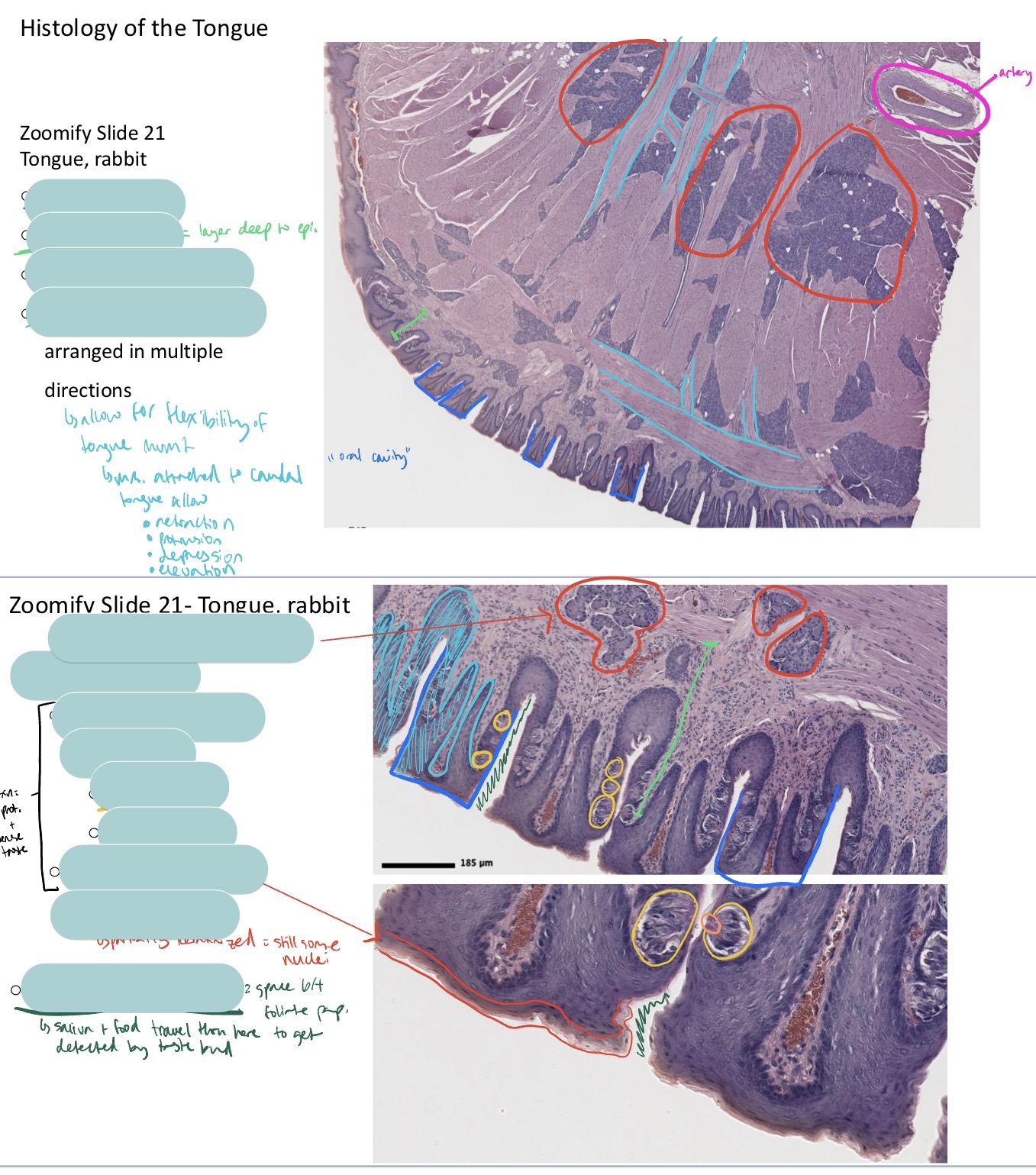
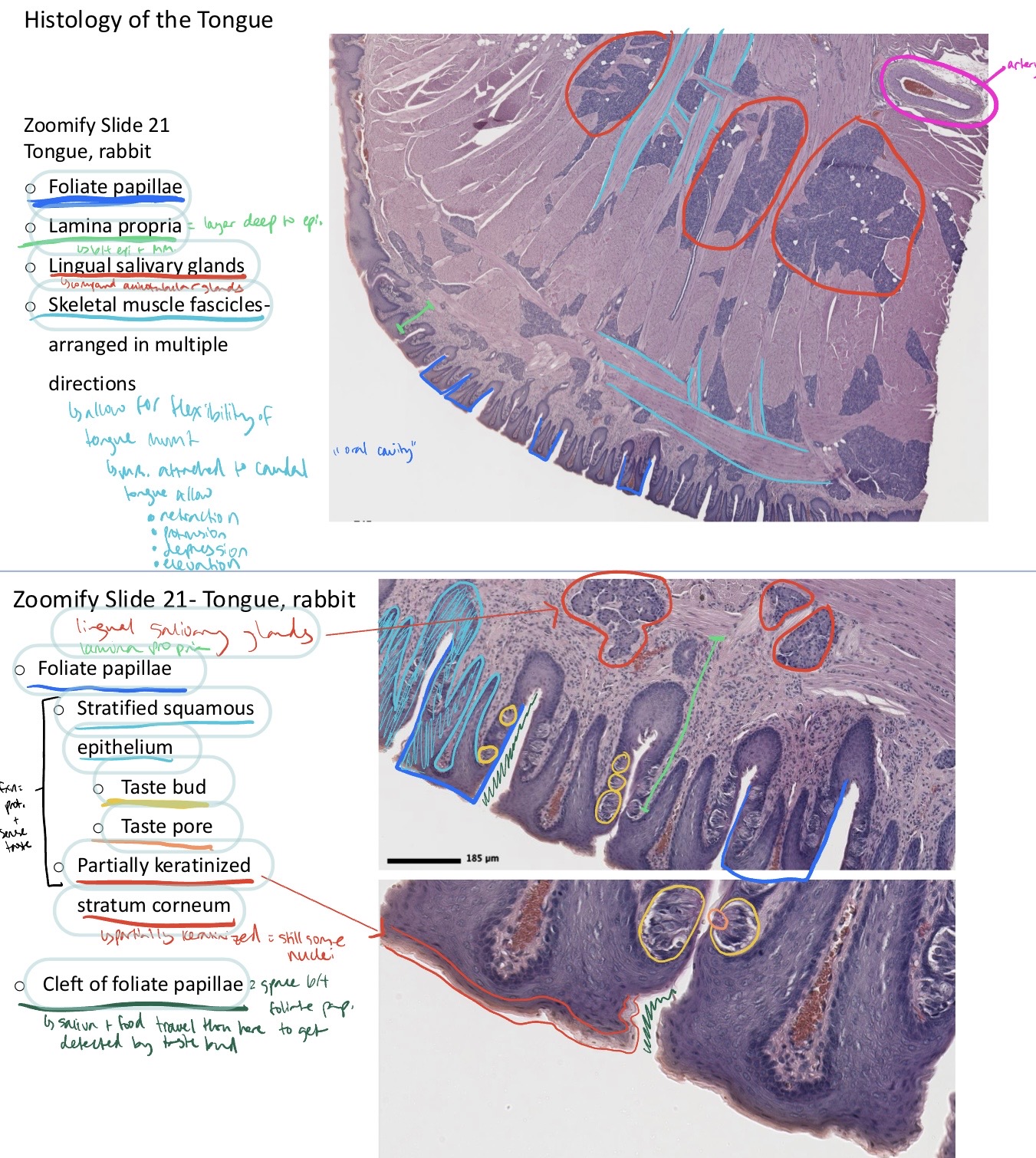
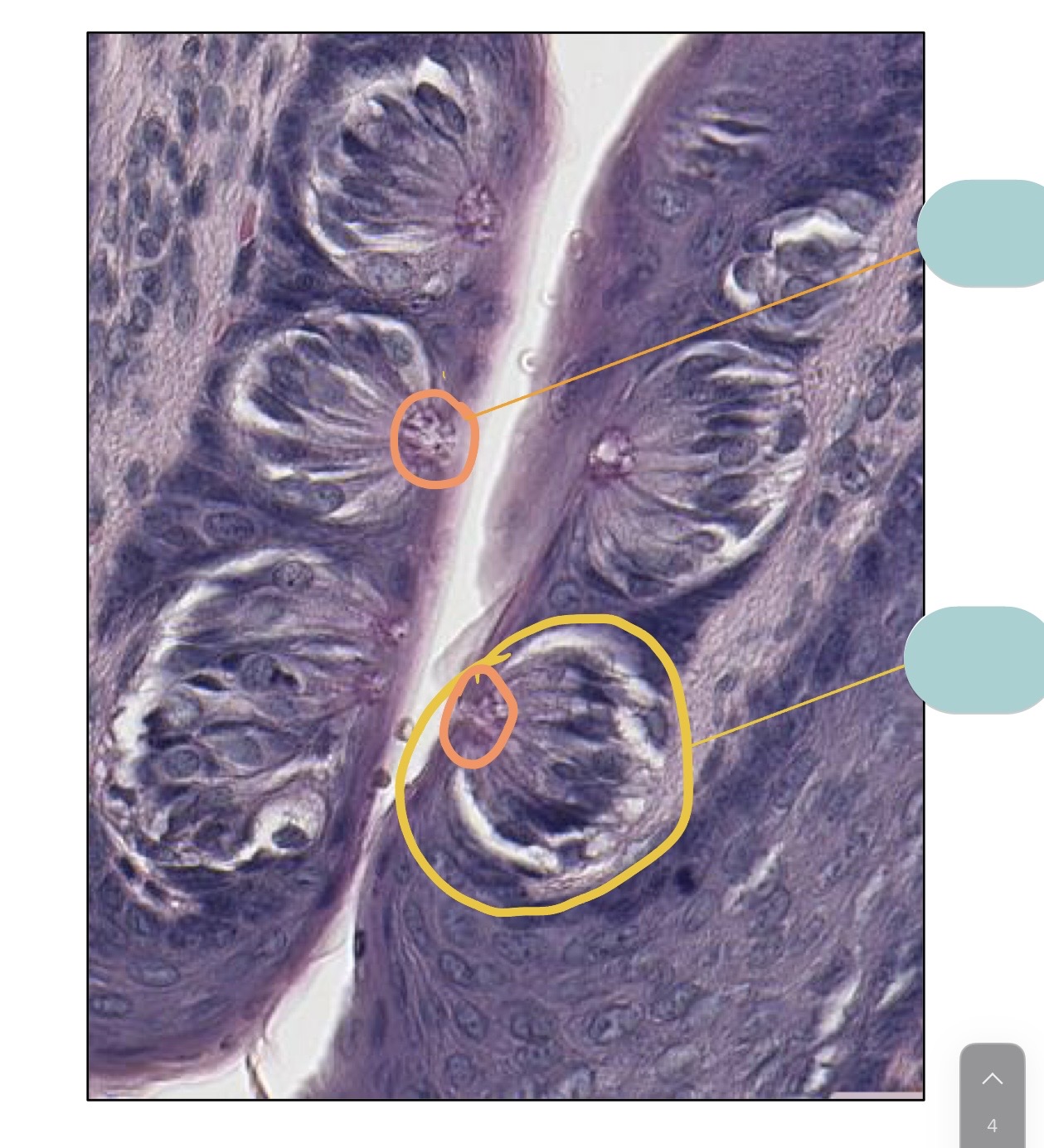
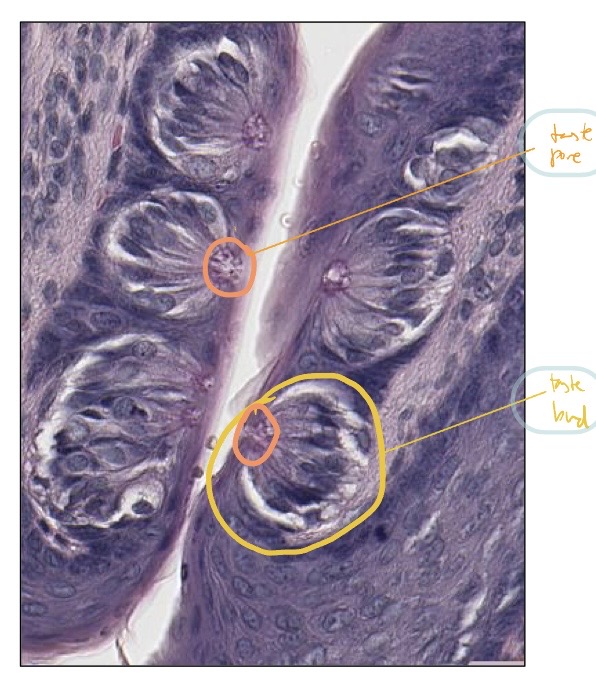
Describe the innervation and function of the tongue
motor → CN 12 hypoglossal
sensory →
rostral 2/3
CN 5 lingual br. → temp + pain + touch
CN 7 → taste
caudal 1/3
CN 9 → taste
List the three types of acinar salivary glands and secretions.
serous acinus → secrete water + electrolytes + digestive enzymes
parotid salivary glands
serous gland
mucus acinus → secrete mucus + electrolytes + digestive enzymes
submandibular salivary glands
mucoserous
mixed seromucous acinus → mucous acinar cells w/ serous demilunes
Describe the anatomical components of the salivary glands/ducts.
acinar cells in acinus secrete mucus/water + electrolytes + digestive enzymes into acinar lumen w/ help of myoepi. cells → secretions go into intercalated duct → move into striated ducts → move into excretory ducts
Describe the pathway of salivary gland secretion: primary salivary gland secretion, modified salivary gland secretion, and saliva.
acinar cells in acinus secrete mucus/water + electrolytes + digestive enzymes into acinar lumen w/ help of myoepi. cells → secretions go into intercalated duct → move into striated ducts where this primary secretion is modded (reabsorb Na+ and Cl-, add K+ and HCO3-) → move into excretory ducts → excreted into oral cavity
What happens when there are high rates of salivary gland secretions? Low rates?
high salivary gland secretion rate → increased dilution of saliva bc decreased modding
low secretion rate → increased modding
Describe the six properties and functions of saliva.
1) moisten
2) lube
3) antibac.
antibodies + lysozymes
4) digestive enzymes
5) evaporative cooling (dog)
6) contain electrolytes
Compare ruminant saliva with canine saliva.
every electrolyte except Cl- higher in rmt than dog bc bicarb buffer system
need to stabilize rumen pH
phosphate also req. by rumen bac for metabolism
List five structures derived from the interaction of the epidermis and dermis.
teeth
hair
mammary glands
geathers
scales
Describe the five steps of brachydont tooth development.
1) enamel organ from epi. + dermal papilla from dermis appears
2) enamel organ prod. ameloblasts + dermal papilla prod. odontoblasts + bone appears
3) primordium of permanent tooth appears
4) tooth crown → root of tooth → cementum + periodontal ligament
5) deciduous tooth erupts + anchored to alveolar socket
What happens if deciduous teeth are retained?
Describe the anatomy of brachydont teeth. What is the structure and function of enamel, dentin, and the pulp cavity? What can happen if the enamel is compromised in a brachydont
tooth?
During mastication, what is the function of incisors, canines, premolars/molars, and saliva? Mastication starts the _______ digestion process.
Does the dog’s normal bite (teeth occlusion) provide a good fit and even wear or not a good fit and uneven wear? What are some common problems that can arise from malocclusion in the dog?
Describe the anatomy of hypsodont teeth. Arrange the following in the order of hardness: Cementum, Dentin, Enamel
Describe normal teeth/dental pad occlusion in the ruminant. Is grass height important for the ox? Why?
What are some common problems that can arise from malocclusion in the sheep?
Describe normal teeth occlusion in the horse. What tissue needs to filed down due to the sharp edges?
Rodents and rabbits have _____________ teeth. Rodents have top and bottom _________. Rabbits have ______, _______, _______. Rodents and rabbits must have ____________ to
keep teeth worn down.
What are some common problems that can arise from malocclusion in the rabbit?
Compare and contrast features of brachydont and hypsodont teeth.
Describe the food prehension mechanism in the chicken, dog/cat, pig, horse, sheep/goat, and ox?
Describe the water prehension mechanism in the dog/cat and horse/cow
List the five systems that regulate gi system function.
How does the CNS regulate gi system function?
List the names of the two ENS enteric nerve plexuses. Where are these structures located? What are the functions?
Describe the structures/functions of the enteric nerve plexuses of the ENS.
List the ENS peptide and nonpeptide neurocrines. Excitatory or inhibitory to gi tract function?
Describe the structure and function of the ANS. Parasympathetic Nervous System- Where is there an increase in
blood flow? Decrease in blood flow? Sympathetic Nervous System- Where is there an increase in blood flow? Decrease
in blood flow?
ANS- Parasympathetic and Sympathetic Nervous System. What is the innervation pathway and which GI segments are
innervated by the craniosacral and thoracolumbar divisions?
Describe the ANS connection to the ENS.
Describe how/what sensory information is relayed to the central nervous system.
Describe how EECs regulate gi system function.
Describe how the enteric immune system regulates gi system function.
GI function is under highly integrated and complex control. What are the various inputs?
Where does integration occur (name the 3 main intrinsic systems)? What are the various
outputs? What is the overall effect
inputs
CNS
chemical environ
antigenic environ
integration
ENS
EEC
enteric immune system
outputs
GI motility
GI blood flow
GI secretions
absorptive cell fxn
overall effect = balance of inhibitory + excitatory regulatory molecules.
Describe how the Interstitial Cells of Cajal (ICC) influence the electrical properties of gi smooth muscle and motility.
What is the membrane potential, frequency of slow waves and/or action potentials, and muscle tone of the gi tract at
rest (ICC), during parasympathetic influence, and sympathetic influence?
What causes gi smooth muscle to contract? What causes gi smooth muscle to relax?
Describe the anatomy of the esophagus.
Define GI motility and the three types of GI motility. What are the four functions of GI motility?
Describe the motility of the esophagus.
Describe the voluntary and involuntary phases of deglutition.
How does aspiration pneumonia occur?
What are the main functions of the stomach?
Is the muscular activity in the fundus of the stomach weak or strong? What is the function of these tonic contractions?
What is the associated muscular reflex in the fundus of the stomach? How does this reflex work?
Is the muscular activity in the body of the stomach weak or strong? What is the function of these contractions?
Describe the four steps involved in the body/pyloric antrum for grinding/churning.
Describe the cephalic phase of digestion.
How do sensory receptors in the stomach create a positive feedback loop to enhance gastric motility? Suppress gastric motility?
The rate at which the stomach empties is regulated by the contents of the __________.
How are reflexes named? Describe the enterogastric reflex. What are the afferent receptors in the duodenum stimulated by? How is stomach emptying inhibited? How are the
inhibitory influences of the stomach removed?
Name the two phases of small intestine motility. When do each of these phases occur?
Name the two motility patterns of the digestive phase.
Describe nonpropulsive motility.
Describe propulsive motility.
Describe the interdigestive phase of small intestine motility and the mechanism/function of the migrating motility complex (MMC). What interrupts the MMC?
Define ileus. What are the findings on ultrasound? Physical exam findings
Describe the three motility patterns of the colon. What does the first word of any reflex indicate? Sensory or motor? What does the second word of any reflex indicate? Sensory or
motor? Describe the gastrocolic reflex.
Describe the rectosphincteric reflex.
Digestion can only take place in an ___________ environment provided by the ingestion of food/water and digestive secretions.
How are digestive system secretions regulated? Do these secretions make up a large or small volume? Is it important for most of these secretions to be absorbed? Why?
List the two general types of gastric mucosa.
List the three layers of gastric mucosa. What is the location and function of surface mucous cells? What is the location, structure, and function of the lamina muscularis?
Describe the location (neck or base) and function of the gastric gland cells- mucous neck cells, chief cells, parietal cells, and EECs- G cells.
Describe how HCL is secreted from parietal cells. What is the function of HCL?
How is HCL secretion stimulated?
Describe how HCL secretion and gastric motility are regulated.
What is the difference between an erosion and an ulcer? How does chronic NSAID therapy cause gastric ulceration?
How do PPIs, H2 blockers, prostaglandin antagonists, and sucralfate function in the treatment gastric ulceration?
Majority of pancreas is composed of endocrine or exocrine tissue?
What cells in the pancreas synthesize digestive enzymes?
_________ digesting enzymes are synthesized as zymogens in the same manner as __________ synthesis in the gastric glands. Why is this important?
What is the anatomical pathway/functions of pancreatic secretions?
Name the receptors found on the surfaces of pancreatic acinar, centroacinar, and duct cells. How is each ligand (hormone or neurotransmitter) released?
CCK stimulates (cell type)?
Secretin stimulates (cell types)?
What happens when all of the receptors are occupied?
Describe how secretin and CCK work together. Negative or positive feedback?
What type of nutrient overload causes pancreatitis in a dog? Carbohydrates, Protein, or Fat (circle one).
How does pancreatitis induce vomiting?
Explore top notes

