Changes in Gene Regulation and Pattern Formation to Morphological Changes
 Call Kai
 Learn
Learn Practice Test
 Spaced Repetition
 Match
Match Flashcards
 Knowt Play
1/4

There's no tags or description
Looks like no tags are added yet.
Name | Mastery | Learn | Test | Matching | Spaced | Call with Kai |
|---|
No analytics yet
Send a link to your students to track their progress
5 Terms
Sonic Hedgehog (SHH)
a signaling molecule that regulates limb development
a target of Hox genes
a morphogen that acts downstream of Hox pathways in patterning of limbs
this protein is critical for development of the central nervous system, brain and other organs
Given the role of Shh in body patterning, where would you find sequences changes in this gene in snakes? (no limbs)
In the regulatory sequence for the Shh gene (not protein!)
we need Shh for development of other systems (needs to be functional) → it can’t be mutated
altering the protein sequence would impact its ability to regulate other developmental pathways
Progressive loss of function in a limb enhancer during Snake Evolution
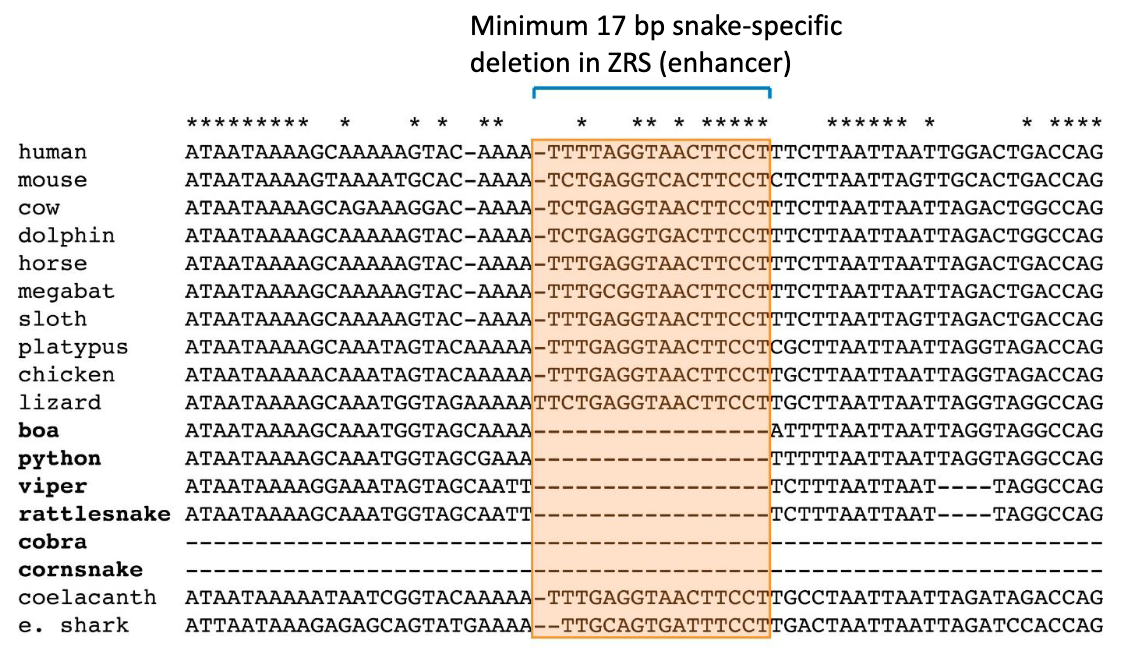
ZRS is a limb-specific enhancer that regulates the expression of Shh
it is highly conserved and found in many vertebrates
there are substantial deletions of this enhancer in snakes (17bp or more)
changes in cis regulatory elements controlling limb formation have led to morphological changes in snakes
933 conserved non-coding elements (CNEs) that regulate limb formation
these elements tend to be conserved in limbed organisms but diverge in snakes
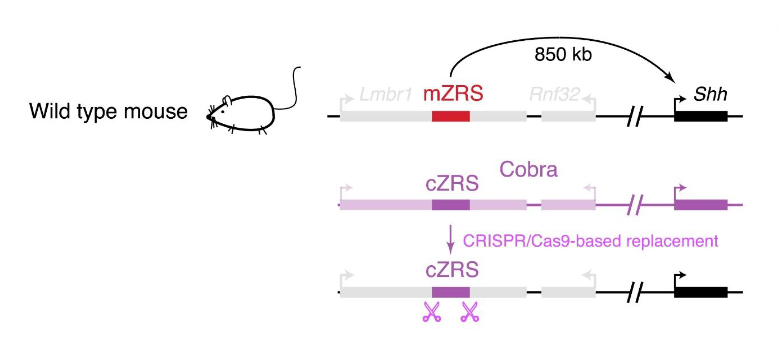
Mice Swap Experiment
in WT mice, HOX protein bind to the ZRS to induce expression of Shh. This results in the developmental of functional limbs
exp: transgenic mice were generated by editing out the mZRS and replacing it w/ the ZRS sequences found in Cobras (cZRS)
results in truncated limbs (cobra ZRS is no longer functional)
since ZRS element regulates other systems, why do other systems appear normal develop in snakes, there is other enhancer elements that direct expression of SHHH in the central nervous system, brain and other organism
reversing the 17bp deletion restores limb-specific enhancer function
Maximizing the diversity or organisms from a limited number of genes
Summary of Alternative transcription control: combinatorial possibility of transcription factors
a greater number of TFs mean that a greater number of unique combinations are possible, allowing for more complex control of gene expression
related to the high number of TFs: expansion of regulatory regions allow for more TF binding sites (and ever more combinations)
concentrations and ratios of the different activators and repressors determine whether any particular regulatory region is activated or repressed
regulatory regions allow for modular control of gene expression
e.g. multiple enhancers, each regulating expression in a diff tissue
mutation of specific regulatory regions such that gene expression is only affected in some tissues, promoting a diversity of form

