ESS W1 L2 - biogeography and biomes
 Call Kai
 Learn
Learn Practice Test
 Spaced Repetition
 Match
Match Flashcards
 Knowt Play
1/44

Earn XP
Description and Tags
biogeography and biomes
Name | Mastery | Learn | Test | Matching | Spaced | Call with Kai |
|---|
No analytics yet
Send a link to your students to track their progress
45 Terms
Biogeography definition 1:
‘the science that attempts to document and understand spatial patterns of biodiversity’
Brown and lomolino, 1998
Biogeography definition 1:
the study of the distribution of organisms, both past and present, and of related patterns of variation over the earth in the numbers and kinds of living things’
Ibid
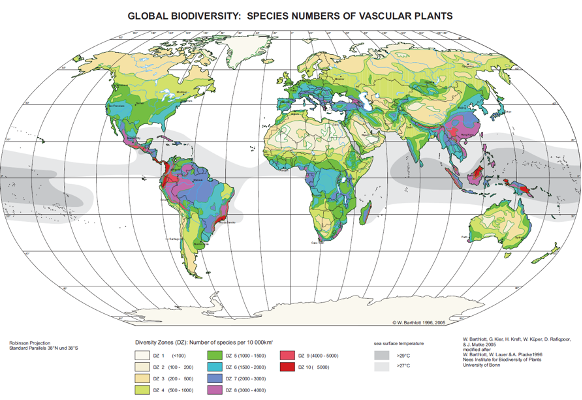
Biogeography: what explains the uneven distribution of species across the planet:
More biodiversity in the tropics (red etc. colours)
Biogeography: what explains the uneven distribution of species across the planet: example
Mediterranean type ecosystems
Mediterranean type ecosystems
Common traits:
Seasonal climate – wet winter, dry summer
Influence of fire (wildfires)
Similar vegetation
Species rich
these common ecological factors lead to dominance by evergreen shrubs and thick leaved (sclerophyll) trees – adapted to fire and retain water
We need to understand ecology to do biogeography
Mediterranean type ecosystems (5)
chaparral - california
fynbos - cape
maquis - med basin
matorral - central chile
kwongan - australia
role of history in med ecosystems
do mediterranean type ecosystems share a common origin and evolutionary history?
Seems unlikely as their floras are comprised of different genera and species
But there are a few plant families (e.g. Rhamnaceae (buckthorns), and Proteaceae (proteas) ) that are common to more than one MTE
How did they get there – tectonics or dispersal
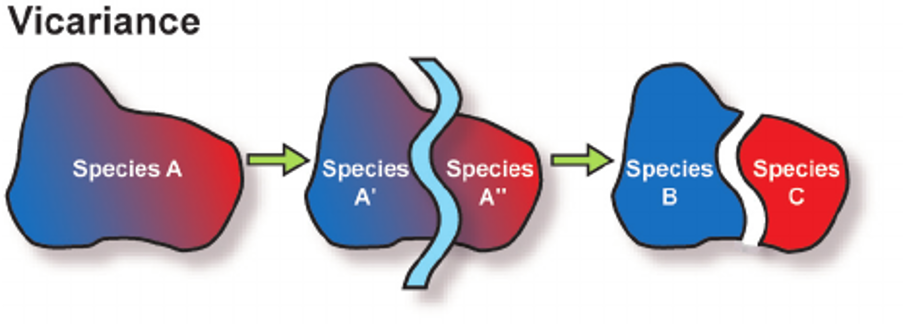
Plate tectonics: vicariance:
Vicariance refers to some kind of event (continents breaking apart, mountain ranges uplifting) physically separating population
Ancestral population - geographic isolation -speciation
Leads to genetic divergence – become different species and wouldn’t be able to reproduce
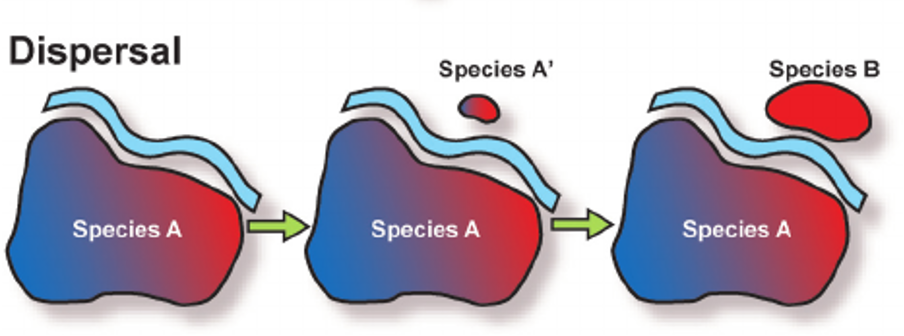
Dispersal:
Refers to the movement of animals and plants moving across land or water to reach new areas
Ancestral population - geographic isolation - speciation
Leads to genetic divergence – become different species and wouldn’t be able to reproduce
Zoogeographic maps:
1876 – Wallace created a map of the difference in animal species throughout the globe
Divided the globe into terrestrial zones with homogenous fauna (animal life)
Match up with the continental plates
Not so different to recent maps produced using phylogenetic data (holt et al 2013)
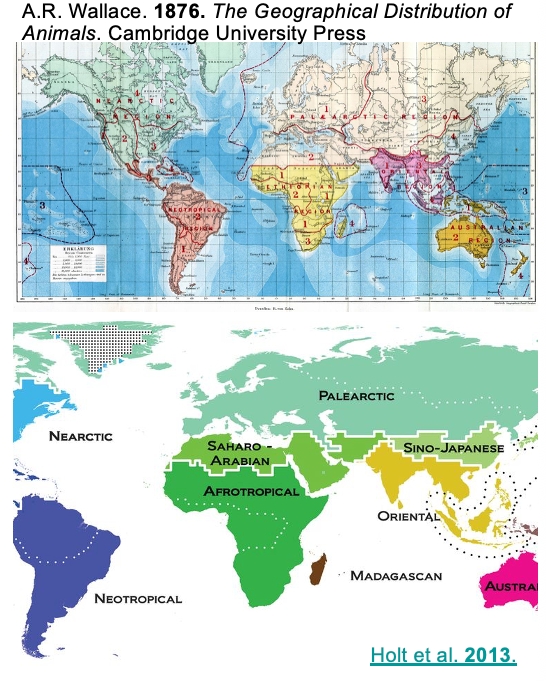
modern maps
use information from phylogenetic trees
Phylogenetic trees use molecular (DNA or protein sequences) techniques to understand evolutionary lineage between species or taxa
Biogeographic realms reflect broad distributions of terrestrial species
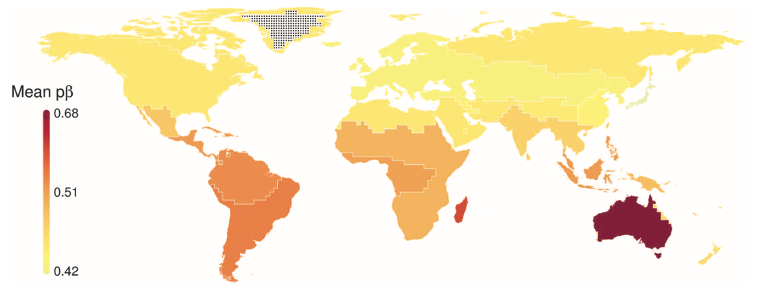
Map of evolutionary uniqueness:
How unique species are to a particular place
Based on data for 21, 037 species of vertebrates
Regions coloured in dark red are the most evolutionary unique
Antarctica isn’t included in the analyses
Unique animals of Australia: marsupials
maternal pouch
koala
kangaroo
wallaby
sugar glider
tasmanian devil
Unique animals of Australia: monotremes
egg laying animals
platypus
echidna
Plate tectonics:
Supercontinent Pangea- separated over 250 mil years
Gondwana breaking into smaller continents over 180 mil years
Australia – approx. 140 mil years ago – one of the first continents to separate from Gondwana
Life started to evolve when all the continents were connected
About 60 mil years ago – most continents isolated
Legume family phylogeny:
Legumes (pea and bean) dominate in tropical forests of South America and Africa
High diversity: 20,000 species
Originally thought legumes originated together when Africa and South America were joined as part of the super continent Gondwana.
Africa separated from S America (when part of Gondwana) 100 - 140 million years ago.
This vicariance instigated the diversity in species.
However, with new molecular techniques we have a greater insight in to the phylogeny (evolutionary relationships) of species in Africa and South America
legumes continued
Molecular clock technique identifies the timing of evolutionary splits
Commonality in legume species between Africa and S America occurred until 10 million years ago.
This is ~90 million years after Gondwana separated.
Dispersal must have been happening across major oceans
dispersal
The spread, isolation and disjunction of organisms reflect long-distance dispersal
Species had reached newly formed volcanic islands never connected to land
via ocean currents, winds, or carried by traveling animals, most recently by humans
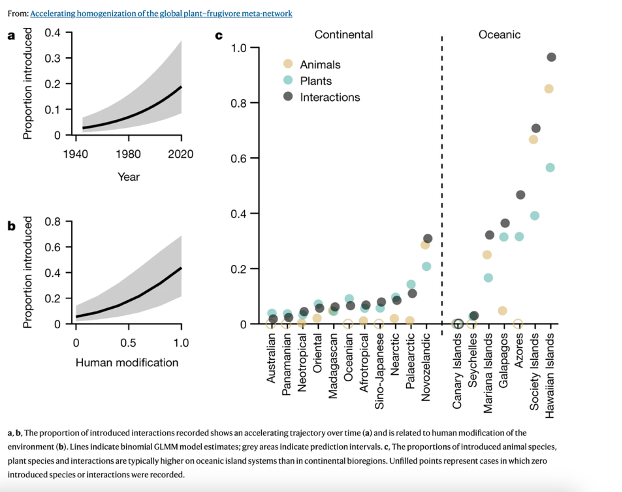
anthropogenic dispersal:
The movement of animals, plants, fungi, or microorganisms by humans across biogeographic barriers to an environment where they are not native (transport and trade).
Factor in global biodiversity loss – as introduce non-native species
Homogenization of habitat and species composition
Anthropogenic dispersal is accelerating
Linked to international travel and tourism
E.g. Hawaii – high level of non-native plants
Conservation:
Biogeography helps to predict how biodiversity will change over time and to develop solutions to help biodiversity respond to future environmental threats
Helps us understand:
Diversity pattern overlaps
Landscape ecology
Conservation assessments
Future predictions
Extinction risk
Biome definition:
Continually evolving definition
‘biomes are major vegetation formations with distinct physical forms (physiognomies) and ecological processes that can be characterised at a global scale’
Pennigton, lehmann, and Rowland 2018
Ecological processes – mechanisms that sustain life
Energy flow, nutrient cycling (biogeochemical cycles), primary production (photosynthesis), decomposition (soils), water cycle, population dynamics (competition, dispersal ecological succession)
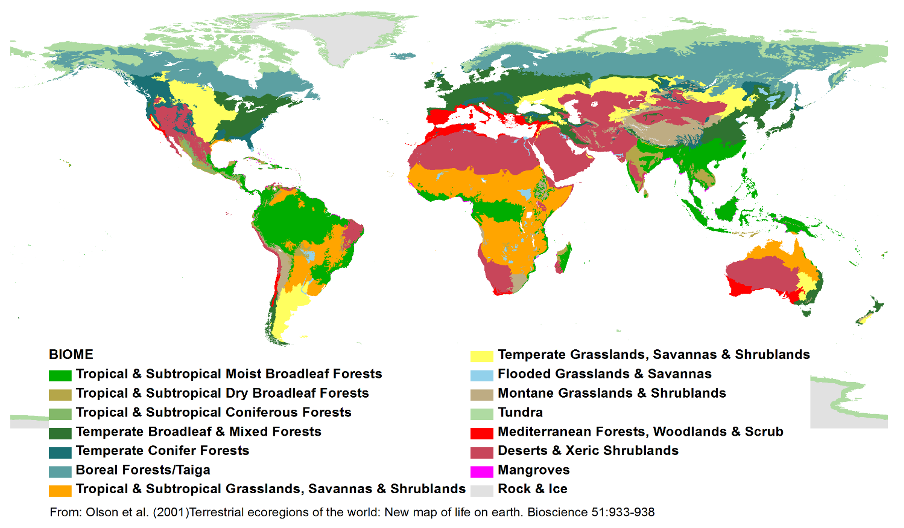
Terrestrial biomes – oversimplified:
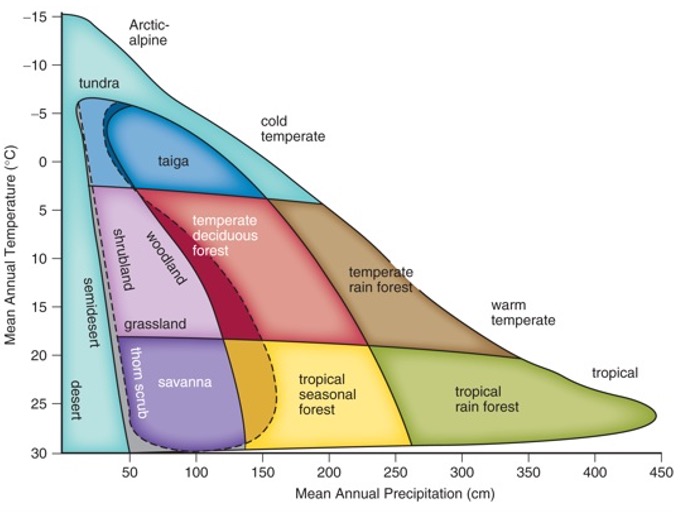
Controls on biomes distribution:
Is it all climate?
Since 1830s, the major driver of vegetation patterns/ zones has been understood to be climate
diagram = whittakers biome scheme
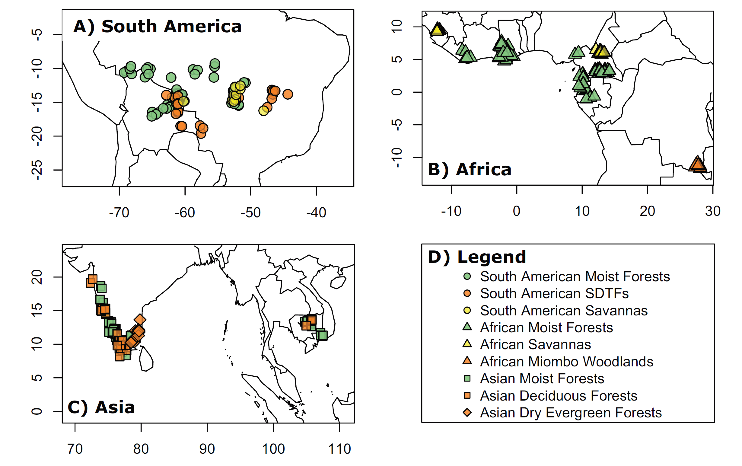
Species inventory from tropical lowlands:
Biomes aren’t just climate controlled
Different species in savannas on different continents – S, America and Africa, and in different moist forest – Africa and Asia
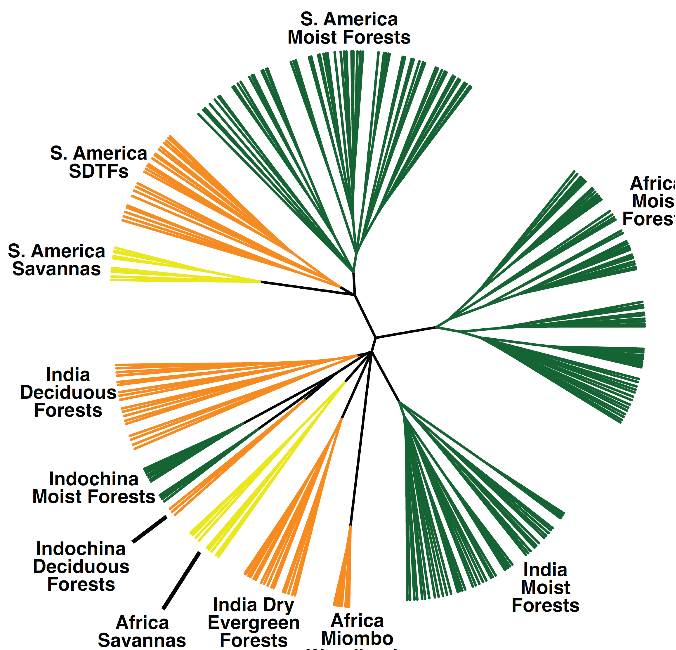
What are biomes:
Dexter, pennington et al 2015
The same biogeographic realm/ region can contain different biomes
This suggests a key role for independent evolution of adaptations required in different ecological settings in different places
SDTF = seasonally dry topical forest
How to define a biome:
Alexander von Humboldt (18th-19th C)
Recognised that vegetations in different locations may look similar but are taxonomically different
Environmentally similar but isolated regions have distinct biotas. So cannot use taxonomic composition to define biomes at global scale
Need to think about ecological processes
Climatic variables are an important control of biome distribution:
Air temperature
Precipitation
Net radiation
Bioclimatic variables are important controls in biome distribution:
More than climate
Precipitation – evaporation
Run off/ water surplus
Soil moisture
Other key variable often neglected:
Soil fertility/ pH factors (edaphic factors)
Presence of regular, natural fire
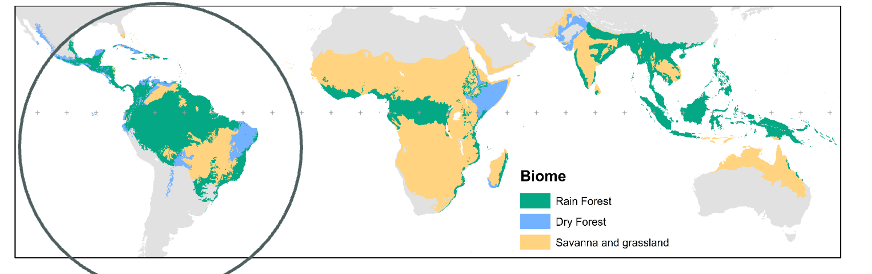
Focus on south America:
Tropical Rain forest, seasonally dry tropical forest and tropical savanna
Neotropical realm - diagram
Biome 1: tropical rain forest:
Characterised by:
High (>25m), closed (continuous) evergreen canopies – dense forests
Annual precipitation >2000mm approx.
Little to no dry season
Biome 2: tropical savanna:
Grassy woodlands:
Open canopies, tree cover from 0-80%
Continuous ground layer of grasses (>50%)
Dry seasons (3-6 months)
Rainfall:
800-2500mm south America
300-1500 mm Africa
350- 2000mm Australia
Nutrient poor, acid soils in neotropics
Evergreen tress
Natural fire prevents forest – fire adaptations
Biome 3: seasonally dry tropical forest:
Often closed canopy
Deciduous trees
Few grasses
Seasonally dry (same climate as savannas)
But richer soils
No fire
Dominance of succulent plants (cacti in neotropics) not adapted to fire
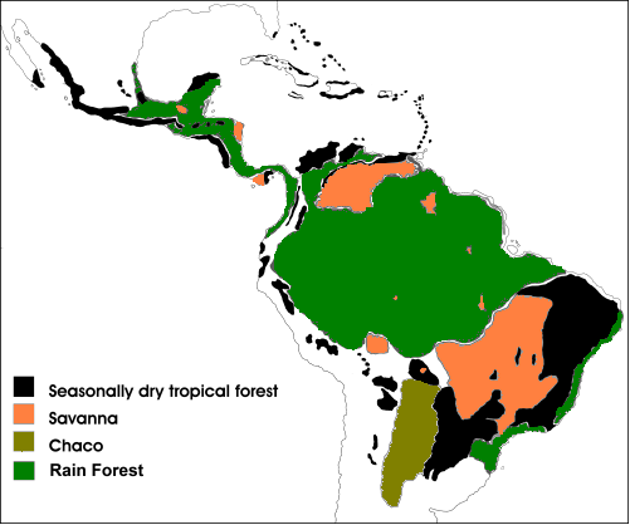
Lowland tropical biomes in Latin America:
Fire and soil are key controls in the distribution of dry biomes in latin America
It’s not all about the climate
As savanna and dry forests grow in the same place
Biomes and bacteria:
Different global biomes (different vegetation and climate) have different bacterial diversity and biomass
Bacteria are important for ecosystem functions:
Nutrient recycling (carbon, nitrogen and phosphorous)
Decomposing dead material
Plant growth
Water recycling
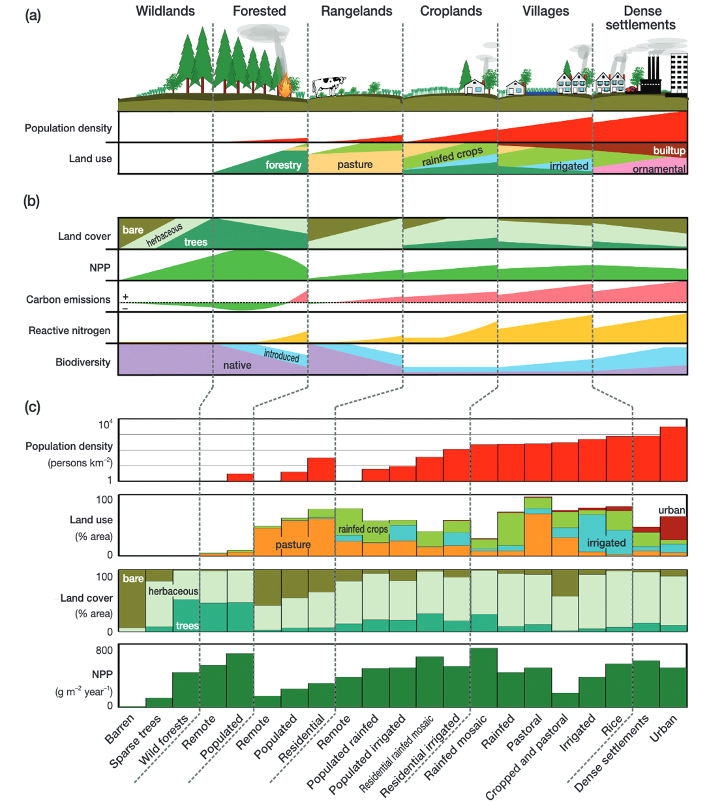
Anthromes:
Human biomes or anthrome
Global ecological patterns shaped by human interactions with ecosystems
Mosaic of different land uses and covers
Terrestrial: managed forests, pasters, crops, plantations, villages, dense urban settlements
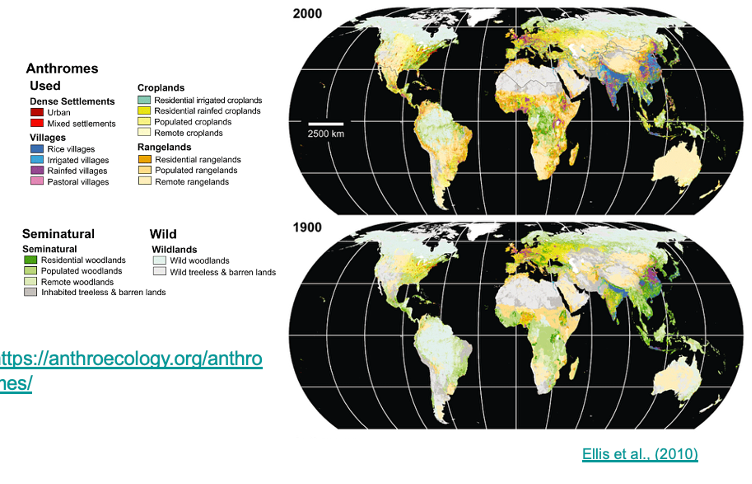
Anthropogenic biome transformation
Human impact on biomes:
Human impact via:
habitat loss
Deforestation
Pollution
Climate change
Invasive species
Hunting
Farming/ crops
Controlled burning
Human induced climate change set to impact biomes further
Summary:
Biogeography – understanding the spatial patterns of biodiversity across the planet
Biogeographic regions = diversity in relation to evolutionary lineages – dispersal and vicariance
Biomes – how to define them
Biome = species diversity in relation to ecological (not just climate) processes
Factors like soil condition and fore occurrence are important and will be examined more

