The Basics of Magnetism
 View linked note
 Call Kai
 Learn
Learn Practice Test
 Spaced Repetition
 Match
Match Flashcards
 Knowt Play
1/17

Earn XP
Description and Tags
This set of flashcards covers key terms and concepts related to magnetism from the lecture notes.
Name | Mastery | Learn | Test | Matching | Spaced | Call with Kai | Chat |
|---|
No analytics yet
Send a link to your students to track their progress
18 Terms
Magnetism
The ability of certain materials to attract iron, cobalt, or nickel.
Magnetic dipole
A tiny magnet created by the orbital electrons of atoms spinning predominantly in one direction.
Magnetic domain
An organized grouping of aligned magnetic dipoles in a material.
Electromagnet
A type of magnet that consists of an iron bar wrapped with a wire carrying electric current to create a temporary magnetic field.
Lodestone
A natural magnet found in the earth, a large piece of magnetite believed to have gained its magnetism from the earth's magnetic field.
Artificial permanent magnet
A magnet manufactured by inducing alignment of atoms through magnetic induction.
Diamagnetic materials
Materials that are weakly repelled by magnetic fields, such as water and gold.
Ferromagnetic materials
Materials that are strongly attracted to magnets, such as iron, cobalt, and nickel.
Tesla (T)
The SI unit of magnetic field strength.
Inverse square law
The principle stating that the strength of a magnetic field is inversely proportional to the square of the distance between two magnetic poles.
Magnetic flux
Lines of force in a magnetic field that travel from the south pole to the north pole inside a magnet.
Paramagnetic materials
Materials that are weakly attracted to magnetic fields, such as platinum and aluminum.
Electrical charge
A property of subatomic particles that causes them to experience a force when placed in an electromagnetic field.
Inducing magnetism
The process by which a magnetic field causes alignment of magnetic domains within a material.
Nonmagnetic materials
Materials that are not affected by magnetic fields, such as glass and wood.
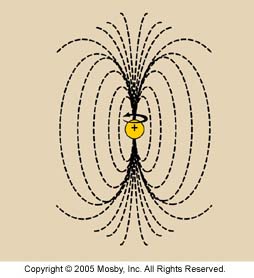
Magnetic field
A field around a magnet containing lines of force that exhibit magnetic effects.
North and south pole
The two opposite ends of a magnet where the magnetic force is strongest; every magnet has these poles.
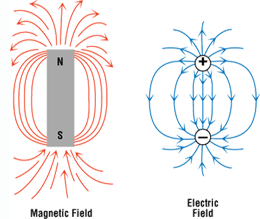
electrical charges of magnetic fields
The field of a positive charge points out from the charge and the field of a negative charge points into the charge.