Lecture 1 (Anatomy, GFR and Clearance, Glucose Handling)
 Call Kai
 Learn
Learn Practice Test
 Spaced Repetition
 Match
Match Flashcards
 Knowt Play
1/38

There's no tags or description
Looks like no tags are added yet.
Name | Mastery | Learn | Test | Matching | Spaced | Call with Kai |
|---|
No analytics yet
Send a link to your students to track their progress
39 Terms
balance in renal system
ingestion + production = excretion + consumption
label section of human kidney diagram
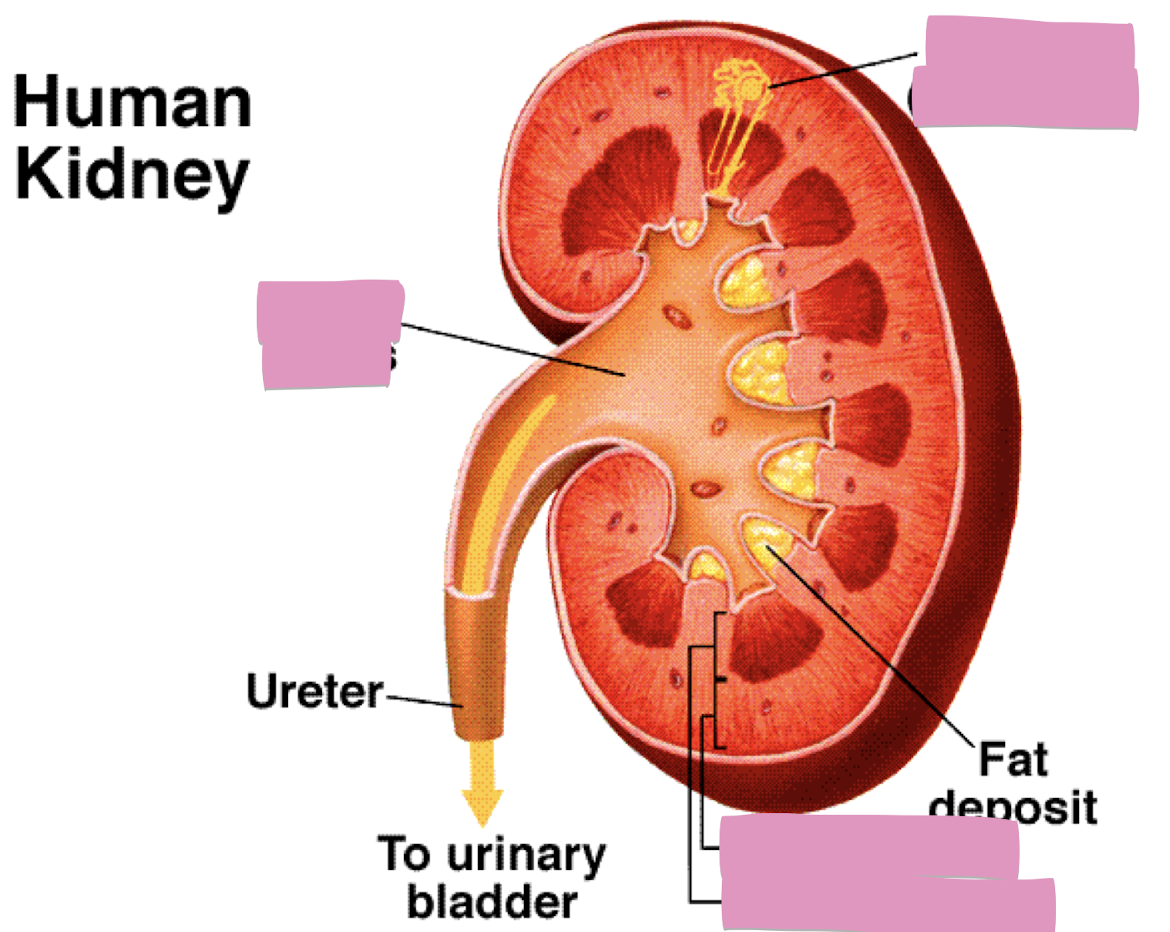
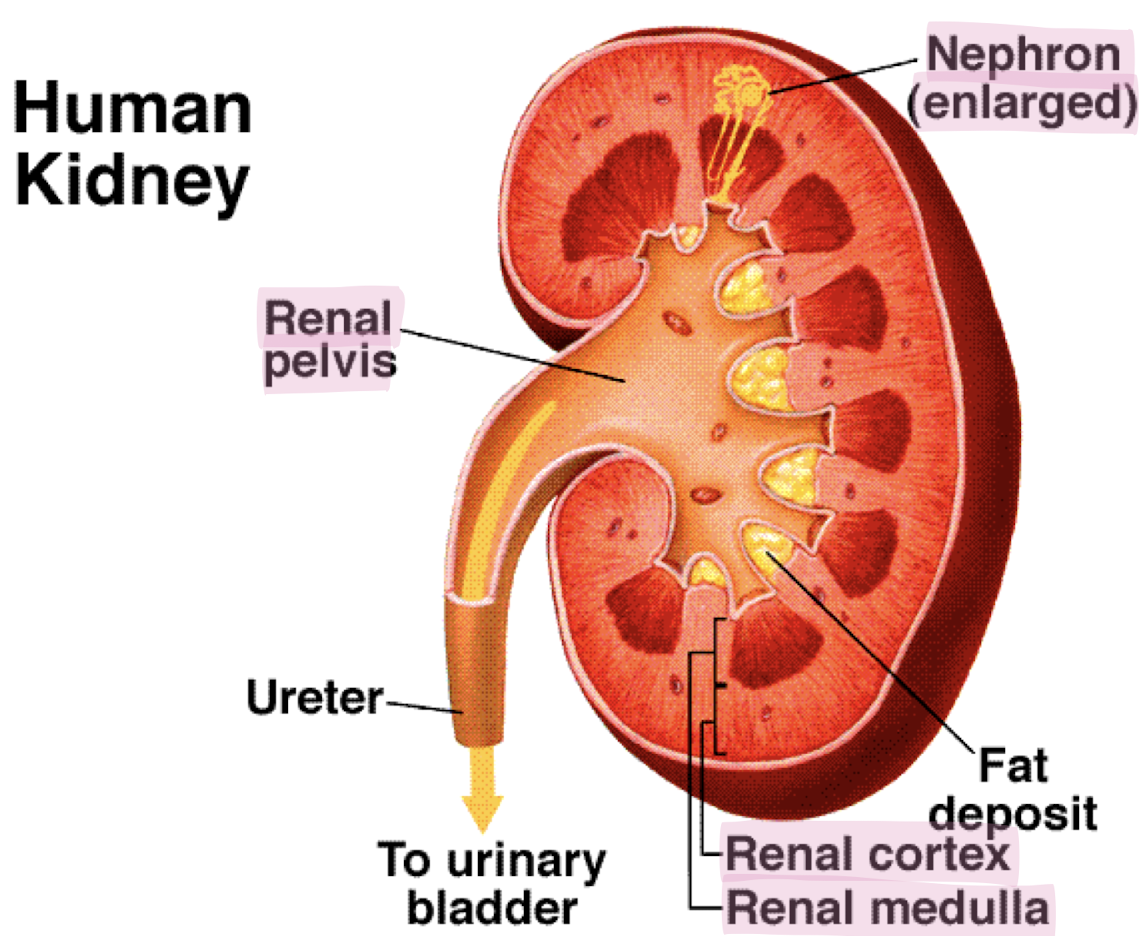
renal corpuscle consists of
glomerular capillaries and Bowman’s capsule
order of filtered fluid flow:
proximal tubule
loop of henle
distal tube
late distal tubule/connecting tubule
collecting duct
cortical nephron (%, function, where it resides)
80-85% of nephrons
main function is reabsorption/secretion
most of the tubular segments are within the cortex
juxtamedullary nephron (% and function)
15-20% of nephrons
main function is establishing hypertonic medullary ISF
loop of henle in renal medulla
label what happens in each part
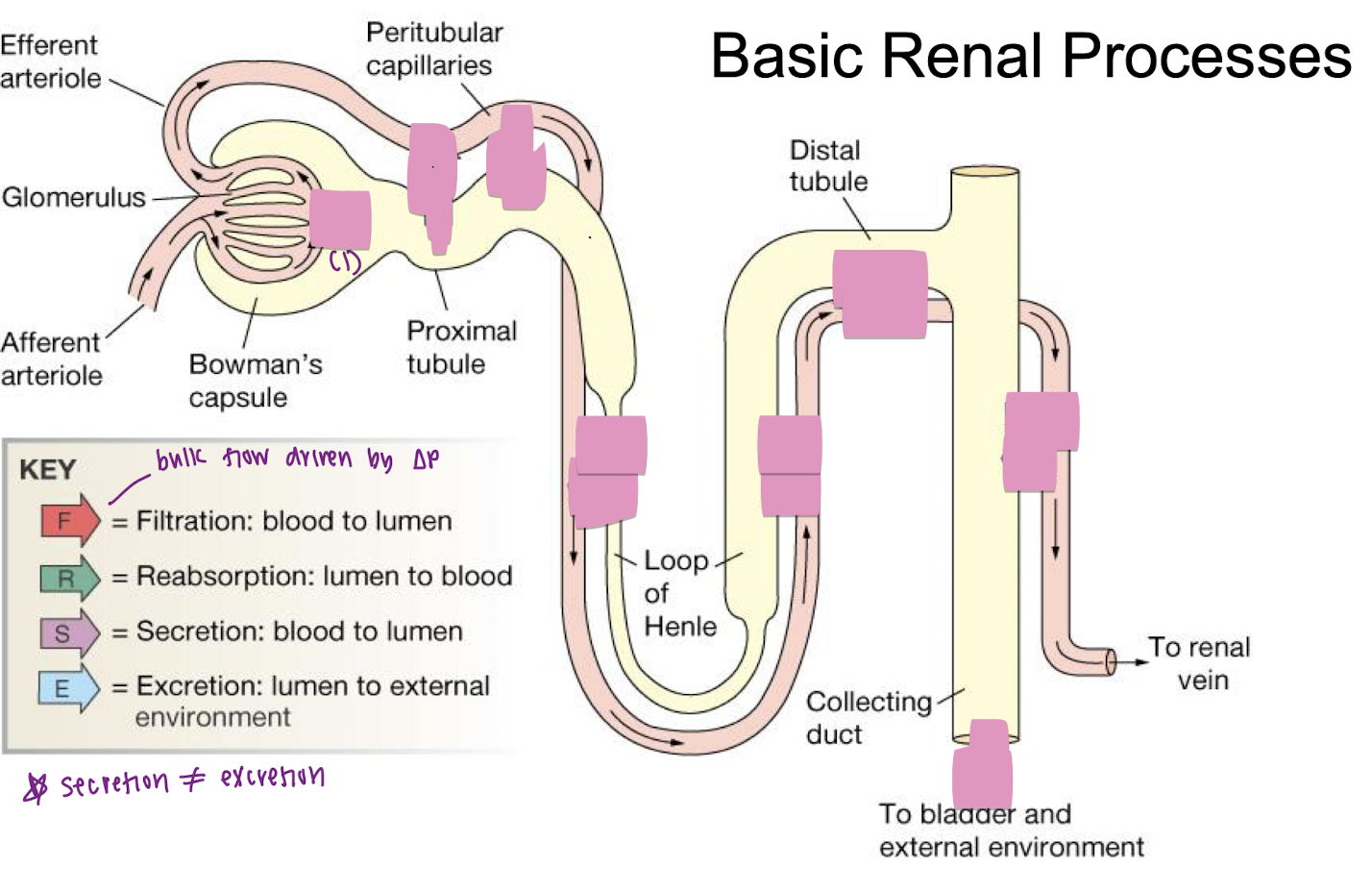
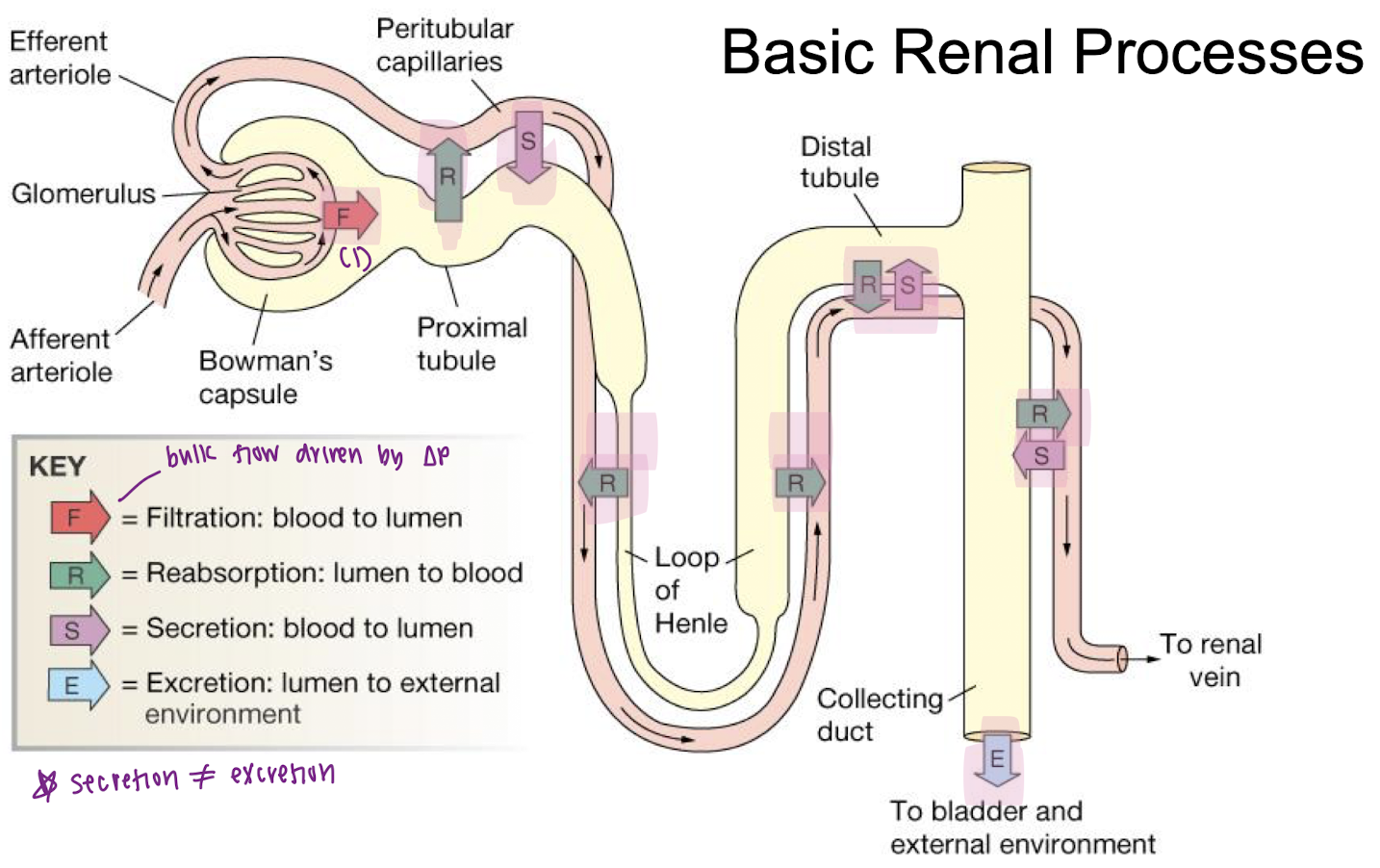
excreted equation
filtered + secreted - reabsorbed
what is the functional unit of the kidney
nephron
what is the site of filtration down the pressure gradient
glomerulus
what brings blood flow into the glomerulus
afferent arteriole
what brings blood flow out of the glomerulus
efferent arteriole
peritubular vs vasa recta capillaries
peritubular = osmotic reabsorption (pressure driven)
vasa recta = important for generating hypertonic renal medulla
how do we describe filtrate
“plasma-like”: cells are not filtered, and very little protein is filtered, but small molecules are in the same concentration as in plasma
does filtration occur by bulk flow or by diffusion and/or active transport
bulk flow
does reabsorption occur by bulk flow or by diffusion and/or active transport
active transport, diffusion, facilitated diffusion
does secretion occur by bulk flow or by diffusion and/or active transport
active transport, diffusion, facilitated diffusion
does excretion occur by bulk flow or by diffusion and/or active transport
bulk flow
glomerular filtration rate (GFR)
volume of fluid filtered into Bowman’s space per unit time (125 ml/min = 180 L/day)
equation for filtered load
[X]p x GFR
equation for amount excreted
[X]u * urine flow rate (V-dot)
clearance
the rate of removal of substance (X) from the plasma compartment
clearance equation
Cx = ([X]u * V-dot)/[X]p
the clearance of what substances can be used to calculate GFR? and which one is exogenous and endogenous?
inulin (exogenous) and creatinine (endogenous)
what happens to Pgc and GFR is you constrict the afferent arteriole?
Pgc and GFR decreases
what happens to Pgc and GFR is you constrict the efferent arteriole?
Pgc and GFR increases
what happens to Pgc and GFR is you dilate the efferent arteriole?
Pgc and GFR decreases
what happens to Pgc and GFR is you dilate the afferent arteriole?
Pgc and GFR increases
if amount excreted < filtered load, then
net reabsorption
if amount excreted > filtered load,
net excretion
if amount excreted = filtered load
no net reabsorption or excretion
where is the only location of kidneys where glucose can be reabsorbed
proximal tubule
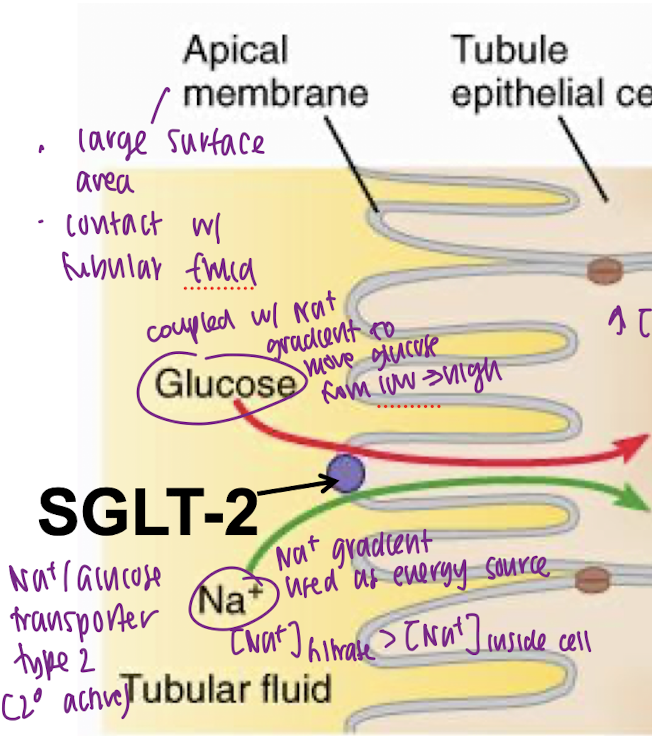
what is the primary glucose transporter in the apical membrane and describe the movement of ions
SGLT-2 (Na+/glucose transporter type 2) — secondary active transporter
Na+ gradient is used as an energy source to move glucose against its concentration gradient
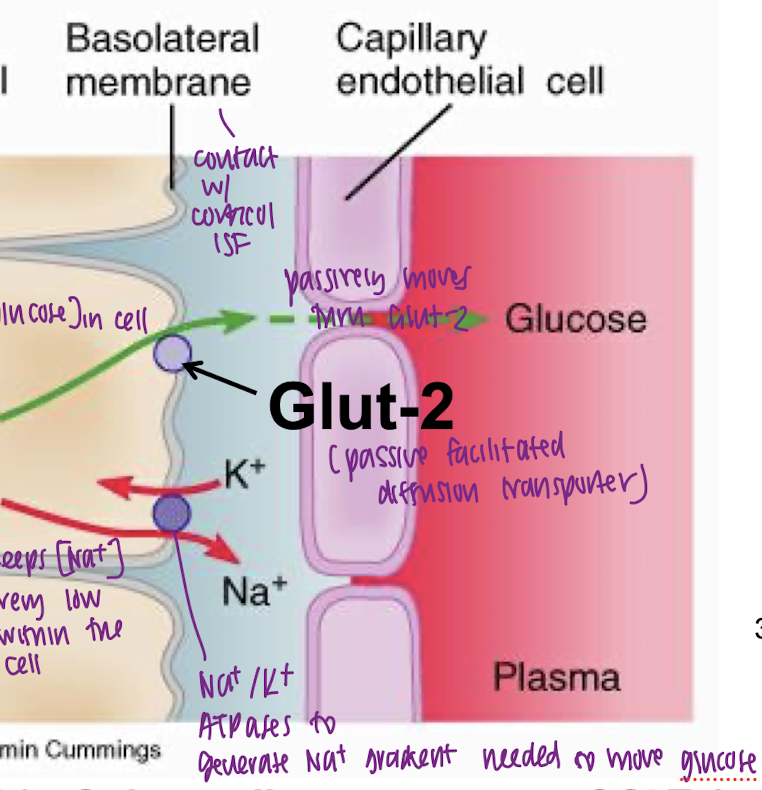
what is the primary glucose transporter in the basolateral membrane and describe the movement of ions
Glut-2 (passive facilitated diffusion transporter)
Na+/K+ ATPases to generate Na+ gradient (keeps [Na+] very low within the tubule epithelial cell)
apical membrane is in contact with
tubular fluid
basolateral membrane is in contact with
corticol ISF
what is normal plasma glucose
~90-100 mg/dL
what does threshold indicate for renal handling of glucose?
is plasma [glucose] at which glucosuria (glucose in urine) begins (~170-200 mg/dL)
what does the transport maximum indicate for renal handling of glucose
highest constant maximal rate for glucose reabsorption. all SGLTs are saturated. (= 375 mg/dL)

