Biological Classification: Euglenoids, Slime Moulds, and Protozoans
 Call Kai
 Learn
Learn Practice Test
 Spaced Repetition
 Match
Match Flashcards
 Knowt Play
1/46

Earn XP
Description and Tags
Vocabulary flashcards covering the characteristics and examples of Euglenoids, Slime moulds, and various groups of Protozoans based on the lecture notes.
Name | Mastery | Learn | Test | Matching | Spaced | Call with Kai | Chat |
|---|
No analytics yet
Send a link to your students to track their progress
47 Terms
Euglenoid
Fresh water organisms mostly found in stagnant water that lack a cell wall and instead have a protein-rich layer called a pellicle.
Pellicle
A protein-rich layer found in Euglenoids that makes their body flexible.
Euglena
A type of Euglenoid that is photosynthetic in the presence of sunlight but behaves like a heterotroph in the absence of sunlight.
Slime moulds
Saprophytic protists that form an aggregated plasmodium under suitable conditions.
Plasmodium
An aggregation formed by slime moulds in suitable conditions which may grow and spread over several feet.
Spores
Resistant structures produced by the fruiting bodies of slime moulds during unfavorable conditions that can survive for many years.
Protoztoans
Heterotrophic organisms that live as predators or parasites and are considered primitive relatives of animals.
Amoeboid protozoans
Organisms that live in fresh water, sea water, or moist soil and capture prey using pseudopodia (false feet).
Pseudopodia
Known as "false feet," these are used by amoeboid protozoans for movement and capturing prey.
Entamoeba
A parasitic amoeboid protozoan; notably, marine forms of this group have silica shells on their surface.
Flagellated protozoans
Protozoans that are either free-living or parasitic and possess flagella for movement.
Trypanosoma
An example of a flagellated protozoan that is a parasite and causes sleeping sickness.
Ciliated protozoans
Aquatic protozoans that are characterized by the presence of cilia and a wall-like cavity (gullet).
Sporozoans
Organisms characterised by infectious spore like stage in their life cycle
ex: plasmodium
Chrysophytes
A group of golden algae known for their chlorophyll pigments and silica cell walls, primarily found in aquatic environments.
Dinoflagellates
A group of single-celled protists that possess two flagella and are often bioluminescent, playing a significant role in marine ecosystems.
What are fungi?
Fungi are a kingdom of primarily multicellular, heterotrophic organisms that absorb nutrients from their environment.
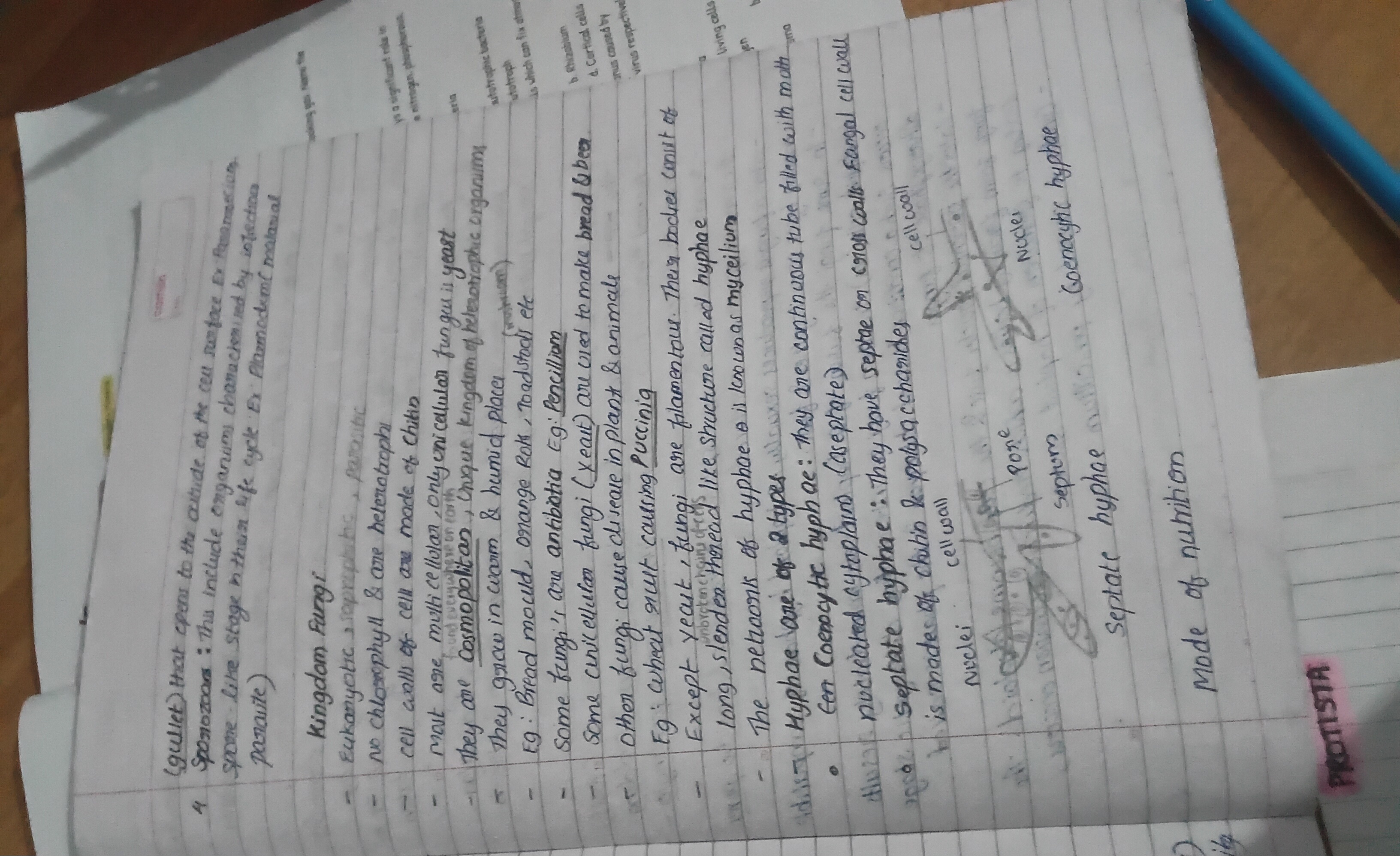
What are hyphae?
Hyphae are long, thread-like structures that make up the body of fungi.
What is mycelium?
Mycelium is the vegetative part of a fungus, consisting of a mass of branching, thread-like structures called hyphae.
What are the types of hyphae?
Hyphae can be categorized into two main types: septate hyphae and coenocytic (or aseptate) hyphae. Septate hyphae have cross-walls (septa) that divide the hyphae into individual cells, allowing for compartmentalization. Coenocytic hyphae, on the other hand, lack these cross-walls and are multinucleate, resulting in a continuous tubular structure.
Symbionts
Symbionts are two different organisms that live together in a close association, where one or both organisms benefit.
Lichen – An alga and a fungus live together. The alga prepares food, and the fungus provides water, minerals, and protection.
Mycorrhiza – A fungus lives with plant roots. The fungus helps absorb water and minerals, while the plant gives food to the fungus.
Reproduction in Fungi
Vegetative Reproduction
Takes place without spores or gametes.
New individuals are formed from the parent body.
Methods:
Fragmentation – Mycelium breaks into pieces, and each piece grows into a new fungus.
Fission – A single cell divides into two equal daughter cells (e.g., yeast).
Budding – A small outgrowth (bud) develops on the parent cell, grows, and separates (e.g., yeast).
Asexual ReproductionOccurs without fusion of gametes.
Produces asexual spores by mitosis.
Common spores:
Zoospores – Motile spores with flagella; formed in water.
Sporangiospores – Produced inside a sporangium.
Conidia – Non-motile spores formed externally on conidiophores.
Chlamydospores – Thick-walled resting spores.
Oidia (Arthrospores) – Formed by breaking of hyphae into small cells.
Sexual reproduction
Definition
Sexual reproduction involves the fusion of compatible male and female nuclei, resulting in genetic variation.
Three Main Steps
1. Plasmogamy
Fusion of the cytoplasm of two compatible fungal cells.
Nuclei do not fuse immediately.
A dikaryotic (n + n) stage is formed.
2. Karyogamy
Fusion of the two haploid nuclei.
Forms a diploid (2n) zygote.
3. Meiosis
The diploid nucleus undergoes meiosis.
Produces haploid sexual spores, which germinate to form new fungi.
Sexual Spores
Depending on the fungal group, sexual spores include:
Oospores – Oomycetes
Ascospores – Ascomycetes
Basidiospores – Basidiomycetes
Zygospores – Zygomycetes
Phycomycetes
Called algal fungi.
Found in water, moist soil, and decaying wood.
Mycelium is aseptate and coenocytic.
Asexual reproduction by zoospores or aplanospores.
Sexual reproduction forms oospores or zygospores.
Examples: Mucor, Rhizopus, Albugo.
Ascomycetes
Called sac fungi.
Mycelium is branched and septate.
Asexual reproduction by conidia.
Sexual spores are ascospores, formed inside asci.
Asci are grouped into ascocarps.
Examples: Yeast, Penicillium, Aspergillus, Claviceps.
Basidiomycetes
Called club fungi.
Mycelium is branched and septate.
Asexual spores are generally absent.
Sexual spores are basidiospores, formed on basidia.
Fruiting body is called basidiocarp.
Examples: Mushroom, Puffball, Rust, Smut.
Deuteromycetes
Called imperfect fungi.
Sexual stage is absent or unknown.
Reproduce only by conidia.
Many are decomposers; some cause diseases.
When the sexual stage is discovered, they are shifted to another class.
Examples: Alternaria, Colletotrichum, Trichoderma.
Kingdom Plantae
Multicellular, eukaryotic organisms.
Cells have cell wall (cellulose) and chloroplasts.
Perform photosynthesis (autotrophic).
Store food as starch.
Mostly reproduce by vegetative, asexual, and sexual methods.
Examples: Mosses, Ferns, Gymnosperms, Angiosperms.
Kingdom Animalia
Multicellular, eukaryotic organisms.
No cell wall.
Heterotrophic (ingest food).
Usually motile.
Reproduction is mainly sexual.
Organ systems are well developed.
Examples: Earthworm, Fish, Frog, Bird, Human.
Virus and their characteristics
Viruses are acellular (non-cellular), ultramicroscopic infectious agents.
They can reproduce only inside a living host cell (obligate intracellular parasites)
Characteristics of Viruses
Acellular and microscopic.
Obligate intracellular parasites.
Contain either DNA or RNA.
Multiply only inside living cells.
Can be crystallized outside the host.
Structure of virus a
Made of nucleic acid (DNA or RNA, never both).
Surrounded by a protein coat called a capsid.
Capsid is made of capsomeres.
Some viruses have an envelope around the capsid.
Discovery of virus
Dmitri Ivanovsky (1892): Discovered the virus causing tobacco mosaic disease.
M.W. Beijerinck (1898): Named it Contagium vivum fluidum (contagious living fluid).
W.M. Stanley (1935): Crystallized the Tobacco Mosaic Virus (TMV).
Common Viral Diseases
Humans: Common cold, Influenza, Measles, Mumps, Chickenpox, Polio, Rabies, AIDS, COVID-19.
Plants: Tobacco Mosaic Disease.
Animals: Foot-and-mouth disease.
Are Viruses Living or Non-living?
Outside the host: Non-living (inactive, can be crystallized).
Inside the host: Living (reproduce using the host's machinery).
Therefore, viruses show both living and non-living characteristics
Viroids
Discovered by T.O. Diener (1971).
Smallest infectious agents.
Made of only naked circular RNA.
No protein coat (capsid).
Cause diseases in plants.
Example: Potato spindle tuber disease.
Prions
Discovered by Stanley B. Prusiner (1982).
Infectious protein particles.
No DNA or RNA.
Cause diseases of the brain and nervous system.
Virus vs Viroid vs Prions
Virus
DNA or RNA + protein coat
Reproduce inside host cells
Has capsid
Viroids
Reproduce in plant cells
No capsid
Infect plants only
Only RNA
Prions
Only protein
Infect animals & humans
No nucleic acid
Convert normal proteins into abnormal proteins
Two-Kingdom Classification
Proposed by Carolus Linnaeus.
Organisms divided into:
Kingdom Plantae
Kingdom Animalia
Limitations
No separation of prokaryotes and eukaryotes.
No separation of unicellular and multicellular organisms.
Fungi placed with plants.
No separate kingdom for microorganisms.
Aristotle classification
Classified animals based on habitat into2
Animals with red blood
Animals without red bloodClassified plants based on habit.
Classified plants into Three groups by size:
Herbs
Shrubs
Trees
Five-Kingdom ClassificationCriteria for
Criteria for Five-Kingdom Classification
Cell structure
Body organisation
Mode of nutrition
Reproduction
Phylogenetic relationships
5 kingdoms Five-Kingdom Classification
Proposed by R.H. Whittaker (1969).
Five kingdoms:
Monera
Protista
Fungi
Plantae
Animalia
Kingdom Monera
Prokaryotic and unicellular organisms.
No true nucleus or membrane-bound organelles.
Cell wall usually made of peptidoglycan (except Mycoplasma).
Reproduce mainly by binary fission.
Nutrition may be autotrophic or heterotrophic.
Subdivisions of monera
1.archaebacteria
2.Eubacteria
3.Cyanobacteria
4.Mycoplasma
Archaebacteria
Live in extreme environments.
Cell wall lacks peptidoglycan.
Types:
Methanogens – Marshes, produce methane.
Halophiles – Salty areas.
Thermoacidophiles – Hot, acidic places
Eubacteria
Eubacteria (True Bacteria)
Most common bacteria.
Cell wall contains peptidoglycan.
Can be autotrophic or heterotrophic.
Includes cyanobacteria (blue-green algae).
Some bacteria fix atmospheric nitrogen (e.g., Rhizobium).
Cyanobacteria
Cyanobacteria
Photosynthetic bacteria.
Contain chlorophyll a.
Also called blue-green algae.
Can fix nitrogen using heterocysts.
Examples: Nostoc, Anabaena.
Mycoplasma
Mycoplasma (PPLO)
Smallest living cells.
No cell wall.
Pleomorphic (change shape).
Resistant to many antibiotics that act on cell walls.
Cause diseases in plants and animals.
Fathers
Father of Botany
Theophrastus is known as the Father of Botany
Father of Biology
Aristotle is known as the Father of Biology.
Father of taxonamy
Carlus linneaus is know as the father of taxonomy