Political Science
0.0(0)
Studied by 8 people Note
Note Call Kai
 Learn
Learn Practice Test
 Spaced Repetition
 Match
Match Flashcards
 Knowt Play
Card Sorting
1/11

Earn XP
Description and Tags
Last updated 2:02 AM on 9/14/22
Name | Mastery | Learn | Test | Matching | Spaced | Call with Kai | Chat |
|---|
No analytics yet
Send a link to your students to track their progress
12 Terms
1
New cards
What is political culture?
The fundamental deep-seated/underline attitude of a particular society. ( A person that grew up in a small town will have a different view than one that grew in the suburbs)

2
New cards
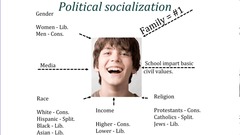
What is political socialization?
The formation of political attitudes.
3
New cards
What are some examples of political socialization?
Family, friends, school, religious institutions, media, political leaders, and educators.
4
New cards
What are the sources of news in the U.S, what are the reliable one's?
Social media, ABC news, CBS news, PBS news, CNN, Fox News, New York times, and the Wall street journal
5
New cards
Authoritarism
Principle of blind submission to authority, as opposed to individual freedom of thought and action. (Russia federation in 1990)
6
New cards
Totalitarianism
A political system in which the government has total control over the lives of individual citizens. (North Korea and Nazi Germany)
7
New cards
Conatitutional government
A constitutional government is one whose powers have been adapted to the interests of its people and to the maintenance of individual liberty. (U.S)
8
New cards
Democracy
A political system in which the supreme power lies in a body of citizens who can elect people to represent them
9
New cards
Discuss the history of immigration in the U.S
After WW1, congress limited the number of immigrants allowed to enter the U.S. This caused the immigrant population to decrease. By 2000 immigration has changed the nation's racial and ethnic profile due to congress in 1965 lifting the tight immigration restrictions of the 1920s. This expanded and diversified America.
10
New cards
Discuss the conflict leading up to the adoption of the U.S constitution. (adopted in 1789 with federalist beliefs)
The conflict leading up to the adoption of the U.S constitution was due to the antifederalist and federalist views on representation. The Antifederalists believed in governments that were close to the people like local and state governments. Antifederalists also wanted the powers of the national government to be carefully specified and limited. The Federalists wanted some distance and wanted a few and talented people to be representatives and serve in a national legislature. Federalist also wanted a national government with broad powers to defend the nation from foreign threats, guards against domestic strife, and expand the nation's economy. (Another conflict was the 3/5 compromise and if slaves would be counted as citizens in the constitution and the great compromise that states that every state gets the same amount of senators and the house of representatives is based on population)
11
New cards
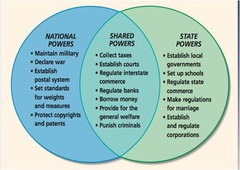
What is federalism?
Strong central government but the states have strong rights as well. Indestructible union of indestructible states and each has powers and responsibilities of its own.
12
New cards
What is the relationship between the national and state government. How has it changed over the years?
The national government regulates money, foreign affairs, the military, and the use of the three branches of government. The state government enforces state laws, education programs, and rods and highways. over time the national government gained more control and the states followed suit.