PSYC248 Exam 2 Vocab
 Call Kai
 Learn
Learn Practice Test
 Spaced Repetition
 Match
Match Flashcards
 Knowt Play
1/71

Earn XP
Description and Tags
Name | Mastery | Learn | Test | Matching | Spaced | Call with Kai | Chat |
|---|
No analytics yet
Send a link to your students to track their progress
72 Terms
massed practice
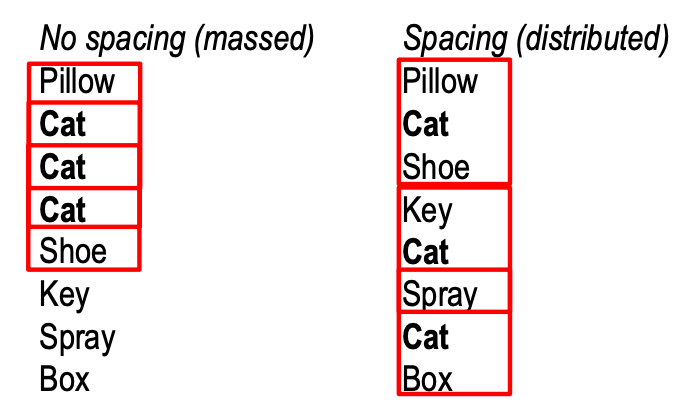
studying repeatedly with little or no time passing between study sessions
distributed practice (spaced learning)
studying repeatedly with time intervals between study sessions
testing effect
testing is most effective when retrieval is difficult, which also occurs at the longest lags (interacts with distributed practice)
reduced processing hypothesis
used to suggest why distributed practice is an effective strategy - people pay less attention to recently encountered things and thus do not process them as well as something seen longer ago
encoding variability
used to suggest why distributed practice is an effective strategy - you will tend to remember something better if you encode it in a variety of different ways (eg, in different environments)
reminding
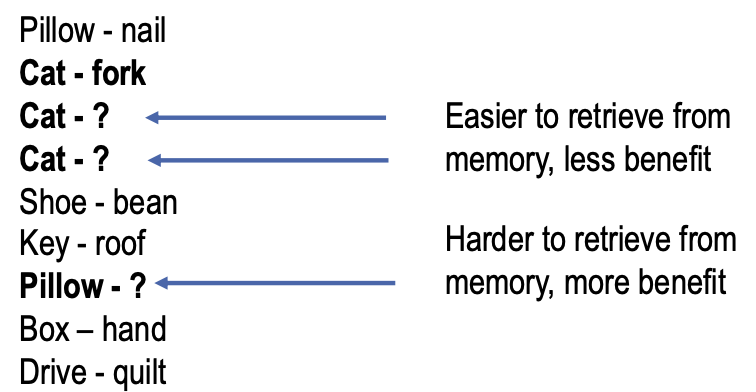
used to suggest why distributed practice is an effective strategy - retrieving items is beneficial for memory → a larger gap between items creates more effort at retrieval, so the benefit is greater
explicit tests
instructions to remember, effort to retrieve, “direct” tests (eg, free recall, cued recall, recognition)
implicit tests
measure effect of past experience on present, no instructions to remember, “indirect” tests (eg, stem completion, fragment completion, lexical decision)
lexical decision
response time to decide if the stimulus is a word or a non-word, after being or not being primed
metamemory
people’s awareness and understanding of their own learning and memory processes
test-enhancing learning
the tendency for a period of study to promote much greater learning when that study follows a retrieval test of the studied material…a new item is initially tested after a short delay to ensure that it is recallable → as the item becomes better learned, the practice-test interval is gradually extended
nonsense syllables
pronounceable but meaningless consonant-vowel-consonant items designed to study learning without the complicating factor of meaning (eg, wax, cal, biz, loj)
total time hypothesis
the proposal that the amount learned is a simple function of the amount of time spent on the learning task
deliberate practice
the engagement (with full concentration) in a training activity that is designed to improve a particular aspect of performance, including immediate feedback, opportunities for graduate refinement over repetitions, and problem solving
schemas
developed by frederick bartlett → long-term structured knowledge used to make sense of new material and subsequently store and recall it
elaborative rehearsal/processing
method of memorization which involves connecting information you already know with new information to expand on what needs to be remembered (eg, making up a story about the words you see in a list)
rote/maintenance rehearsal
repeatedly rehearsing an item on the same level (eg, repeating a phone number to yourself before you write it down)
levels of processing framework
information can be processed on a variety of levels, from the most basic (visual form), to phonology (sounds), to the deepest level (semantic meaning)
dual-coding hypothesis
items that are easy to visualize are encoded as images and words, and are therefore easier to retrieve
transfer-appropriate processing
proposal that retention is best when the mode of encoding and mode of retrieval are the same
incidental learning
learning situation in which the learner is unaware that a test will occur
intentional learning
learning when the learner knows that there will be a test of retention
mere exposure effect
repeated exposure to a stimulus increases perceptual fluency (the ease with which a stimulus can be processed)
distinctiveness
items that are unusual are also easy to remember from long-term memory (Von Restorff effect)
retrieval
the process of getting information back out of long-term memory (job is to use cues to find a target memory)
cues
pieces of information that are associated with a memory
target memory
the particular memory you are trying to retrieve
pattern completion
retrieving features in a memory that were not cued
tip-of-the-tongue states
occurs when we know information but cannot successfully retrieve it
reconstructive memory
an active and inferential process of retrieval whereby gaps in memory are filled-in based on prior experience, logic, and goals - during this process, memories are susceptible to being reconstructed incorrectly
source monitoring/misattribution error
when we do not correctly remember the source of a memory
cryptomnesia
when we believe that we generated something that is actually a memory with a forgotten source
context cues
retrieval cues that specify aspects of the conditions under which a desired target was encoded
environmental context
refers to the spatial and temporal conditions under which a memory was made
incidental context
the ability to retrieve a memory not necessarily because you are trying to, but because the context of the present situation matches the context of the past memory
context-dependent memory
the finding that memory benefits when the spatio-temporal, mood, physiological, or cognitive context at retrieval matches that present at encoding
state-dependent memory
changes in physiological state that can act as context (eg, induced by drugs like alcohol or caffeine or other physiological processes like exercise/heartrate)
mood-dependent memory
a form of context-dependent effect whereby what is encoded in a given mood, whether positive, negative or neutral, is best recalled in that mood (regardless of mood of event itself); affects neutral memories
mood-congruent memory
bias in the recall of memories such that negative mood makes negative context memories more readily available than positive, and vice versa; does not affect the recall of neutral memories
recall
actually drawing items out of memory and reporting them
recognition
saying whether or not you have seen an item before
signal detection theory
some items in memory are more active than others - active memories will seem more familiar, but different people have different thresholds at which they say an item was seen before
hit: correctly identifying an old item
miss: identifying an old item as new
false alarm: identifying a new item as old
correct rejection: correctly identifying a new item
spreading activation
the appropriate node in semantic memory is activated when we see, hear, or think about a concept. activation then spreads rapidly to other concepts, with greater activation for concepts closely related semantically than those weakly related.
encoding specificity principle
the more similar the cues available at retrieval are to the conditions present at encoding, the more effective the cues will be
retrieval mode
the cognitive set, or frame of mind, that orients a person towards the act of retrieval, ensuring that stimuli are interpreted as retrieval cues
incidental forgetting
memory failures occurring without the intention to forget
motivated forgetting
occurs when people purposefully engage in processes/behaviors that intentionally diminish a memory’s accessibility
availability
whether or not an item is in the memory store
accessibility
whether the memory can be retrieved, given that it is stored
consolidation
process by which a memory is hardened or made more robust over time due to an association just learned
trace decay
the gradual weakening of memories resulting from the mere passage of time
interference
arises whenever the cue that is used to access a target becomes associated with other memories
contextual fluctuation
mismatches between the retrieval and encoding contexts encourages forgetting - incidental context shifts over time
retroactive interference
the tendency for newer memories to interfere with the retrieval of older memories
proactive interference
the tendency for older memories to interfere with retrieval of more recent experiences
retrieval-induced forgetting
the tendency for the retrieval of some target items from long-term memory to impair the later ability to recall other items related to those targets
inhibition
a general term applied to mechanisms that suppress other activities
forgetting curve
the logarithmic decline in memory retention as a function of time elapsed, first described by Ebbinghaus
directed forgetting
the tendency for an instruction to forget recently experienced items to induce memory impairment for those items
item-method directed forgetting
a participant receives a series of items to remember
after each item, an instruction appears indicating whether they should either continue to remember it or to forget it, because they will no longer be held responsible for it
after the list ends, participants are tested on all of the to-be-remembered and to-be forgotten words
interestingly, recall for to-be-forgotten words is substantially impaired, relative to to-be-remembered items
list-method directed forgetting
presents the instruction to forget only after half of the list (often 10–20 items) has been studied, and usually as a surprise
typically, deception is employed, in which the experimenter tells the participant that the list they just studied was for “practice,” and that the real list is about to be presented
other times, the experimenter may pretend that the participant had received the wrong list, which they should “forget about.”
Following this instruction, participants receive a second list. A final test is then given, quite often for both lists, but sometimes only for the first list. Participants are asked to disregard the earlier instruction to forget, and to remember as much as they can
Performance in this forget group is contrasted with a remember group who follows the same procedure, except that the instruction after the first list simply reminds people that they should continue remembering the first list.
Two findings are consistently observed
1. when participants believe that they can forget the first list, they often do much better at recalling the second list on the final test
2. compared to the remember group, proactive interference causes better recall of the first list
selective rehearsal
items that receive a “remember” instruction are encoded more deeply
encoding suppression
encoding is stopped for items that receive a “forget” instruction
retrieval inhibition hypothesis
suggesting that first-list items are temporarily inhibited in response to the instruction to forget and can be reactivated by subsequent presentations of the to-be-forgotten items
cognitive control
the ability to activate wanted thoughts and prevent unwanted thoughts from distracting us
think/no think paradigm
a procedure designed to study the ability to volitionally suppress retrieval of a memory when confronted with reminders
mimics those times in life when we stumble on a reminder to an experience that we would prefer not to think about, prompting the desire to put the unwelcome memory out of mind
direct suppression
directly prevent the unwanted thought from being retrieved
thought substitution
think of something different instead of the unwanted thought
spontaneous recovery
the re-emergence of a previously extinguished conditioned response after a delay; similarly - forgotten declarative memories have been observed to recover over time
hypermnesia
the improvement of memory over time after repeated testing
reminiscence
remembering items that were unrecallable in past sessions without additional relearning
cue reinstatement
unwanted memories may be brought back by cues
cause us to experience unintended forms of reminding and show power of cues to reinstate painful or unwanted memories