Consequences of WW1 Peace Treaties and Rise of Dictatorships
 Studied by 0 people
 Call with Kai
 Learn
Learn Practice Test
 Spaced Repetition
 Match
Match Flashcards
 Knowt Play
1/104

There's no tags or description
Looks like no tags are added yet.
Name | Mastery | Learn | Test | Matching | Spaced | Call with Kai |
|---|
No analytics yet
Send a link to your students to track their progress
105 Terms
Russian Civil War
A traumatic event that determined control of Russia between the Bolsheviks and anti-bolshevik groups from 1918-21.
Impact of German nationalism
The Treaty of Versailles was regarded as a 'diktat', undermining the authority of the government and discrediting the Weimar Republic.
Conditions that gave rise to dictatorships
World War 1 demoralised and divided European societies, leading to militarised politics and the end of empires and monarchies.
Italian Nationalism
A result of disappointment from the Treaty of Versailles, with Italians feeling cheated as they were denied territorial gains originally promised.
Economic problems in Italy
Post-WW1 Italy experienced serious issues such as unemployment, inflation, and high budget deficits.
League of Nations
An intergovernmental organization founded after WW1 to promote peace and cooperation among countries.
New countries post-WW1
New countries such as Czechoslovakia, Yugoslavia, and Poland were established as a result of the war.
Breakup of empires
The German, Russian, Austro-Hungarian, and Ottoman Empires ceased to exist after WW1.
Ramifications of the Treaty of Sèvres
The treaty prevented Arab peoples of the Middle East from ruling themselves as the Ottoman Empire was divided into mandates by Britain and France instead of one united nation, leading to ongoing issues.
Italian Fascism
Inspired German Nazis to imitate its features.
Joseph Stalin
Leader of Soviet Union known for totalitarian rule.
Cult of Personality
Excessive admiration for a political leader.
Communism
Advanced socialism eliminating private property.
Stalinist Russia
Characterized by terror, famine, and labor camps.
Single Political Party
Only one party dominated all institutions.
Surveillance
Monitoring citizens to eliminate state enemies.
Totalitarianism
State controls all aspects of people's lives.
Collectivisation
Soviet policy transforming agriculture, 1929-1933.
Benito Mussolini
Founded the Fascist Party in Italy, 1919.
Blackshirts
Fascist party militants who attacked opponents.
March on Rome
1922 demonstration establishing Mussolini's power.
Musolini's Domestic Policy
Included secret police and prohibition of opposition.
Mussolini's Foreign Policy
Aimed to create a second Roman Empire.
Treaty of Versailles Racial Equality Proposal
Rejected amendment fueling Japanese nationalism.
Manchuria Crisis
Japanese staged explosion to justify military takeover of the Manchuria region in China.
Ebert-Groener Pact
Agreement to maintain order post-German Revolution.
Armistice of 1918
Ended fighting between Allies and Germany.
Weimar Republic
German democracy from 1918 to 1933.
Stab in the Back Myth
Belief army betrayed by homefront groups.
November Revolution
Power struggle leading to Weimar Constitution.
Spartacist Uprising
1919 power struggle crushed by army and Freikorps.
Weimar Constitution
Established democracy and basic freedoms in Germany.
Hyperinflation
Rapidly accelerating inflation affecting German economy.
Occupation of the Ruhr
French and Belgian troops seized Germany's industrial area.
Passive Resistance
Policy to resist occupation leading to economic chaos.
Treaty of Versailles
The peace settlement between Germany and the Allies, signed on June 28 1919, which 'officially' ended the war after WW1 had 'ended' in 1918.
TRAWL (T): Territorial Provisions
(TRAWL) T: Consequences for Germany including Alsace-Lorraine returned to France, Anschluss with Austria forbidden, Poland given Posen and Upper Silesia, loss of land to Belgium and Denmark, loss of all colonies, and Saar and Danzig regions placed under the control of the League of Nations.
TRAWL (R): Reparations
Germany to pay $40bn USD in reparations to the allies and provide locomotives, machinery, and shipping to the allies.
TRAWL (A): Military Provisions
The German army was reduced to 100,000 men; no airforce, no submarines, and no tanks allowed.
TRAWL (W): War Guilt Clause
Article 231, the opening article of the reparations section of the Treaty of Versailles, which laid total blame on Germany for the war and its destructiveness.
TRAWL (L): League of nations
This was set up after the war to promote peace and co-operation between countries of the world. Germany was not allowed to join the League. This did little to show the German people that they were still internationally recognised as a powerful and peaceful country. Germany was not brought into the decision making process and was essentially an outcast at the whims of the allied powers.
Treaty of Brest-Litovsk
The treaty between Soviet Russia and the Central Powers, signed on March 3, 1918, which ended Russia's involvement in World War 1.
Treaty of Saint-Germain-en-Laye
The treaty between Austria and the Allied Powers, signed on September 10, 1919, which established the Republic of Austria and recognised Austria and Hungary as separate nations.
Treaty of Sèvres
The treaty between the Ottoman Empire and the Allied Powers, signed on August 10, 1920, which resulted in Turkey losing most of their European-held territory.
Kiel Mutiny
A sailors' mutiny in the northern German city of Kiel in resistance to an apparent suicide mission in the final days of World War 1, leading to the abdication of the Kaiser and the German Revolution.
Kapp Putsch
A 1920 attempt to overthrow the government by forces of the right, triggered by the government's desire to meet the military clauses of the Treaty of Versailles.
Nationalism
Identification with one's own nation and support for its interests, especially to the exclusion or detriment of the interests of other nations.
Diktat
A dictated peace, referring to the Treaty of Versailles which was imposed without popular consent.
Freikorps
Right-wing paramilitary militias raised during the German revolution, consisting largely of World War 1 veterans.
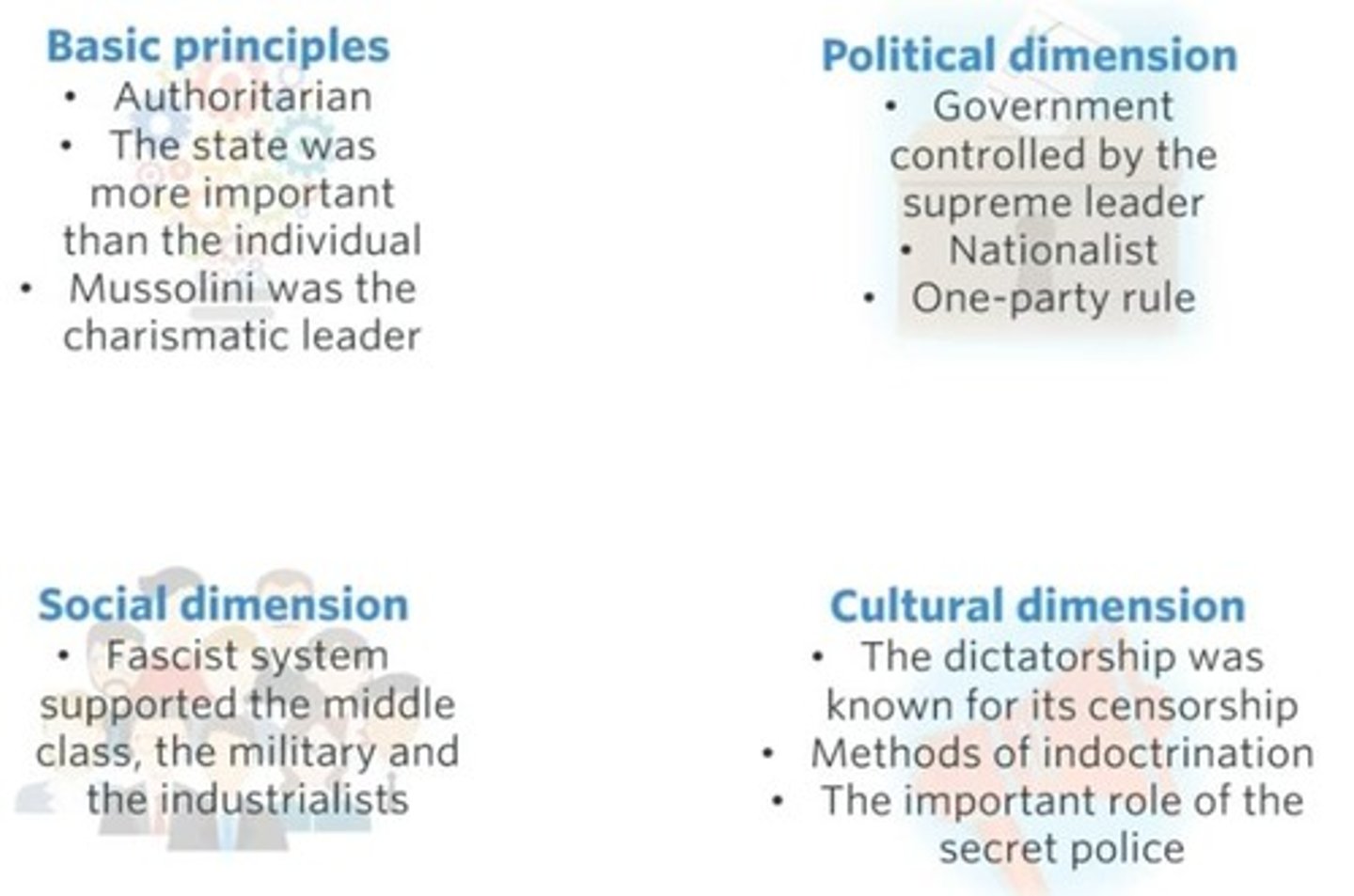
Fascism
A political ideology and mass movement of extreme militaristic nationalism and the breakdown of democratic principles.
Consequences of WW1 on Germany
World War 1 had a devastating impact on German social and political life, with almost 2 million dead and a pervasive atmosphere of bitterness and disappointment.
Real value of currency
It quickly erodes the real value of the currency, as the prices of most or all goods increase.
Origins of the Nazi Party
The German Workers' Party was founded by Anton Drexler in the atmosphere of chaos during the post-war social and political uncertainty and radicalism.
German Workers' Party
Founded in 1919 by Anton Drexler, it was not so much a political party but a cause to complain about the Republic.
Adolf Hitler's early speeches
Key messages included anti-democracy, anti-Weimar Republic, and anti-Semitism Judeo-Bolshevism.
25-point program
The political program of the early Nazi Party, composed by Adolf Hitler and Anton Drexler and published in February 1920.
National Socialism or Nazism
The doctrine of the National Socialist German Workers' Party, which ruled Germany from 1933 to 1945.
Beer Hall Putsch
Hitler and his followers attempted to seize power when they detained the leaders of Bavaria at a political rally in a Munich beer hall on 8 November 1923.
Kampfbund
The 'Fighting League'. An organisation of right wing military groups in Bavaria set up in 1923.
Period of relative stability
The years from 1924 to 1929 were the good years for Weimar Germany, following the crises of 1923.
Dawes Plan
The plan prepared in 1924 by a committee led by American banker Charles Dawes to adjust Germany's capacity to pay.
Young Plan
The Plan further reduced Germany's reparation repayment figure.
The Great Depression
Germany suffered an immediate and dramatic economic collapse as a result of the depression.
Unemployment figures by 1933
By early 1933, 6 million (26 percent) Germans were without a job.
Deflationary policy
The policy followed by the German government from 1930 that involved cutting government spending, increasing taxes, and attempting to balance the budget.
Presidential rule
The President ruled Germany through Article 48.
Heinrich Brüning
Proved to be ineffective as he relied completely on Article 48 and was a believer in deflationary policy.
Nazi Party electoral success
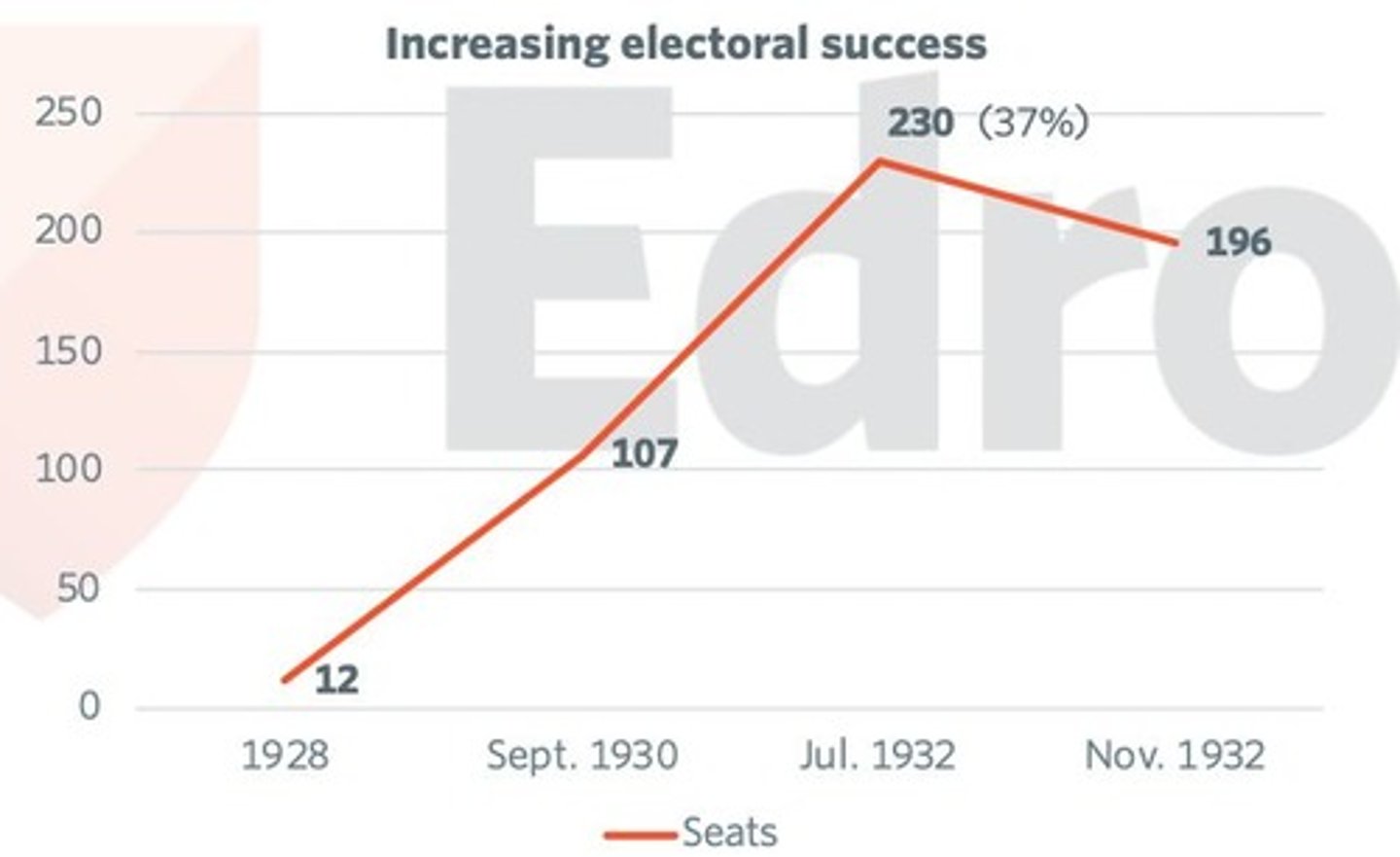
The Great Depression provided the conditions for the Nazi Party to gain electoral success, increasing their seats in the Reichstag from 12 to 107.
Political Instability
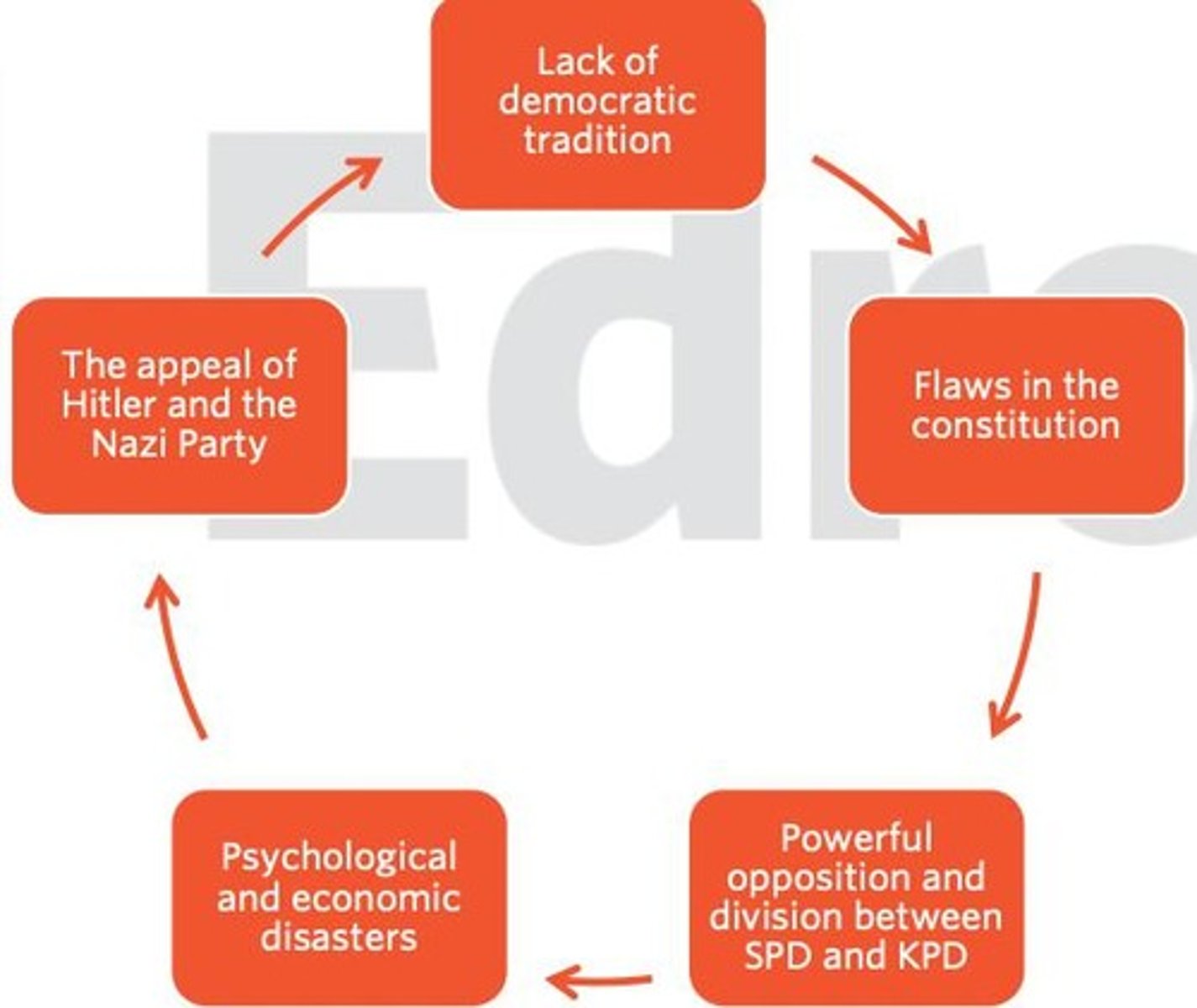
The Nazis projected themselves as the party of action, tapping into the mood of resentment and frustration.
Hitler's rise to power
Political intrigue and petty jealousies brought Hitler to power between December 1932 and January 1933.
Demagogue
A political figure who wins support by appealing to people's emotions rather than by using rational arguments.
Sturm-Abteilung (SA)
The military wing of the Nazi Party, made up of a large measure of ex-Freikorps troops.
Gleichschaltung
This means the 'coordination' and refers to the process of Nazification.
Enabling Act
A law passed by a two-thirds of the Reichstag in March 1933 that allowed Hitler to rule independently of both the Reichstag and the President.
Civil Service
The various government departments and agencies that deliver day-to-day functioning of the state.
Third Reich
The period of German history from 1933 to 1945.
Reichstag Fire
On 27 February 1933, the Nazis accused the Communists of setting the fire.
Decree of the Reich President for the Protection of People and State
Civil liberties and freedoms of the German people were 'suspended' on 28 February 1933.
Night of Long Knives
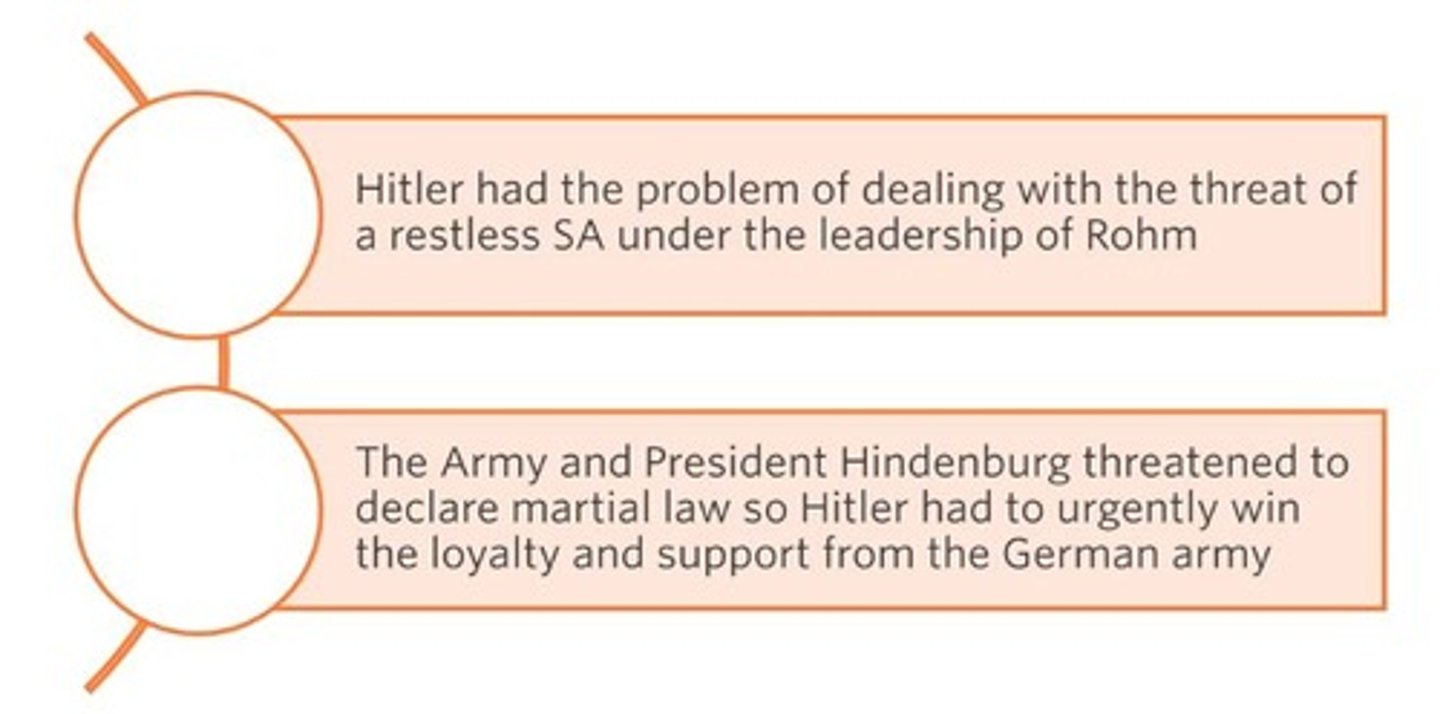
The 'Night of Long Knives' took place on 30 June 1934 when the SS took the SA leaders by surprise.
Führer
The German word for leader.
Night of the Long Knives
Elimination of SA leadership on June 30, 1934.
Legal Dictatorship
Hitler's consolidation of power after Hindenburg's death.
Fuhrer Principle
One leader controls all decision-making processes.
Lebensraum
Living space sought in Poland and Russia.
Autarky
Economic self-sufficiency for Germany's security.
German Unification
Unifying German-speaking peoples under Nazi ideology.
Volksgemeinschaft
Concept of a people's community in Nazi Germany.
Social Darwinism
Belief in Aryan superiority over other races.
Anti-Semitism
Belief in Aryan racial purity; hatred of Jews.
Judeo-Bolshevism
Conspiracy theory linking Jews to Soviet Communism.
Leadership Principle
Führer has ultimate authority over the state.
Hermann Göring
Powerful Nazi leader, head of Luftwaffe.
Gestapo
Secret police enforcing Nazi policies.
Luftwaffe
German air force under Nazi command.
Albert Speer
Nazi architect and Minister for Munitions.
1934 Nuremberg Rally
Iconic Nazi rally showcasing propaganda techniques.
Heinrich Himmler
SS leader responsible for concentration camps.
Final Solution
Nazi plan for the genocide of Jews.
Rudolf Hess
Deputy Führer, negotiated peace in Scotland.
Mein Kampf
Hitler's autobiography outlining Nazi ideology.
 Note
Note  Flashcards (42)