BIOM 1060 (Module 1)
 Call Kai
 Learn
Learn Practice Test
 Spaced Repetition
 Match
Match Flashcards
 Knowt Play
1/25

There's no tags or description
Looks like no tags are added yet.
Name | Mastery | Learn | Test | Matching | Spaced | Call with Kai |
|---|
No analytics yet
Send a link to your students to track their progress
26 Terms
4 main tissue types
Epithelia (External surface of the body/ lining of internal glands)
Connective (Tendons, bones, cartilage, ligaments)
Muscle (cardiac, skeletal, smooth muscles)
Neural (neurons)
Superior
Toward the head/ upper part of the body
Inferior
toward the feet/ lower part of the body
Medial
Toward the midline of the body
Lateral
Away from the midline from the body
Anterior
Toward the front of the body
Posterior
Toward the back of the body
Superficial
Close to the surfae of the body
Deep
Further inside the body
Proximal
Close to where a limb attaches to the body
Distal
Further from where a limb attaches to the body
Nucleus
control centre of the cell
contains DNA (genetic material)
Ribosome
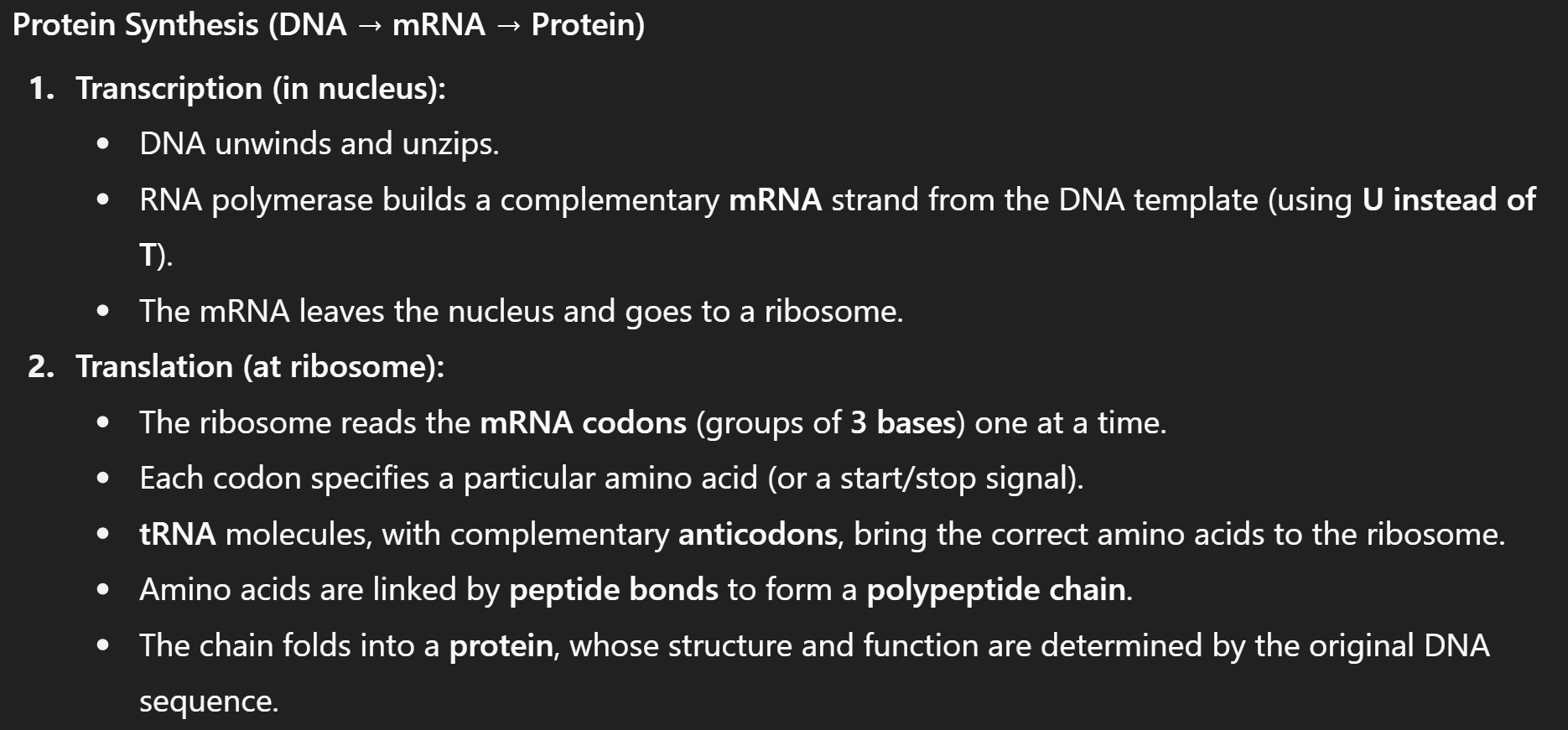
Used for protein synthesis
Membrane bound ribosomes - Makes proteins that function in the membrane
Endoplasmic reticulum (rough and smooth)
Rough:
Covered in rough ribosomes and is what is used to make proteins
Smooth:
Specialised functions in certain cells (e.g detoxification within the livers and kidneys)
Golgi Apparatus
Accepts transport vesicles from the ER, carrying proteins for further modifications, sorted and then sent outside to other cells and various membranes and organelles.
Lysosomes and peroxisomes
Membrane bound organelles
Lysosomes:
Break down of organic material inside the cells
Peroxisomes:
Degrade toxic molecules inside the cell
Mitochondria
Releases energy that is stored in ATP
Carries out aerobic cellular respiration
Protein synthesis
Plasma Membrane (structure)
Separates intracellular and extracellular fluid
Determines which molecules move in between
Phospholipid bilayer where the tail is hydrophobic (hates water) and hydrophilic (loves water)
What molecules can penetrate and not through the plasma membrane
Penetrating molecules:
Gases (O2 & CO2)
Water
Ethanol
Non-penetrating molecules
Ions
Glucose & proteins
Difference between active and passive transport
Active (Requires ATP, moving molecules from high to low concentrations):
Primary and secondary active transport as well as vesicular transport
Passive (Does not require ATP, molecules from high to low):
Simple diffusion
Facilitated diffusion
Osmosis
Difference between simple and facilitated diffusion
Simple diffusion:
Where small molecules move directly through the cell membrane (O2, CO2)
Facilitated diffusion:
Molecules move from high to low, however uses the help of proteins such as channel and carrier proteins.
Osmosis
Diffusion of water across a partially permeable membrane.
Isotonic solution - No net movement of water (does not change shape)
Hypotonic solution - water moves into the cell, lower solute concentration outside of the cell (cell will swell)
Hypertonic solution - Water moves out of the cell, higher solute concentration outside of the cell (cell will shrink)
Describe which ions are high in concentration in: a) the intracellular fluid, b) the extracellular fluid.
Intracellular fluid:
K (potassium) dominates
Extracellular fluid:
Na (sodium) dominas
This is due to the fact that are sodium pumps pumping 3 Na out of the cell with K pumps pumping 2 K into the cell.
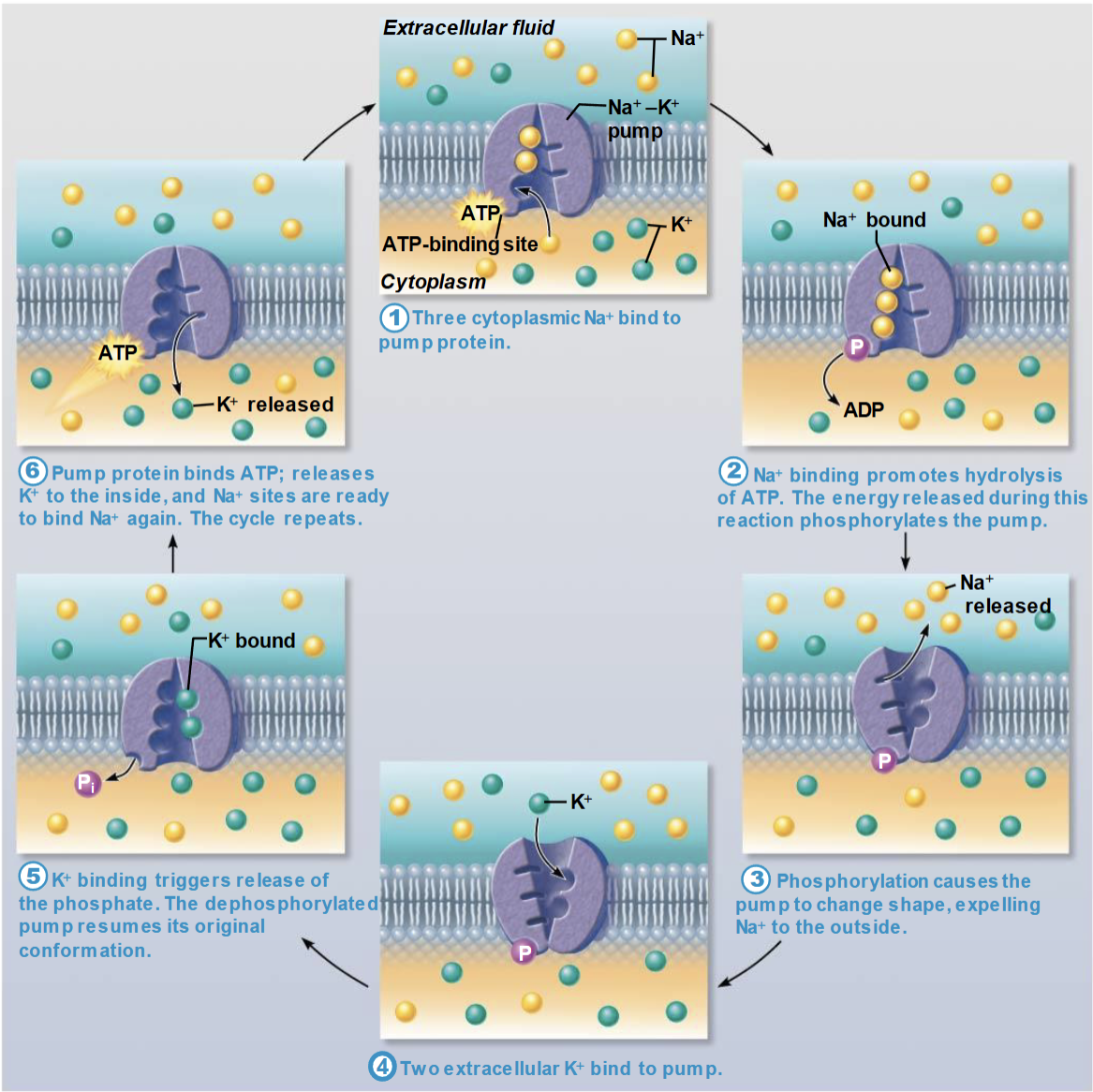
Explain how the Na+-K+ pump works to move ions across the plasma membrane.
1. 3 Na⁺ bind inside
Pump opens to the cell
3 sodium ions attach
2. ATP is used → ADP + Pi
ATP is broken down
This releases energy
3. Na⁺ released outside
Pump changes shape
3 Na⁺ are pushed out
4. 2 K⁺ bind outside
2 potassium ions attach
5. Pump returns to shape
Phosphate (Pi) leaves
Pump resets
6. K⁺ released inside
2 K⁺ enter the cell
Compare and contrast primary and secondary active transport.
Similarities
Both move substances against their concentration gradient
Both require membrane transport proteins
Both are essential for maintaining cellular homeostasis
Differences
Energy source:
Primary → Direct ATP use
Secondary → Indirect (ion gradient energy)
Protein type:
Primary → ATPase pumps
Secondary → Co-transporters (symport/antiport)
Dependency:
Primary → Independent
Secondary → Relies on primary transport
Examples:
Primary → Na⁺/K⁺ pump
Secondary → Na⁺–glucose symporter

