bio exam 3 sample problems
 Call Kai
 Learn
Learn Practice Test
 Spaced Repetition
 Match
Match Flashcards
 Knowt Play
1/71

There's no tags or description
Looks like no tags are added yet.
Name | Mastery | Learn | Test | Matching | Spaced | Call with Kai |
|---|
No analytics yet
Send a link to your students to track their progress
72 Terms
Which of the following is the main advantage to those animal species that are true hermaphrodites?
They don't need to find a mate to produce offspring.
You would expect cephalization to occur where on the body?
anterior
Organisms that have two germ layers following gastrulation are said to be
diploblastic
Organisms that undergo determinate development
have cells that have a predetermined fate early in development
Thermoregulation in mammals is controlled by
the hypothalamus
Which plant adaptation is absent in both ferns and mosses?
pollen
An individual fern sporophyte is able to produce far more spores than an individual moss sporophyte because, unlike the moss, the fern sporophyte has
sporophylls
In the early history of land plants, which of the following trends was observed?
- from sporangia on a single stalk to multiple branches with sporangia
- from dominant gametophyte stage to dominant sporophyte stage
- from no leaves to microphylls to megaphylls
- from low ground-level plants to taller, more upright plants
Many of the coal deposits we have today date to the Carboniferous Period and were formed from great forests that thrived at that time. Which of the following characteristics would you be LEAST likely to find among the plants in those forests?
pollen
Which of the following would describe the gametophyte generation in a plant?
haploid
Which of the following characteristics is shared by mosses and ferns?
fertilization requires water for motile sperm.
If a male and female flower are on the same plant, that plant would be considered:
monoecious
What is the function of pollen?
deliver sperm to the egg
In the ferns and horsetails, dispersal to new locations occurs through
air-borne spores
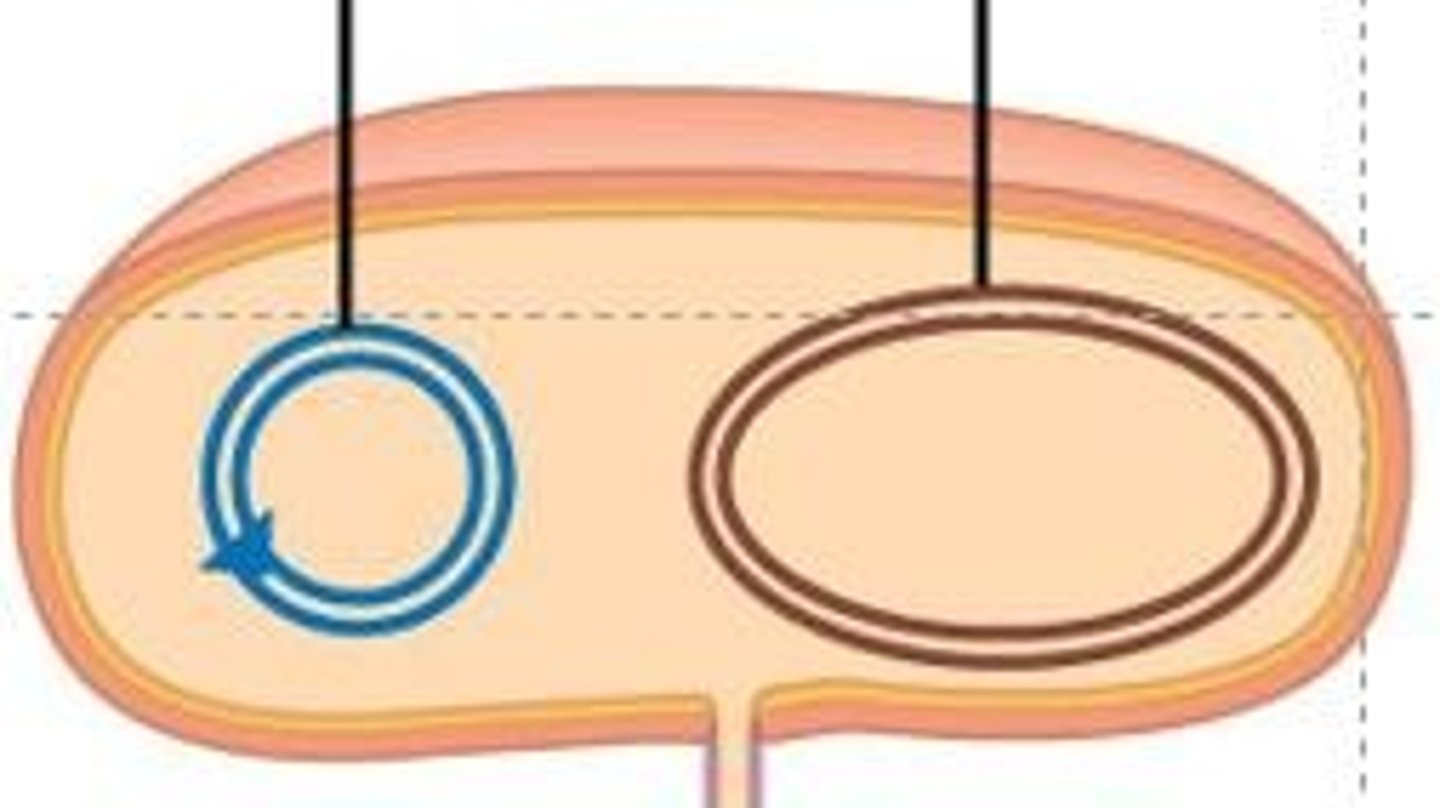
A = blue plasmid
B = brown genome
In this Hfr bacterium, the region of the cell that is carrying the genetic information for creating the mating bridge is A or B?
B
The host range of a virus is determined by _______
the proteins on the surface of the virus and that of the host
In the fungi, the process that directly produces the zygote stage is called
karyogamy
Euglenozoans
no cell wall, but pellicle. Some free living, others are parasites
Diatoms
are key primary producers, have silica skeletons and produce oils to maintain buoyancy
brown algae
exhibit alteration of generations and produces both motile zoospores and sperm
apicomplexans
no cell wall but have alveoli and a complex life cycle, some are pathogens of humans
chlorophytes
unicellular or colonial, photoautotrophic and biflagellate
Which of the following is NOT evidence supporting the hypothesis of the endosymbiotic evolution of mitochondria and chloroplasts?
photosynthetic eukaryotes must have evolved prior to the oxygen revolution
In the life-cycle of the malaria parasite Plasmodium, where does fertilization and formation of the zygote occur?
within the body of a mosquito
A geologist asks you to look at some ocean sediment, knowing this "dirt" contains the remains of dead protists whose hard shells have fossilized. You mix the sediment with water and examine it under the microscope. The "shells" or "tests" you observe will most likely belong to which group(s)?
Radiolarians, Foraminiferans, or Diatoms
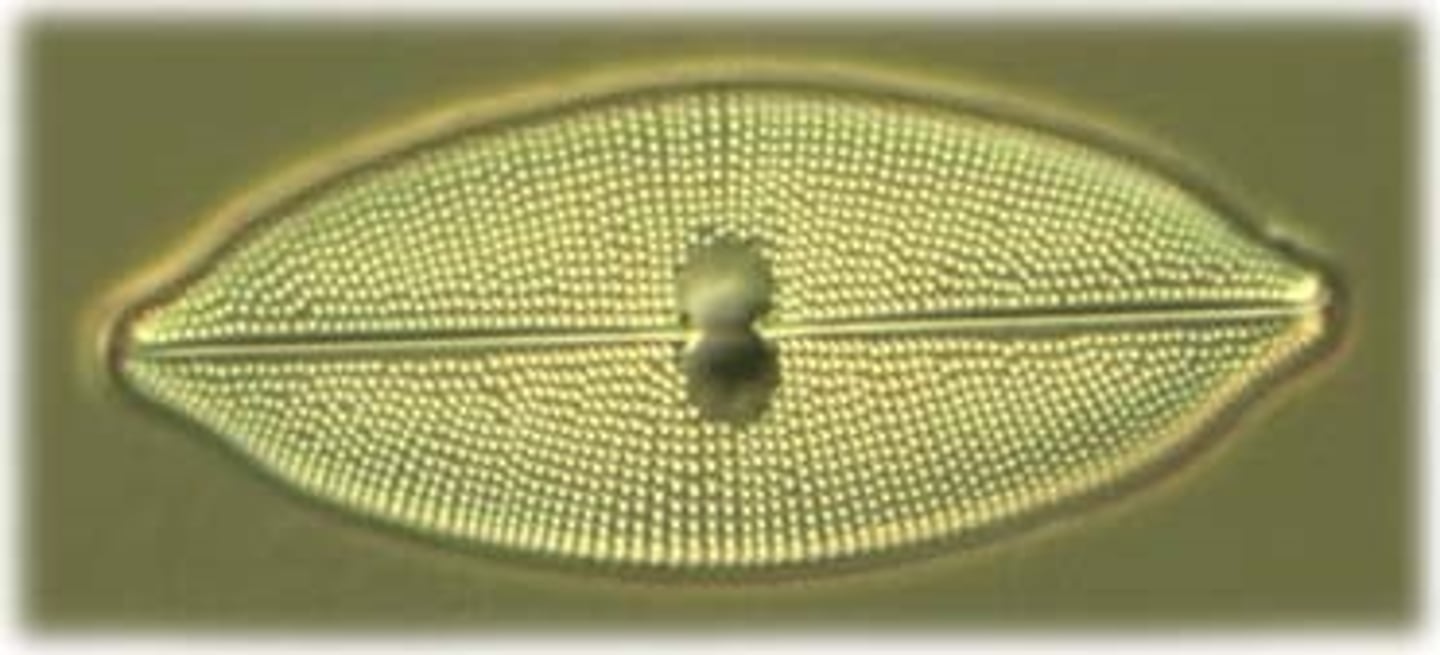
Dr. Bio samples some pond water to observe under the microscope. She finds the specimen above, which seems to have a clear shell or wall with yellowish pigmentation within. No flagella or cilia are observed. Recognizing that this is clearly a unicellular organism, Dr. Bio's best guess as to its classification is:
diatom
The main body of a multicellular fungus is called
mycelium
Fungal cell walls contain
chitin
Most fungi spend the majority of their life cycle as
haploid mycelium
Looking under the microscope, you see hyphae that are coenocytic. What are you likely to see
- hyphae with no cross walls (septa)
- multinucleate hyphae
In the lab, you are observing some plant roots and notice that in many of the root cells there are tree-like projections inside the cells. Subsequent staining indicates that these structures are fungal in origin. What are these structures? What is their purpose?
- haustoria
- nutrient exchange
This group of organisms have pairs of flagella located in perpendicular grooves, and includes Karenia brevis, a common cause of red-tides on the Gulf coast.
Dinoflagellates
What is the primary function of endosperm in plants?
A) protection of ovule
B) nutrition for embryonic plant
C) increases genetic diversity of offspring
D) dispersal of offspring to new location
E) enhances fertilization of egg
B
With protostome development,
A) the blastopore ultimately develops into the mouth.
B) mesoderm never forms.
C) only a pseudocoelom can form.
D) body cavities are always absent.
E) cleavage is indeterminate.
A
On the phylogenetic tree, animals are most closely related to
A) slime molds.
B) opisthokonts called choanoflagellates.
C) fungi.
D) chromalveolates.
E) amoebozoans called gymnamoebas.
B
All types of muscle tissue have ________.
A) interactions between actin and myosin
B) striated banding patterns seen under the microscope
C) a response that can be consciously controlled
D) cells that lengthen when appropriately stimulated
A
Sporopollenin coatings and branched sporangia were adaptations in early plants that improved the chances of A) survival of embryos.
B) successful sexual reproduction.
C) absorbing water from soil.
D) avoidance of herbivores.
E) dispersal to a favorable location.
E
If you find a flower part called a "stigma," then that same flower certainly has
A) anthers.
B) petals.
C) scent glands.
D) an insect pollinator.
E) an ovary.
E
In the sexual life cycle of the fern, the sporophyte form
A) is the only independent multicellular form.
B) protects the archegonia and the antheridia.
C) is a small, inconspicuous, and very vulnerable stage.
D) initially depends upon the gametophyte, but becomes independent as it grows larger.
E) produces eggs and sperm by meiosis.
D
Penguins, seals, and tuna have body forms that permit rapid swimming, because ________.
A) all of their bodies have been compressed since birth by intensive underwater pressures
B) all share a recent common ancestor
C) the shape is a convergent evolutionary solution, which reduces drag while swimming
D) this is the only shape that will allow them to maintain a constant body temperature in water
C
In seed plants, the female gametophyte
A) is reduced to microscopic size.
B) is the dominant stage of the life cycle.
C) is located within a microsporangium.
D) is an independent multicellular plant.
E) ALL of the above.
A
What key feature makes it possible for jellies ("jellyfish;" see above) to obtain food?
A) radula
B) scolex
C) collagen
D) cnidocyte
E) choanocyte
D
Which of the following is a correct match of structure and its function?
A) mesoglea -- helps to catch prey
B) cnidocyte -- distributes nutrients to other parts of body
C) amoebocyte -- filter feeding
D) spicules -- support of body
E) proglottid -- attachment to host
D
The large forest plants of the mid- to late-Paleozoic Era were largely replaced in the Mesozoic by a newer group of plants better adapted to the warmer, drier climate. Which of the following was an adaptation that gave particular advantage to this highly successful group?
A) lignin
B) fruit
C) pollen
D) ovaries
E) flowers
C
As animals have evolved large body size, they have also evolved adaptations to improve exchange of energy and materials with the environment. For example, in many larger organisms, evolution has favored lungs and a digestive tract with ________.
A) increased thickness
B) decreased blood supply
C) more branching or folds
D) larger cells
C
Collagen is primarily found as a component of
A) the extracellular matrix.
B) synapses.
C) the larval stage.
D) muscle cells.
E) homeostatic systems.
A
Select the CORRECT match of term and definition, function or description:
A) lophophore -- a larval stage found in certain mollusks and annelids
B) hermaphroditic -- able to reproduce both sexually and asexually
C) trochophore -- a filter-like structure used for feeding
D) blastopore -- an opening to the pseudocoelom
E) aceolmate -- lacking a body cavity
E
The crab shown above is crawling across the aquarium floor. The side of the animal that is closest to the floor is the
A) aboral side.
B) dorsal side.
C) ventral side.
D) anterior side.
E) posterior side.
C
The important derived characteristics that allowed taller growth in the early seedless vascular plants were A) megaphylls & microphylls.
B) sporopollenin, pollen, & ovaries.
C) rhizoids & protonema.
D) phloem, lignin, & xylem
E) cuticles, spores, & stomata.
D
Which of the following characteristics is shared by mosses and ferns?
A) dominant body form is haploid.
B) fertilization requires water for motile sperm.
C) dispersal is primarly through seeds.
D) well-developed vascular tissue.
E) spores produced in strobili.
B
Most land-dwelling invertebrates and all of the amphibians ________.
A) become more active when environmental temperatures drop below 15°C
B) alter their metabolic rates to maintain a constant body temperature of 37°C
C) are endotherms but become thermo-conformers when they are in water
D) are ectothermic organisms with variable body temperatures
D
The process of metamorphosis transforms a ______ into a ______________.
A) blastula; gastrula
B) zygote; blastula
C) blastopore; mouth
D) pseudocoelom; true coelom
E) larva; sexually mature adult
E
The closest relatives of plants do not have a multicellular sporophyte stage. What was most likely the greatest reproductive advantage of having this stage in the earliest plants?
A) The sporophyte could depend upon the gametophyte.
B) The sporophyte could produce many more genetically diverse spores.
C) Because it is diploid, sporophyte cells could be twice as large as gametophyte cells. D) The stronger sporophyte could replace the weaker gametophyte stage.
E) The sporophyte could stand up tall and reach the sun better.
B
Which of these is a CORRECT match of term with description?
A) myosin -- a junction between two neurons
B) archenteron -- embryonic structure that becomes the ventral nerve cords
C) sessile -- having a body elongated from anterior to posterior
D) mesoderm -- germ layer that is the origin of muscle tissue
E) gastrulation -- transformation from an embryo to a larval stage
D
In a typical English pea or sweet pea (shown above) the peas develop directly from _______ and the pod develops from __________.
A) pollen grains; carpel
B) ovules; the ovary
C) eggs; an ovule
D) ovaries; sepals and petals
E) cotyledons; endosperm
B
If you travel to Asia, you can avoid contracting schistosomiasis by
A) not eating undercooked meats.
B) not getting bit by mosquitos.
C) not drinking contaminated water.
D) not wading in freshwater ponds and streams.
E) not engaging in sexual activity.
D
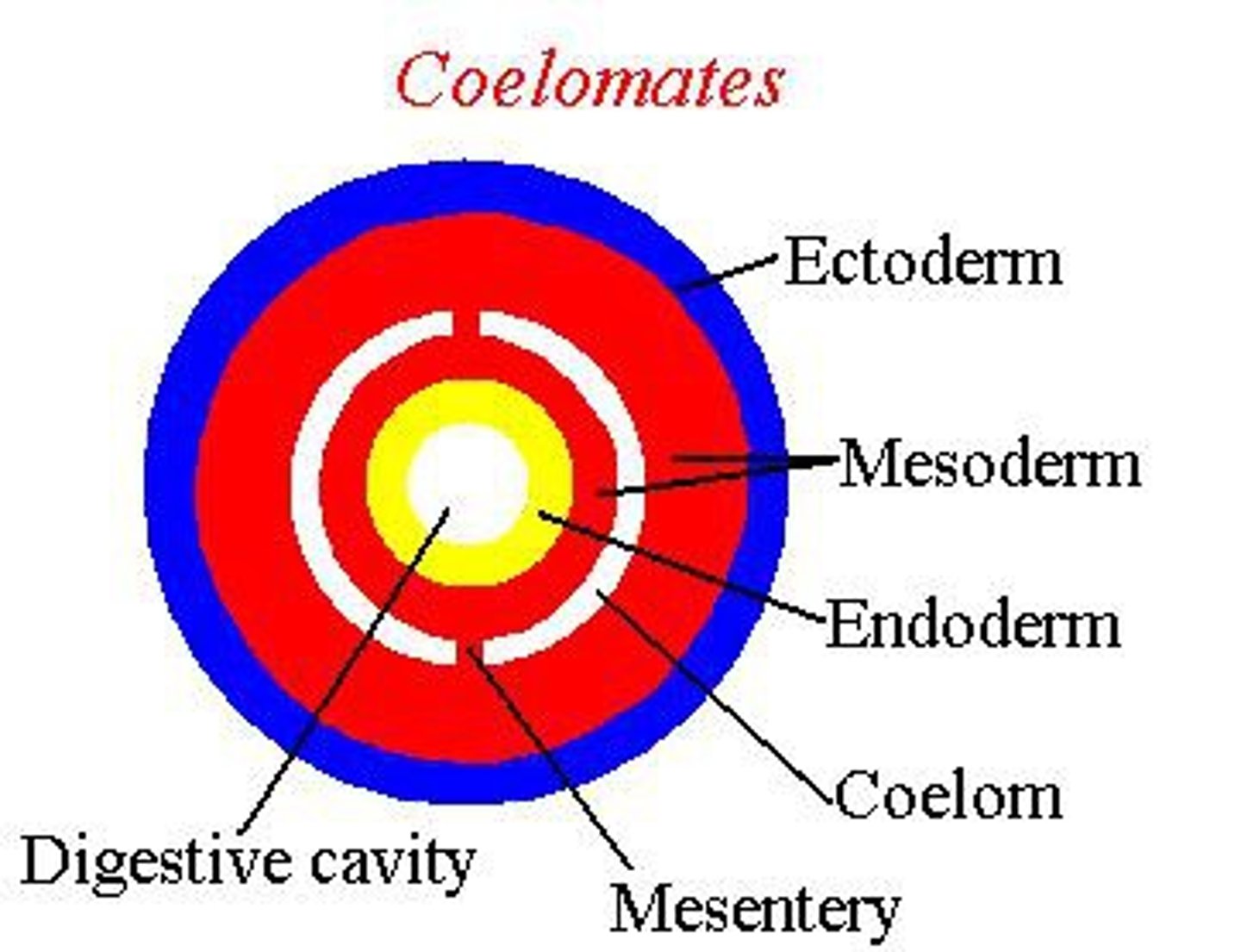
The illustration above is a diagrammatic representation of a cross-section through the earthworm body. The coelom is indicated by the letter
A) --S
B) --Q
C) --T
D) --U
E) --R
A (
Which of the following statements about the life cycle of mosses is FALSE ?
A) Photosynthetic gametophytes grow from protonema.
B) Antheridia and archegonia are found within the gametophyte body.
C) Haploid spores are the major means of dispersal.
D) Gametophytes produce eggs and sperm by meiosis.
E) Moss sperm are flagellated and need water to reach the egg.
D
An animal that is diploblastic could not possibly have
A) sexual reproduction.
B) a true coelom.
C) a blastula stage in its development.
D) tentacles.
E) endoderm.
B
Reproduction in angiosperms include this process that is NOT found in gymnosperms: A) development of zygote into diploid embryo
B) growth of pollen tube
C) pollination
D) formation of pollen
E) formation of endosperm
E
Consider the life cycle of a monocot. Which of the following is a CORRECT match of plant part and its chromosome number (ploidy)?
A) ovary -- n
B) seed coat -- 2n
C) endosperm -- n
D) egg -- 2n
E) embryo -- 3n
B
Which of the following correctly describes protostome development?
A) radial and determinate cleavage; blastopore becomes mouth; coelom from split in mesodermal mass
B) spiral and determinate cleavage; blastopore becomes anus; coelom from split in mesodermal mass
C) spiral and indeterminate cleavage; blastopore becomes mouth; coelom from folds of archenteron
D) radial and indeterminate cleavage; blastopore becomes anus; coelom from folds of archenteron
E) spiral and determinate cleavage; blastopore becomes mouth; coelom from split in mesodermal mass
E
In the moss life cycle, meiosis occurs in the ______ to produce ______.
A) archegonium, haploid eggs
B) archegonium; diploid zygote
C) spores; more haploid spores
D) sporangium, haploid spores
E) antheridium, haploid sperm
D
Sponges are called "basal metazoans" because their phylogenetic position is closest to the common ancestor of all animals. What feature of sponges is visible evidence of the ancestral relationship?
A) contractile vacuoles
B) choanocytes
C) cnidocytes
D) oscula
E) spicules
B
Elephants can often be observed cooling off by spraying water over their bodies with their trunks. What type of heat exchange is occurring?
A) conduction
B) radiation
C) convection
D) evaporation
D
Flowers having colorful petals and fragrant scents are associated most closely with
A) formation of fleshy fruits.
B) gymnosperms.
C) producing self-fertilized ovules.
D) having animal pollinators.
E) eudicots rather than monocots.
D
A woman standing and watching the stars on a cool, calm night will lose most of her body heat by ________.
A) conduction
B) convection
C) evaporation
D) radiation
D
A hermaphroditic animal
A) has both male and female reproductive organs.
B) must infect two different hosts in order to complete its life cycle.
C) can produce eggs without fertilization.
D) has an immature form distinctively different from the adult form.
E) shares resources with another species.
A
Which of these plant adaptations is MISMATCHED with its description?
A) antheridium -- multicellular structure containing sperm
B) sporopollenin -- protective coating on surface of leaves and stems C) secondary compounds -- chemicalS that defend against parasites D) placental transfer cells -- cells that nurture the developing embryo E) lignin -- supports and strengthens vascular tissue
B
What is the function of the pollen tube?
A) contains nectar and fragrance to attract animal pollinators
B) feeds the sporophyte embryo within the maturing ovule
C) allows pollination to occur
D) protects the male gametophyte
E) allows the sperm to reach the egg within the ovule
E
Planarians obtain oxygen and get rid of carbon dioxide by means of
A) an open respiratory system.
B) a pseudocoelom.
C) direct diffusion between body tissues and the surrounding water. D) flame bulbs.
E) feathery gills.
C
Digestive organs, circulatory system, and nerve cords are completely absent in
A) Annelida
B) Mollusca
C) Platyhelminthes
D) Porifera
E) Ectoprocta
D

