Long Essays

0.0(0)
studied byStudied by 0 people
0.0(0)
full-widthCall Kai
learnLearn
examPractice Test
spaced repetitionSpaced Repetition
heart puzzleMatch
flashcardsFlashcards
GameKnowt Play
Card Sorting

1/7

encourage image

There's no tags or description

Looks like no tags are added yet.

Study Analytics
Name
Mastery
Learn
Test
Matching
Spaced

No study sessions yet.

8 Terms

1
New cards
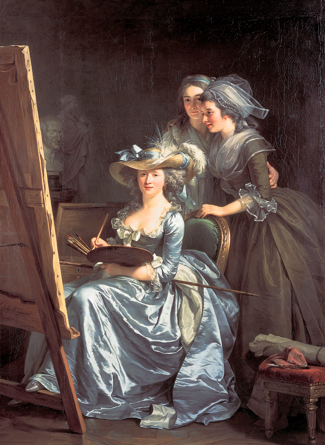
  • Adelaide Labille-Guiard

  • Self-portrait with Two Pupils

  • Oil on canvas

  • NEOCLASSISM [1780-1815]

Obstacles and Challenges

  • Barred from life-drawing instruction at the French Academy.

  • Faced intense gender-based criticism for becoming a highly successful portraitist.

  • Attacked by the press during the French Revolution because of her association with Marie Antoinette.

  • Required royal intervention to be admitted to the Royal Academy—a rare achievement for a woman at the time.

How Her Art Communicates or Advocates

  • In her self-portraits, including this work, she emphasizes her professionalism and artistic identity even while depicting maternal tenderness.

  • She challenges stereotypes that women could not be both mothers and serious artists; her self-representation is controlled, elegant, and authoritative.

  • By painting herself as confident and morally upright, Vigée Le Brun advocates for women’s legitimacy in the artistic sphere at a moment when female public identities were under attack.
<p><strong>Obstacles and Challenges</strong> </p><ul><li><p>Barred from life-drawing instruction at the French Academy.</p></li><li><p>Faced intense gender-based criticism for becoming a highly successful portraitist.</p></li><li><p>Attacked by the press during the French Revolution because of her association with Marie Antoinette.</p></li><li><p>Required royal intervention to be admitted to the Royal Academy—a rare achievement for a woman at the time.</p></li></ul><p> <strong>How Her Art Communicates or Advocates</strong> </p><ul><li><p>In her self-portraits, including this work, she emphasizes her professionalism and artistic identity even while depicting maternal tenderness.</p></li><li><p>She challenges stereotypes that women could not be both mothers and serious artists; her self-representation is controlled, elegant, and authoritative.</p></li><li><p>By painting herself as confident and morally upright, Vigée Le Brun advocates for women’s legitimacy in the artistic sphere at a moment when female public identities were under attack.</p></li></ul><p></p>
2
New cards
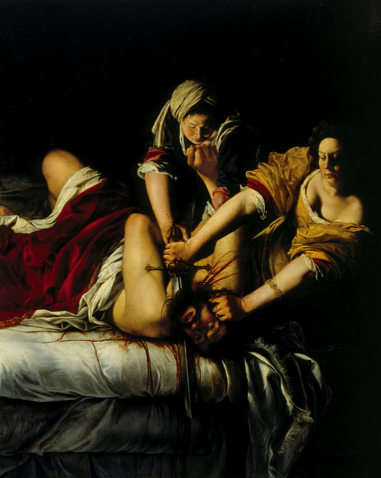
  • Artemesia Gentileschi

  • Judith Slaying Holofernes

  • Oil on Canvas

  • BAROQUE [1600-1700}

Obstacles and Challenges

  • Barred from formal academy training; women were not permitted to study from nude male models, limiting technical instruction.

  • Faced patriarchal control of artistic careers—her father was both gatekeeper and necessary patron.

  • Endured sexual assault by Agostino Tassi; courtroom testimony damaged her public reputation.

  • Persistent dismissal of her achievements as “derivative” of her father or of Caravaggio.

How Her Art Communicates or Advocates

  • Judith Slaying Holofernes visually communicates both personal and collective struggle: the intensely physical depiction of Judith and Abra overpowering Holofernes conveys rage, agency, and female strength.

  • Through violent realism and psychological intensity, Gentileschi challenges typical Baroque depictions where women appear passive or decorative.

  • Her art advocates for women’s autonomy by portraying women as active protagonists and moral agents—turning a biblical story into a broader statement of empowerment.
<p><strong>Obstacles and Challenges</strong> </p><ul><li><p>Barred from formal academy training; women were not permitted to study from nude male models, limiting technical instruction.</p></li><li><p>Faced patriarchal control of artistic careers—her father was both gatekeeper and necessary patron.</p></li><li><p>Endured sexual assault by Agostino Tassi; courtroom testimony damaged her public reputation.</p></li><li><p>Persistent dismissal of her achievements as “derivative” of her father or of Caravaggio.</p></li></ul><p> <strong>How Her Art Communicates or Advocates</strong> </p><ul><li><p><strong><em>Judith Slaying Holofernes</em></strong> visually communicates both personal and collective struggle: the intensely physical depiction of Judith and Abra overpowering Holofernes conveys rage, agency, and female strength.</p></li><li><p>Through violent realism and psychological intensity, Gentileschi challenges typical Baroque depictions where women appear passive or decorative.</p></li><li><p>Her art advocates for women’s autonomy by portraying women as active protagonists and moral agents—turning a biblical story into a broader statement of empowerment.</p></li></ul><p></p>
3
New cards
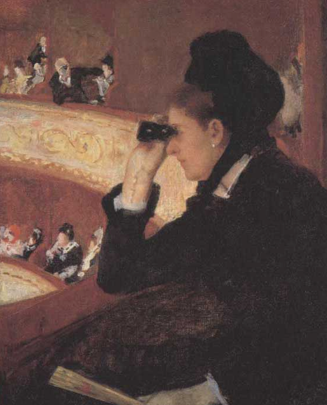
  • Mary Cassatt

  • Woman in Black at the Opera

  • Oil on Canvas

  • Impressionism [1860-1900]

Obstacles & Challenges

  • Cassatt was excluded from the École des Beaux-Arts because women were not admitted.

  • Restrictions on public mobility meant women could only attend certain social spaces, and doing so alone risked social judgment.

  • Impressionist circles were male-dominated; critics often categorized her work as “feminine” and therefore less serious.

How Her Art Communicates or Advocates

  • Cassatt’s opera scene highlights the complexities of women’s visibility in public spaces: the woman looks through opera glasses, but men also look at her, commenting on how women were constantly observed and judged.

  • By focusing on a middle-class woman actively engaging with culture (rather than being passive decoration), Cassatt challenges male-centered perspectives.

  • She uses modern composition—cropping, asymmetry, and vantage points influenced by Japanese prints—to elevate subjects centered on women’s experiences.

  • Her work advocates for female agency in the public sphere and critiques the male gaze embedded in social spaces.
<p><strong>Obstacles &amp; Challenges</strong> </p><ul><li><p>Cassatt was excluded from the École des Beaux-Arts because women were not admitted.</p></li><li><p>Restrictions on public mobility meant women could only attend certain social spaces, and doing so alone risked social judgment.</p></li><li><p>Impressionist circles were male-dominated; critics often categorized her work as “feminine” and therefore less serious.</p></li></ul><p> <strong>How Her Art Communicates or Advocates</strong> </p><ul><li><p>Cassatt’s opera scene highlights the complexities of women’s visibility in public spaces: the woman looks through opera glasses, but men also look at <em>her</em>, commenting on how women were constantly observed and judged.</p></li><li><p>By focusing on a middle-class woman actively engaging with culture (rather than being passive decoration), Cassatt challenges male-centered perspectives.</p></li><li><p>She uses modern composition—cropping, asymmetry, and vantage points influenced by Japanese prints—to elevate subjects centered on women’s experiences.</p></li><li><p>Her work advocates for female agency in the public sphere and critiques the male gaze embedded in social spaces.</p></li></ul><p></p>
4
New cards
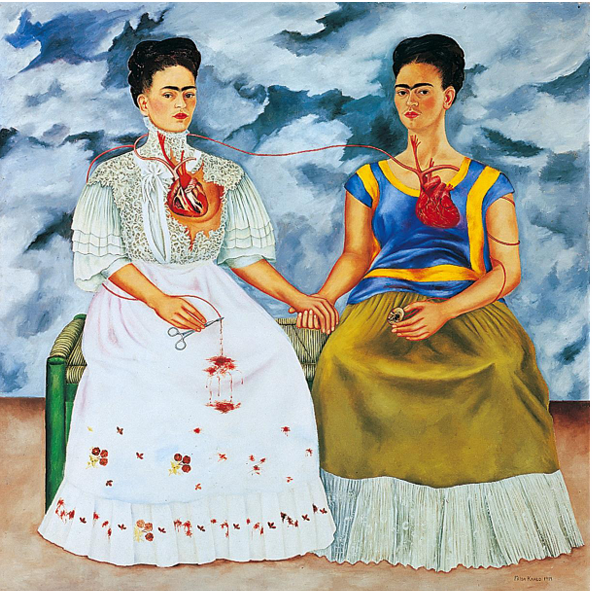
  • Frida Kahlo

  • The Two Fridas

  • Oil on Canvas

  • SURREALISM [1915-1940]

Obstacles and Challenges

  • Constantly dismissed by male contemporaries—often called “Diego Rivera’s wife” rather than recognized as an independent artist.

  • Faced gendered expectations that Indigenous, political, or autobiographical themes were inappropriate or overly emotional.

  • Navigated chronic health issues in a world that undervalued women’s bodily autonomy and emotional expression.

How Her Art Communicates or Advocates

  • Kahlo uses dual self-portraiture to communicate the internal conflict produced by cultural, gender-based, and personal pressures.

  • The open hearts, exposed veins, and symbolic clothing articulate experiences—pain, identity, vulnerability—that women were discouraged from expressing.

  • Her work advocates for women’s right to self-definition, blending political nationalism, female subjectivity, and personal narrative.

  • By placing the female body at the center—not as an object for the male gaze but as a vessel of emotion and agency—Kahlo challenges patriarchal narratives in modern art.
<p><strong>Obstacles and Challenges</strong> </p><ul><li><p>Constantly dismissed by male contemporaries—often called “Diego Rivera’s wife” rather than recognized as an independent artist.</p></li><li><p>Faced gendered expectations that Indigenous, political, or autobiographical themes were inappropriate or overly emotional.</p></li><li><p>Navigated chronic health issues in a world that undervalued women’s bodily autonomy and emotional expression.</p></li></ul><p> <strong>How Her Art Communicates or Advocates</strong> </p><ul><li><p>Kahlo uses dual self-portraiture to communicate the internal conflict produced by cultural, gender-based, and personal pressures.</p></li><li><p>The open hearts, exposed veins, and symbolic clothing articulate experiences—pain, identity, vulnerability—that women were discouraged from expressing.</p></li><li><p>Her work advocates for women’s right to self-definition, blending political nationalism, female subjectivity, and personal narrative.</p></li><li><p>By placing the female body at the center—not as an object for the male gaze but as a vessel of emotion and agency—Kahlo challenges patriarchal narratives in modern art.</p></li></ul><p></p>
5
New cards
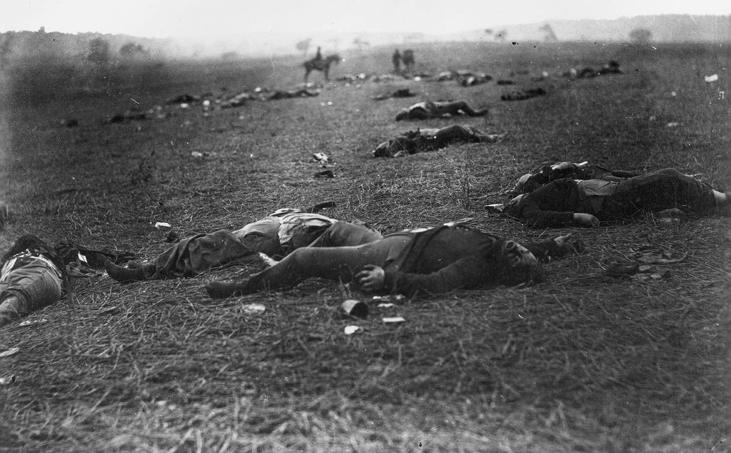
  • Timothy O’sullivan

  • A harvest of death

  • albumen print

  • EARLY PHOTOGRAPHY [1848-1860]

Artist’s Goal

  • Document the true cost of the American Civil War without romanticization

  • Provide visual evidence of battlefield death for public understanding

  • Support the idea that photography could truthfully record history

What It Says About Artist / Society / History

  • Reflects O’Sullivan’s belief in showing reality over heroism

  • Indicates the public’s growing desire for factual, unfiltered war images

  • Demonstrates a shift from glorified battle paintings to brutal documentation

  • Shows a nation grappling with mass death and industrialized warfare

How the Message Is Communicated

  • Unposed bodies in the foreground convey devastation and anonymity

  • Repetition of corpses creates a sense of scale and inevitability

  • Bleak, barren landscape emphasizes the emptiness and futility of war
<p><strong>Artist’s Goal</strong> </p><ul><li><p>Document the true cost of the American Civil War without romanticization</p></li><li><p>Provide visual evidence of battlefield death for public understanding</p></li><li><p>Support the idea that photography could truthfully record history</p></li></ul><p> <strong>What It Says About Artist / Society / History</strong> </p><ul><li><p>Reflects O’Sullivan’s belief in showing <strong>reality over heroism</strong></p></li><li><p>Indicates the public’s growing desire for <strong>factual, unfiltered war images</strong></p></li><li><p>Demonstrates a shift from glorified battle paintings to <strong>brutal documentation</strong></p></li><li><p>Shows a nation grappling with mass death and industrialized warfare</p></li></ul><p> <strong>How the Message Is Communicated</strong> </p><ul><li><p>Unposed bodies in the foreground convey <strong>devastation and anonymity</strong></p></li><li><p>Repetition of corpses creates a sense of <strong>scale and inevitability</strong></p></li><li><p>Bleak, barren landscape emphasizes the <strong>emptiness and futility</strong> of war</p></li><li><p></p></li></ul><p></p>
6
New cards
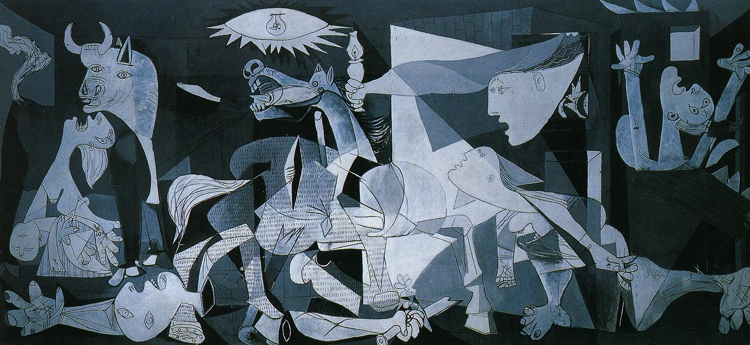
  • Pablo Picasso

  • Guernica

  • Oil on Canvas

  • SURREALISM [1915-1940]

Artist’s Goal

  • Respond to the bombing of Guernica during the Spanish Civil War

  • Create a universal anti-war statement against Fascist violence

  • Convey the chaos, fragmentation, and psychological trauma of modern warfare

What It Says About Artist / Society / History

  • Picasso’s political stance against Franco’s regime and totalitarian brutality

  • Reflects the horrors of aerial warfare and attacks on civilians

  • Shows the modern world’s fear, instability, and loss of moral grounding

  • Demonstrates how art in the 20th century becomes explicitly political and global

How the Message Is Communicated

  • Fragmented, shattered forms visually mirror trauma and chaos

  • Monochrome palette evokes newspaper photographs, tying art to modern reporting

  • Distorted faces and screams show psychological suffering, not heroic sacrifice

  • Collapsing spaces create an overwhelming sense of disorientation and violence
<p><strong>Artist’s Goal</strong> </p><ul><li><p>Respond to the bombing of Guernica during the Spanish Civil War</p></li><li><p>Create a universal anti-war statement against Fascist violence</p></li><li><p>Convey the chaos, fragmentation, and psychological trauma of modern warfare</p></li></ul><p> <strong>What It Says About Artist / Society / History</strong> </p><ul><li><p>Picasso’s political stance against Franco’s regime and totalitarian brutality</p></li><li><p>Reflects the horrors of aerial warfare and attacks on civilians</p></li><li><p>Shows the modern world’s fear, instability, and loss of moral grounding</p></li><li><p>Demonstrates how art in the 20th century becomes explicitly political and global</p></li></ul><p> <strong>How the Message Is Communicated</strong> </p><ul><li><p>Fragmented, shattered forms visually mirror <strong>trauma and chaos</strong></p></li><li><p>Monochrome palette evokes <strong>newspaper photographs</strong>, tying art to modern reporting</p></li><li><p>Distorted faces and screams show <strong>psychological suffering, not heroic sacrifice</strong></p></li><li><p>Collapsing spaces create an overwhelming sense of <strong>disorientation and violence</strong></p></li></ul><p></p>
7
New cards
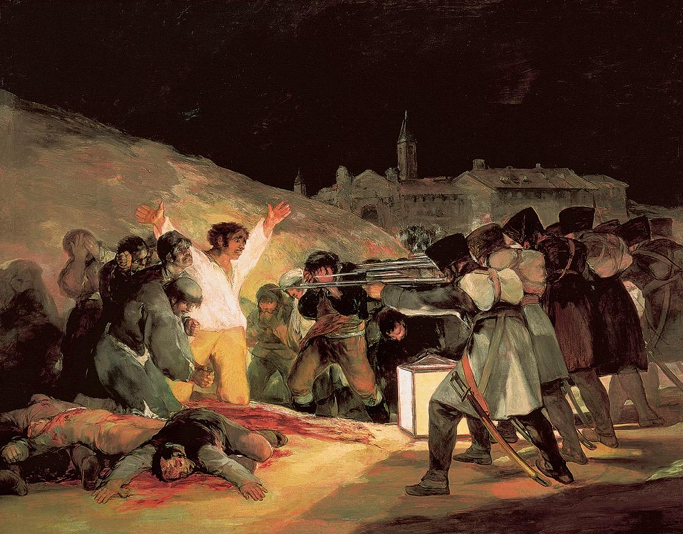
  • Francisco de Goya

  • Third of May

  • Oil on Canvas

  • ROMANTICISM [1780-1860]

Artist’s Goal

  • Memorialize the Spanish civilians executed by Napoleon’s forces

  • Condemn political violence and tyranny

  • Present the Spanish people as tragic martyrs

What It Says About Artist / Society / History

  • Shows Goya’s deep disillusionment with war and human cruelty

  • Reflects Spain’s national trauma under French occupation

  • Transforms a political event into a universal symbol of oppression

  • Highlights Romanticism’s focus on emotion, heroism, and individual suffering

How the Message Is Communicated

  • Central figure in white, arms raised, resembles a Christ-like martyr

  • Harsh lantern light exposes brutality and moral clarity (victims vs. executioners)

  • Firing squad shown as a faceless machine, dehumanizing the oppressors

  • Strong contrast and dramatic composition evoke shock and empathy
<p><strong>Artist’s Goal</strong> </p><ul><li><p>Memorialize the Spanish civilians executed by Napoleon’s forces</p></li><li><p>Condemn political violence and tyranny</p></li><li><p>Present the Spanish people as tragic martyrs</p></li></ul><p> <strong>What It Says About Artist / Society / History</strong> </p><ul><li><p>Shows Goya’s deep disillusionment with war and human cruelty</p></li><li><p>Reflects Spain’s national trauma under French occupation</p></li><li><p>Transforms a political event into a <strong>universal symbol of oppression</strong></p></li><li><p>Highlights Romanticism’s focus on emotion, heroism, and individual suffering</p></li></ul><p> <strong>How the Message Is Communicated</strong> </p><ul><li><p>Central figure in white, arms raised, resembles a <strong>Christ-like martyr</strong></p></li><li><p>Harsh lantern light exposes brutality and moral clarity (victims vs. executioners)</p></li><li><p>Firing squad shown as a <strong>faceless machine</strong>, dehumanizing the oppressors</p></li><li><p>Strong contrast and dramatic composition evoke <strong>shock and empathy</strong></p></li></ul><p></p>
8
New cards
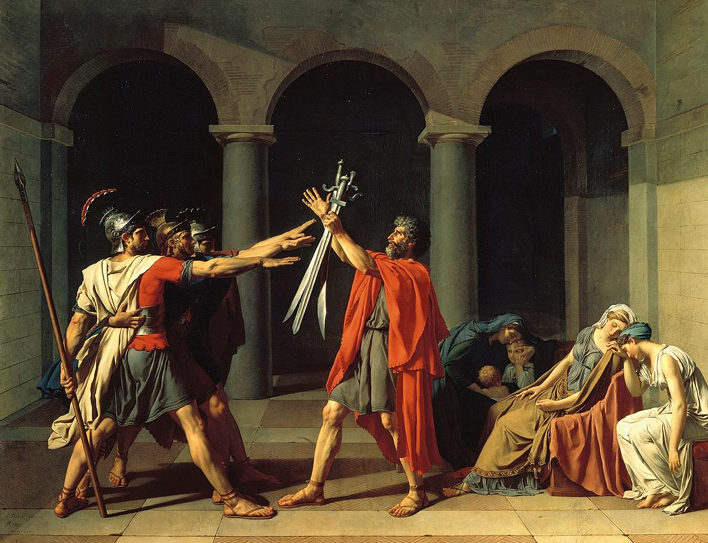
  • Jacques-Louis David

  • Oath of the Horatii

  • Oil on Canvas

  • NEOCLASSISM [1780-1815]

Artist’s Goal

  • Promote civic virtue, patriotism, and sacrifice for the state

  • Reinforce Enlightenment ideals of moral clarity and duty

  • Provide a model of heroic behavior for contemporary French society

What It Says About Artist / Society / History

  • Reflects David’s belief in reason, order, and loyalty to the nation

  • Commissioned by King Louis XVI, revealing the monarchy’s desire to promote unity

  • Foreshadows the French Revolution by celebrating citizen valor over aristocratic privilege

  • Illustrates Neoclassicism’s role as a political tool for moral instruction

How the Message Is Communicated

  • Rigid, geometric composition reflects order, discipline, and control

  • Male figures in strong diagonals show strength and resolve

  • Women slumped in the background reveal the personal cost of political duty

  • Precise lines, clarity, and seriousness communicate moral purpose and strength
<p><strong>Artist’s Goal</strong> </p><ul><li><p>Promote civic virtue, patriotism, and sacrifice for the state</p></li><li><p>Reinforce Enlightenment ideals of moral clarity and duty</p></li><li><p>Provide a model of heroic behavior for contemporary French society</p></li></ul><p> <strong>What It Says About Artist / Society / History</strong> </p><ul><li><p>Reflects David’s belief in <strong>reason, order, and loyalty to the nation</strong></p></li><li><p>Commissioned by King Louis XVI, revealing the monarchy’s desire to promote unity</p></li><li><p>Foreshadows the French Revolution by celebrating <strong>citizen valor over aristocratic privilege</strong></p></li><li><p>Illustrates Neoclassicism’s role as a political tool for moral instruction</p></li></ul><p> <strong>How the Message Is Communicated</strong> </p><ul><li><p>Rigid, geometric composition reflects <strong>order, discipline, and control</strong></p></li><li><p>Male figures in strong diagonals show <strong>strength and resolve</strong></p></li><li><p>Women slumped in the background reveal the <strong>personal cost of political duty</strong></p></li><li><p>Precise lines, clarity, and seriousness communicate <strong>moral purpose and strength</strong></p></li></ul><p></p>