L5: Comparative Digestive physiology
 Call Kai
 Learn
Learn Practice Test
 Spaced Repetition
 Match
Match Flashcards
 Knowt Play
1/69

There's no tags or description
Looks like no tags are added yet.
Name | Mastery | Learn | Test | Matching | Spaced | Call with Kai |
|---|
No analytics yet
Send a link to your students to track their progress
70 Terms
What is cellulose
unbranched polymer of glucose
residues are joined by beta-1,4 linkage
forms microfibrils which are hard to digest
what can break down cellulose?
No vertebreates
do not synthesize cellulase
rely on cellulase-secreting microbes in some part of the digestive tract to achieve this
What is this process called
anerobic→ fermentation
Types of fermenters
Foregut
Hind gut
Foregut fermenters examples
Artiodactyl
suborder of Ruminantia
cow and sheep
kangeroos
sloths
certain monkeys
rodents
Whales
use this for chitin
Hoatzin
bird
has enlarged stomach
cannot fly?
What animals Ruminantia includes
cows
sheep
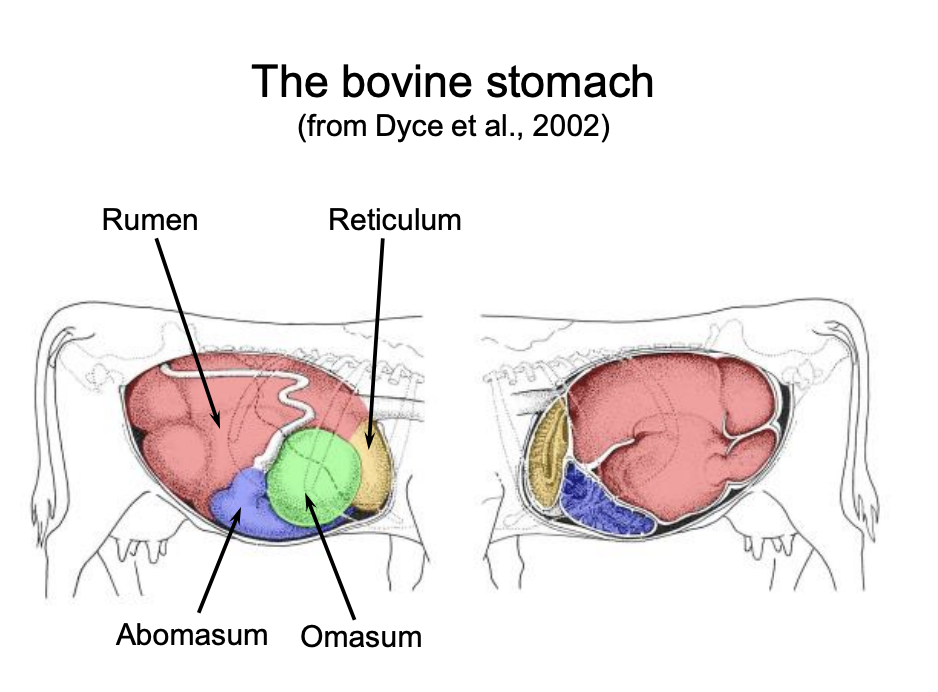
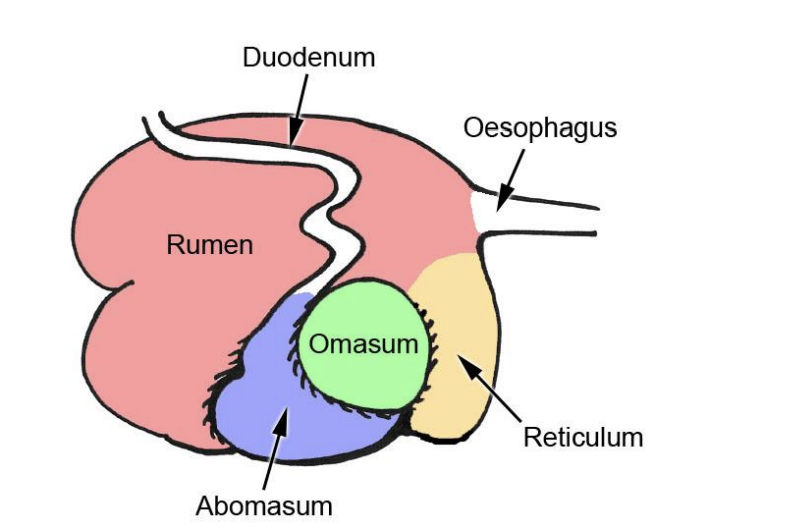
Stomach of cow
Four chambers→ takes up the entire left half of the abdomen
Ingest passes from the oesophagus into both…
Reticulum→ does not secrete acid or proteases
buffers pH (to help fermentation)
rumen
incompletely divided and often referred to reticulorumen
acts as fermenting vat
Omasum→ 100 internal foldings increase the surface area for absorption
some absorption here
Abomasum→ resembles true stomach of other mammals like humans
secretes acid and kills and begins digestion of the microbes
acid secretion
pepsin secretion
What are the rumen ,reticulum and omasum all lined with
stratified, squamous epithelia
similar to skin
Rumen: Characteristics (with some comparisons to humans)
60-300 litres in volume 85% of stomach volume (vs 1.5 litres in cow)
Anaerobic
37-39 degrees
pH 5.5 to 6.8
10^10 bacteria
human→ 10^12 intestines so cow is more dilute than humans
include: Fibrobacter and Ruminococcus species
10^6 ciliated protozoa
10^4 anearobic fungi /ml
some archae too
note: relative proportions of these microbes vary with diet
Why is the reticulorumen slightly acidic if it doesn’t secrete acid
due to fermentation products of the bacteria
but cow continuously tries to buffer this so does not kill the micrboes
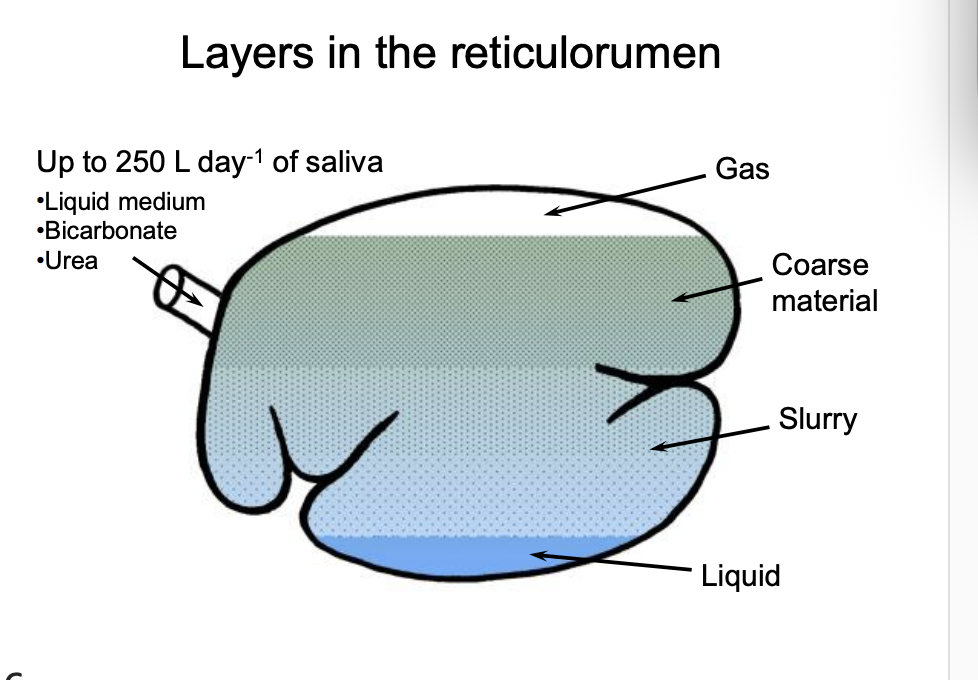
Layers of the reticulorumen
Layers separate due to density
Gas bubble
coarse, fibrous material floating on top of the liquid contents
Slurry → suspended particule
liquid virtually free of particles
What provides the liquid medium for these layesr
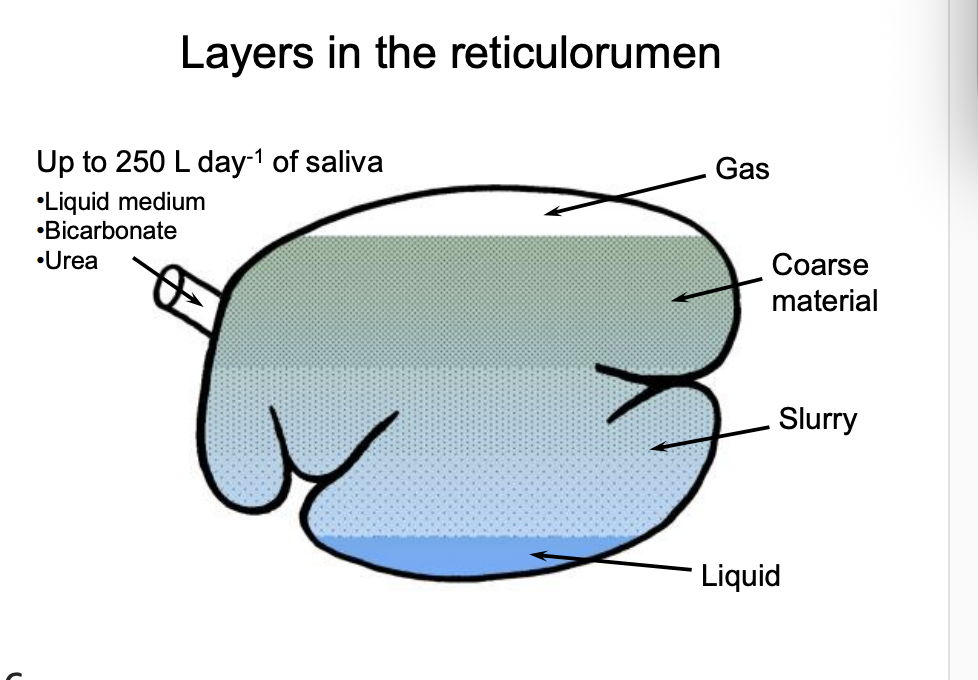
ruminants secrete copious saliva
250L of saliva vs 1L in humans
What does the saliva provide
Liquid medium
Bicarbonate→ buffering
Urea→ to fertilise the microbes
Is the reitculorumen passive?
No
active cycles of contractions that pass continuously
to circulate and mix the contents
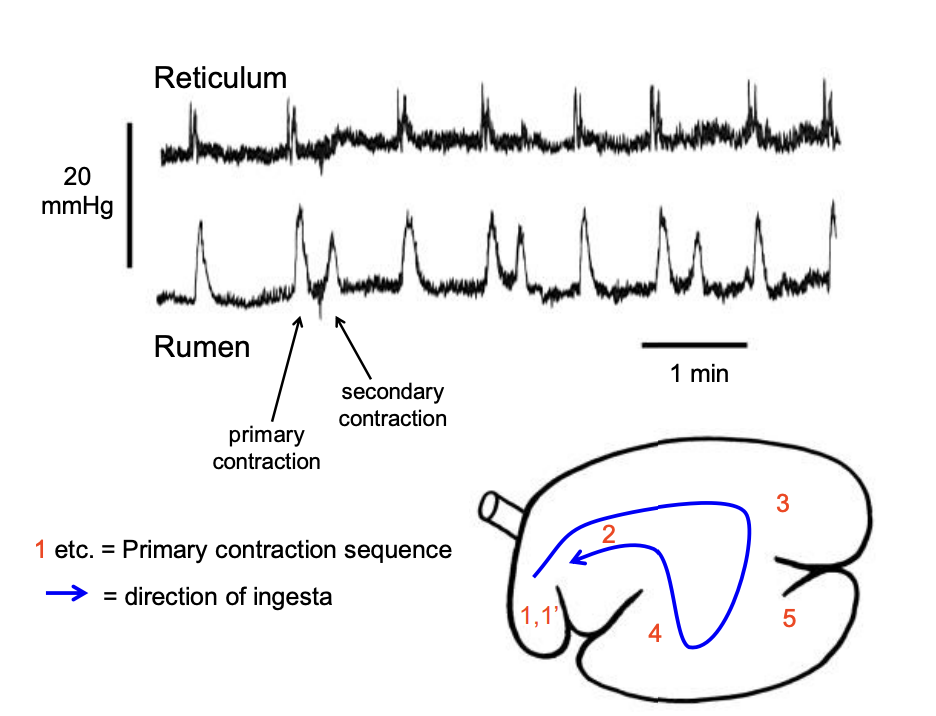
Two types of contractions and their use
Primary contractions→ mixing sequence
Secondary contractions→ movement of ruminal gas to the oesophagus
typically follows every second primary contraction
leads to eructation→ belching
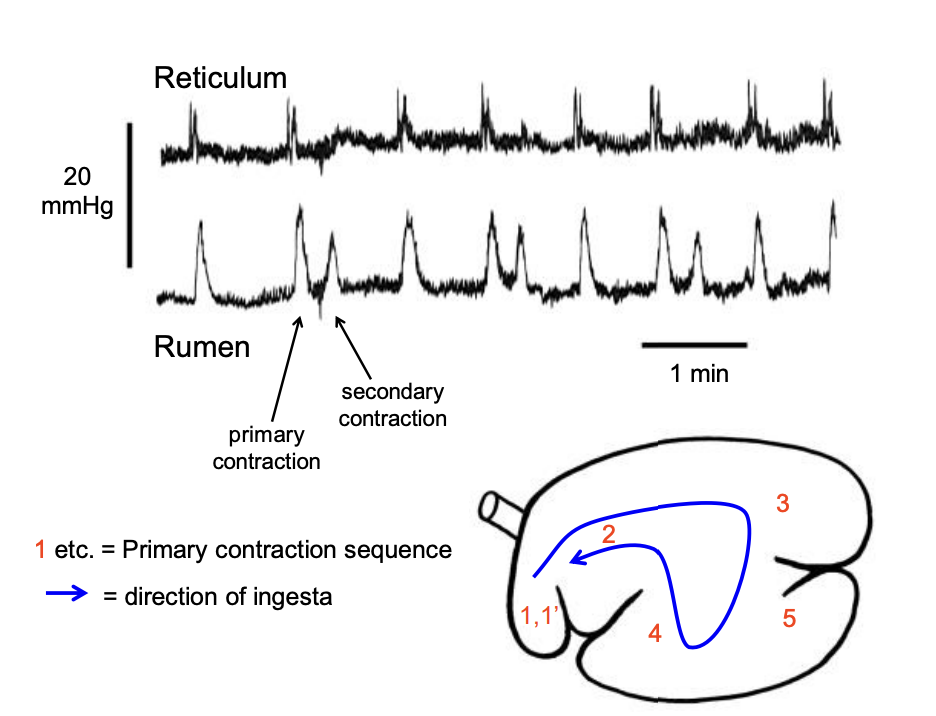
Primary contractions what augmented by and how they work
Augmentation
vagovagal reflexes
triggered by stretch, touch or chemosensory afferents
How they work
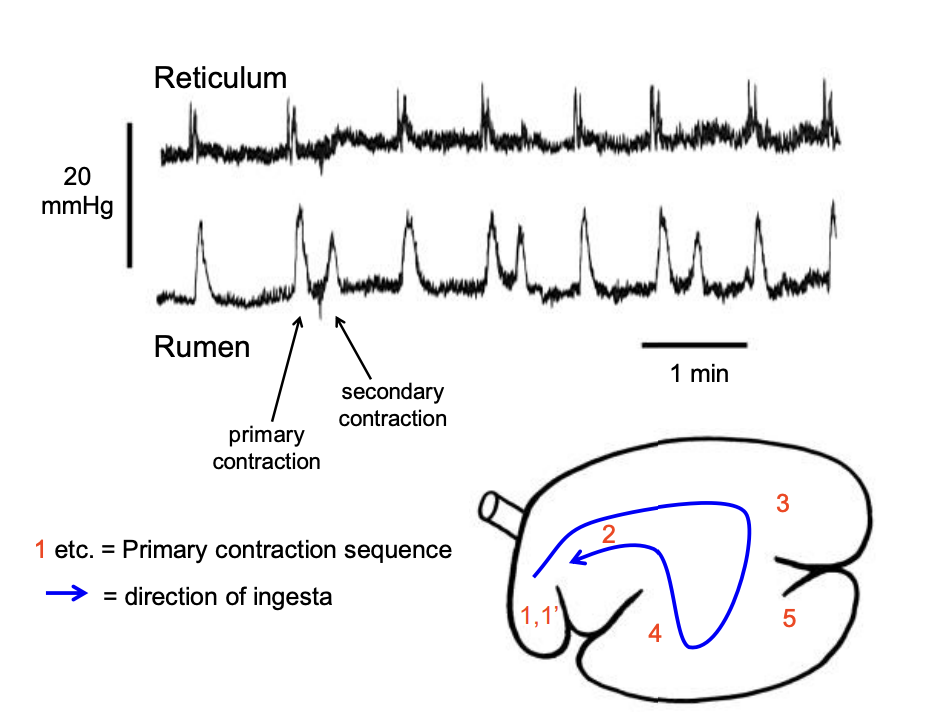
Wave starts with double reticular contraction (1, 1’)
then sequence of contractions around rumen (2,3, 4,5)
mixes the contents in a circular motion
Similar to normal mammalian stomach (humans)
see the data that has been recorded from the different pressure in sifferent parts
How does digesta move to the next chamber (omasum)
Reticular contractions, small amounts of digesta forced into omazum
via reticulo-omasal orifice
sucking action when the muscular omasum relaxes contributes to this
Ruminal half-life
Depends on the coarseness of food
Solid→ 30-50 hours
15-20 hours for liquid contnets
Are movements of the abomasum tied to the cycles of the other stomachs?
No
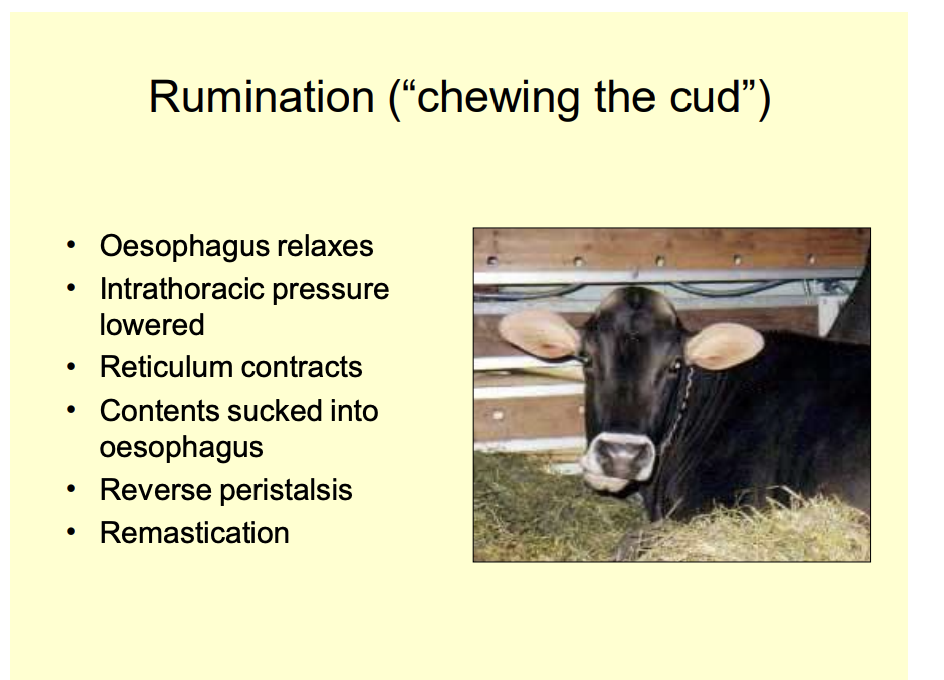
What is rumination
Chewing the cud
regurigitation of the cud
and chewing and digesting this again
How long does this last for
up to 10 hours per day
depending on the nature of the food
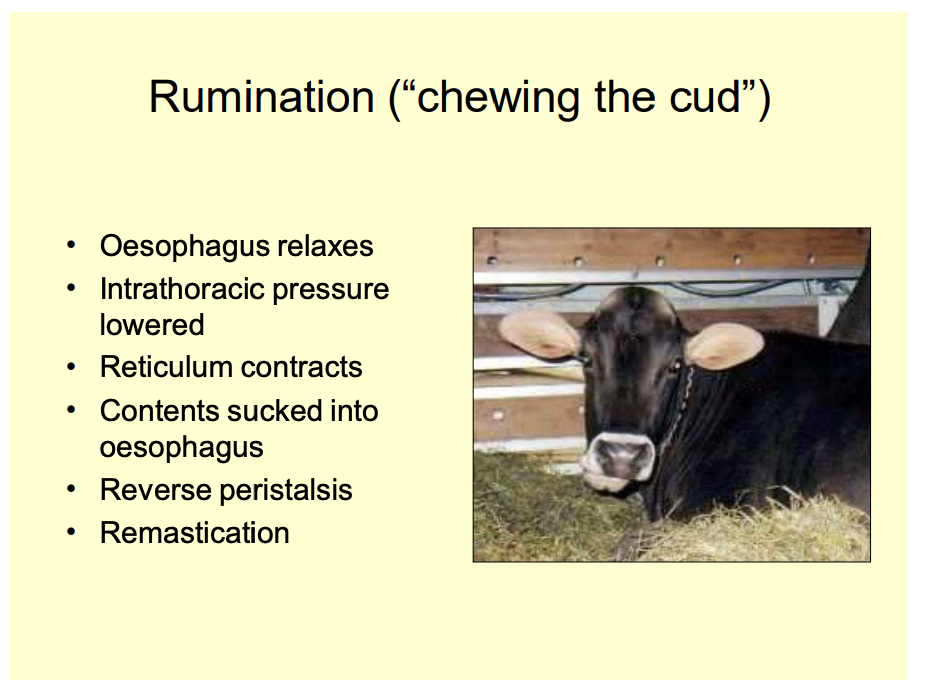
How does rumination happen
Thoracic cavity is expanded with glottis closed
decreasing the thoracic pressure while the reticulum contracts
lower oesphageal sphincter is relaxed
some of the ruminal contents are sucked into the oesophagus
reverse peristalsis takes over→ delivers a bolus to the mouth
Remastication
similar to vomiting
How is rumination different to vomiting
effortless
non-painful
involuntary
not really digested yet
Regulation in rumiannts vs monoastric species
Monogastric
modulatory role on the stomach
Ruminant
ruminant cyclic movements, rumination and eructation
completely abolished by vagotomy
some, erratic, instricically driven motility reappears later
Cellulose fermentation by bacteria: why extracellular?
too big to be taken up into the cell
bacteria cannot do endocytosis
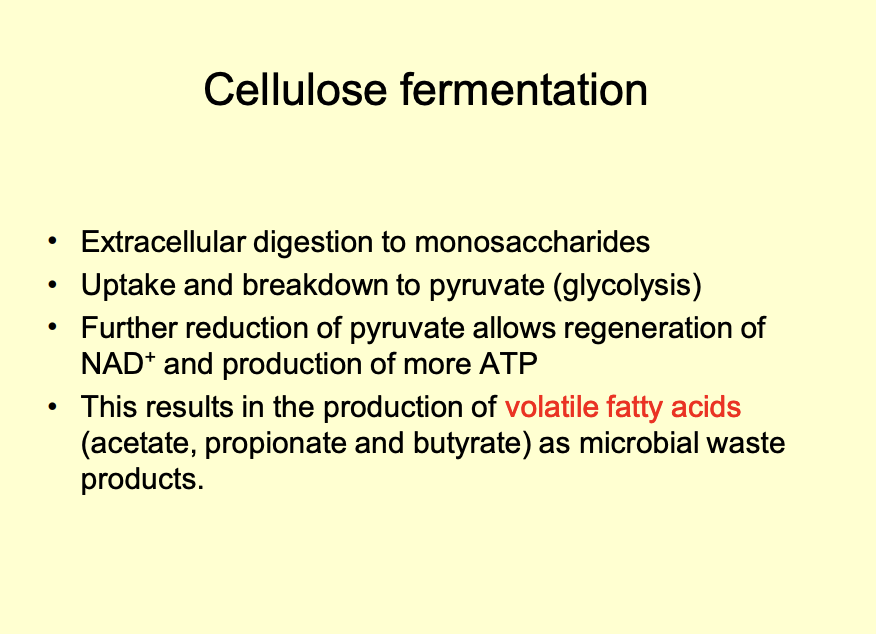
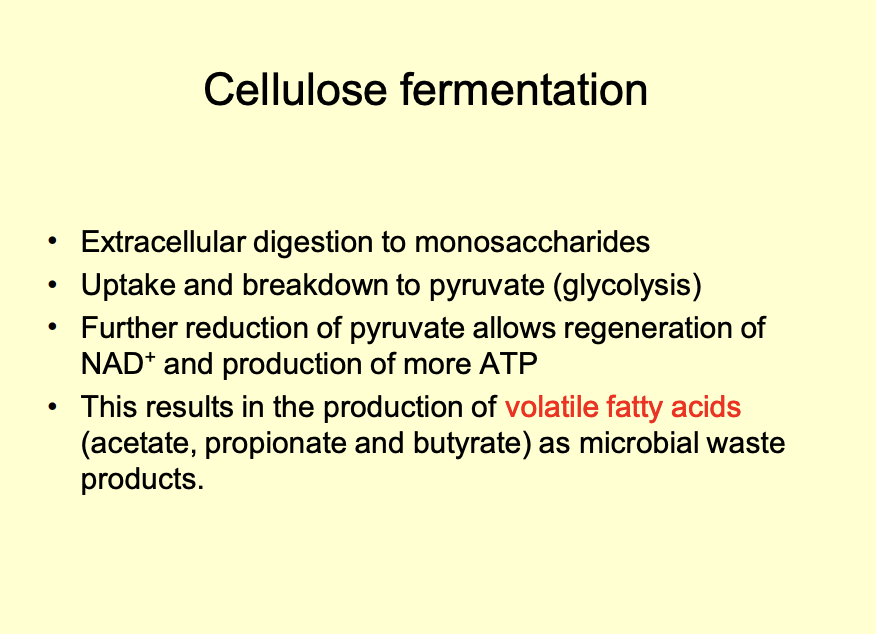
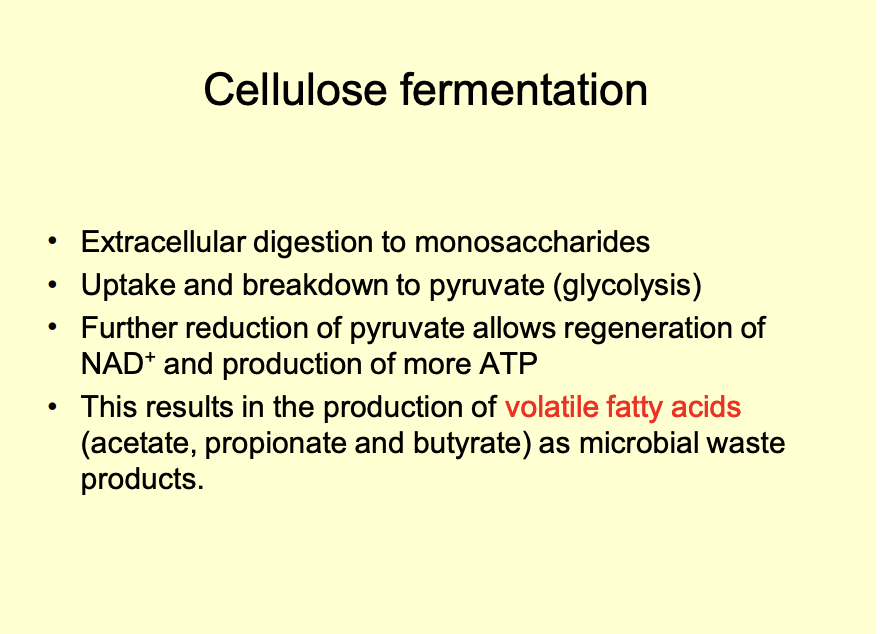
How do bacteria digest and metabolise cellulse (celluloase fermentation)
extracellular breakdown by secreting cellulase
microbes rapidly absorb the monosaccharides
break them down to pyruvate (glycosis)
further reduce pyruvate anearbocially
WHY: regenerate NAD+ to allow glycolysis to continue to make more ATP
similar to how we use lactate
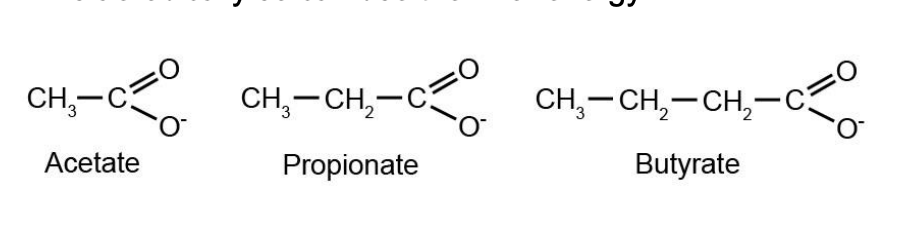
RESULT: makes volatile fatty acids (VFAs, aka short chain fatty acids) as waste
acetate
propionate
butyrate
MICROBES CANNOT USE THESE but can be taken up and used by the cow (Symbiosis)
One way NAD+ can be regenerated
Via formation of hydrogen:
NADH + H+ → NAD+ + H2
What is this H2 then used for
4H2 + CO2 → CH4 + 2H2O
by methanogenic archaeons
Methanobrevibacter ruminantium
Reduce CO2 to methane
Ruminal gas composition and how much per day
Reactions make a considerable amount of ruminal gas
150-200 L per day→ average cow
500 L per day→ lactating
50% CO2→ from the bicarbonate buffering of VFA
35% CH4
7% N2
5% H2
Trace O2
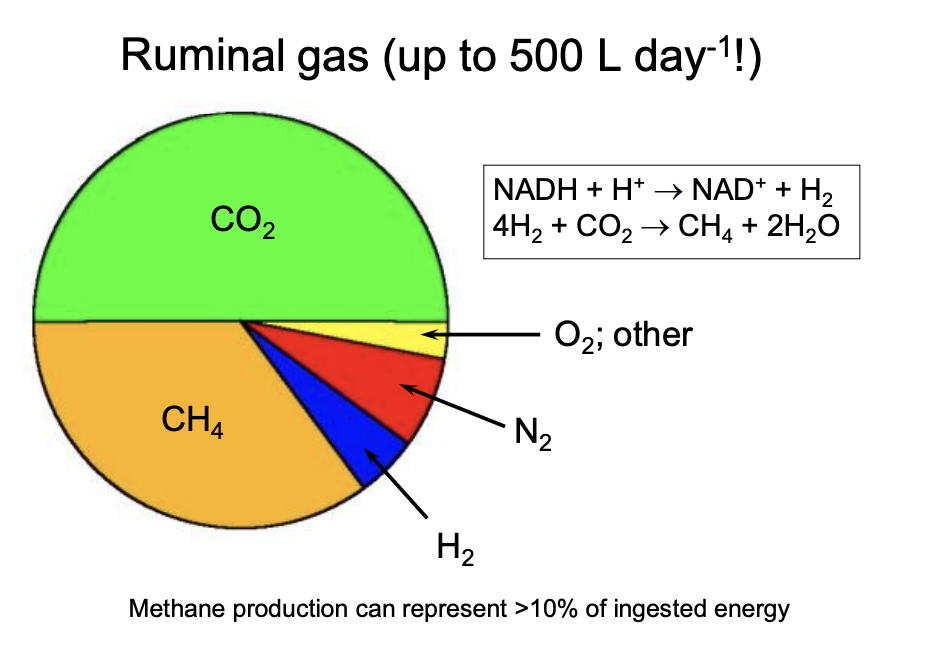
What are the N2 and O2 from
swallowed air
Issue with making methane
greenhouse gas
Way to decrease greenhouse gas
fed a methanogenic archae inhibitor
stops methan production
Why else is methane production a disadvanatge (to the cow)
represents significant loss of energy
10% of energy loss of what is ingested
What can happen if too much gas and waht caued by
Bloat
Caused by
plants that cause foaming (clover)
Rumen becoming too acidic→ stops motility→ no belching→ bloat
VFA produced in what proportions
Acetate→ 65%
Propionate→ 25%
Butyrate→ 10%
Where are VFAs absorbed
wall of rumen and reticulum
note: no absorption of stuff in the human stomach
ruminant host is then able to metabolise these aerobically so can use them for energy
What challenges are faced when VTA are being absorbed
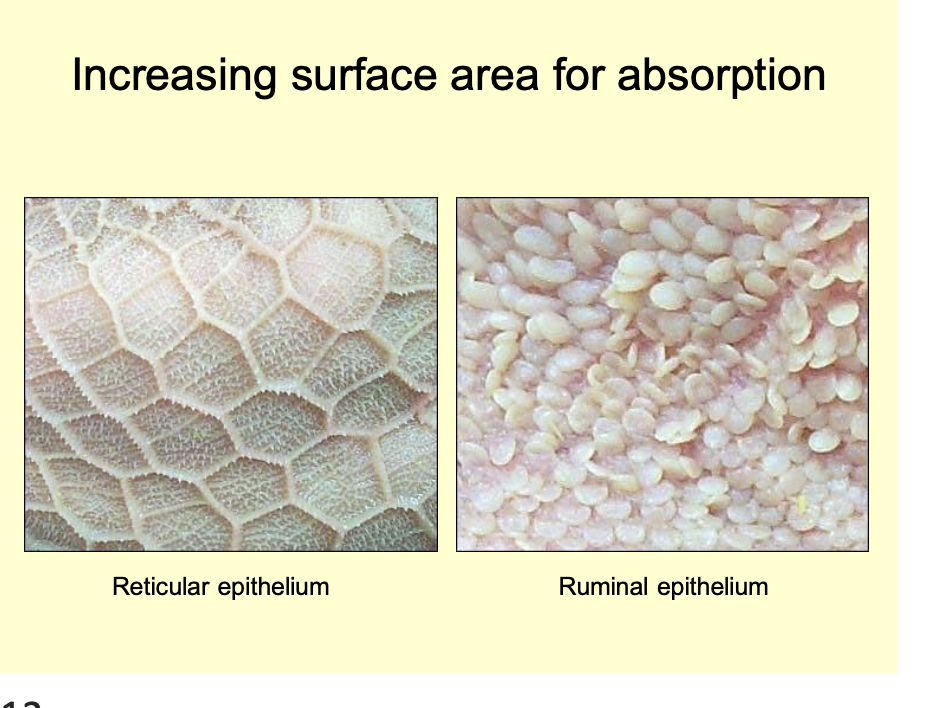
Low SA of the rumen/reticulum
Stratified squamous epithelium is like skin (unlike what is seen in the rumen)→ difficult to get through
Solution
Increasing SA
Reticulum→ hexagonal ridges
Rumen→ protrusions
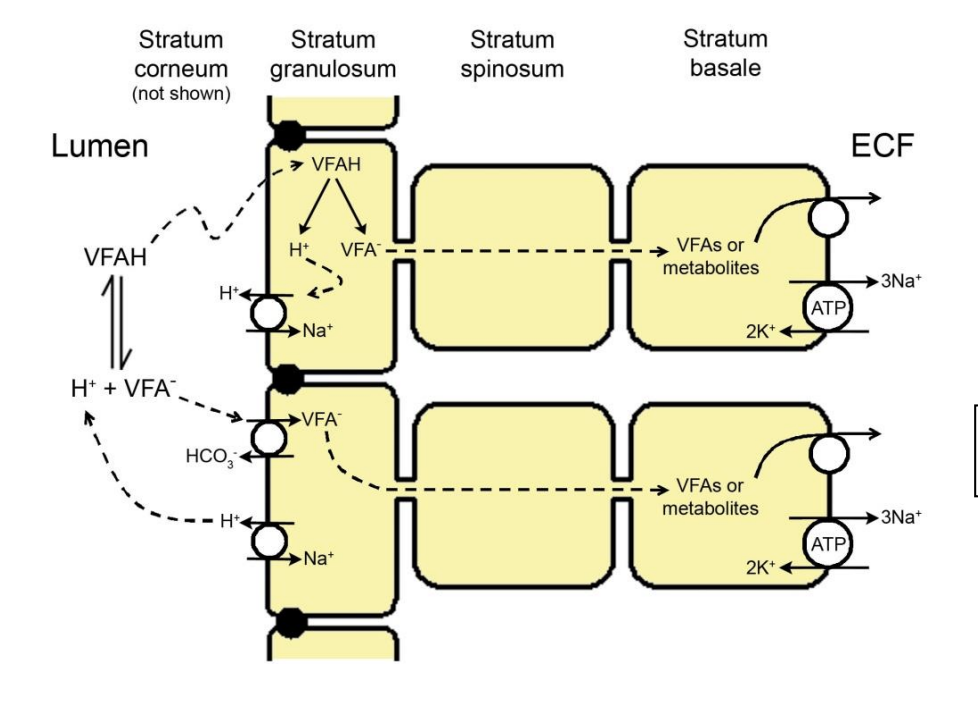
Solution
transporters responsible are localised on the different cell layers
cells connected by gap junctions to form syncytium
rich subepithelial capillary plexus to facilitate removal of absorbed substances
not really an optimal strategy
Fats of absorbed products: what generally used for
supply 60-80% of the daily energy requirements of the ruminant
Acetate
Respired directly by many tissues
also converted into fatty acids by mammary or adipose tissue
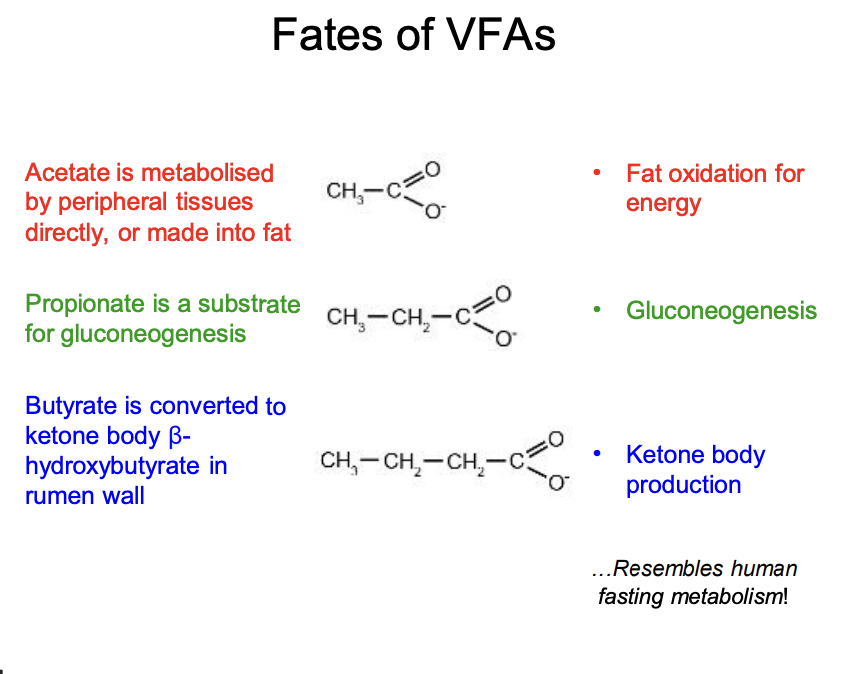
Propionate
passes in the portal blood to the liver
major substrate for gluconeogenesis
note: short-chain fatty acids can be made into glucose (unlike in long chain)
or made into fat
Butyrate
converted to ketone body beta-hydroxybutyrate
in its passage across the rumen wall
Used as a source of energy by many tissues
How is this VFA use similar to humans?
Similar to how humans get energy in starvation
humans→ up to 10% of energy like this from starvation→ ketosis
Fat oxidation for energy
Gluconeogenesis
Ketone body production
human fasting metbolism
but note the cow gets 80% of energy from this
Blood glucose level in ruminants vs humans
only half that in humans
What is glucose still needed for in cows
e.g
high-producing dairy cows suspectible to lactation ketosis
Protein metabolism in cows
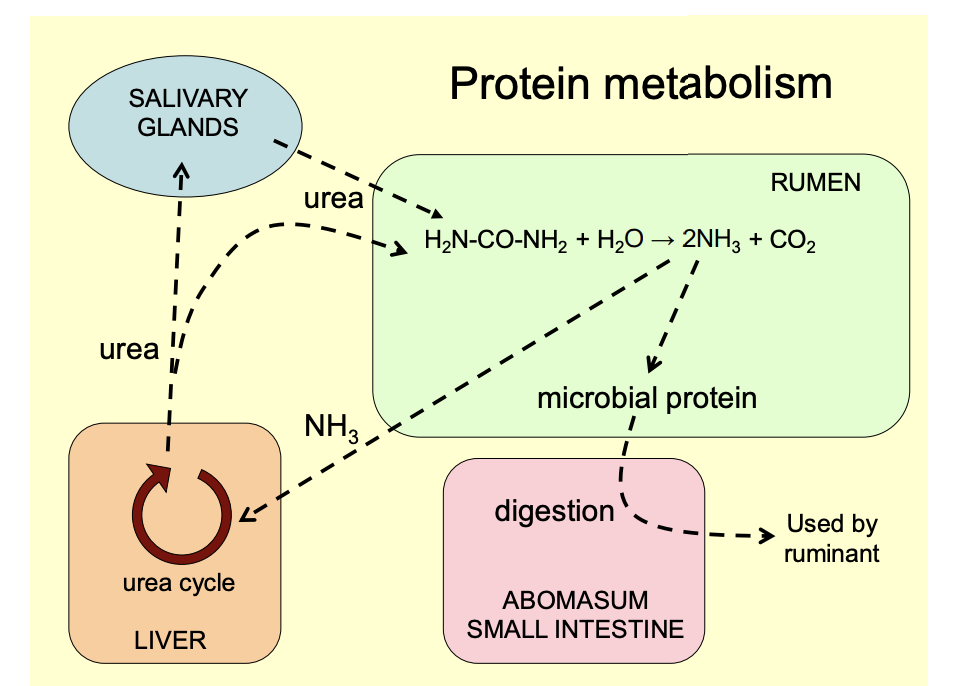
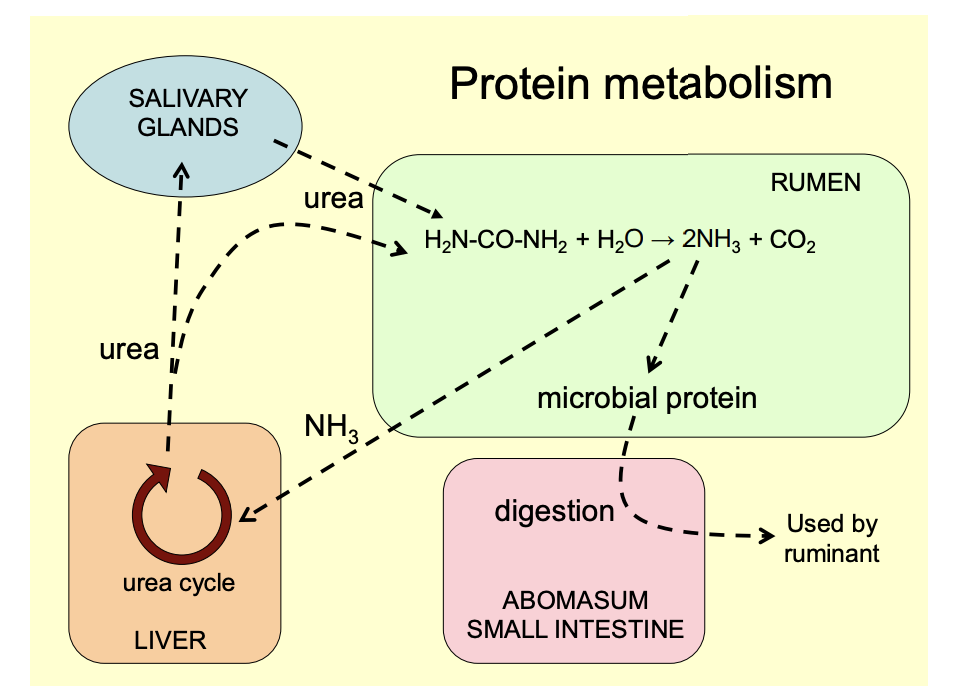
Urea enters the rumen both directly across wall and in saliva
microbs in rumen hydrolyze it to produce ammonia
incorporate into their own protein
ammonia not used reabsorbed by host
reconverted to urea in the liver
The host then digests the microbes when get to abomasum
amino acids are absorbed in the small intestine
What does this nitrogen cycle allow
less nitrogen is lost in the urine as urea
Why are these micrboes good for protein metabolism
can synthesise all the amino acids needed by the host
so not really an ‘essential’ amino acids
note: but they still may not be made at a high enough rate
so dietary supplements may need to be required
e.g in high-yielding dairy cows
Fat and vitamins: What happens as fat is eaten
Eaten: only polyunsaturated fats
Hydrolysed in rumen by microbial lipases
glycerol product is fermented to propionate
fatty acids produced are hydrogenated by bacteria
so become saturated
These are long chain fatty acids→ (so unlike STFA)
go on to be emulsified
absorbed in the small intestine
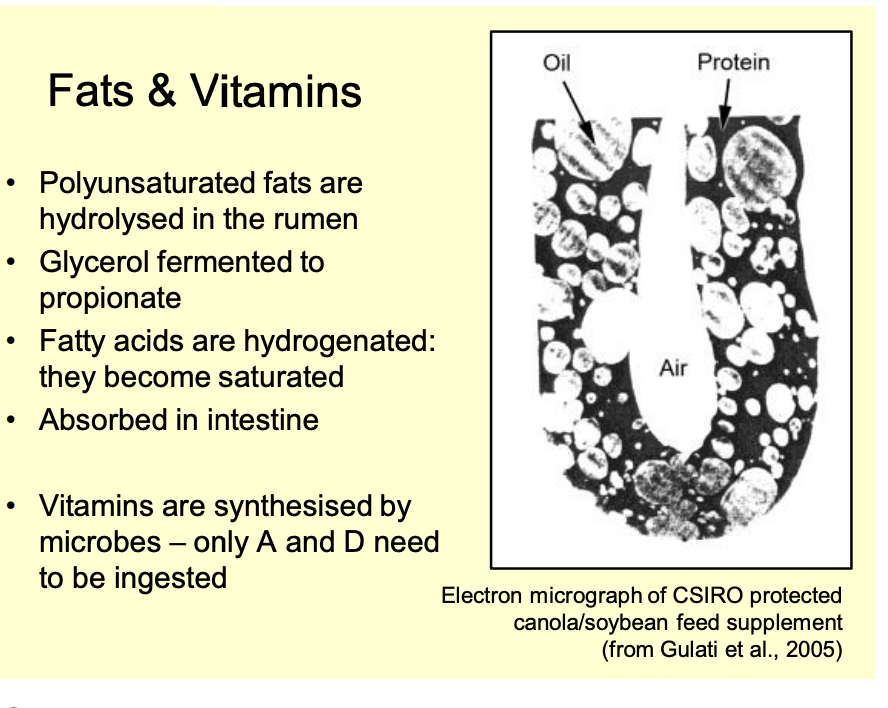
How this has been used to make spreadable butter
fed pellet with oil
this is protected from micrboes
released into the milk
unsaturated to makes the butter less solid
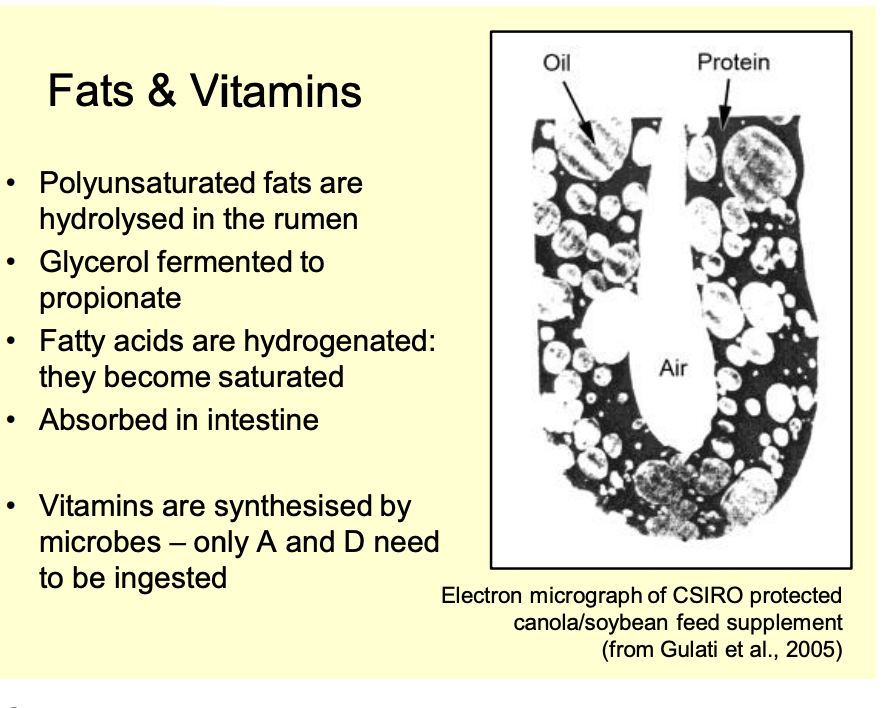
Where do the vitamins come from
syntehesize K and B-group vitamins
animals themselves can synthesise their own C and D
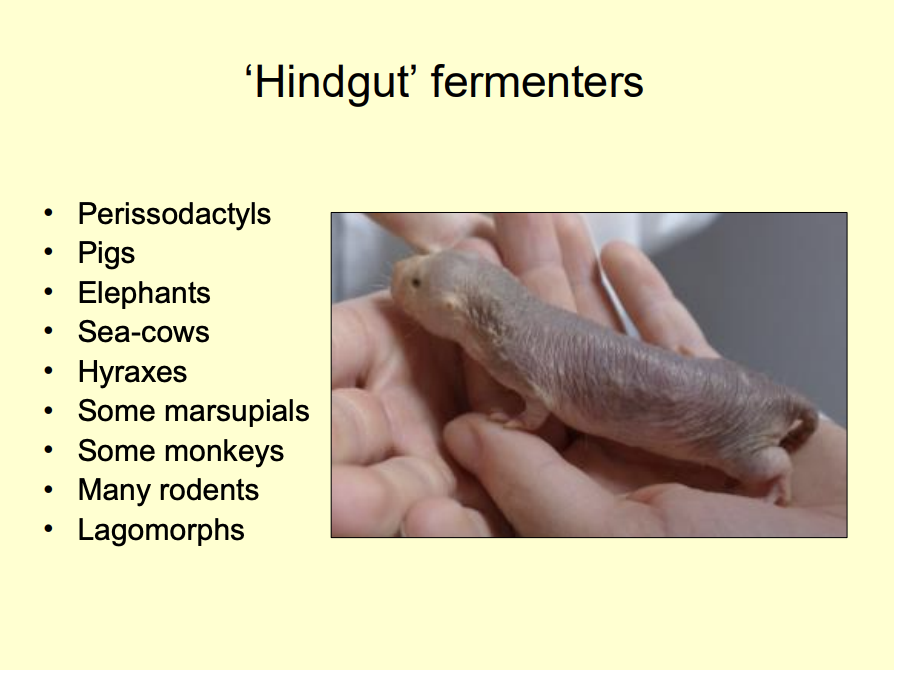
Hind gut fermenters: what animals are included
Perissodactyl
odd toed undulates
Pigs
elephants
sea-cows
hyraxes
Lagomorphs
rabbits
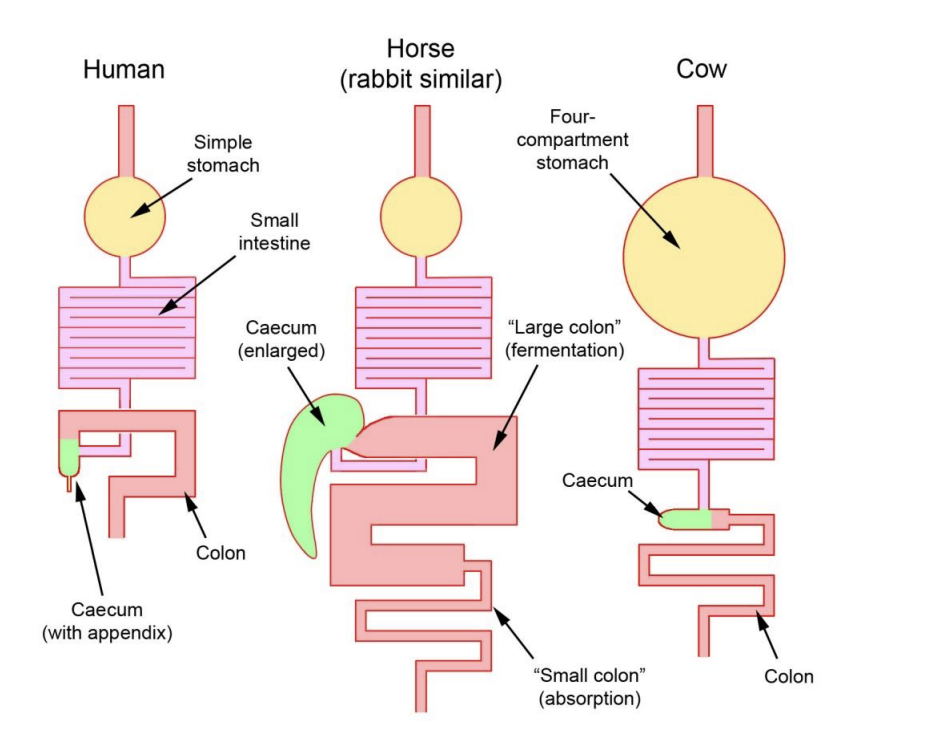
What parts of the hind gut fementers are enlarged
Caecum
Ascending colon (proximal)
note: this embryologically is the midgut
In horses and rabbits
provides a substantial contribution to daily energy intake→ 60-80%
other animals→ provide a modest amount of energy
also seen in cows
generally just everywhere
human→ 10%
Horse digestive system features
Most fermentaion in
Enlarged caecum→ 30 L capacity
Expanded proximal colon→ ‘large colon’→ >60L
Smaller parts
distal ‘small colon’ is narrower→ used for absorption of e.g VFAs
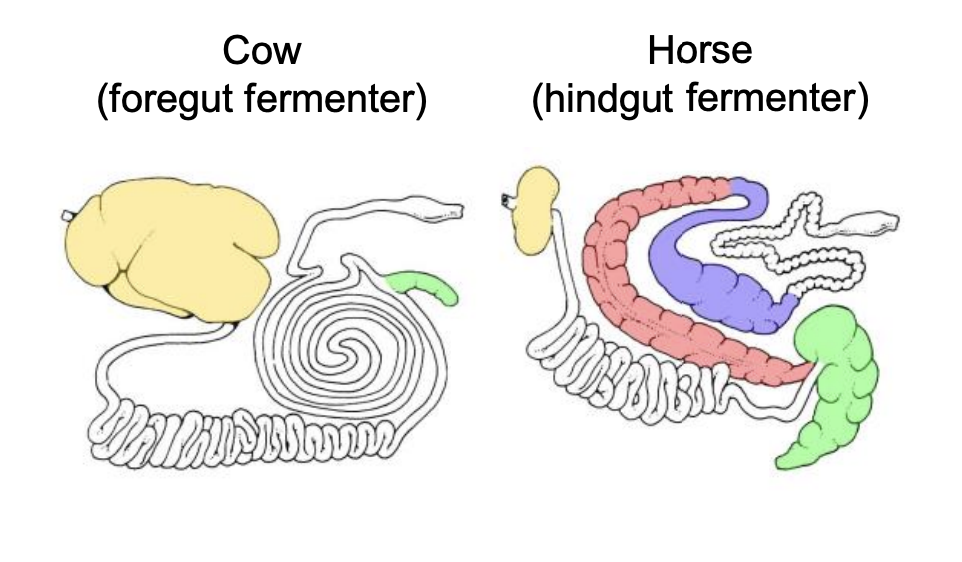
Digestive tract comparison with cow and human
Rabbit: what else do they do to increase absorption
Coprophagy→ eat feaces (but not really feaces) ceacal pellets
urea enters the large intestine from blood
can be convreted into microbial protein
BUT has no means to break this down so often lost in faces
THEREFORE reingest microbial protein (that would otherwise be lost because oly found in the hind gut (cannot be digested by the stomach because already passed)
remain as nodules in the stomach for a while
have a phosphate buffered, strong mucus envelope
protects the bacteria from stomach acid
allows to continue to ferment for 6 hours in fundus
eventually broken down
broken down the small intestine
improves nitrogen use efficiency
mainly in small animals
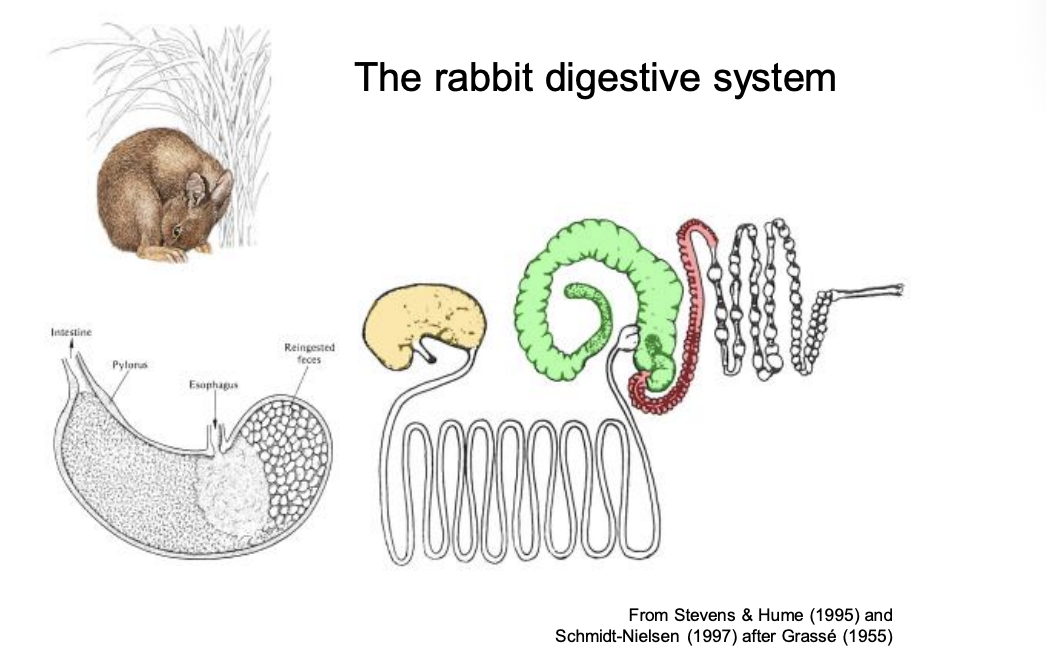
What happens to coarser fibres
coarser fibres are lost in hard pellets which are not eaten
how this fibre separation is achieved is unclear
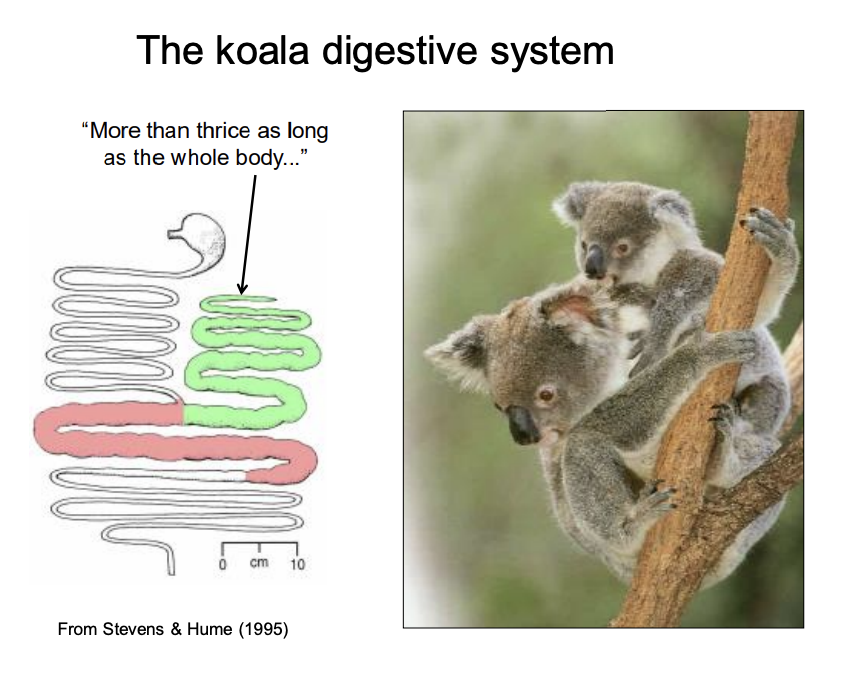
Koala digestive system
2.5 m caecum→ very long
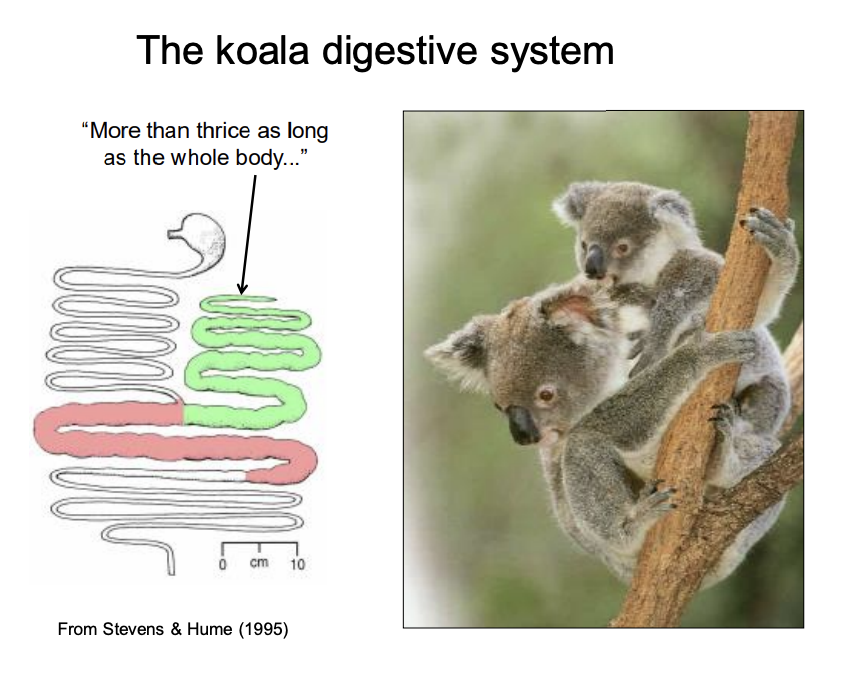
How to kaola acquire mirboes for special eucalptus tree break down
eat mother ‘pap’ feaces
What kind of digestive system should you have?
Comparing sheep, cows and horse
should be able to extrapolate these data from foregut and hindgut to see which kind we have:
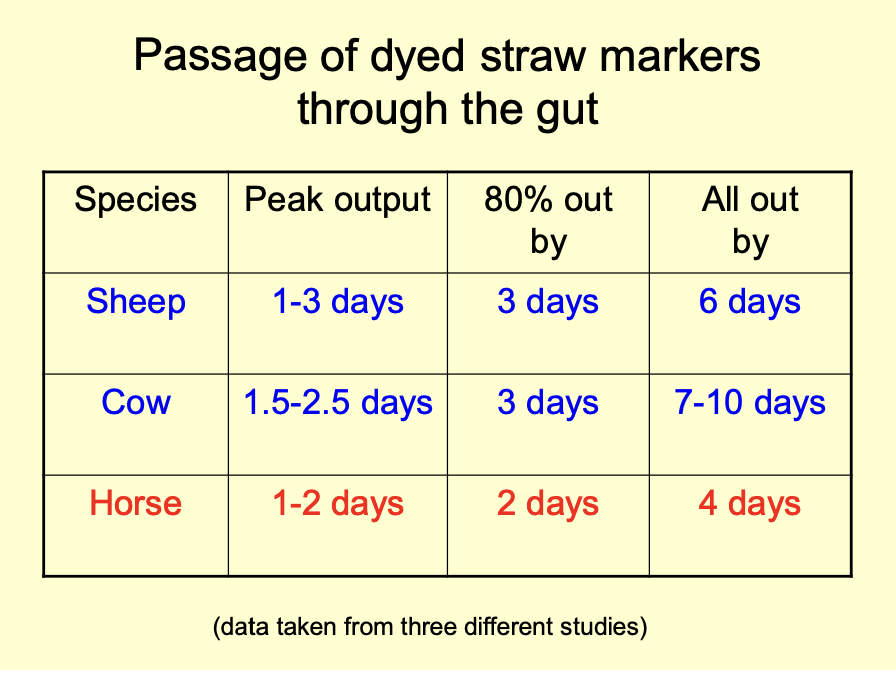
Passage of dried straw markers through the gut
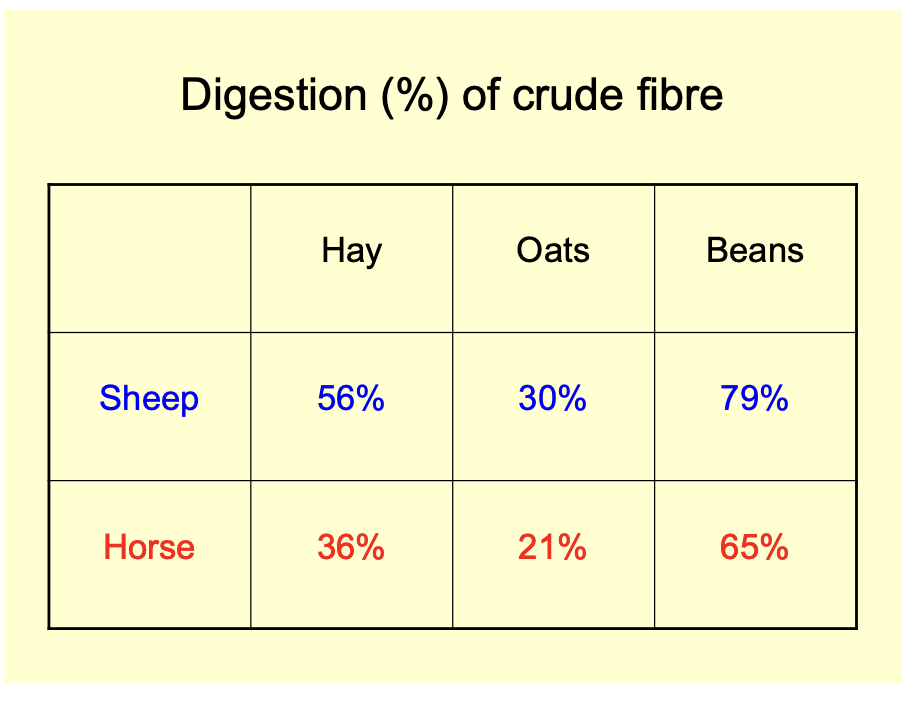
Digestion of crude fibre in various foodstuffs
Passage of dried straw markers through the gut
note: straw is low nutrition while Hay is high nutriion and green
Result: Hind gut passes it out quicker
Digestion of crude fibre in various food stuffs
Result: rumen does better job of breaking fibre down
Advatnage of foregut
more complete digestion of fibre
Food can be bolted and stored for later mastication
toxins can be dealt with by microbes rather than the host
Nitrogen recycling ore efificent
because micrboical protein can be digested throughly in the small intestine
Advantages of hindgut fermentation
Easily digestible food processed directly
good if you want the energy now
more active species?
compared to foregt fermenters
have to first be processed by micrboes and then micrboes digested
so more stages for loss of energy at each stage
esp loss from methane
transit time quicker: more food can be ingested
(Coprophagy) gets over the nitrogen recyling inefficiency of uding the hindgut
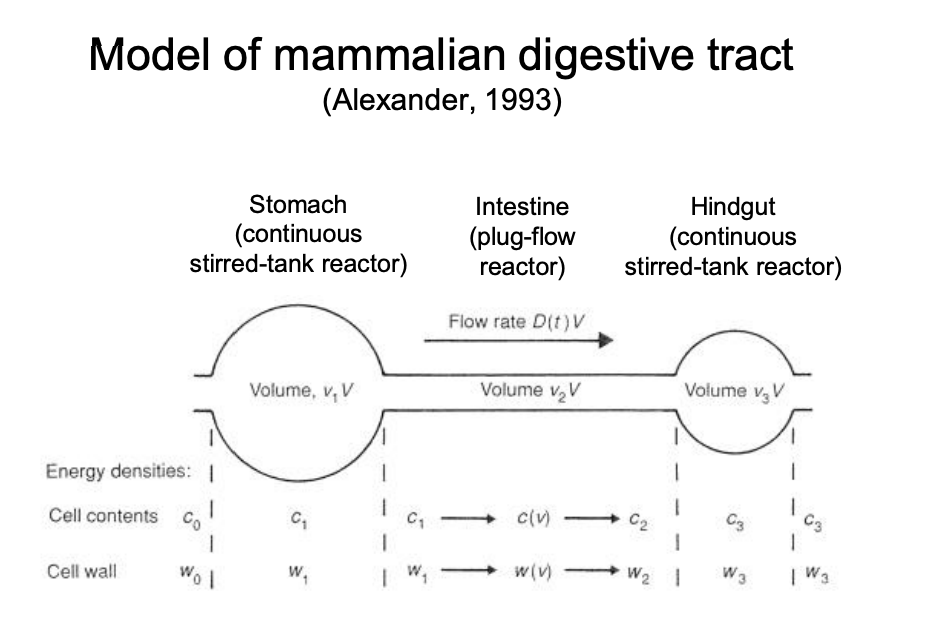
What did Alexnader conclude from mathematical models of the digestive tract (ie. what fermentr for what food eaten)
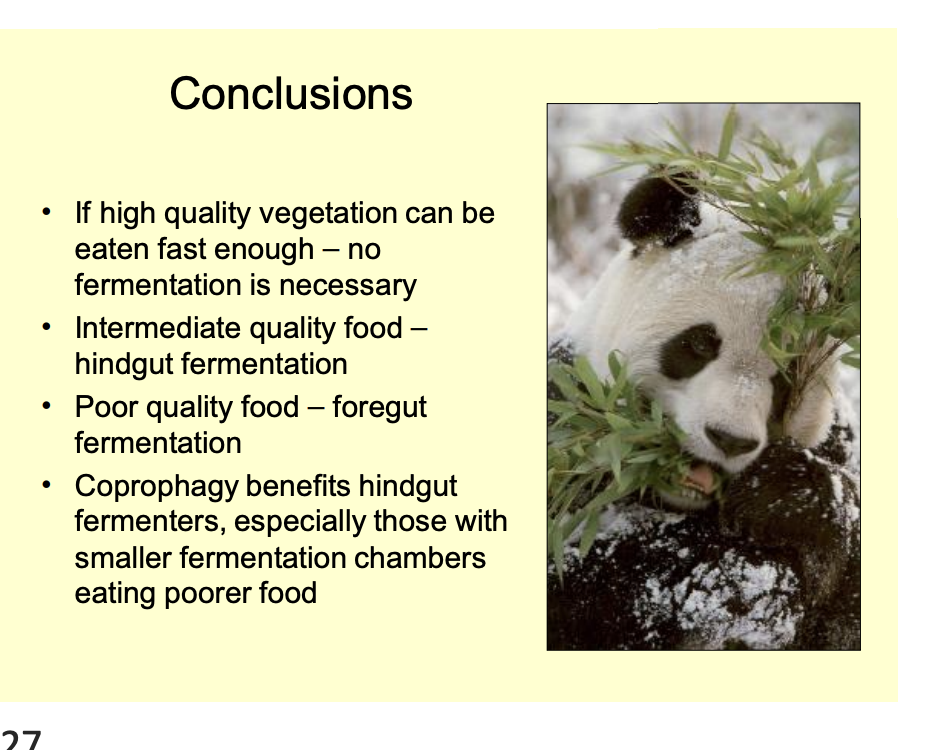
If veggie with high digestible content can be process fast enough→ no fermentation chamber is necessary
If food quality is intermediate→ hind gut fermentation
If food quality poor→ large foregut fermentation chamber is needed
Coprophagy is much more advantageous in hindgut than foregut
particulalry if the fermentation chamber is small and the animal feed on low-quality, fibrous food
which is incompletely fermented first time around
Wouldn’t it ben better to eat fresh food than caecal pellets to get more out of it??
idk maybe coz you get more micrboes that have grow ndue to the aas they made for themselves?
Which mammal adopts this strategy?
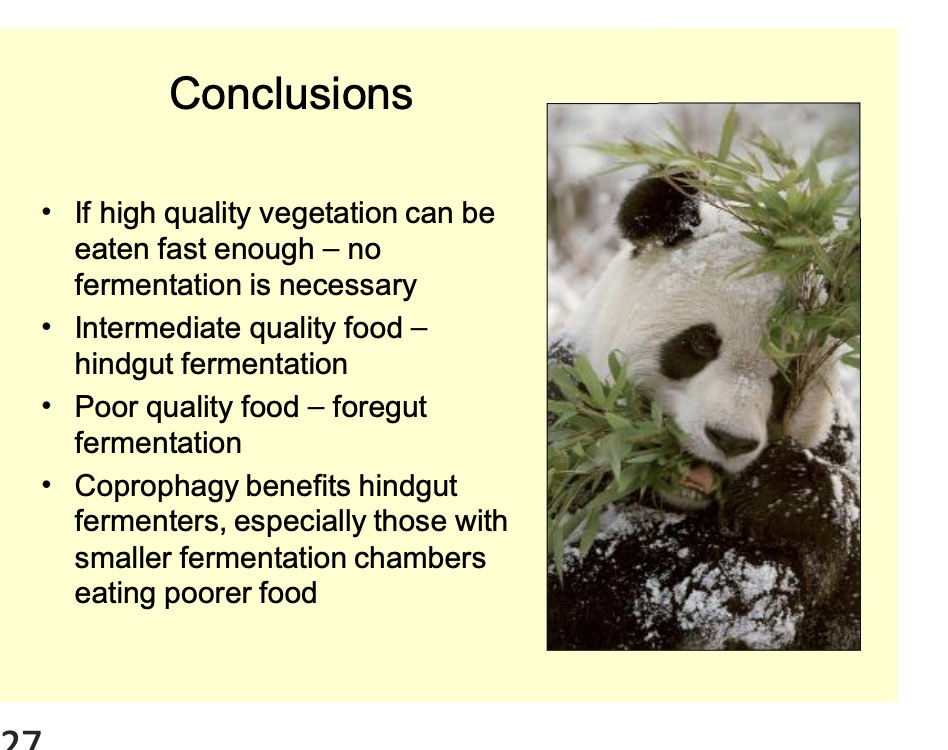
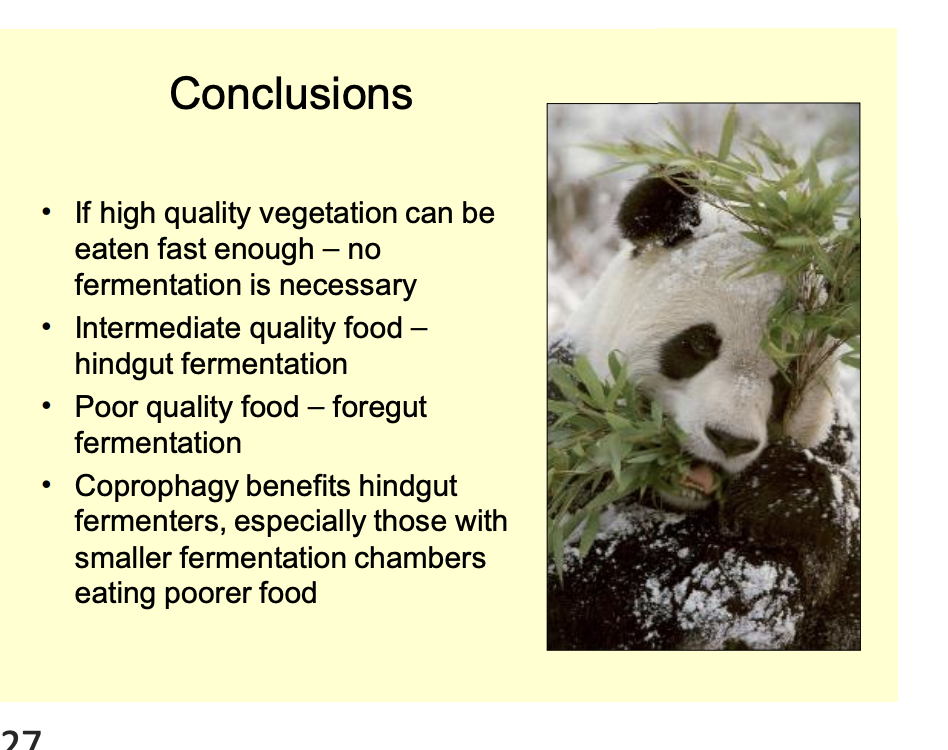
Panda
carnivore GI tract
but eat high quality bamboo
Essay questions
Discuss the relative merits of foregut and hind-gut fermentation.
Compare and contrast carbohydrate digestion in a cow and in a human.
Compare and contrast the metabolic strategies of a cow and a human.

