2.1 Models in Psychological Assessment
 Studied by 0 people
 Call with Kai
 Learn
Learn Practice Test
 Spaced Repetition
 Match
Match Flashcards
 Knowt Play
1/60

Earn XP
Description and Tags
Models in Psychological Assessment
Name | Mastery | Learn | Test | Matching | Spaced | Call with Kai |
|---|
No analytics yet
Send a link to your students to track their progress
61 Terms
Behvaiour in this course
actions, feelings & thoughts
Models in Psychological Assessment
6 main models
7 differentiating criteria
6 main models
Psychodynamic model
Trait model
Behavioral model
Cognitive model
Biological model
Constructivist model
7 differentiating criteria
1. Theoretical formulation
2. Type of variable
3. The basic methods
4. The assessment techniques
5. Levels of inference
6. The objectives/aims of assessment
7. Areas of application
Theoretical formulation
How each model explains behavior (which variable)
B (Behaviour), P (psychological variables), O (organs), E (environment)
For each model, variables P & O can mean different things, depending on the
type of variables they include
The same behaviour can be explained though different variables
• B (behavior, response)
• P (personal or psychological variables of the person)
• O (organism, biological variables)
• E (environment, stimulus, situation)
B
Behavior
Response
P
Personal or psychological variables of the person
how do they perceive the smoke (internal)
O
Organism
Biological variable
(brain/ hormonal functioning → more physical)
E
Environment, stimulus, situation)
External (punishment or reinforcement)
Types of variables
Element under analysis in each model
Basic methods
The way to operationalize the variables that are being studied (correlational/experimental)
Assessment techniques
Instruments through which data are collected
Inference level
The level of deduction-inference that is used on the recorded behaviors.
Inference level 1
conduct understood as a manifestation of behavior
→ E.g.: "Smiling", "going out with friends on weekends", "high number of social interactions during breaks”
Inference level 2
Based on the assumption that a relationship or correlation exists between the behavior being assessed & other behaviors
→ E.g.: If a psychologist records the above, he could infer that the patient is a social person.
Inference level 3
an explanation behind the associated observed behaviors
→ E.g.: The patient meets friends on weekends BECAUSE they are social.
Inference level 4
The integration of the inferred concept into a complete theory.
→ E.g.: The sociability variable in the trait theory (Personality variables)
The objectives/aims of assessment:
Describe, classify (diagnose), predict (orient), explain or control (modify / control) behavior.
It depends on the demand of each process of psychological assessment.
Areas of application
each model has emerged in a given area, so its application is usually is related to it.
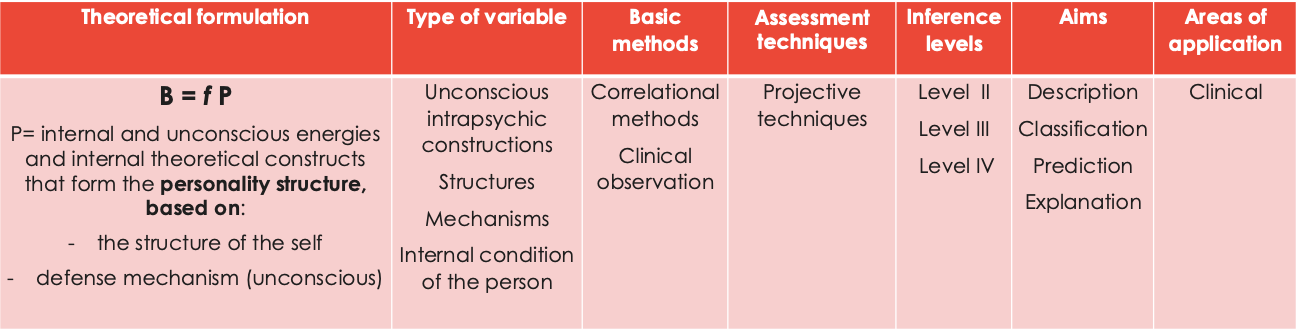
PSYCHODYNAMIC MODEL → formula
(B= f P)
PSYCHODYNAMIC MODEL
Behavior is driven by unconscious forces & early childhood experiences
Emphasizes internal conflicts between desires, morals, & reality
Personality develops through stages in childhood
Past experiences strongly shape current behavior (Fear of authority figures rooted in early parental conflict)
PSYCHODYNAMIC MODEL / author
Freud → the unconscious mind is the primary source of human behavior.
According to the psychodynamic model any behavioral manifestation will be understood as an expression of
The internal condition of the person
The unconscious mind comprises
Mental processes that are inaccessible to consciousness but that influence judgments, feelings, or behavior
Example of B = f P
B (anxiety)= f P (a conflict between the id- instinctual desires- and ego -organized, realistic agent that mediates with super ego)
P
Internal & unconscious energies & internal theoretical constructs that form the personality structure, based on:
- the structure of the self
- defense mechanism (unconscious)
The aim of PSYCHODYNAMIC MODEL
Description
Classification
Prediction
Explanation
Types of variables in the PSYCHODYNAMIC MODEL
Unconscious intrapsychic constructions
Structures
Mechanisms
Internal condition of the person
Assessment techniques in PSYCHODYNAMIC MODEL
Projective techniques
B = f P
Behaviour is a function of the person (sub-conscious/internal)
TRAIT MODEL (B= f P)
Personality is made up of stable traits that differ between people
Traits are consistent patterns of thoughts, feelings, and behaviors
Focuses on measuring personality differences
Often used in personality tests
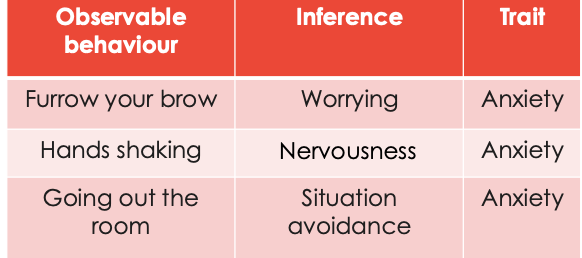
Traits are
consistent patterns of thoughts, feelings, and behaviors
e.g., someone is consistently introverted across situations
TRAIT MODEL (types of variables)
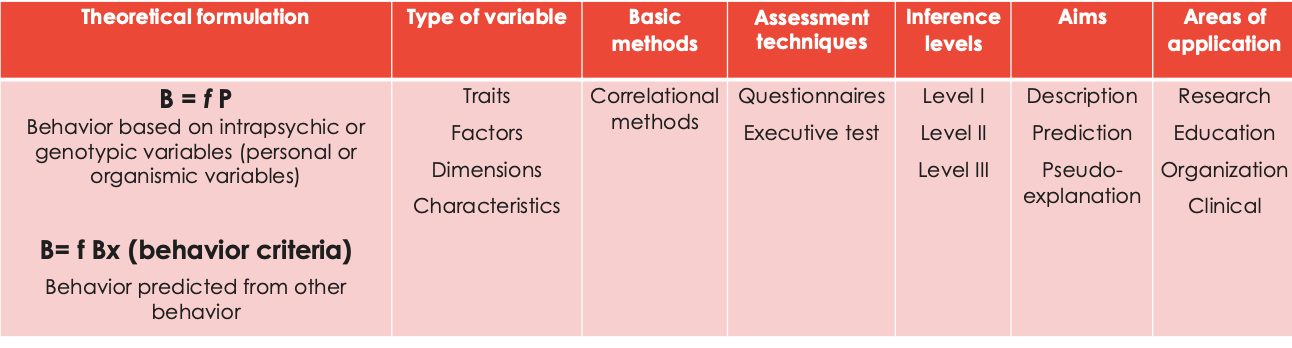
Traits
Factors
Dimensions
Characteristics
Assesment teqchniques of trait model
Introversion Questionnaires (NEO-PI)
Behaviour in trait model
Behavior based on intrapsychic or genotypic variables (personal or organismic variables)
→ B= f Bx (behavior criteria) Behavior predicted from other behavior
B= f Bx (behavior criteria)
Behavior predicted from other behavior
Example of TRAIT MODEL (B= f P)
who I am as a student (inhereted personality traits)
BEHAVIORAL MODEL (B= f E)
Psychology should study observable behavior, not thoughts or feelings
Behavior is learned through interaction with the environment
Behaviourism focus on
Conditioning
Types of conditioning
Classical conditioning (Pavlov): learning by association
Operant conditioning (Skinner): learning through rewards & punishments
In behaviourism the mind is treated like a
black box
Behaviour according to behaviourism
A person has been conditioned to associate public speaking situations with fear
They avoid public speaking → feel relief → avoidance gets reinforced
BEHAVIORAL MODEL (B= f E) → Theoretical formulation
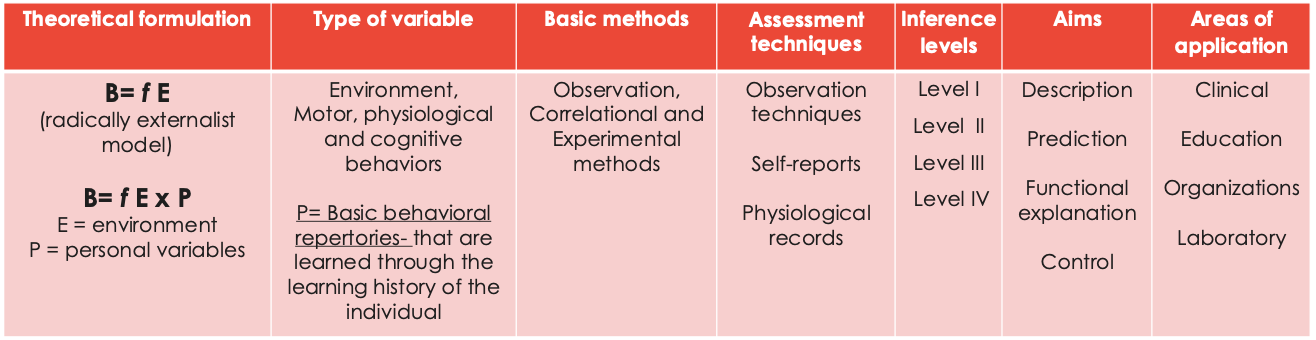
B= f E (radically externalist model)
B= f E x P → E = environment & P = personal variables
Type of variable in the BEHAVIORAL MODEL
Environment, Motor, physiological & cognitive behaviors
P= Basic behavioral repertories → that are learned through the learning history of the individual
BEHAVIORAL MODEL Assessment techniques
Observation techniques
Self-reports
Physiological records
BEHAVIORAL MODEL (B= f E) → table
COGNITIVE MODEL (B= f P)
Behavior is influenced by mental processes
Studies how people think, remember, perceive, problem-solve, & make decisions
The mind is often compared to a computer that processes information
Focuses on internal processes that behaviorism ignored
Example of the COGNITIVE MODEL
Catastrophic thinking before an exam increases anxiety → Thoughts like “I’ll fail” or “Everyone will judge me”
Theoretical formulation of the cognitive model
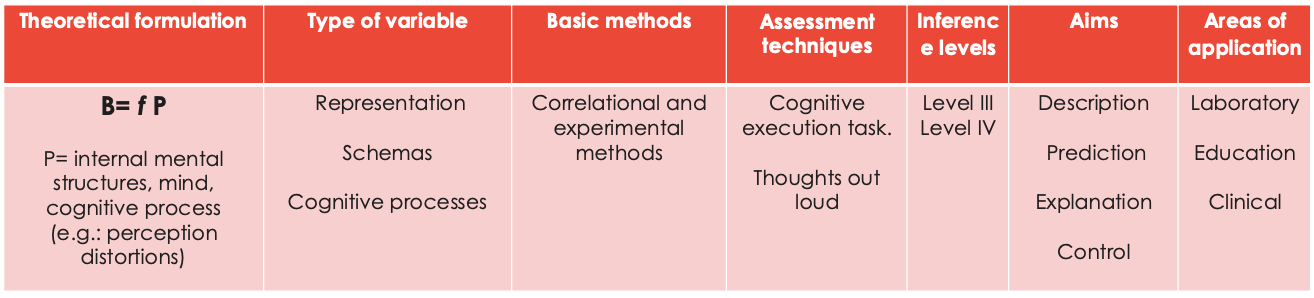
B= f P
P= internal mental structures, mind, cognitive process
→ (e.g.: perception distortions)
Types of variables in cognitive model
Representation
Schemas
Cognitive processes
Assessment techniques COGNITIVE MODEL
Cognitive execution task.
Thoughts out loud
Example of COGNITIVE MODEL
BIOLOGICAL MODEL (B= f O) THEORETICAL FORMULATION
→ B = f O
Behavioral dysfunctions that have a biological / neurological base
Types of variables in BIOLOGICAL MODEL
Nosological entity
Biological disorders
Assessment techniques in BIOLOGICAL MODEL
Examination
Executive test
Observation scales
Devices
CONSTRUCTIVIST MODEL (B= f P)
People actively construct their own understanding of reality
Knowledge is built from personal experiences & social interactions
Different people experience the same event differently
Emphasizes meaning-making rather than objective truth
Example of CONSTRUCTIVIST MODEL
One person sees an exam as a threat; another sees it as a challenge
Theoretical formulation of the CONSTRUCTIVIST MODEL
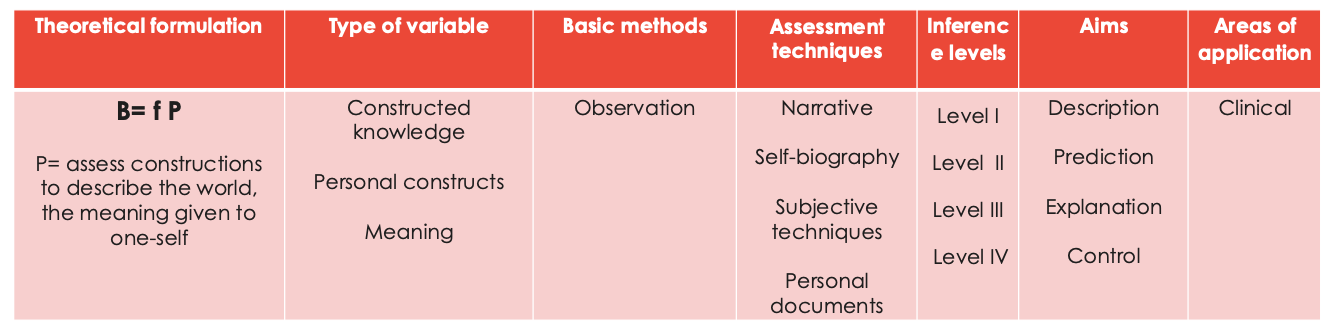
B= f P
P = assess constructions to describe the world, the meaning given to one-self
Assessment techniques applied in CONSTRUCTIVIST MODEL
Narrative
Self-biography
Subjective techniques
Personal documents
CONSTRUCTIVIST MODEL table
 Note
Note  Flashcards (34)