Topic 7 Magnetism
 Call Kai
 Learn
Learn Practice Test
 Spaced Repetition
 Match
Match Flashcards
 Knowt Play
1/6

There's no tags or description
Looks like no tags are added yet.
Name | Mastery | Learn | Test | Matching | Spaced | Call with Kai |
|---|
No analytics yet
Send a link to your students to track their progress
7 Terms
6.2 Properties of (permanent) magnets
The ends of a magnet are called poles
Magnets have two poles: a north and a south
Opposite poles of a magnet attact(e.g. S and N)
Like poles of a magnet repel (e.g. S and S or N and N)
The attraction or repulsion between two magnetic poles occurs due to the magnetic force.
6.3 Magnetic Materials (magnetically hard & soft)
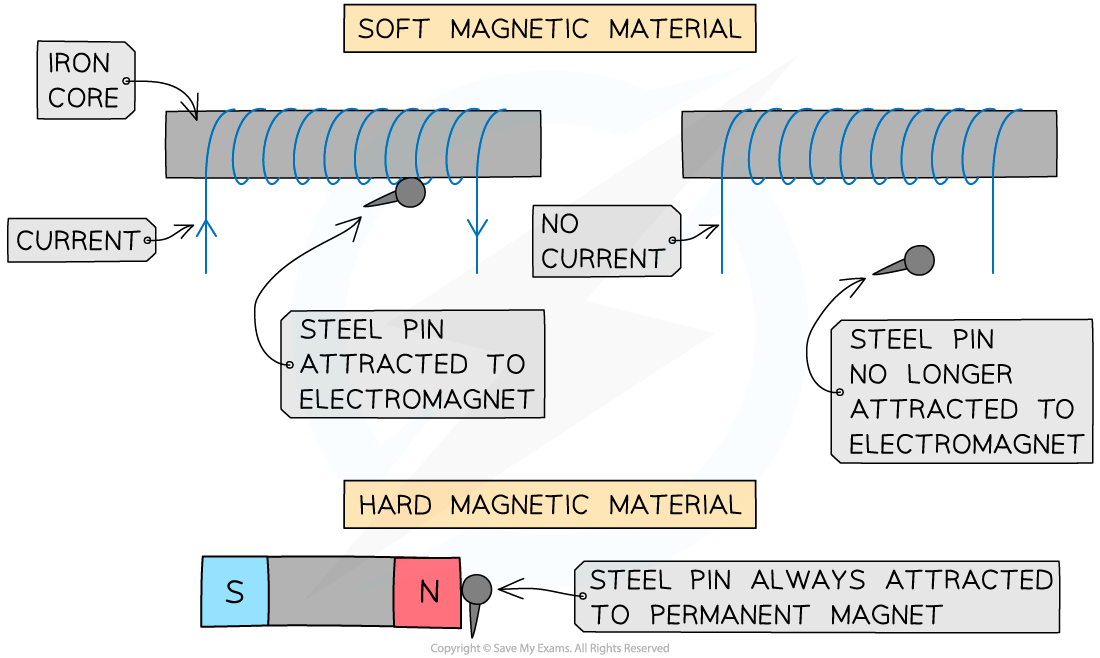
Magnetically soft materials (e.g. iron):
Are easy to magnetise
Easily lose their magnetism, temporarily magnetised
Magnetically hard materials (e.g. steel):
Are difficult to magnetise
Do not easily lose their magnetism, permanently magnetised
Permanent magnets are made out of magnetically hard materials
Electromagnets are made out of magnetically soft materials
This means that electromagnets can be made magnetic or non-magnetic as an when required: A steel pin will be attracted when an electromagnet switches on but not when it switches off. It is always attracted to a permanent magnet
Magnetic field
All magnets are surrounded by a magnetic field.
A magnetic field is defined as: The region around a magnet where a force acts on another magnet or a magnetic material.
6.4 Magnetic field line
Magnetic field lines (are visual, imaginary lines) used to represent the strength and direction of a magnetic field.
direction: shown by arrows
strength: shown by the spacing of the magnetic field lines
If lines are close together = the magnetic field will be strong
If lines are far apart = the magnetic field will be weak
Magnetic field lines always go from north to south and are always parallel (never cross).
Non-magnetic and magnetic material
Non-magnetic materials are materials that are not attracted to magnets and that cannot be magnetised.

