BIO 167 Exam 5 - Nervous System
 Call Kai
 Learn
Learn Practice Test
 Spaced Repetition
 Match
Match Flashcards
 Knowt Play
1/186

There's no tags or description
Looks like no tags are added yet.
Name | Mastery | Learn | Test | Matching | Spaced | Call with Kai |
|---|
No analytics yet
Send a link to your students to track their progress
187 Terms
organization of the nervous system
central nervous system (CNS) + peripheral nervous system (PNS)
What are the components of the CNS?
brain and spinal cord
What are the components of the PNS?
cranial nerves, spinal nerves, ganglia
What is the difference b/t motor (efferent) and sensory (afferent) division of the nervous system?
sensory (afferent) = towards CNS
motor (efferent) = away from CNS
sensory (afferent) neuron
transmits impulses from sensory receptors to CNS
motor (efferent) neuron
transmits impulses away from CNS to effecto
effector
muscles and glands that respond to stimulus
What is the difference b/t the somatic nervous system and autonomic (visceral) nervous system?
somatic = voluntary movement
autonomic = involuntary movement
Describe the histology of the nervous system.
neurons and neuroglial cells
List the general fxns of neuroglial cells and neurons.
maintain homeostasis, support, protect, regulate ions in interstitial spaces
astrocyte
structure: highly branched glial cell
location: neurons, synaptic endings, capillaries
fxn:
- support and brace neurons
•Nutrient exchange b/t neuron and capillaries
•Guide migration of young neurons
• control chem environ around neurons
•Have been found to respond to nerve impulses and release neurotransmitters
•Participate in information processing
oligodendrocyte
structure: branched cell
location: around CNS nerve fibers
fxn: accelerating nerve impulse via saltatory conduction, metabolic support to axons, and maintaining axonal health
microglia
structure: Small, ovoid cells with thorny processes that touch and monitor neighboring neuron health
location: injured neurons
fxn: transform into special macrophage to phagocytize microorganisms or neuronal debris
ependymal
structure: squamous or columnar, some have cilia
location: line central cavities of brain and spinal cord
fxn: forms permeable barrier b/t CSF in cavities and tissue fluid bathing CNS cells
Schwann cells
structure: form myelin sheaths around thicker nerve fibers
location: peripheral nerve fibers
fxn: vital to regeneration of damaged peripheral nerve fibers
satellite cells
structure: lie flat
location: surround neuron cell bodies in PNS
fxn: muscle repair, regeneration, and growth
Describe the specific anatomy of a neuron.
nerve cell body
chromatophilic substance (Nissl body)
rough ER of neuron cell body
axon hillock
site where nerve impulse begins
dendrite
convey incoming messages toward cell body as graded potentials
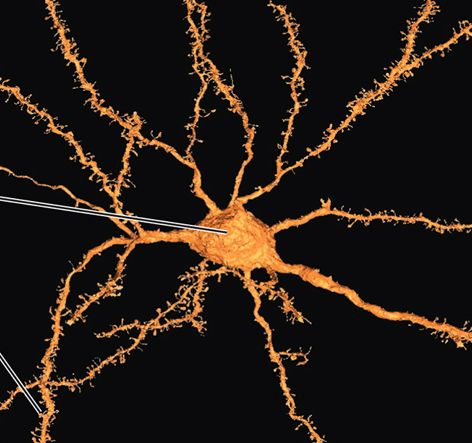
axon
conducting region of neuron that generates nerve impulses
axoplasm
specialized cytoplasm contained within the axon of a neuron
axolemma
axon cell membrane
axon collateral
occasional branches of axon at approx. right angles
myelin sheath
protect and insulate axon, increases speed of nerve impulse transmission
sheath of Schwann (neurilemma)
outer collar of perinuclear cytoplasm
node of Ranvier
gab b/t adjacent Schwann cells
axon terminals (synaptic end bulb)
knoblike distal ending of terminal branches
terminal branches (telodendria)
branching at end of axon
What is the difference b/t the structure of a myelinated and unmyelinated axon (nerve fiber)?
Myelinated fiber: Segmented sheath found around most long or large diameter axons
Nonmyelinated fibers: lack sheath and conduct impulses slower
multipolar neuron
structure: 3 or more processes
location: major neuron type in CNS
bipolar neuron
structure: one axon, one dendrite
location: rare, found in some special sensory organs (olfactory mucosa, eyes, ears)
unipolar neuron
structure: single short process off the neuron cell body
location: mainly in PNS, dorsal root ganglia of spinal cord, sensory ganglia of cranial nerves
List and describe the functional components in a peripheral nerve.
resting membrane potential
Explain why a resting membrane potential occurs and how it is maintained.
excitability
ability of neurons to respond to stimuli & to convert this information into nerve impulses
action potential
brief reversal of membrane potential
Describe the physiology of a continuous conduction.
Interpret a voltage vs. time graph of an action potential and describe its periods and events.
depolarization
decrease in membrane potential (-70mV → -60mV)
repolarization
hyperpolarization
increase in membrane potential (-70mV → -80mV)
refractory period
absolute refractory period
nerve cannot respond to another stimulus no matter how strong
relative refractory period
an exceptionally strong stimulus can reopen Na+ channels and generate another AP; threshold is elevated
all-or-none principle of impulse conduction
threshold stimulus
subthreshold stimulus
temporal summation
spatial summation
saltatorial conduction
Compare and contrast continuous and saltatorial conduction of nerve impulses.
Name the specific fiber types based on the speed of impulse conduction.
A fibers
structure: large diameter, thick myelin sheath
conduction speed: up to 150 m/s (300 mph)
location: somatic sensory and motor fibers serving skin, skeletal muscles, and joints
B fibers
structure: medium-sized, lightly myelinated fibers
conduction speed: 15 m/s (30 mph)
location: ANS visceral motor and sensory fibers, and smaller somatic sensory fibers from skin
C fibers
structure: small, nonmyelinated fibers
conduction speed: 1 m/s (2 mph)
location: ANS visceral motor and sensory fibers, and smaller somatic sensory fibers from skin
neuromuscular junction
neuron - muscle
neuroglandular junction
neuron - gland
synapse
neuron - neuron
What is the general structure of a synapse?
Presynaptic neuron - postsynaptic neuron
Axodendritic synapses
Axosomatic synapses
synaptic cleft
presynaptic neuron
postsynaptic neuron
one-way impulse conduction
neurotransmitter
synaptic vesicle
facilitation
Explain the physiology of an excitatory postsynaptic potential (EPSP).
Explain the physiology of an inhibitory postsynaptic potential (IPSP).
Describe the neural integration of EPSP’s and IPSP’s.
acetylcholine
site of release: neuromuscular junctions and by many neurons of the autonomic nervous system
general action: binds to postsynaptic receptors
mechanism for inactivation: acetylcholinesterase
norepinephrine
site of release:
general action:
mechanism for inactivation: Catechol-O-Methyltransferase (COMT), Monoamine Oxidase (MAO)
cholinergic effect
adrenergic effect
List examples of neurotransmitters.
white matter
gray matter
nerve
ganglion
nucleus
tract
ascending tract
descending tract
Identify the major regions of the brain and list the specific parts contained within each major region.
cranial meninges
structure:
location:
List in order the structures passed from the bone of the skull to the surface of the brain.
epidural space
dural veinous sinus
arachnoid villi
arachnoid trabeculae
falx cerebri
tentorium cerebelli
falx cerebelli
Compare and contrast the structure of cranial and spinal meninges.
medulla oblongata
location:
structure:
fxn:
pons
location:
structure:
fxn:
midbrain
location:
structure:
fxn:
structural/functional significance: ascending and descending tracts

