Predation
 Call Kai
 Learn
Learn Practice Test
 Spaced Repetition
 Match
Match Flashcards
 Knowt Play
1/25

There's no tags or description
Looks like no tags are added yet.
Name | Mastery | Learn | Test | Matching | Spaced | Call with Kai |
|---|
No analytics yet
Send a link to your students to track their progress
26 Terms
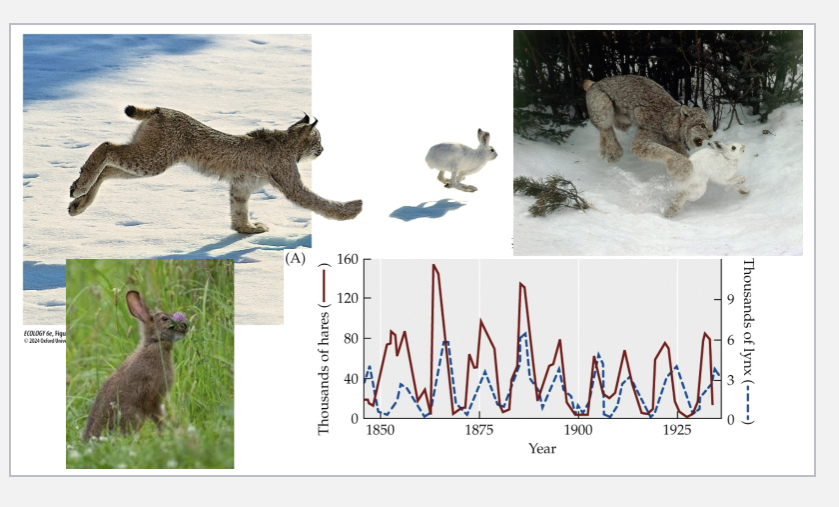
Snowshoe hares and Canada lynx predators
Snowshoe hares constitute a major portion of lynx diet
Historical trapping data from the Hudson’s Bay Company indicate that numbers of both hares and lynx fluctuated in a 10-year cycle
Hare survival rates are highest several year before hare density peaks and fall and do not rise again until several years after hare density peaks —> change in food supplies
Main concern…predation
Chronic stress: response is maintained for long periods; can affect growth and reproduction and susceptibility to
Trophic vs Non-trophic
Interactions of evolutionary change can be based on feeding (trophic) or on space/resources (non-trophic, like competition).
Symbiosis
A specific type of interaction where species live in close physical or physiological contact. This can be positive (mutualism), negative (parasitism), or neutral.
Competition
two or more species overlap in the use of limiting resources
Mutualism
Both species benefit (e.g., pollinators and flowers)
Commensalism
One benefits, the other is unaffected
Amensalism
One is harmed, the other is unaffected (e.g., an elephant stepping on ants).
Competition
Both species are harmed by the shared use of limiting resources
Predation
an individual of one species (predator) consuming individuals or parts of another (prey).
Carnivory
Both predator and prey are animals
Herbivory
The predator is an animal; the prey is a plant or algae
Parasitism
predator (a parasite) lives symbiotically on or in the prey (its host) and consumes certain tissues; may not kill the host
Most carnivores have ___ diets, whereas most herbivores
have relatively ___ diets.
broad; narrow
Predation results in a wide range of ________ mechanisms
capture and recapture
Most carnivores have broad diets, whereas a majority of herbivores have relatively narrow diets – why?
Optimal Foraging Theory: theory: encounter rate vs. handling
time
Generalist: mostly carnivores, encounter rates and handling times are low
Specialist: mostly herbivores, encounter rates and handling times are high
Mechanism for Predators:
Find prey
MOVE AROUND
AMBUSH
SET TRAP
Capture prey
BURST OF SPEED
MORPHOLOGICAL CHARACTERISTICS
POISON
MIMICRY
ETC
Mechanism for Prey:
Avoid being eaten
Physical features
Warning coloration
Crypsis
Mimicry
Behavioral Adaption
Trade-offs
The Landscape of Fear
wolves make roadways safer, generating large economic returns to predator
conservation
an ecological concept describing how prey animals perceive and react to predation risk, creating a "map" of high-risk (peaks) and low-risk (valleys) areas that shapes their behavior.
Mechanisms for prey (plant edition):
Avoid being eaten
PRODUCE HUGE NUMBER OF OFFSPRING
STRUCTURAL DEFENSES
CHEMICAL DEFENSES
INDUCED DEFENSES
COMPENSATIVE GROWTH
INCREASING EXISTING DEFENSES
Mechanisms for Predator (who eats plants edition):
Avoid being eaten
Digest plants
DIGESTIVE ENZYMES
BEHAVIORAL AVOIDANCE
AND MORE!!!
Predator-prey cycles
If there are no predators, what happens to prey? → exponential growth
What slows prey growth? → encounters with predators
If there's no prey, what happens to predators? → exponential decline
What helps predators grow? → encounters with prey
Lotka–Volterra predator–prey model
Prey Growth: In the absence of predators, the prey population is assumed to grow exponentially.
Predator Decline: In the absence of prey, the predator population is assumed to decrease exponentially at a specific mortality rate.
Interactions: Prey growth is slowed by encounters with predators, while predator growth is fueled by encounters with prey
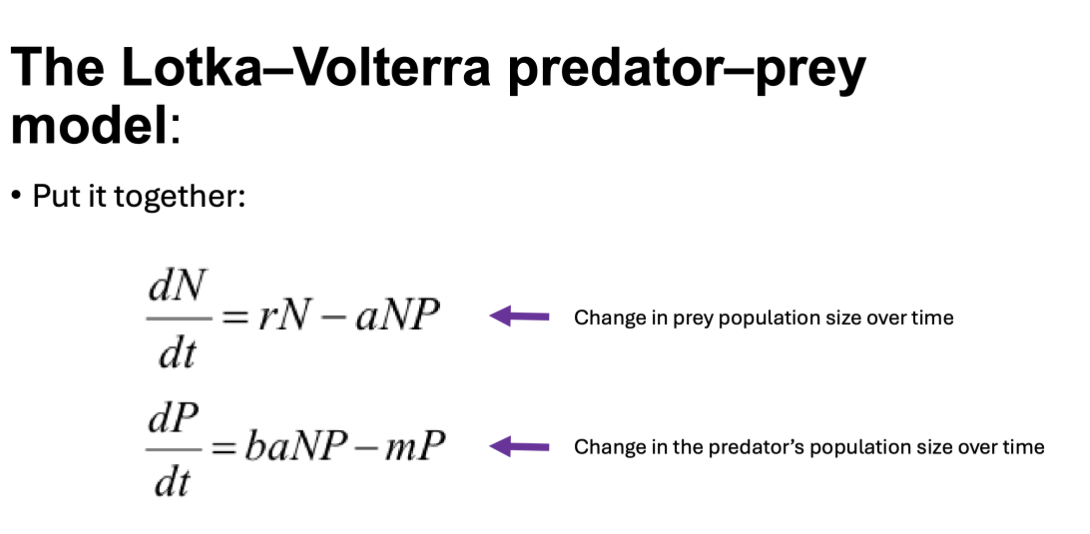
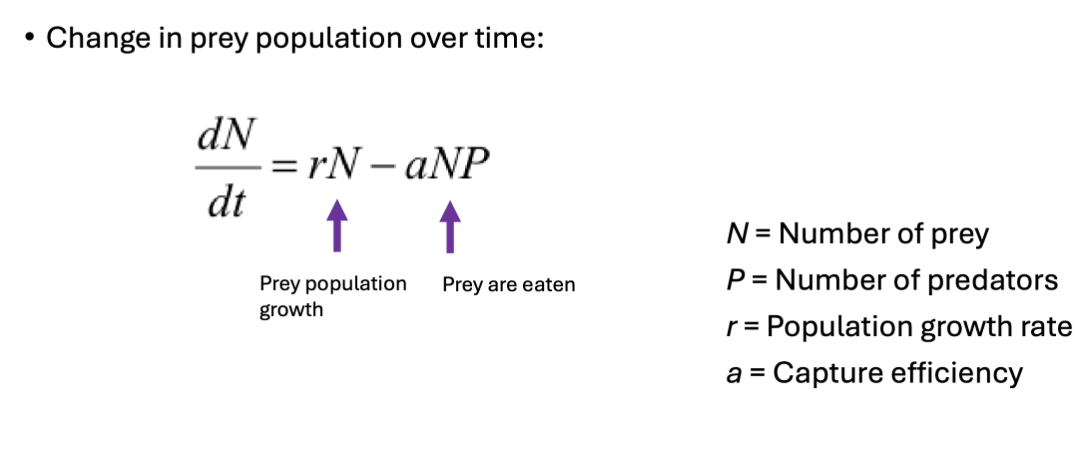
For prey population…
When P = 0, the prey population grows exponentially.
• With predators present (P ≠ 0), rate of prey capture
depends on how frequently they encounter each other
(NP) and efficiency of prey capture (a)
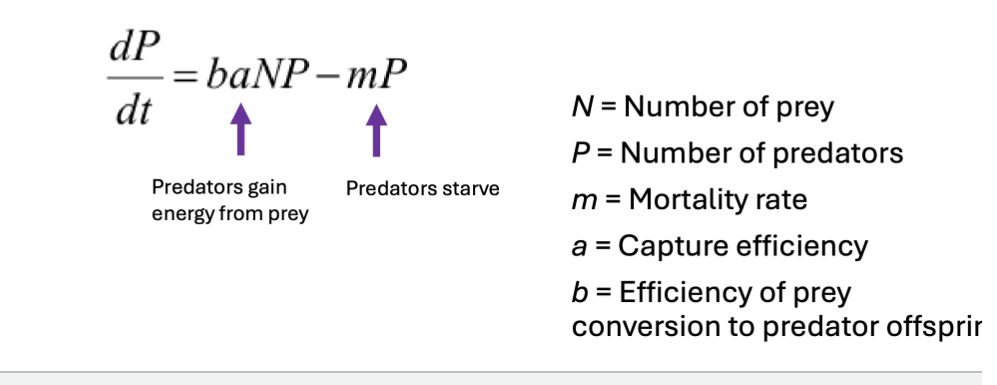
For predator population…
If N = 0, predator population decreases exponentially at death rate d.
When prey are present (N ≠ 0), individuals are added to the predator population according to the number of prey killed (aNP) and efficiency (b) of conversion of prey into more pre
Cycling
When these isoclines are combined, they reveal that predator and prey populations tend to cycle around a neutrally stable equilibrium point where the two lines cross.'
Population cycles are difficult to achieve in the lab
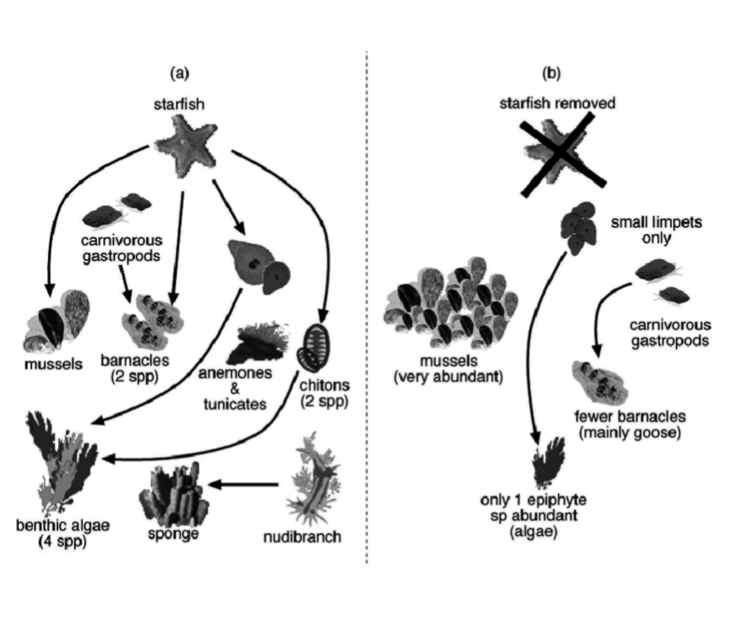
Predators can change the outcome of competition, affecting distribution or abundance of competitor species
If a predator or herbivore decreases performance of the top competitor, the inferior
competitor may increase in abundance.
Ex: Paine (1974) removed starfish
predators from a rocky intertidal zone.