Key NOSE2 Concepts
0.0(0)
 Studied by 2 people
 Call Kai
 Learn
Learn Practice Test
 Spaced Repetition
 Match
Match Flashcards
 Knowt Play
Card Sorting
1/100

Earn XP
Description and Tags
Key concept as listen in the NOSE2 revision lecture
Last updated 2:10 PM on 12/12/22
Name | Mastery | Learn | Test | Matching | Spaced | Call with Kai |
|---|
No analytics yet
Send a link to your students to track their progress
101 Terms
1
New cards
what are the OSI layers?
* application
* presentation
* session
* transport
* network
* data link
* physical
* presentation
* session
* transport
* network
* data link
* physical
2
New cards
physical layer focus
transmission of raw data bits
3
New cards
physical layer service for data link layer
sequence of bits
4
New cards
baseband data encoding
encoding performed by varying the voltage in an electrical cable or the intensity of light in an optical fibre (physical layer)
5
New cards
baseband data encoding scheme examples
* NRZ
* NRZI
* Manchester
* NRZI
* Manchester
6
New cards
carrier modulation
* carrier wave applied to channel at frequency C
* signal modulated onto the carrier
* allows multiple signals on a single channel
* provides carriers spaced greater than bandwidth, H, of the signal
* physical layer
* signal modulated onto the carrier
* allows multiple signals on a single channel
* provides carriers spaced greater than bandwidth, H, of the signal
* physical layer
7
New cards
maximum transmission rate of a channel
* depends on the channel’s bandwidth
* subject to noise that corrupts the signal
* can measure channel’s signal power S, and noise floor N, and compute its signal-to-noise ratio (SNR)
* maximum transmission rate grows logarithmically to the SNR
* physical layer
* subject to noise that corrupts the signal
* can measure channel’s signal power S, and noise floor N, and compute its signal-to-noise ratio (SNR)
* maximum transmission rate grows logarithmically to the SNR
* physical layer
8
New cards
data link layer focus
arbitrate access to the physical
9
New cards
data link layer service for network layer
structured communication (addressing, packets)
10
New cards
addressing
* physical links can be point-to-point or multi-access
* host addresses may be link-local or global scope
* sufficient to be unique only amongst devices connected to a link
* many data link layer protocols use globally unique addresses
* host addresses may be link-local or global scope
* sufficient to be unique only amongst devices connected to a link
* many data link layer protocols use globally unique addresses
11
New cards
framing
* physical layer provides unreliable raw bit stream
* data link layer corrects this
* break the raw bit stream into frames
* transmit and repair individual frames
* limit scope of any transmission errors
* data link layer corrects this
* break the raw bit stream into frames
* transmit and repair individual frames
* limit scope of any transmission errors
12
New cards
error detection and correction
* noise and interference at physical layer can cause bit errors
* error detecting codes can be extended to also correct errors
* transmit error correcting code as additional data within each frame
* data link layer
* error detecting codes can be extended to also correct errors
* transmit error correcting code as additional data within each frame
* data link layer
13
New cards
error detection and correction examples
* parity codes
* internet checksum
* internet checksum
14
New cards
data link synchronisation
* how to detect the start of messages
* leave gaps between frame
* problem - physical layer doesn’t guarantee timing
* precede each frame with a length field
* add a special code to beginning of frame
* leave gaps between frame
* problem - physical layer doesn’t guarantee timing
* precede each frame with a length field
* add a special code to beginning of frame
15
New cards
contention based MAC
* contention based means multiple hosts share channel in a way that can lead to collisions
* two stage access to channel
* detect that a collision is occurring/will occur
* send if no collision or back off and/or retransmit data according to some algorithm to avoid/resolve collision
* data link layer
* two stage access to channel
* detect that a collision is occurring/will occur
* send if no collision or back off and/or retransmit data according to some algorithm to avoid/resolve collision
* data link layer
16
New cards
contention based MAC examples
* ALOHA network
* CSMA
* CSMA-CD
* CSMA
* CSMA-CD
17
New cards
network layer focus
responsible for end-to-end delivery of data
18
New cards
the internet
the globally interconnected networks running the internet protocol (IP)
19
New cards
IP service model
* just send - no need to setup a connection first
* network makes its best effort to deliver packets but provides no guarantees
* easy to run over any type of link layer
* network layer
* network makes its best effort to deliver packets but provides no guarantees
* easy to run over any type of link layer
* network layer
20
New cards
IPv4 addressing
* every network interface on every host is intended to have a unique address
* 32 bits (eg. 130.209.241.197)
* significant problems due to lack of addresses
* 32 bits (eg. 130.209.241.197)
* significant problems due to lack of addresses
21
New cards
consideration regarding IPv6 adoption
* will increase the size of the address pace to allow more hosts on the network
* simplifies the protocol and makes high speed implementations easier
* straight-forward to build applications that work with both IPv4 and IPv6
* simplifies the protocol and makes high speed implementations easier
* straight-forward to build applications that work with both IPv4 and IPv6
22
New cards
fragmentation
* link layer has a maximum packet size (MTU)
* IPv4 routers will fragment packets that are larger than the MTU
* IPv4 routers will fragment packets that are larger than the MTU
23
New cards
session layer focus
manages transport layer connection
24
New cards
inter-domain routing
find the best route to destination network
25
New cards
routing in the DFZ
* core networks are well connected and must know about every other network
* the default free zone where there is no default route
* route based on policy non necessarily shortest path
* requires complete AS-level topology information
* the default free zone where there is no default route
* route based on policy non necessarily shortest path
* requires complete AS-level topology information
26
New cards
distance vector protocols
* each node maintains a vector containing the distance to every other node in the network
* forward packets along route with least distance to destination
* forward packets along route with least distance to destination
27
New cards
link state routing
* nodes know the link to their neighbours and the cost of using those links - the link state information
* reliably flood this information giving all node complete map of the network
* each node then directly calculates shortest path to every other node locally
* reliably flood this information giving all node complete map of the network
* each node then directly calculates shortest path to every other node locally
28
New cards
distance vector routing advantages
* simple to implement
* routers only store the distance to each other node
* routers only store the distance to each other node
29
New cards
distance vector routing disadvantages
suffers from slow convergence
30
New cards
link state routing advantages
faster convergence
31
New cards
link state routing disadvantages
* more complex
* requires each router to store complete network map
* requires each router to store complete network map
32
New cards
transport layer focus
* isolate upper layers from the network layer
* provide a useful, convenient and easy to use service
* provide a useful, convenient and easy to use service
33
New cards
end-to-end principle
only put functions that are absolutely necessary within the network and leave everything else to end systems
34
New cards
transport layer framing
applications may wish to send structured data
* transport layer responsible for maintaining the boundaries
* transport must frame the original data if this is part of the service model
* transport layer responsible for maintaining the boundaries
* transport must frame the original data if this is part of the service model
35
New cards
congestion control
* transport layer controls the application sending rate
* to match rate at which network layer can deliver data
* to match rate at which network layer can deliver data
36
New cards
UDP applications
* useful for application that prefer timeliness to reliability
* voice-over-IP
* streaming video
* must be able to tolerate some loss of data
* must be able to adapt to congestion in the application layer
* voice-over-IP
* streaming video
* must be able to tolerate some loss of data
* must be able to adapt to congestion in the application layer
37
New cards
TCP applications
* useful for applications that require reliable data delivery and can tolerate some timing variations
* file transfer
* email
* instant messaging
* file transfer
* instant messaging
38
New cards
TCP connection setup
* 3 way handshake
* the SYN and ACK flags the TCP header signal connection progress
* initial packet has SYN bit set, includes randomly chosedn initial seq number
* reply also has SYN bit set and randomly chosen sequence number ACKnowledges initial packet
* handshake completed by ACKnowledgement of second packet
* the SYN and ACK flags the TCP header signal connection progress
* initial packet has SYN bit set, includes randomly chosedn initial seq number
* reply also has SYN bit set and randomly chosen sequence number ACKnowledges initial packet
* handshake completed by ACKnowledgement of second packet
39
New cards
loss detection
* triple duplicate ACK → some packets lost but later packets arriving
* timeout → send data but acknowledgements stop returning
* timeout → send data but acknowledgements stop returning
40
New cards
reordering of packets
* TCP will retransmit the missing data transparently to the application
* a recv() for missing data will block until it arrives
* a recv() for missing data will block until it arrives
41
New cards
TCP congestion control
can implement congestion control at either the network or the transport layer
42
New cards
conservation of packets
* the network has a certain capacity
* when in equilibrium at that capacity send one packet for each acknowledgement received
* when in equilibrium at that capacity send one packet for each acknowledgement received
43
New cards
addictive increase multiplicative decrease (AIMD)
* start slowly increase gradually to find equilibrium
* respond to congestion rapidly
* faster reduction than increase → stability
* respond to congestion rapidly
* faster reduction than increase → stability
44
New cards
network address translation (NAT)
suppose an internet service provider owns an IP address prefix
* an address is assigned for a single host but when an additional host is added they get the previous address
* ISP assigns a new range of IP addresses to customer and gives each host an address from that range
* hides a private network behind a single public IP address
* an address is assigned for a single host but when an additional host is added they get the previous address
* ISP assigns a new range of IP addresses to customer and gives each host an address from that range
* hides a private network behind a single public IP address
45
New cards
content negotiations
* many protocols negotiate the media formats used
* ensures sender and receiver have common format both understand
* the offer lists supported formats in order of preference
* receiver picks highest preference format it understands
* negotiates common format in one round trip time
* ensures sender and receiver have common format both understand
* the offer lists supported formats in order of preference
* receiver picks highest preference format it understands
* negotiates common format in one round trip time
46
New cards
text data transfers
* flexible and extensible
* high-level application layer protocols
* email, web, instant messaging….
* high-level application layer protocols
* email, web, instant messaging….
47
New cards
binary data transfers
* highly optimised and efficient
* audio and video data
* low-level or multimedia protocols
* audio and video data
* low-level or multimedia protocols
48
New cards
DNS zones
* hierarchy of zones
* one logical server per zone
* delegation follows hierarchy
* hop-by-hop name look-up, follows hierarchy via root
* one logical server per zone
* delegation follows hierarchy
* hop-by-hop name look-up, follows hierarchy via root
49
New cards
presentation layer focus
manages the presentation, representation and conversion of data
50
New cards
uniform resource identifier (USI)
consists of 4 parts
1. protocol (eg. https)
2. hostname (IP address or DNS domain name)
3. port number (if omitted, the protocol’s default port is used)
4. path and filename (location of requested resource)
1. protocol (eg. https)
2. hostname (IP address or DNS domain name)
3. port number (if omitted, the protocol’s default port is used)
4. path and filename (location of requested resource)
51
New cards
application layer focus
user application protocols
52
New cards
CIA triad
* confidentiality - who is allowed to access what?
* integrity - data to not be tampered by unauthorised party
* availability - data protected but available when needed
* integrity - data to not be tampered by unauthorised party
* availability - data protected but available when needed
53
New cards
symmetric encryption
* function converts plain text into cipher text
* conversion is protected by a secret key
* fast - suitable for bulk encryption
* key distribution problem
* conversion is protected by a secret key
* fast - suitable for bulk encryption
* key distribution problem
54
New cards
asymmetric encryption
* public key cryptography
* public key - widely distributed
* private key - must be kept secret
* encrypt using public key → need private key to decrypt
* problem → very slow to encrypt and decrypt
* public key - widely distributed
* private key - must be kept secret
* encrypt using public key → need private key to decrypt
* problem → very slow to encrypt and decrypt
55
New cards
transport layer security (TLS)
* de facto standard/protocol for internet security
* enables privacy and data integrity between two communicating applications
* reliable in terms of CIA
* enables privacy and data integrity between two communicating applications
* reliable in terms of CIA
56
New cards
TLS handshake
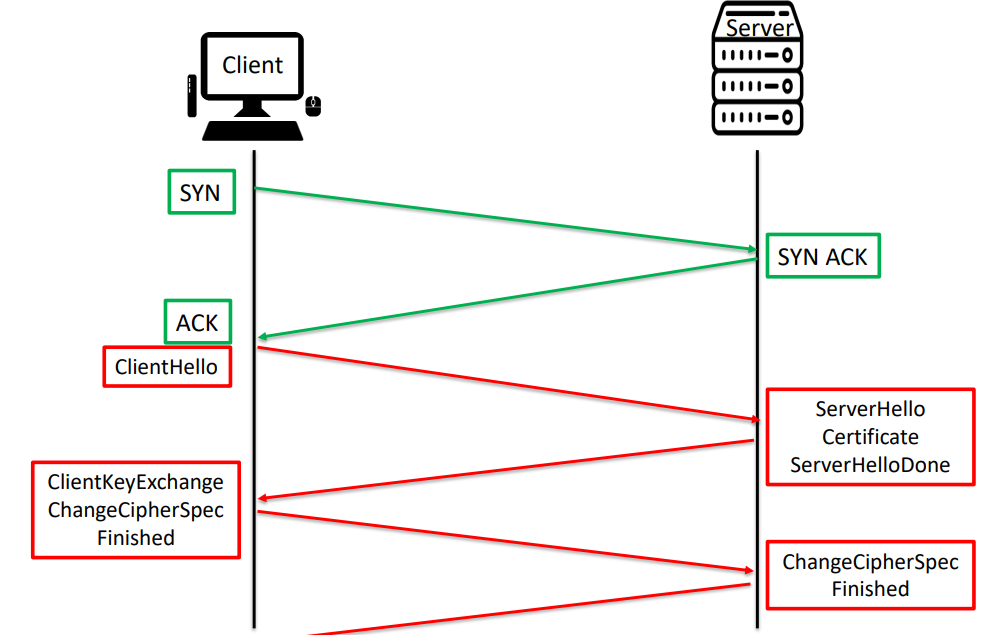
57
New cards
IPSec
* a set of protocols
* resides on network layer
* can encrypt from network layer and above
* resides on network layer
* can encrypt from network layer and above
58
New cards
ISAKMP
* part of IPSec
* establishing security associations
* procedures for
* authentication
* creation/management of SAs
* key generation/key transport techniques
* threat mitigation
* establishing security associations
* procedures for
* authentication
* creation/management of SAs
* key generation/key transport techniques
* threat mitigation
59
New cards
IPSec modes
* gateway-to-gateway
* end device-to-gateway
* gateway-to-server
* end device-to-gateway
* gateway-to-server
60
New cards
IKE
internet key exchange → provides perfect forward secrecy
61
New cards
ESP
payload encryption
62
New cards
AH
packet header encryption
63
New cards
GDPR principles
* lawfulness, fairness and transparency
* purpose limitation
* data minimisation
* accuracy
* storage limitation
* integrity and confidentiality
* accountability
* purpose limitation
* data minimisation
* accuracy
* storage limitation
* integrity and confidentiality
* accountability
64
New cards
privacy criteria
* anonymity
* pseudonymity
* unlinkability
* unobservability
* pseudonymity
* unlinkability
* unobservability
65
New cards
man-in-the-middle examples
* ARP poisoning
* port stealing
* SSL stripping
* port stealing
* SSL stripping
66
New cards
storage/memory hierarchy
* registers
* cache
* main memory
* solid-state disk
* magnetic disk
* optical disk
* magnetic tapes
* cache
* main memory
* solid-state disk
* magnetic disk
* optical disk
* magnetic tapes
67
New cards
main components of a processor
* cache memory
* control unit
* arithmetic/logic unit (ALU)
* control unit
* arithmetic/logic unit (ALU)
68
New cards
instruction set architecture (ISA)
the interface of the processor for programs running on that processor
69
New cards
operating system roles
* acts as a resource allocator
* manages all resources
* acts as a control program
* try to prevent errors and improper use of computer system
* manages all resources
* acts as a control program
* try to prevent errors and improper use of computer system
70
New cards
direct memory access (DMA)
* used by high-speed I/O devices
* direct transfer from device controller buffer’s storage to main memory region
* use of a single purpose processor
* direct transfer from device controller buffer’s storage to main memory region
* use of a single purpose processor
71
New cards
system calls
provides a programming interface to the service provided by the OS
72
New cards
system call parameter passing
* pass the parameters in registers
* parameters stored in memory and address passed as a parameter in a register
* placed/pushed onto the stack by the program and popped off the stack by the OS
* parameters stored in memory and address passed as a parameter in a register
* placed/pushed onto the stack by the program and popped off the stack by the OS
73
New cards
process
a program in execution
74
New cards
threads and processes differences
* threads share memory and resources by default
* threads are faster/more economical to create
* in older operating systems, it was much faster to context switch between threads than processes
* can have different schedulers for processes and threads
* if a single thread in a process crashes, the whole process crashes as well
* threads are faster/more economical to create
* in older operating systems, it was much faster to context switch between threads than processes
* can have different schedulers for processes and threads
* if a single thread in a process crashes, the whole process crashes as well
75
New cards
multiprogramming
have some program/process running at all times
76
New cards
time-sharing
switch among (concurrently running) processes quickly enough to give the impression of parallel execution
77
New cards
concurrency vs parallelism
* concurrency: multiple tasks make progress over time
* time-sharing system, requiring scheduling and synchronization
* parallelism: multiple tasks (threads/processes) execute at the same time
* requires multiple execution units (CPUs, CPU cores, CPU vCores, etc.)
* time-sharing system, requiring scheduling and synchronization
* parallelism: multiple tasks (threads/processes) execute at the same time
* requires multiple execution units (CPUs, CPU cores, CPU vCores, etc.)
78
New cards
process control block (PCB)
information associated with each process
* also known as process table entry
* also known as process table entry
79
New cards
process creation
parent process → child processes
* a “process tree”
* a “process tree”
80
New cards
process states
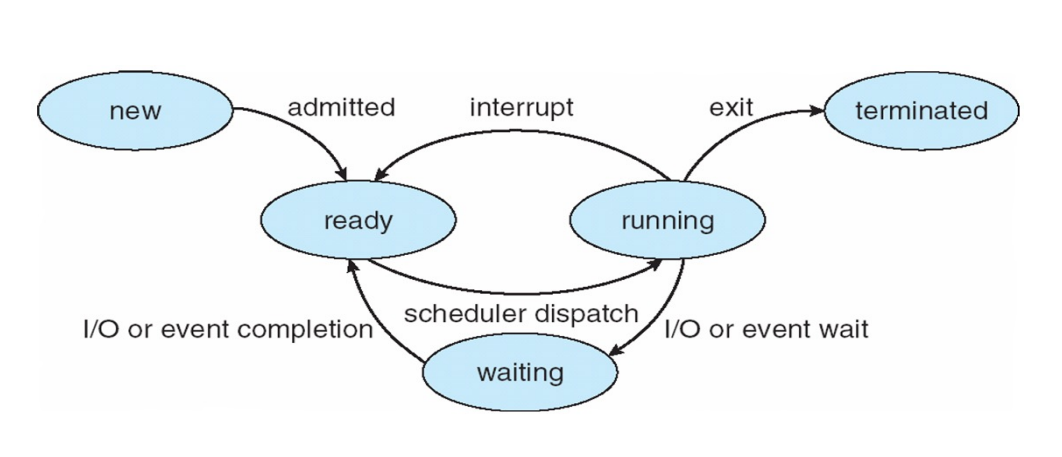
81
New cards
message passing
requires a “communication link” between communicating processes
82
New cards
direct communication
* processes must name each other explicitly (symmetric)
* or only the recipient is names (asymmetric)
* communication links are established by the OS
* exactly one link between a pair of communicating processes
* links may be unidirectional but are usually bidirectional
* or only the recipient is names (asymmetric)
* communication links are established by the OS
* exactly one link between a pair of communicating processes
* links may be unidirectional but are usually bidirectional
83
New cards
indirect communication
* messages are directed and received from mailboxes
* mailboxes are dedicated memory managed by the OS for the communication
* links between processes are established only if processes share a common mailbox
* a mailbox may be associated with many processes
* each pair of processes may share several communication links that may be unidirectional or bi-directional
* mailboxes are dedicated memory managed by the OS for the communication
* links between processes are established only if processes share a common mailbox
* a mailbox may be associated with many processes
* each pair of processes may share several communication links that may be unidirectional or bi-directional
84
New cards
synchronous communication
* blocking send → sender blocked until the message is received by the recipient
* blocking receive → receiver blocked until the message is available
* blocking receive → receiver blocked until the message is available
85
New cards
asynchronous communication
* non-blocking send → sender enqueues the message and continues operation
* non-blocking receive → receiver receives either a valid message or a null
* non-blocking receive → receiver receives either a valid message or a null
86
New cards
critical section problem
1. mutual exclusion: no two processes in their critical section at the same time
2. progress: entering one’s critical section should only be decided by its contenders in due time; a process cannot immediately re-enter its critical section if other processes are waiting for their turn
3. bounded waiting: it should be impossible for a process to wait indefinitely to enter its critical section
87
New cards
starvation
processes/threads unable to enter their critical section because of “greedy” contenders
88
New cards
livelock
special case of starvation where competing parties both try to “avoid” each other at the same time
89
New cards
priority inversion
special case where lower priority processes can keep higher priority processes waiting
90
New cards
deadlock
all parties of a group are waiting indefinitely for another party to take action (but no one can)
91
New cards
cycle of a process
CPU burst → IO burst
92
New cards
long term scheduler
loads programs into memory (turns a program into a process)
93
New cards
medium term scheduler
freezes and unloads (swaps out) a process, to be reintroduced at a later stage
94
New cards
short-term scheduler
selects which process to execute next
95
New cards
non pre-emptive scheduling
let the process give up the CPU
96
New cards
preemptive scheduling
the scheduler decides when a process yields the CPU
97
New cards
dispatcher
gives control of the CPU to the process selected by the short-term scheduler
98
New cards
dispatcher tasks
* switch context
* switch to user mode
* jump to proper instruction in the user program to continue execution
* switch to user mode
* jump to proper instruction in the user program to continue execution
99
New cards
first come first served (FCFS)
* processes are added to a queue in order of arrival
* algorithm picks the first process in the queue and executes it
* if the process needs more time to complete, it places it at the end of the queue again
* algorithm picks the first process in the queue and executes it
* if the process needs more time to complete, it places it at the end of the queue again
100
New cards
shortest job first (SJF)
* non-preemptive
* processes are added to a queue; queue is kept ordered by remaining CPU burst time
* algorithm picks the first process in the queue and executes it
* processes are added to a queue; queue is kept ordered by remaining CPU burst time
* algorithm picks the first process in the queue and executes it
 Note
Note  Flashcards (152)