wk6 urinary elimination, fluid Balance, and Assessing Intake and Output
0.0(0)
Studied by 1 person Call Kai
 Learn
Learn Practice Test
 Spaced Repetition
 Match
Match Flashcards
 Knowt Play
Card Sorting
1/31

Earn XP
Description and Tags
Last updated 3:36 PM on 2/28/23
Name | Mastery | Learn | Test | Matching | Spaced | Call with Kai | Chat |
|---|
No analytics yet
Send a link to your students to track their progress
32 Terms
1
New cards
fluid balance
maintained by ingestion, distribution, and excretion of water and electrolytes. renal system.
2
New cards
intracellular fluid (ICF)
fluids within cells; 60% of total body fluids
3
New cards
extracellular fluid (ECF)
fluid outside of cells. 3 types: interstitial, intravascular, transcellular
4
New cards
interstitial ECF
fluid bs the cells and outside the blood vessels
5
New cards
intravascular ECF
blood and plasma
6
New cards
transcellular ECF
fluid separated from another fluid by epithelium
7
New cards
osmosis
movement of water through a semipermeable membrane form an area of lesses solute concentration to one of greater concentration
8
New cards
diffusion
movement of ions + molecs across a semipermeable membrane, from area of high to low concentration
9
New cards
active transport
movement of molecules across a concentration gradient, using chemical energy
10
New cards
filtration
uses hydrostatic pressure gradien + results in 2-4L of fluid per day entering the intersitital fluid from intravascular space\`\`\`\`
11
New cards
intake
everything that goes in; regulated by thrist control
12
New cards
output
everything that we lose through the kidneys, the skin, the lungs + the gastrointestinal tract
13
New cards
sensible water loss
thing you can measure. urine + feces
14
New cards
insensible water loss
things you can’t measure. skin (sweat) + resp system
15
New cards
fluid volume deficite causes
dehydation, vomiting, decreased oral intake extreme heat, diarrhea
16
New cards
fluid volume excess
heart failure, kidney disease, IV therapy
17
New cards
calculating fluid balance
total intake (ml) - total output (ml) = fluid balance
18
New cards
pos fluid balance
excess
19
New cards
neg fluid balance
deficit
20
New cards
dysuria
pain while urination
21
New cards
polyuria
excessive urination
22
New cards
oliguria
low urine output
23
New cards
nocturia
excessive urination at night
24
New cards
hematuria
blood in the urine
25
New cards
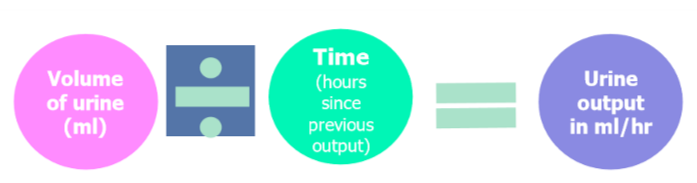
calculate adult urine output
volume of urine (ml) / time (hours since previous output) - urine output in ml/hr
26
New cards
normal adult output
greater than 30ml/hr
27
New cards
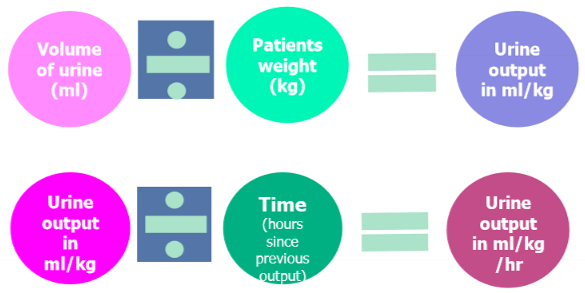
calculate pediactric urine output
vol of urine (ml) / pt wt = urine output in ml/kg
urine output in ml/kg / time (hours since prev output) = urine output in ml/kg/hour
urine output in ml/kg / time (hours since prev output) = urine output in ml/kg/hour
28
New cards
normal infant output
2 ml/kg/hr
29
New cards
normal children output
1 ml/kg/hr
30
New cards
normal adolescents output
0\.5 ml/kg/hr
31
New cards
urinalysis
can measure protein, glucose, ketones, blood, WBC, bacteria, casts
32
New cards
midstream testing
useful bc the first bit of urine that you pass may be contaminated w bacteria from the skin