Exam 3-
 Call Kai
 Learn
Learn Practice Test
 Spaced Repetition
 Match
Match Flashcards
 Knowt Play
1/76

There's no tags or description
Looks like no tags are added yet.
Name | Mastery | Learn | Test | Matching | Spaced | Call with Kai |
|---|
No analytics yet
Send a link to your students to track their progress
77 Terms
Motor hierarchy consists of the
Direct (pyramidal) pathway and Indirect (extrapyramidal) pathway
Direct (pyramidal) pathway consists of the ?
Brainstem and Spinal cord
Indirect (extrapyramidal) pathway consists of?
Basal ganglia, thalamus, cerebellum, pons
What is the Direct (pyramidal) pathway and its functions?
It is a pathway that originates at the motor cortex which then sends signals to the brainstem and spinal cord through UMN and LMN to innervate skeletal muscles to create an initiated voluntary movement and fine motor movements.
What is the Indirect (Extrapyramidal) pathway and its functions? If damaged what does it cause?
The indirect pyramidal pathway originates in the brainstem/spinal cord providing connections between various structures within/between the motor system and brainstem nuclei to refine and modulate movements initiated by the direct motor system
Its function is to modulate involuntary movements, muscle tone, balance, and posture, acting like a clutch for fluid movement
What are the motor pathways in the spinal cord?
Lateral Corticospinal tract
Anterior corticospinal tract
Rubrospinal
Tectospinal
Vestibulospinal
What are the tracts included in the pyramidal system
Corticospinal tract: Orignates in the primary motor cortex with axons extending down to the spinal cord
Corticobulbar tract: UMNs originate in the face/head area of the motor cortex and travel to the brainstem synapsing into the motor cranial nerve nuclei
Where does the Corticospinal tract originate? What is its innervation pattern?
Originates in the primary motor cortex with its upper motor neurons extending down to synapse to the cell bodies of LMNs in spinal cord and its innervation pattern is primarily contralateral
What is the origination of the corticobulbar tract? What is its innervation pattern?
Upper motor neurons that originate in the face/head area of the motor cortex travel down to the brainstem where they synapse into the motor cranial nerve nuclei making its innervation pattern mostly bilateral.
What occurs at the level of the medulla in the corticospinal tract after axons extends from the motor cortex and bundles to form internal capsules
Lateral and anterior corticospinal tracts separate
What is the function, decussation, origination and termination of the lateral corticospinal tract?
voluntary motor control, specifically governing fine, dexterous movements of the distal limbs, such as finger and hand manipulation
After axons decussate at the level of the medulla
It then innervates the limbs and has the motor control of the arms/ legs, hands/feet
Axons extending from the left motor cortex would cross over to the right in the medulla
It will continue descending down the lateral portion of the spinal cord
Then UMNs terminate and synapse onto the cell bodies of the LMNs in the ventral horn of the spinal cord
The axons of the LMNs then exit the spinal cord and make up the motor component of the spinal nerve
LMNs then end at the neuromuscular junction and synapse with muscles
What is the function, decussation, origination and termination of the anterior corticospinal tract?
Controlling voluntary movement of proximal muscles, particularly in the trunk and axial skeleton
Separates from lateral corticospinal tract in the caudal medulla
Then innervates the trunk for motor control of the trunk, axial/girdle muscles
It remains ipsilateral before synapsing on LMNs and provide bilateral innervation (fibers crossing over at each lvl synapsing on a LMN)
UMNs synapse on LMNs in the anterior and ventral spinal cord
Maps of somatotopy of the trunk portion in the motor strip homunculus to the body
What is the function, decussation, origination and output/input of the Rubrospinal tract?
It provides a fraction of controlled fine motor movements in the fingers and hands
Inputs come from the frontal cortex
Outputs to the LMNs to arms and legs
What is the function, decussation, origination and output/input of the Tectospinal tract?
The head turner track! It influences voluntary motor movement of the neck, trunk, and shoulders while also orienting eye and head to any external stimuli
Receives information from visual and auditory-vestibular systems (super/inferior colliculi)
Outputs to trunk
What is the function, decussation, origination and inputs of the Vestibulospinal tract balance?
It is voluntary control by balancing the head and help support an upright, and balanced posture
Lateral vestibulospinal provides inputs to extensor muscles in legs
Medial vestibulospinal provides inputs to neck and upper back
What is the function, decussation, origination and where it arises and output of the Reticulospinal tract?
Assists with upright posture and influences respiration, heart rate and blood circulation
Arises from the reticular formation
Outputs to extensor leg muscles and spinal reflexive circuits
Connections with autonomic nervous system to influence respiration, heart rate and blood circulation
What happens at the neuromuscular junction?
When a muscle contracts a synapse with the LMN and muscle fibers happens creating an electrical current that moves down to the lower motor neuron triggering a release of acetylcholine
Explain the reflex arc
An outside stimuli is detected (pain, heat) this stimuli transmits as an impulse to the spinal cord through a sensory nerve, which then connects with a motor neuron transmitting impulse to muscles or gland in response to the outside stimuli
UMN damage causes?
Weakness
Hyperactive reflexes
Increased tone
No atrophy
No fasciculations
Spasticity present= Meaning that their is increased tone and hyperactive reflexes making it to tight to respond
Speech impairments= Spastic dysarthria
LMN damage causes?
Weakness
Hypoactive reflexes= Barely almost No reflexes
Decreased tone= Example used in class is baby’s loose flabby skin
Atrophy present= wasting, shrinkage, loss of muscle tissue
Fasciculations present= Flickering like involuntary twitches of muscles
Flaccidity present= hypoactive and decreased tone
Speech impairments= Tongue atrophy and fasciculations
What happens at the neuromuscular junction?
A synapse between the LMN and muscle fibers where the release of acetylcholine happens creating a bind of muscle fibers and muscles itself to form a contraction
What is the function, decussation, origination and termination of the Corticobulbar tract?
Innervates CN nuclei- motor function ONLY
Cell bodies start at the UMN and are in the motor cortex
Those UMN move down in the brainstem synapse with cranial nerve nuclei
Most cranial nerve motor nuclei get bilateral innervation but may be asymmetrical
What is the difference in UMN and LMN lesions in the facial muscles?
UMN= Bilateral innervation of the upper face and Contralateral innervation of the lower face
LMN= remains ipsilateral
What does cerebral palsy impact? What damage is most common?
Can impact the pyramidal, extrapyramidal or both systems and damage most common is Spastic (most common), dyskinetic, ataxic and mixed
What does Amyotrophic Lateral Sclerosis (ALS) impact and how does it commence? What do SLPs do to treat?
ALS impacts UMN and LMN and can commence in the muscles of the limbs or the muscles of speech and swallowing. SLPs work to support speech that include augmented communication, and swallowing
What does Primary lateral sclerosis impact and cause?
Impacts UMN and it is a progressive neurogenerative diesease that causes muscle stiffness, weakness, and balance issues
What is Corticobasal degeneration? What is the cause and when is it present ?
It is a progressive neurodegenerative disease that causes atrophy of the cerebral cortex and basal ganglia causing severe motor, cognitive and speech/language dysfunction. Usually present between ages 50-70 first signs being clumsy limbs
The basal ganglia is part of what system?
The extrapyramidal system that focuses on refining and modulating volitional movement while also controlling involuntary movements
What is the basal ganglia’s function?
Its function is to refine voluntary movements while suppressing unwanted or competed. It is also involved in cognition and language processing
List the symptoms of basal ganglia damage and provide descriptions of each.
Involuntary movement
Slowness of movement
Difficulty initiating movement
Too little or much movement
Stiffness in muscles
Involuntary muscle contractions
What is the function of the Striatum (caudate + putamen)
It receives input from the brainstem, thalamus, and the cortex
What is the function of the globus pallidus internal and the substantia nigra pars reticulata?
They are major outputs from the basal ganglia by sending signals to the thalamus, brainstem, frontal lobes, and cerebellum.
What are the structures of the basal ganglia?
Straitum= caudate nucleus, putamen
Globus Pallidus= Internal and external
Subthalamic nucleus
Substantia nigra= consists of the pars compacta (dopamine) and Pars reticulata (GABA)
Thalamus
Substantia nigra pars reticulata
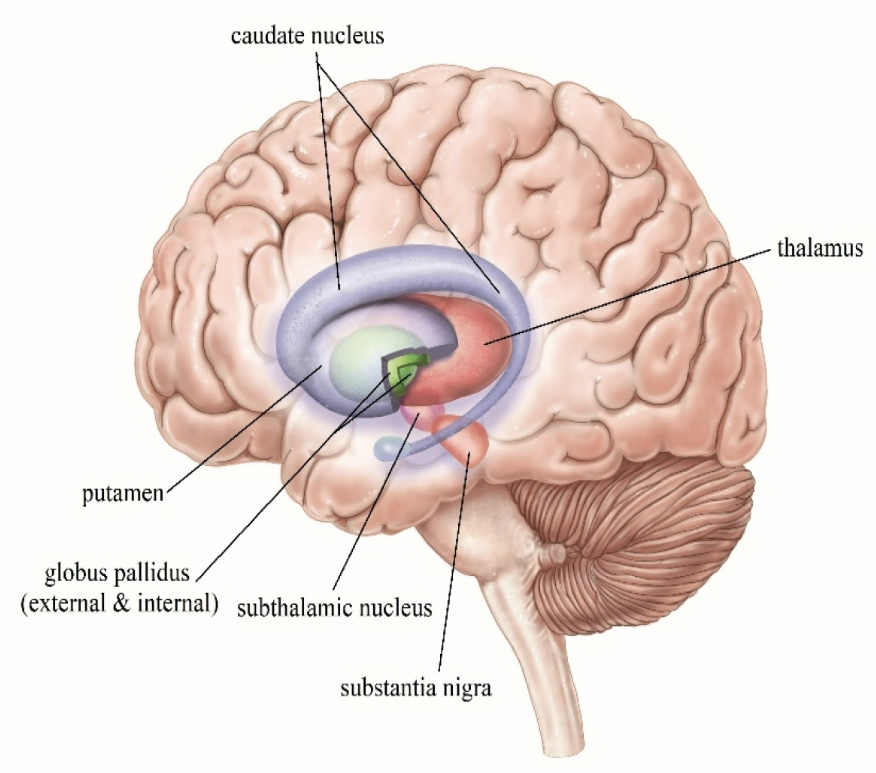
What is the difference between direct and indirect circuits?
The direct circuit facilitates signals and movement via the primary motor cortex while the indirect circuit inhibits or dampens signals which results in inhibition of movement to suppress unwanted movements
Describe the process direct circuits go through to facilitate or enhance motor signals
First the motor cortex sends excitatory signals to the striatum excite it
Then the excited striatum inhibits via GABA the globus pallidus internal and substantia nigra
Since globus pallidus internal and substantia nigra are inhibited now they cant inhibit the thalamus, to allow movement facilitation rather then inhibiting it
The thalamus sends excitatory signals to the motor cortex for movement facilitation.
What is the function of the indirect circuit?
Motor cortex sends excitatory signals to the striatum to excite it
The excited striatum then fires actions potentials that causes the release of an inhibitory neurotransmitter causing an inhibition of the globus pallidus external
The inhibited globus pallidues external can not inhibit the subthalamic nucleus
The subthalamic nucleus then excites the globus pallidus internal and the substantia nigra
Both the globus pallidus internal and the substantia nigra then inhibit the thalamus
Since thalamus is already inhibited it cannot send signals that excite the motor cortex for movement facilitation or enhancement of movement
Therefore the thalamus sends sends to the motor cortex that is dampened movement or inhibited
What are the types of involuntary movement or changes in movements caused by damage to the basal ganglia
Dyskinesia (includes sub categories: Chorea, athetosis, ballism, tremor)
Bradykinesia
Akinesia
Rigidity
Hypokinesia
Hyperkinesia
Dystonia
What is Dyskinesia and what are its subcategories?
Dyskinesia is an involuntary movement disorder and its subcategories are…
Chorea
Athetosis
Ballism
Tremor
What is chorea?
An involuntary rhythmic and quick movement disorder of the muscles and proximal extremities
What is Athetosis?
A slow twisting movement disorder of the upper extremities
What is Ballism?
Wild swinging movement disorder
What is a tremor?
Rhythmic small movement disorder
Define Bradykinesia
Slowness of movement
Define Akinesia
Difficulty initiating movement
Define Rigidity
Stiffnes in the muscles
Define Hypokinesia
Too little movement, usually small amplitude movements that happen quickly
Define hyperkinesia
Too much movement
Define Dystonia
Involuntary muscle contractions that cause repetitive, twisting, or abnormal postures
What is Parkinson’s disease?
A disease that results from degeneration of the substantia nigrea that reduces dopamine causing too much and not enough movement usually diagnosed by age 50 and up with a long life expectancy of 10-20 or more years.
What is Parkinson’s disease characterized by?
akinesia, bradykinesia, hypokinesia and “pill-rolling” tremor, masked face, reduced involuntary movements
What is huntington’s disease?
A rare genetic neurodegenerative disease characterized by involuntary “chorea” type movements, trouble with thinking, and planning, and mental health symptoms with a typical onset of 30-40 years and a life expectancy of 15-20 years after diagnosis.
What is the function of the cerebellum?
Targeting, smooth tracking and coordination; is applied to movements of the eyes, trunk, limbs, speech, swallowing
What are the parts of the cerebellum?
Vestibulocerebellum
Spinocerebellum
Cerebrocerebellum
Cerebellar Peduncles
What is the function of the Vestibulocerebellum and what does it contain?
It is connected to the vestibular and visual nuclei in the brainstem to control balance, head coordination, vestibular reflexes, and eye movements that contribute to initiation, planning, and timing of movements.
What does the Spinocerebellum consist of? what is its function?
The spinocerebellum consist of the vermis and intermediate regions. Its function is to receive somatosensory and propropceptive info from the spinal cord.
Function of the vermis?
Visual, auditory, vestibular, and somatosensory inputs to control posture, locomotion, and eye movements
Function of the intermediate regions?
Receive signals from distal limbs and digits. primarily concerned with the control of distal muscles—those responsible for precise movements of the hands and feet.
What does the cerebrocerebellum include? What is its function?
Includes lateral portions of the cerebellar hemispheres
Its function it to receive input from the cerebral cortex
Then sends output to the cerebral hemispheres (premotor, motor, and prefrontal areas.
These signals then influence movement planning, programming, timing, and execution.
This region also has control over the influences of cognitive processing of time (judging time) and influences working memory, social cognition, and language
The cerebellar peduncles contain 3 pairs of what? What is its function?
The cerebellar peduncles contain 3 pairs listed and called as follows;
Inferior peduncle
Middle peduncle
Superior cerebellar
It has both afferent and efferent fibers traveling to and from the cerebellum pass through one of the cerebellar peduncles.
Afferent= inferior and middle peduncles
Efferent= superior peduncle
Explain the circuits of the cerebellum
Circuits influence the sequence and timing of muscle coordination while also contributing to motor learning. The connections between the circuits provide comparisons about intended movements and actual movements.
Explain motor learning of the cerebellum
The cerebellum is active in motor learning and it begins with conscious control of skilled movement. After repeating the same skilled movement sensorimotor adjustment occurs requiring less conscious regulation.
Example: Your UNCG login, what happens after changing?
What happens to a patient who losses the ability to motor learn?
Patients with cerebellar pathologies often lose movement automaticity and require more conscious control of movement
What fibers does the cerebellum consist of?
Parallel fibers
Mossy fibers
Climbing Fibers
Function of the parallel fibers
They are granule cells in the most superficial layer
Function of the mossy fibers
Carryout learned movements (e.g., riding a bike, playing a piano)
Function of the climbing fibers
Provides inputs to Purkinje cells, either sensory from the body or from motor cortex and are important for motor learning
What cells does the cerebellum consist of?
Granule cells
Purkinje cells
What is Purkinje cells?
A broad but flat shape that is stacked like dominos and connected by parallel fibers. They also control cerebellar outputs and movement refinement.
What is granule cells?
receive inputs to the cerebellum
What are the types of cerebellum damage
Hypotonia
atasia
abasia
ataxia
action or intention tremor
nystagmus
What is hypotonia?
Reduced muscle tone
What is atasia?
Lack of coordination of limb and body postures across joints (difficulty walking)
What is abasia?
Inability to maintain upright body posture agaisnt force of gravity (difficulty standing)
What is ataxia?
Uncoordinated movements with Dysmetria (impaired targetting of movements) and dysdiadochokinesis (impaired alternating of movements)
What is action or intention tremor?
Tremor at the end of movements; corresponds with impaired smooth tracking of movements
What is nystagmus?
Irregular, beat like movement of the eyes (can be lateral or vertical)
The corticobulbar tract primarily innervates motor nuclei of cranial nerves such as ?
V (#5 Trigeminal), VII (#7 Facial), IX (#9 Glossopharyngeal), X (#10 Vagus), XI (#11 Accessory), and XII (#12 Hypoglossal)

