1.1 - The Nature of Economics
 Studied by 0 people
 Call Kai
 Learn
Learn Practice Test
 Spaced Repetition
 Match
Match Flashcards
 Knowt Play
1/20

There's no tags or description
Looks like no tags are added yet.
Name | Mastery | Learn | Test | Matching | Spaced | Call with Kai |
|---|
No analytics yet
Send a link to your students to track their progress
21 Terms
difference between positive and normative statements
- A positive statement is one that is factual and objective whereas normative statements are subjective statements which cannot be empirically proven
what are value judgments?
- Value judgments influence individuals choices in the economic decision
- they influence governments choices with regards to the economic policies they choose to adopt and spend money on
what is the basic economic problem?
- resources are scarce but might have infinite want
- economics is used as a tool when choosing between competing demands placed on available resources, however, with an opportunity cost
what is the opportunity cost?
the loss of potential gain from other alternatives when one alternative is chosen.
e.g. if someone buys a phone and cannot afford jeans as a result, the opportunity cost are the jeans
definition of renewable resources
- natural resources that can be replenished or regenerated over a relatively short period of time
definition of non-renewable resources
- Non-renewable resources are natural resources that are available in limited quantities
- Cannot be replenished within a human lifespan once they are used up.
- These resources take millions of years to form.
what is a production possibility frontier?
- an economic model that considers the maximum possible production (output) that a country can generate if it uses all of its factors of production efficiently to produce only two goods and services
what does a ppf graph look like?
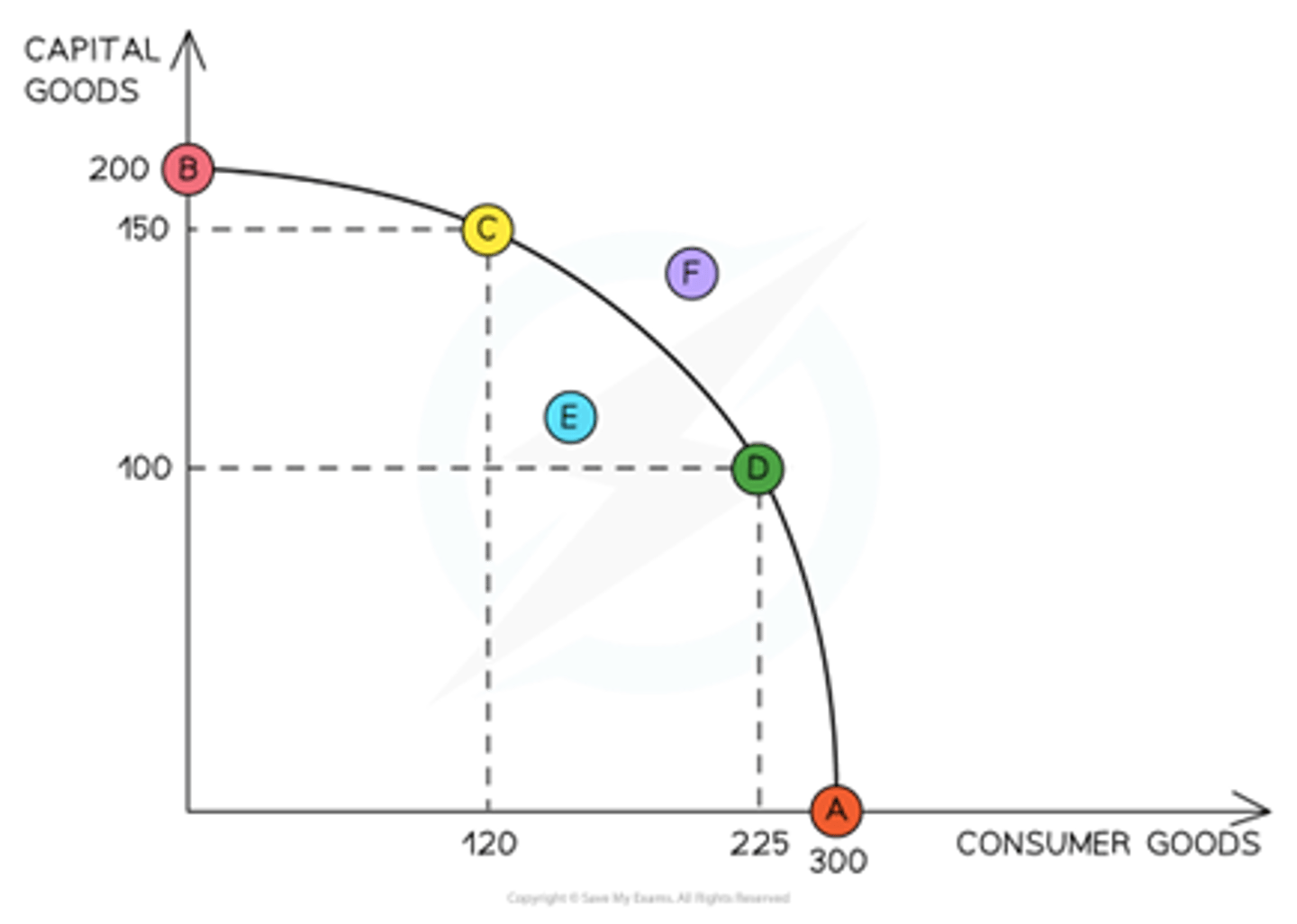
what does it mean if a point is on the curve
- full use of an economy's resources with productive efficiency
what does a point inside the curve represent?
- inefficiency
what does a point outside the curve represent?
- unattainable
how will a shift occur?
- due to economic growth e.g. the quality of an economy. More consumer and capital goods can be produced using all of the available resources
two ways in which economic growth can occur?
- specialisation or division of labour
what is a capital good?
- Capital goods are assets that help a firm or nation to produce output (manufacturing). For example, a robotic arm in a car manufacturing company is a capital good
what is a consumer good?
Consumer goods are end products and have no future productive use. For example, a watch
Why is Adam Smith relevant to this?
- published 'Wealth of Nations'
relevance of book, what were the findings?
- studying a pin factory he found that when workers completed all of the tasks involved in producing each pin independently, output was low.
- By splitting the production into a number of different tasks, and allocating each task to a different worker, more could be produced.
- IE he divided the labour - gave each worker a specialised job to do
- Workers developed greater skill in performing their particular task with the use of specialist tools designed just for that task, therefore leading to less wastage of materials and less time spent on their task.
advantages of specialisation and division in production
- Higher labour productivity lowers cost/unit for firms
- Lower cost/unit can be passed on to consumers in the form of lower prices
- Lower cost/unit can mean higher profits for the firms. This may lead to higher wages for workers
- increased productivity allows for selling international markets aswell
- creates many low skilled jobs
disadvantages of specialisation and division in production
- Task repetition often leads to boredom and a decrease in worker motivation
- A decrease in motivation may lead to less productivity and/or poorer manufacturing quality
- It may increase worker turnover rates as workers look to move on to a role that is more stimulating
- Mass produced products often lack variety and do not take different consumer preferences into account
- If workers lose their jobs, then it may be hard for them to find work as they are only trained in one skill
disadvantages of specialisation and division in trade
· Higher labour productivity lowers cost/unit for firms, which makes their goods more competitive internationally (exports)
· Increased exports can result in economic growth for the nation
· Economic growth usually leads to higher income and a better standard of living
· Income gained from exports can be used to purchase other goods from around the world (imports). This increases the variety of goods available in a country
advantages of specialisation and division in trade
- · International trade is beneficial for the firms that can compete globally. However, some industries will be unable to compete and will go out of business
· Many firms in an entire industry may close, leading to structural unemployment
· Specialisation may create over-dependency on other countries' resources. This may cause problems if conflict arises (For example, Europe's reliance on Russian natural gas during the Ukraine crisis)
· Specialisation using a country's own resources will lead to resource depletion over time. Specialisation will increase the rate of resource depletion

