1.5 Growths and Evolution
 Call Kai
 Learn
Learn Practice Test
 Spaced Repetition
 Match
Match Flashcards
 Knowt Play
1/43

There's no tags or description
Looks like no tags are added yet.
Name | Mastery | Learn | Test | Matching | Spaced | Call with Kai |
|---|
No analytics yet
Send a link to your students to track their progress
44 Terms
Economies of scale
When average costs of production decrease as a business increases the size of its operation and itself becomes bigger
Diseconomies of scale
When the average cost per unit increases and the efficiency lowers as a business increases the size of its operation and itself becomes bigger
Internal economies of scale
When the average cost per unit decreases as a business grow by increasing the size of its operation.
External economies of scale
When the average cost per unit decreases as a business grows due to the industry or the market grows.
Types of internal economies of scale
Technical, Financial, Managerial, Specialization, Marketing, Purchasing
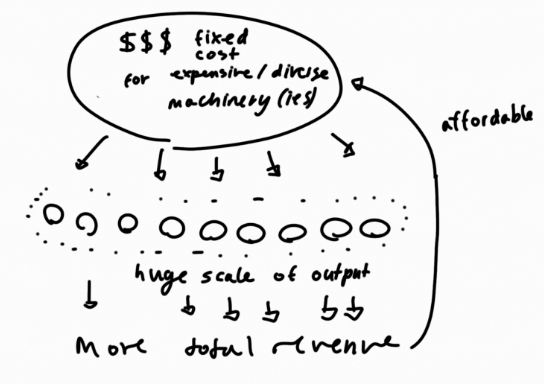
Technical internal economies of scale
The high fixed costs of the technological equipment and machinery are spread over the huge scale of output
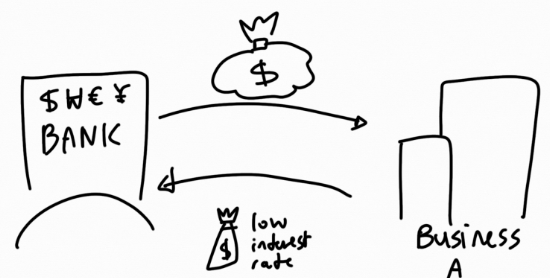
Financial internal economies of scale
Large firms can borrow large sums of money at lower interest rates because they are seen as less risky financiers
Managerial internal economies of scale
Large firms divide managerial roles by employing specialist managers. This results in a fall in average costs due to higher productivity
Specialization internal economies of scale
By using mass production techniques, specialists are responsible for a single part of the production process. This results in the fall of average costs and high quality due to higher productivity and a skilled workforce.
Marketing economies of scale
Large firms can also spread the high costs of advertising by using the same marketing campaign across the world. No need to do more.
Purchasing economies of scale
Large firms benefit from buying resources in bulk through discounts.
Risk-bearing economies of scale
Conglomerates can spread fixed costs across a wide range of business operations. Unfavorable trading conditions for some products can be offset by more favorable trading conditions for their other products.
Types of internal diseconomies of scale
Lack of control and coordination, difficult communication, bureaucracy
Types of external economies of scale
Technological progress, abundance of skilled labor, improved transportation network, regional specialization
Technological progress
Technological innovations increase productivity within an industry, with significant cost savings
Improved transportation network
Import raw materials and finished goods that have been manufactured at much lower costs.
Increased convenience for faster deliveries at lower costs.
Abundance of skilled labor
Local businesses benefit from this by having a suitable pool of educated and trained labor. This reduces the costs of recruitment and training
Regional specialization
Firms in those locations benefit from having access to specialist labor, sub-contractors, and suppliers.. They are also able to change the premium price for their products.
Types of external diseconomies of scale
Higher rents, Local market conditions for pay and financial rewards, Traffic congestion, Context-specific problems
Internal growth
To grow the business (increasing the scale of its operations and sales revenue) by expanding its existing operations, using their own capabilities and resource; Try to grow sales of its existing products in its existing markets, Develop new products for its customers
Purpose of internal growth
To foster brand awareness and brand loyalty
To increase market share
To maintain its corporate culture
To maintain ownership and control of the organization
To avoid the comparatively high expenses and risks associated with external growth.
Examples of internal growth
Developing new products, opening new stores, increasing production scale, entering new markets
Pros of internal growth
Easier to control and coordinate
Long-lasting growth
Less risky
Cons of internal growth
Slow method of growth, requires significant amount of time and resources , the existing market may be reluctant
External growth
This occurs through dealing with outside organizations. Such growth usually comes in the form of alliances or mergers with other firms or through the acquisition of other businesses.
Purpose of external growth
To grow at a faster pace
To diversify their product portfolio
To gain market share
To gain customers in new and existing markets
To reduce competition in the industry.
Pros of external growth
Faster method of growth, access new markets, easily increase market share, gain new expertise and capabilities
Cons of external growth
Very expensive, integration difficulties, less control and greater risk of conflict

Mergers
One new company with its own legal identity created from a union of two existing companies under an agreement

Acquisitions
Consolidation or merger after a transaction in which one business buys a controlling share in another firm with the permission and agreements of its board of directors

Takeover
Consolidation or mergers that are caused when a company purchases a controlling stake in another company without the permission and agreement of the company or board of directors
Advantages of M&A and turnovers
Greater market share, economies of scale, synergy, survival, diversification, gain entry into new markets
Disadvantages of M&A and turnovers
Culture clash, loss of control, diseconomies of scale, regulatory problems
Joint ventures
A commercial enterprise with a separate legal entity that occurs when two or more businesses agree to accomplish a specific task. The costs, risks, control, and rewards of its business projects are split
Strategic alliances
An arrangement between two or more businesses to undertake a mutually beneficial project while each retains its independence.
Advantages of JVs and SAs
Synergy, spreading costs and risks, entry to new/foreign markets - exploitation of local knowledge
Disadvantages of JVs and SAs
Rely heavily on good will and resources of their counterparts, enormous expenditure on brand development, possible culture clashes
Franchising
A form of business ownership whereby a person or business buys a license to trade using another firm's name, logos, brands, and trademarks
Franchisor
The firm selling the right to the product in return for an initial fee and a percentage of the franchisee's turnover
Franchisee
The entrepreneur buying the right to the name and the systems used by the franchisor. E.g. materials, training methods
Advantages of franchising
Less risky than setting up a completely new business - a proven method
Support of the franchisor for decisions e.g. pricing, choosing suppliers, and planning ahead
More bargaining power against the franchisor as a group of franchisees
Disadvantages of franchising
Costs money to buy the right
Linked to another franchisee for brand reputation. One bad apple spoils the bunch.
Not free from deciding what to sell, or how to promote.
Reasons for business to grow
economies of scale, sources of finance, recruitment and retention of finance, brand awareness and brand loyalty, spreading risks
Reasons for business to stay small
Cost control, Operational control, financial risks, attracts less attention (publicity, rivalry), flexibility, personalization

