Test 2
0.0(0)
Studied by 2 people Call Kai
 Learn
Learn Practice Test
 Spaced Repetition
 Match
Match Flashcards
 Knowt Play
Card Sorting
1/174

Earn XP
Description and Tags
Last updated 6:42 AM on 2/28/23
Name | Mastery | Learn | Test | Matching | Spaced | Call with Kai | Chat |
|---|
No analytics yet
Send a link to your students to track their progress
175 Terms
1
New cards
What are the primary differences between the autonomic and somatic divisions?
somatic controls skeletal muscles and is mostly voluntary
autonomic controls smooth and cardiac muscle, many glands, and some adipose tissue and is mainly involuntary
autonomic controls smooth and cardiac muscle, many glands, and some adipose tissue and is mainly involuntary
2
New cards
What is antagonistic control?
one autonomic branch is excitatory and another is inhibitory
3
New cards
What are the exceptions to antagonistic control in the autonomic nervous system?
smooth muscle in most blood cells always have some tension and sweat glands always sweat a little
4
New cards
cooperative control
work on different tissues to achieve a common goal
ex. erection (parasympathetic) and ejaculation (sympathetic)
ex. erection (parasympathetic) and ejaculation (sympathetic)
5
New cards
What are the primary differences in the sympathetic and parasympathetic branches?
sympathetic is fight or flight while parasympathetic is rest and digest
sympathetic originates at the thoracic and lumbar regions of the spinal cord while parasympathetic originates in the brain stem and leaves the brain through cranial nerves
sympathetic originates at the thoracic and lumbar regions of the spinal cord while parasympathetic originates in the brain stem and leaves the brain through cranial nerves
6
New cards
What is the central integration location for autonomic control?
hypothalamus, spinal cord, brain stem (pons, medulla)
7
New cards
Where do the primary stimuli come from?
sensory input from somatosensory and visceral receptors
8
New cards
What are the primary responses?
autonomic, endocrine, behavioral responses
9
New cards
What neurotransmitters does the sympathetic branch use?
ACh (acetylcholine) and norepinephrine
10
New cards
What neurotransmitters does the parasympathetic branch use?
ACh (acetylcholine)
11
New cards
What is the difference between muscarinic and nicotinic receptors?
muscarinic are receptive to muscarine and nicotinic and receptive to nicotine
12
New cards
varicosity
swelling at the end of postganglionic neuron; like a net thrown over all receptors, efficient way of getting large area to react at same time
13
New cards
Where do we find varicosities?
found in neuroeffector junction
14
New cards
How do varicosities differ from synaptic clefts?
synaptic cleft is a gap that neurotransmitters diffuse across while varicosities are a net that dumps out neurotransmitters on multiple receptors at the same time
15
New cards
What occurs if we administer alpha beta agonists?
stimulate receptors, increase heart rate and force of contractions, increase blood pressure
16
New cards
What occurs if we administer alpha beta antagonists/blockers?
decrease heart rate and force of contractions; prevent norepinephrine from creating contractions; lower blood pressure
17
New cards
What occurs if we administer muscarinic and nicotinic agonists?
causes bronchoconstriction, increases mucus, increases blood pressure, increases smooth muscle tone
18
New cards
What occurs if we administer muscarinic and nicotinic antagonists?
block synaptic transmission, bronchodilators (used to treat COPD)
19
New cards
What is special about the adrenal medulla (in terms of tissue type)?
neuroendocrine tissue (not true hormonal tissue); innervated by preganglionic fibers; secretes epinephrine into the blood
20
New cards
How is epinephrine released into circulation?
adrenal medulla secretes epinephrine into the blood
spinal cord to preganglionic neuron to adrenal medulla ACh bonds to chromaffin cell (postganglionic) and epinephrine enters blood and blood vessels go to target tissues
spinal cord to preganglionic neuron to adrenal medulla ACh bonds to chromaffin cell (postganglionic) and epinephrine enters blood and blood vessels go to target tissues
21
New cards
How does the efferent pathway of somatic motor neurons differ from autonomic motor neurons?
somatic motor consists of one neuron that is myelinated, long, and excitatory, terminal branches close to target and each terminal innervated and single skeletal muscle fiber
autonomic motor has two efferent neurons and two branches (symp. and parasymp.), it uses a variety of chemical/electrical signals to target smooth and cardiac muscle and glands
autonomic motor has two efferent neurons and two branches (symp. and parasymp.), it uses a variety of chemical/electrical signals to target smooth and cardiac muscle and glands
22
New cards
Why is acetylcholinesterase so important?
terminates neuronal transmission and signaling to prevent ACh dispersal; inhibits/stops movement; breaks down acetylcholine is synapses
23
New cards
acetylcholine
neurotransmitter used by neurons of CNS and PNS
24
New cards
adrenergic
receptor pertaining to epinephrine or norepinephrine
25
New cards
afferent pathway
pathway that connects receptors to integrating center
26
New cards
efferent pathway
outgoing signal that goes from integrating center to an effector
27
New cards
ganglion
cluster of nerve cell bodies in PNS
28
New cards
motor
control skeletal muscles
29
New cards
motor endplate
on postsynaptic side of neuromuscular junction, muscle cell membrane that lies opposite to axon terminal; series of folds that look like shallow gutters
30
New cards
muscarinic
subtype of cholinergic receptor
31
New cards
nicotinic
nicotine is agonist; cholinergic receptor
32
New cards
neuromuscular junction
synapse of somatic motor neuron and skeletal muscle fiber
33
New cards
postganglionic neuron
autonomic neuron that has its cell body in ganglion and sends axon to target tissue
34
New cards
preganglionic neuron
autonomic neuron that originates in CNS and terminates in an autonomic ganglion
35
New cards
What are the 3 different types of muscles?
skeletal, smooth, cardiac
36
New cards
skeletal muscle
striated, attached to bones, control body movement, voluntary, respond to somatic motor neurons
37
New cards
smooth muscle
internal organs and tubes, involuntary, movement into and out of and within body, respond to autonomic innervation, spontaneous contraction, modulated by endocrine system
38
New cards
cardiac muscle
striated, only in heart, move blood, involuntary, respond to autonomic innervation, spontaneous contraction, modulated by endocrine system
39
New cards
What is muscle antagonism?
move in opposite directions
40
New cards
structure of skeletal muscle
muscle cells are muscle fibers (long and cylindrical, fused cells with many nuclei), fibers bundled together into fascicles surrounded by CT sheath, CT surrounds entire muscle (fascia; continuous with CT sheath, holds muscle to bone with tendon)
41
New cards
organization of sarcomere
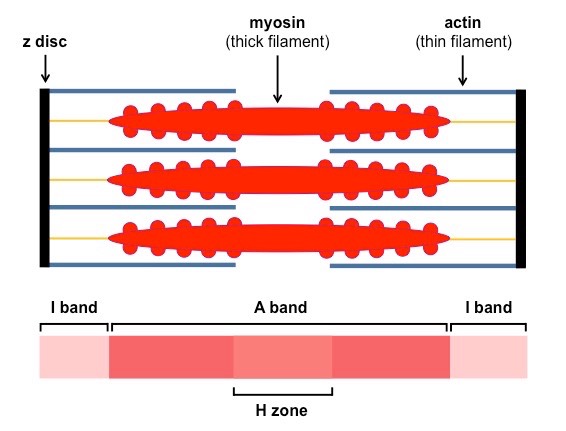
42
New cards
sliding filament theory
overlapping actin and myosin myofibrils slide past each other in energy dependent process
describes mechanism that allows muscles to contract
myosin binds to actin, myosin alters its configuration resulting in a stroke that pulls on actin and causes it to slide across myosin filament
describes mechanism that allows muscles to contract
myosin binds to actin, myosin alters its configuration resulting in a stroke that pulls on actin and causes it to slide across myosin filament
43
New cards
How does muscle cross bridging work?
as active muscle lengthens/shortens and filaments slide, cross bridges detach and reattach to new positions
powerstroke repeated multiple times
move actin filaments
powerstroke repeated multiple times
move actin filaments
44
New cards
powerstroke
myosin cross-bridge swivels and pulls actin toward M-line (sarcomere shortens)
movement of mysoin head that is basis for muscle contraction
movement of mysoin head that is basis for muscle contraction
45
New cards
end of powerstroke
myosin releases actin and resets and binds to another actin (heads are not released in unison)
46
New cards
Explain excitation contraction coupling
somatic motor neuron releases ACh at neuromuscular junction; net entry of Na+ through ACh receptor channel initiates a muscle action potential; action potential in T-tubule alters conformation of DHP receptor; DHP receptor opens RyR Ca2+ release channels in sarcoplasmic reticulum and Ca2+ enters cytoplasm; Ca2+ binds to troponin allowing myosin-actin binding; myosin heads execute powerstroke; actin filaments slide toward center of sarcomere
47
New cards
explain contraction-relaxation cycle
muscle twitch is a single cycle; can be summed
sarcoplasmic reticulum Ca2+ -ATPase pumps Ca2+ back into SR; decrease in free cytosolic (Ca2+) causes Ca2+ to unbind from troponin; tropomyosin recovers binding site; when myosin heads release elastic elements pull filaments back to relaxed position
contraction: muscle generating tension
relaxation: muscle returning to normal length
sarcoplasmic reticulum Ca2+ -ATPase pumps Ca2+ back into SR; decrease in free cytosolic (Ca2+) causes Ca2+ to unbind from troponin; tropomyosin recovers binding site; when myosin heads release elastic elements pull filaments back to relaxed position
contraction: muscle generating tension
relaxation: muscle returning to normal length
48
New cards
What actions required for skeletal muscle contraction require ATP?
1. ATP hydrolysis provides energy for myosin head to rotate and reattach to actin
2. ATP powers pump that transports Ca2+ from cytosol back into SR
1. ATP binding to myosin causes detachment from actin after powerstroke
49
New cards
What path does a signal take (how does a signal for muscle contraction go from CNS to sarcomere)?
CNS to action potential along motor neuron to neuromuscular junction to excitation-contraction coupling to muscle twitch
50
New cards
How is calcium removed from the cytosol?
sarcoplasmic Ca2+ -ATPase pumps Ca2+ back into SR
51
New cards
What are the 3 energy systems for muscle contraction?
phosphocreatine, anaerobic glycolysis, aerobic respiration
52
New cards
phosphocreatine
produces short burst of energy by breaking down, muscle molecule that stores energy in high-energy phosphate bonds
53
New cards
anaerobic glycolysis
produces lactate and acid, quick, no oxygen required, small amount of energy released
54
New cards
aerobic respiration
citric acid cycle and electron transport chain, slow, oxygen required, large amount of energy released
55
New cards
How does phosphocreatine renew ATP?
breakdown of phosphocreatine produces a short energy burst
56
New cards
What is the difference between central and peripheral fatigue and what are causes for both?
central fatigue is due to CNS, giving up; chemoreceptors release when something is working to hard
peripheral fatigue is due to neuron or muscle; extended submaximal exercise leads to depletion of glycogen stores; short-duration maximal exertion leads to increased levels of phosphate buildup; maximal exercise leads to ion imbalances
peripheral fatigue is due to neuron or muscle; extended submaximal exercise leads to depletion of glycogen stores; short-duration maximal exertion leads to increased levels of phosphate buildup; maximal exercise leads to ion imbalances
57
New cards
What are the different types of muscle fibers?
type 1 (slow-twitch), type 2 (fast-twitch) (fast-twitch oxidative-glycolytic fiber and fast-twitch glycolytic fibers)
58
New cards
type 1 (slow-twitch) fibers
rely primarily on oxidative phosphorylation (lots of capillaries, mitochondria, oxygen, myoglobin), have low ATPase activity, high oxidative and low glycolytic capacity, relatively fatigue resistant, small diameter, longest contraction duration, oxidative/aerobic, high capillary density, numerous mitochondria, dark red in color; develop tension slowest
use: posture
use: posture
59
New cards
type 2 (fast-twitch) fibers
develop tension faster (split ATP more rapidly), pumps Ca 2+ into SR more rapidly
fast-twitch oxidative-glycolytic fiber
fast-twitch glycolytic fiber
muscle fibers that develop tension rapidly
fast-twitch oxidative-glycolytic fiber
fast-twitch glycolytic fiber
muscle fibers that develop tension rapidly
60
New cards
fast-twitch oxidative-glycolytic fiber
use oxidative and glycolytic metabolism, red muscle, moderate mitochondria, medium capillary density, glycolytic metabolism but becomes more oxidative with endurance training, fatigue resistant, short contraction duration, medium diameter
use: standing and walking
use: standing and walking
61
New cards
fast-twitch glycolytic fibers
rely primarily on anaerobic glycolysis; fastest, large diameter, short contraction duration, easily fatigued, glycolytic metabolism, low capillary density, few mitochondria, pale color
use: least used; jumping; quick, fine movements
use: least used; jumping; quick, fine movements
62
New cards
How does muscle fiber length affect muscle tension?
sarcomeres contract with optimum force if at optimum length (not too short or too long) before contraction begins
tension generated directly proportional to number of cross bridges
tension generated directly proportional to number of cross bridges
63
New cards
What is summation?
stronger contraction when muscle doesn’t relax completely between action potentials
64
New cards
What is tetanus?
maximal contraction; sustained muscle contraction
65
New cards
What is a motor unit?
one motor neuron and its muscle fiber
66
New cards
How do we get our skeletal muscles to generate a greater force?
recruitment of additional motor units increase contraction force
67
New cards
What is asynchronous recruitment?
recruiting different motor neurons at different times; motor neurons “take turns” to give time to rest to help avoid fatigue
68
New cards
What is nerve-to-muscle ratio for generating force?
larger number, up to 150
69
New cards
What is nerve-to-muscle ratio for fine motor control?
smaller number, as low as 3
70
New cards
What are the elastic elements of skeletal muscle contraction?
tendons, aponeuroses, connective tissue
71
New cards
How are we able to generate force if our limbs aren’t moving (isometric contraction)?
series elastic elements; sarcomeres shorten while elastic elements stretch resulting in little change to overall length, force created cannot move load, movement at microscopic level
72
New cards
Know how to calculate force generation to move a weight at a joint
F1 x D1 = F2 x D2
73
New cards
What is the load velocity relationship of skeletal muscle?
as load increases, velocity is slower
74
New cards
How does smooth muscle differ from skeletal muscle?
smooth is involuntary and not striated; smooth responds to autonomic innervation and is modulated by endocrine system; smooth controls materials into and out of and within body; smooth is in internal organs and tubes; more variable, must operator of a range of lengths within organ layers and must run several directions; contract and relax more slowly, use less energy, maintain given amount of force, small spindle-shaped cells with single nuclei connected by gap junctions; initiated by chemical/electrical signals; ANS control, lacks specialized receptor regions; Ca2+ from SR and extracellular fluid; Ca2+ signal initiates cascade that ends with phosphorylation of myosin light chain and activation of myosin ATPase
75
New cards
What are the two ways phasic smooth muscle can act?
usually relaxed (esophagus) or cycles between contraction and relaxation (intestine)
76
New cards
What are the two ways tonic smooth muscles can act?
usually contracted (sphincters that relax to allow material to pass i.e. esophageal and urinary sphincter) and contraction is varied as needed (vascular smooth muscle)
77
New cards
Why do smooth muscles have gap junctions?
single-unit smooth muscle cells use gap junctions to connect to each other to contract as a single unit
allow rapid spread of depolarization; permit flow between neighboring cells
allow rapid spread of depolarization; permit flow between neighboring cells
78
New cards
How does the contraction unit of smooth muscle differ from skeletal muscle sarcomeres?
uses contraction of myosin and actin
actin is more plentiful and associated with tropomyosin (smooth doesn’t have troponin)
myosin filaments are longer and entire surface is covered in myosin heads
no t-tubules; amount of SR varies and is less organized
extensive cytoskeleton (intermediate filaments and dense bodies)
smooth muscles lack sarcomeres
actin is more plentiful and associated with tropomyosin (smooth doesn’t have troponin)
myosin filaments are longer and entire surface is covered in myosin heads
no t-tubules; amount of SR varies and is less organized
extensive cytoskeleton (intermediate filaments and dense bodies)
smooth muscles lack sarcomeres
79
New cards
How does the calcium source of smooth muscle differ from skeletal muscles?
Ca2+ in smooth muscle comes from extracellular fluid and sarcoplasmic reticulum while in skeletal in comes only from SR
80
New cards
How does the contraction cycle of smooth muscle differ from skeletal muscle?
electrical signaling causes electromechanical coupling; chemical signaling causes pharmacomechanical coupling; skeletal is excitation-contraction coupling
81
New cards
What are the different smooth muscle channels?
voltage-gated, ligand-gated, stretch activated
82
New cards
voltage-gated Ca2+ channels
triggered by self or gap junctions
83
New cards
ligand-gated Ca2+ channels
receptor operated calcium channels (ROCC)
84
New cards
stretch-activated Ca2+ channels
open when pressure or other force distorts cell membrane (muscle fights strong force to prevent it from breaking); myogenic contraction (tissue protects itself after being stretched further than it should have)
85
New cards
Why do some smooth muscle cells have varying resting potentials?
due to ion channels spontaneously opening and closing (create slow wave and pacemaker potentials)
some smooth muscles have unstable membrane potentials
some smooth muscles have unstable membrane potentials
86
New cards
pacemaker potentials
always depolarize to threshold
87
New cards
A-band
band of striated muscle sarcomere whose length equals that of the thick filament
88
New cards
actin
a globular protein that polymerizes to form thin filaments
89
New cards
calmodulin
intracellular second messenger that binds Ca2+
90
New cards
central fatigue
subjective feeling of fatigue during exercise
91
New cards
concentric action/contraction
muscle tension rises to meet resistance then remains stable as muscle shortens
92
New cards
contraction
creation of tension in muscle
93
New cards
contraction-relaxation cycle
can be explained by sliding filament theory at molecular level and at muscular level is a muscle twitch
94
New cards
cytoskeleton
internal scaffolding of cell, composed of microfilaments, intermediate filaments, and microtubules
95
New cards
dihydropyridine (DHP)
calcium channel blocker
96
New cards
eccentric action-contraction
muscle lengthens as resistance becomes greater than force the muscle is producing
97
New cards
excitation-contraction coupling
sequence of action potentials and Ca2+ release that initiated contraction
98
New cards
extensor
a muscle that move bones away from each other when muscle contracts
99
New cards
flexor
muscle that brings connected bones closer together when it contracts
100
New cards
glycogen granule
independent metabolic unit composed of a highly branched polysaccharide and various proteins involved in its metabolism