Marketing Flashcards
 Call Kai
 Learn
Learn Practice Test
 Spaced Repetition
 Match
Match Flashcards
 Knowt Play
1/153

There's no tags or description
Looks like no tags are added yet.
Name | Mastery | Learn | Test | Matching | Spaced | Call with Kai |
|---|
No analytics yet
Send a link to your students to track their progress
154 Terms
Where does distribution fit in the marketing mix?
The decisions and activities that make products available to consumers when and where they want to purchase them
Essential to the success of other mix elements
Range of options
Difficult to change once established
Logistics
The activities that focus on getting the right amount of the right products to the right place at the right time at the lowest possible cost (lowest efficient cost)
Supply Chain
All the organizations and activities involved with the flow and transformation of products from raw materials through to the end customer
Supply Chains
Suppliers
Producers
Consumers
Upstream Partners
Downstream Partners
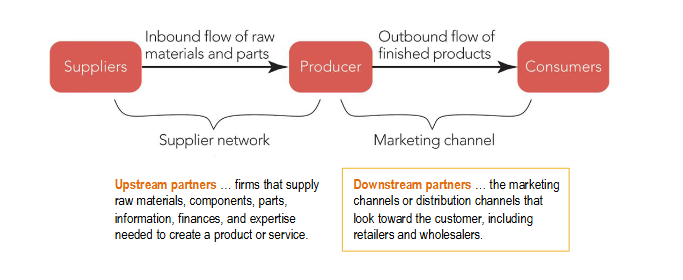
Upstream Partners
Firms that supply raw materials, components, parts, information, finances, and expertise needed to create a product or service
Downstream Partners
the marketing channels or distribution channels that look toward the customer, including retailers and wholesalers
Marketing Intermediaries
Middlemen that link producers to other intermediaries or ultimate consumers through contractual agreements or through the purchase and resale of products
Names for Intermediaries
Agent
Wholesaler
Distributor
Retailer
Agent
indipendent individual company whose main function is to act as the primary selling arm of the producer, take possession of products but do not actually own them
Wholesaler
independently owned firms that take the title to the merchandise they handle, purchase product in bulk and store it until they can resell it
Distributor
buys noncompeting products or product lines, warehouses them, and resells them to retailers or direct to the end users or customers
Retailer
Sells goods to the consumer, as opposed to a wholesaler, who normally sell their goods to another business; typically purchases the product that is sold to consumers
Marketing Channel
A set of interdependent organizations that help make a product or service available for use or consumption by the customer or business user
The major role of marketing channels is to make products available at the right time at the right place in the right quantities
Providing customer satisfaction should be the driving force behind marketing channel decisions
Why do companies use marketing channels
Channels create greater efficiency in making goods available to target markets
How do marketing channel members add value
Benefits (Utility) Consumers get from Intermediaries
Time (having the product/service when they want it)
Place (having the product/service where they want it)
Form (Enhancing a product/service to make it more appealing to the consumer)
Possession (Helping buyers take possession or ownership of a product/service)
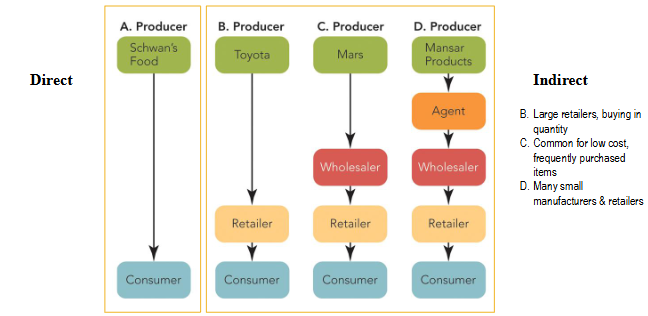
Levels of Distribution Channels
Channel Level is a layer of intermediaries that performs some work in bringing the product and its ownership close to the final buyer
Direct
Indirect
The length of the channel is measured by the number of intermediaries that are involved
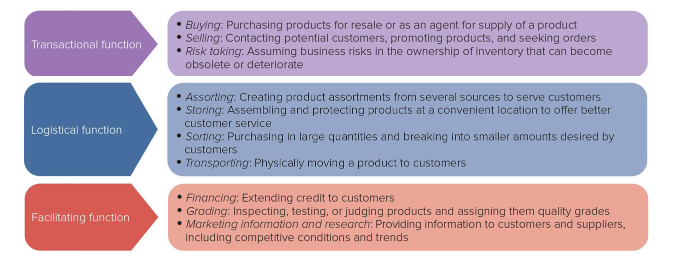
Transactional Function: Buying
Purchasing products for resale or as an agent for supply of a product
Transactional Function: Selling
Contracting potential customers, promoting products, and seeking orders
Transactional Function: Risk Taking
Assuming business risks in the ownership of inventory that can become obsolete or deteriorate
Logistical Function: Assorting
Creating product assortments from several sources to serve customers
Logistical Function: Storing
Assembling and protecting products at a convenient location to offer better customer service
Logistical Function: Sorting
Purchasing in large quantities and breaking into smaller amounts desired by customers
Logistical Function: Transporting
Physically moving a product to customers
Facilitating Function: Financing
Extending credit to customers
Facilitating Function: Grading
Inspecting, testing, or judging products and assigning them quality grades
Facilitating Function: Marketing Information and Research
Providing information to customers and suppliers, including competitive conditions and trends
Marketing Channels
More than a simple collection of firms linked by flows of physical products, payments, promotion and information
Complex behavioral systems organized in various ways to accomplish individual, company, and channel goals
Unified System
Producers, wholesalers, and retailers act as a unified system. One member
owns the others
has contracts
exercises power
Corporate Vertical Marketing System
Combine successive stages of production and distribution under single ownership
Contractual vertical Marketing Systems
Consists of independent firms at different levels of production and distribution who join together through contracts. 4 Types:
Manufacturer- sponsored retail franchise system
Manufacturer- sponsored wholesale franchise system
Service- sponsored retail franchise system
Service- sponsored franchise system
Administered Vertical Marketing System
Coordinates successive stages of production and distribution through the size and power of one of the parties
Horizontal Marketing System
A channel arrangement in which two or more companies at one level join together to follow a new marketing opportunity
Target market coverage
Which channel and intermediaries will provide the best coverage for the target market
Buyer Requirements
Which channel and intermediaries will best satisfy the buying requirements of the target market
Profitability
Which channel and intermediary will be the most profitable
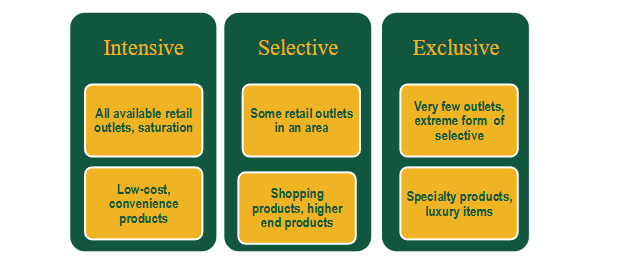
Target market coverage: Intensity of Distribution
The number and kinds of outlets in which a product will be sold
Intensive Distribution
Using all available outlets to distribute a product
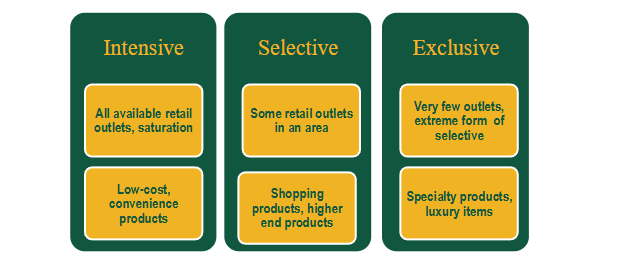
Selective Distribution
Using only some available outlets in an area to distribute a product
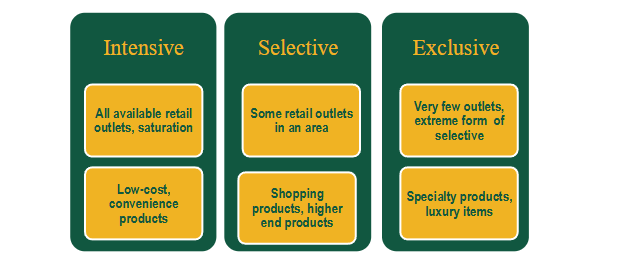
Exclusive Distribution
Using a single outlet in a fairly large geographic area to distribute a product
Buying Requirements: Different Types
Information
Convenience
Variety
Pre-or Post Sales
Information
Key concern when buyers have limited knowledge
Does the intermediary communicate through in-store displays, demonstrations, personal selling
Convenience
Multiple aspects, proximity, minimize time, easy to locate and navigate
Variety
Availability of different choices
Pre-or-Post sale services
important for items that require delivery, installation, or credit
Disintermediation
The cutting out of marketing channel intermediaries by product or service producers or the displacement of traditional retailers by radical new types of intermediaries
Selecting an approximate Price level
cost-oriented approaches
profit-oriented approaches
competition oriented approaches
demand-oriented approaches
Cost Oriented Approaches
Standard Markup
Cost-plus
experience curve
This approach has the disadvantage of ignoring customer demand
sellers are more comfortable about their costs than they are about their demand.
greater uncertainty about consumer demand levels
Makes pricing easy
When used by all firms in an industry, similar pricing, minimizing competition
profit-oriented approaches
target profit
target return on sales
target ROI
Competition oriented approaches
customary above, at, or below market
loss leader
Demand Oriented approaches
new product
product mix
psychological
Cost Plus
Add a specific amount to the unit cost to arrive at price
one-or-few-of-a-kind items
cost plus percentage of pricing
cost plus fixed fee pricing
Standard Markup
add a fixed percentage to the cost of all items in a specific product class
A fixed percentage is added to the cost of a product at each new level in the distribution channel
The percentage markup varies by type of retailer
Within a retail outlet, the percentage markup will vary by product
high volume products will generally have a smaller markup than low volume products
Experience curve
based on a learning effect
unit cost declines by 10-30% each time a firm’s experience at producing and selling them doubles
price follows cost
Target Profit
Set an annual target of a specific dollar amount volume of profit
Simple approach
Target Return on Sales
Set price to achieve a profit that is a specified percentage of the sales volume
Target ROI
Set price to achieve an annual target return on investment (ROI)
Customary
Tradition, a standardized channel of distribution or other competitive factors dictate a price
Above, at, or below market
Set a market price for a product class based on a subjective feel for the competitors’ price or market price as the benchmark
Loss Leader
Deliberately selling a product below its customary price, not to increase sales, but to attract customers’ attention in hopes that they will buy other products with large markups as well
New Product
Skimming
Penetration
Skimming
The highest initial price that customers will pay (maximize profit)
Overtime, price is lowered to attract another, more price-sensitive segment
product quality and image
Enough buyers
competitors cannot undercut
Penetration
Low initial price to penetrate the market quickly and deeply, attracting large numbers of buyers to build market share
price sensitive market
production and distribution costs drop with volume
challenge-raising price
Product Mix
A pricing approach where a company sets prices for its various products in a way that considers how they relate to each other, aiming to maximize overall profits rather than focusing on individual product prices
Price Lining
Captive Product
By-Product
Product Bundle
Price Lining
Setting the price of a line of products at a number of different specific pricing points
Prices for multiple products in a line are set at intervals
The underlying assumption is that price is elastic at each of the specific price points but inelastic between them
Manufacturers may design products for different price points and retailers apply the same mark-up percentage to each
Products may be purchased by a retailer at the same costs and then marked up by different percentages
Number of price points should be limited (3 or 4) to avoid confusing consumers
Captive Product
Pricing products that must be used with the main product
By-Product
Pricing low-value-by-products to get rid of or make money on them
Product Bundle
Combine several products and offer the bundle at a reduced price
Psychological Pricing
Prestige
Odd-Even
Multiple-unit
reference
Prestige Pricing
Consumers may use price as an indicator of quality or prestige
set a high price so that quality-or status-conscious consumers will be attracted to the product
As the price drops initially between points A and B, consumers see the lower price a as bargain, and buy more
As price drops further (B to C) consumers question the quality and prestige, buying less
Odd-Even
Ending the price with certain numbers to influence buyers’ perceptions of the price or product ($199)
Multiple Unit
Packaging together two or more identical products and selling them at a signle price
increase sales by encouraging multi-unit purchases
Reference
pricing a product at a moderate level and displaying it next to a more expensive model or brand
Competitve Effects
anticipate potential price response
“price war” - successive price cutting
Customer Effects
ultimate consumers’ perceptions and expectations
Resellers price to gain their support
Price Policy
How a company sets the price of its products and services based on costs, values, demands, and competitions
Fixed
One price policy, setting one price for all buyers of a product or service `
Dynamic
Flexible price policy, setting different prices in real time in response to supply and demand conditions; tech driven
ability to customize price by customer
Company Effects
product line or mix
Product line pricing
lowest price (entry)
highest price (premium)
Differentials (perceived value)
Special Adjustments to the list price or quoted price
Discounts
Allowances
Geographical adjustments
Quantity
Reductions in unit costs for a larger order
Seasonal
Encourage buyers to stock inventory earlier than normal demand would require
Reward wholesalers and retailers for assuming risk and higher inventory carrying costs
Trade
Compensation to resellers for marketing activity they are expected to perform
Cash
Incentives to encourage retailers to pay manufactures quickly
Promotional Allowances: EDLP
Constant low price with few temporary price reductions
Generally, generates less profit per unit, but overall, more profit
Promotional Allowances: High Low
Higher everyday prices coupled with frequent temporary deep discounts on selected products
Illegal Pricing Practices
Horizontal Price Fixing
Predatory Pricing
Geographical Pricing
Price Discrimination
Vertical Pirce Fixing
Deceptive Pricing
Horizontal Price Fixing
Two or more competitors explicitly or implicitly set prices
Predatroy Pricing
low price to force competition out of business
Price Discrimination
same product, different prices to different buyers
Vertical Price Fixing
Controlling agreements between a manufacturer and a retailer
Deceptive Pricing
Bait and Switch
Comparable price comparisons
former price comparisons
Price
Money or other considerations (including other products and services) exchanged for the ownership or use of a product or service
Barter
Exchanging products or services for other products or services; does not involve the use of money
Price Paid and Value are not the same
Price if often used to indicate value when compared to perceived benefits
Value= Perceived Benefits/ Price
Value Pricing
The practice of simultaneously increasing product and service benefits while maintaining or decreasing price
Setting Price Objectives: Manage long-term profits
Give up immediate profit to penetrate the market
Initial price is low vs. costs
higher market share yields greater profit over time
Setting Price Objectives: Maximize Short-term profits
targets are set vs. performance that can be measured quickly
quarterly, annual
Setting Price Objectives: Achieve target return
goal determined by the board of directors
Setting Price Objectives: Unit Volume
Quantity produced or sold; potentially counterproductive

