PE2
0.0(0)
Studied by 0 people Call Kai
 Learn
Learn Practice Test
 Spaced Repetition
 Match
Match Flashcards
 Knowt Play
Card Sorting
1/222

Earn XP
Description and Tags
Last updated 2:23 AM on 11/2/22
Name | Mastery | Learn | Test | Matching | Spaced | Call with Kai | Chat |
|---|
No analytics yet
Send a link to your students to track their progress
223 Terms
1
New cards
What happens when platelets bind to collagen?
release chemical mediators, change in surface receptor expression, become more sticky
2
New cards
What two things cause further platelet activation and trigger vasoconstriction?
ADP and thromboxane
3
New cards
cross linked fibrin is broken down by which enzyme to dissolve a stable clot?
plasmin
4
New cards
What is the only thing necessary for a clot to form?
platelets
erythrocytes and other cells trapped in fibrin but not necessary
erythrocytes and other cells trapped in fibrin but not necessary
5
New cards
What is an embolus?
clot moving through body
6
New cards
What is an embolism?
when embolus gets lodged in vessel
7
New cards
What are reasons to take an anti thrombotic drug?
for clot prevention when vascular endothelial cells are disrupted or when other risk factors are present
8
New cards
What are anti platelet drugs?
decrease platelet activation/plug formation
ex. clopidogrel, aspirin
ex. clopidogrel, aspirin
9
New cards
What is an ADP receptor antagonist drug?
anti platelet
clopidogrel
clopidogrel
10
New cards
What is a TXA2 synthesis inhibitor?
anti platelet drug
aspirin
aspirin
11
New cards
What is an anticoagulant?
decreases clotting factor activity
12
New cards
What is an anticoagulant that decreases synthesis of clotting factors?
warfarin
13
New cards
What is an anticoagulant that inhibits factor Xa?
rivaroxaban
14
New cards
What is an anticoagulant that inhibits thrombin?
dabigatran
15
New cards
What is an anticoagulant that inhibits action of multiple factors?
heparin
16
New cards
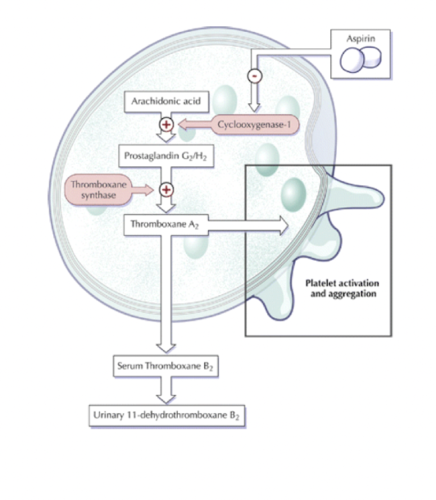
How does aspirin work?
inhibits cyclooxygenase-1 (COX-1) which is required in the pathway to synthesize TXA2 from arachidonic acid
GI symptoms
GI symptoms
17
New cards
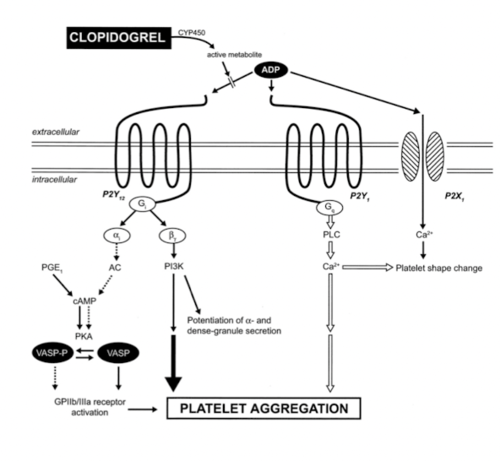
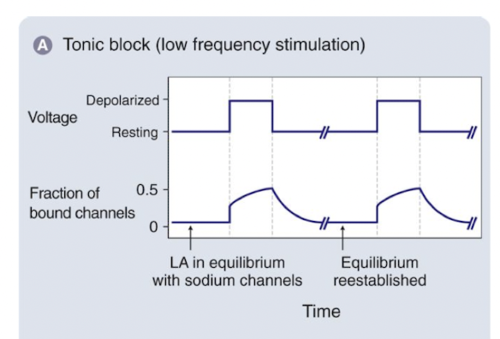
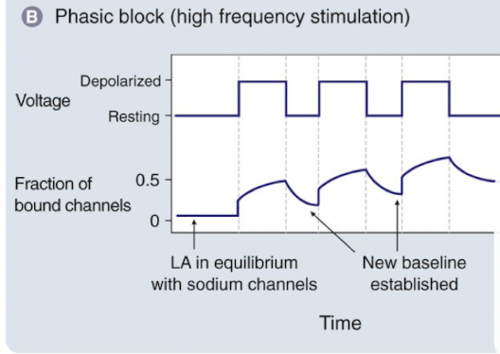
how does clopidogrel work?
irreversibly blocks P2Y12 (ADP) receptor expressed by platelets
synergistic effects when taken with aspirin
bruising, bleeding most common side effects
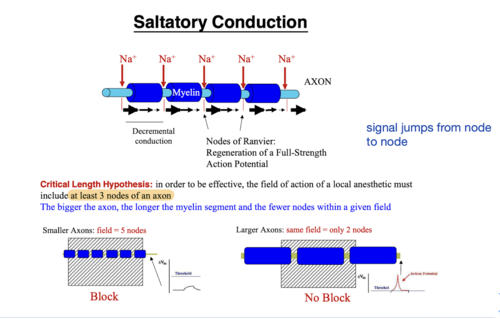
synergistic effects when taken with aspirin
bruising, bleeding most common side effects
18
New cards
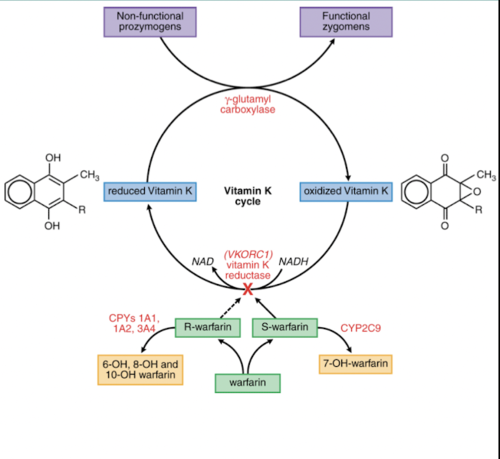
How does warfarin work?
vitamin K-dependent carboxylase produces active clotting factors
vit K is a cofactor that gets oxidized in this reaction and must be reduced in order to be used again
step performed by vitamin K reductase, which is blocked by warfarin
vit K is a cofactor that gets oxidized in this reaction and must be reduced in order to be used again
step performed by vitamin K reductase, which is blocked by warfarin
19
New cards
What is prothrombin time and what is it used for?
common lab test to measure ability of blood to clot
tissue factor added to sample, timed until clot forms
expressed as INR (international normalized ratio), which is a ratio of a patient's clotting time to normal reference value
tissue factor added to sample, timed until clot forms
expressed as INR (international normalized ratio), which is a ratio of a patient's clotting time to normal reference value
20
New cards
What does a high INR mean?
decreased ability to clot
21
New cards
how to reverse warfarin therapy?
vitamin K (~24 hr effect)
Kcentra or fresh frozen plasma (rapid)
Kcentra or fresh frozen plasma (rapid)
22
New cards
direct oral anticoagulants are also known as
non-vitamin K antagonist oral anticoagulants
23
New cards
what are direct oral anticoagulant examples?
rivaroxaban and dabigatran
24
New cards
advantages of direct oral anticoagulants?
monitoring of coagulation and dose titration generally not needed
rapid onset/offset of action
few drug/diet interactions
rapid onset/offset of action
few drug/diet interactions
25
New cards
disadvantages of direct oral anticoagulants?
less clinical experience
higher cost
antidotes relatively new and may not be widely available
higher cost
antidotes relatively new and may not be widely available
26
New cards
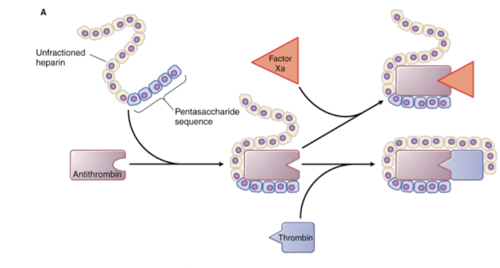
how does heparin work?
polysaccharide that binds and activates antithrombin
antithrombin inhibits thrombin and other clotting factors
immediate effect, useful for acute clotting risk
antithrombin inhibits thrombin and other clotting factors
immediate effect, useful for acute clotting risk
27
New cards
what is a topical option for when excessive bleeding occurs?
tranexamic acid mouth rinse
inhibits plasmin
inhibits plasmin
28
New cards
What is analgesia?
relief from pain despite presence of painful stimulus
29
New cards
What are analgesics?
drugs that decrease pain without major impairment of other senses
30
New cards
What are anesthetics?
block all sensation
31
New cards
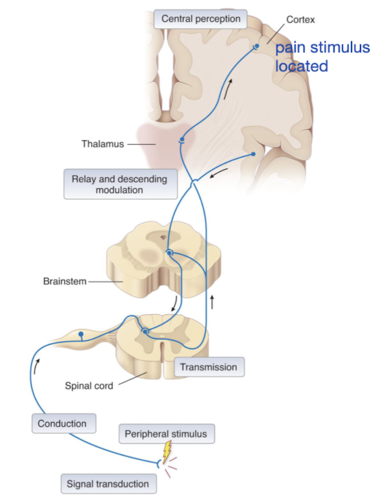
What is the basic pain pathway?
nociceptors in skin and other tissues detect painful stimuli
enters spinal cord, synapse at dorsal horn
signal carried up to brain through ascending pathway
enters spinal cord, synapse at dorsal horn
signal carried up to brain through ascending pathway
32
New cards
What is the body's natural pain control system?
descending pathways
inhibit transmission of pain in spinal cord
inhibit transmission of pain in spinal cord
33
New cards
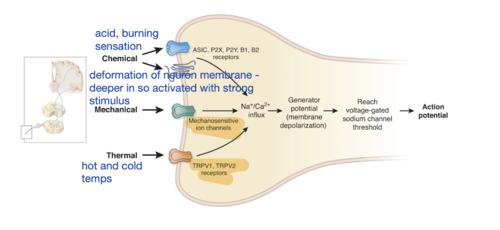
What is a chemical stimuli?
some directly activate nociceptors while others (prostaglandins) sensitize the neuron, making it easier to reach threshold (peripheral sensitization)
34
New cards
receptors for thermal stimuli?
TRPV1, TRPV2 receptors
35
New cards
receptors for mechanical stimuli?
mechxnosensitive ion channels
36
New cards
What is allodynia?
something that is normally painful becomes painful
ex. showering after sunburn
prostaglandins make more painful
ex. showering after sunburn
prostaglandins make more painful
37
New cards
What is hyperalgesia?
a normally painful stimulus is more painful than usual
ex. pricked with a pain
ex. pricked with a pain
38
New cards
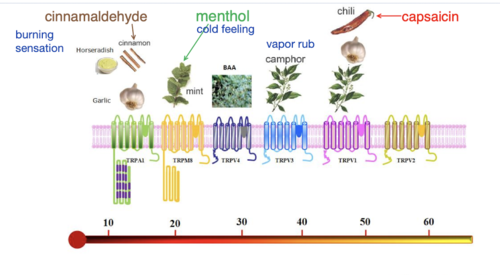
What are TRP channels?
ion channels that open in response to temp and certain other chemicals
39
New cards
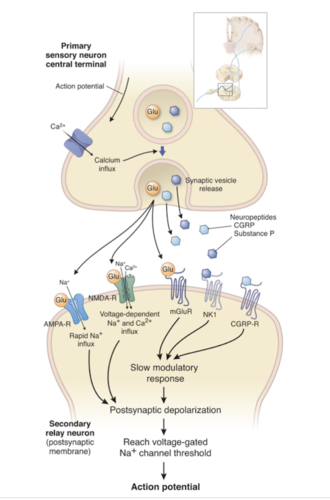
major NTs that work in transmission of pain signals from primary neuron to secondary neuron in spinal cord?
glutamate (acts on AMPA and NMDA receptors, directly depolarize postsynaptic neuron)
substance P (peptide, allows channel to open more readily)
substance P (peptide, allows channel to open more readily)
40
New cards
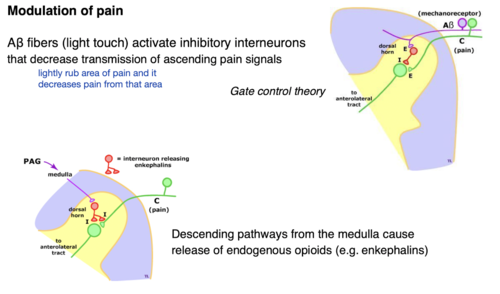
how does the brain modulate pain?
A beta fibers (light touch) activate inhibitory interneurons that decrease transmission of ascending pain signals
descending pathways from medulla cause release of endogenous opioids (enkephalins)
descending pathways from medulla cause release of endogenous opioids (enkephalins)
41
New cards
2 major mechanisms for pain control?
1. activate opioid receptors
2. decrease production of inflammatory mediators that sensitize pain fibers (NSAIDS)
2. decrease production of inflammatory mediators that sensitize pain fibers (NSAIDS)
42
New cards
What are opioids?
compounds that activate the body's endogenous opioid receptors to produce analgesia
include morphine and codeine, derived from poppy plant
include morphine and codeine, derived from poppy plant
43
New cards
name the opioid receptors and what they do?
mu: responsible for most, if not all, analgesic effects
kappa: dysphoria and hallucination at high doses
delta: not well understood, may have role in analgesia
endogenous peptide ligands: endorphins, enkephalins, dynorphins
all GPCR coupled to Gi
kappa: dysphoria and hallucination at high doses
delta: not well understood, may have role in analgesia
endogenous peptide ligands: endorphins, enkephalins, dynorphins
all GPCR coupled to Gi
44
New cards
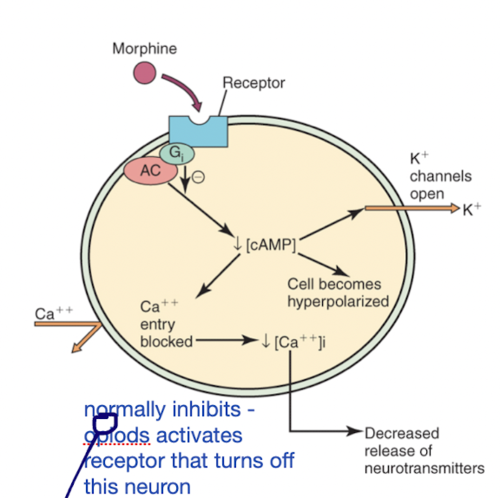
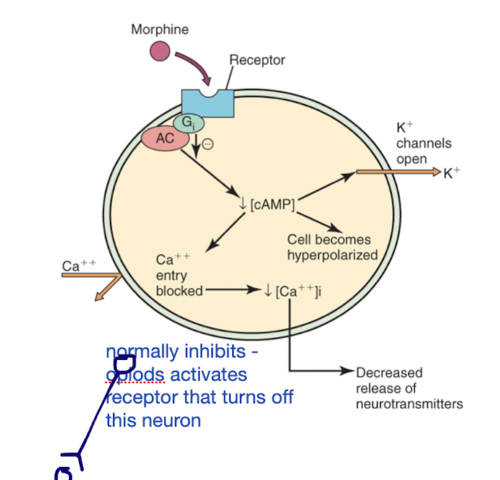
cellular effects of opioid receptors?
inhibit adenylyl cyclase (decreased cAMP)
open K+ channels and close Ca channels
open K+ channels and close Ca channels
45
New cards
physiological effects of opioid receptors?
inhibition of NT release at pro-nociceptive synapses
release of inhibition on descending pathways
release of inhibition on descending pathways
46
New cards
actions of opioids at brain, spinal cord, peripheral nociceptors, and brainstem?
brain: decreased emotional suffering associated with pain, sedation, euphoria especially when large dose is given quickly
spinal cord: decreased activity of ascending pathways
peripheral nociceptors: decreased activation
brainstem: increased activity of descending inhibitory pathways
spinal cord: decreased activity of ascending pathways
peripheral nociceptors: decreased activation
brainstem: increased activity of descending inhibitory pathways
47
New cards
adverse effects of opioids?
respiratory depression most serious (main cause of overdose, decrease sensitivity of brainstem to increased CO2, effects are additive with alcohol)
abuse/addiction
pruritis
nausea, vomiting, constipation
abuse/addiction
pruritis
nausea, vomiting, constipation
48
New cards
natural and semisynthetic opioids? (phenanthrene)
morphine (prototype drug)
hydromorphone (10x potency, better water solubility)
oxycodone (lower efficacy, good oral bioavailability)
codeine (low efficacy, prodrug susceptible to CYP2D6 pharmacogenetics)
hydromorphone (10x potency, better water solubility)
oxycodone (lower efficacy, good oral bioavailability)
codeine (low efficacy, prodrug susceptible to CYP2D6 pharmacogenetics)
49
New cards
synthetic opioid drugs?
fentanyl (fast acting, potent, short duration of action)
methadone (treat addiction and pain, long duration of action)
methadone (treat addiction and pain, long duration of action)
50
New cards
What is loperamide?
antidiarrheal
effect at normal dose is restricted to GI tract
activation of mu receptors in GI tract reduces contraction and decreases secretions
potential for abuse
effect at normal dose is restricted to GI tract
activation of mu receptors in GI tract reduces contraction and decreases secretions
potential for abuse
51
New cards
what is tramadol?
inhibits serotonin and norepinephrine reuptake
very weak mu agonist
CYP2D6 converts it into mu agonist 300x more potent
adverse effects: dependence potential, lowers seizure threshold
very weak mu agonist
CYP2D6 converts it into mu agonist 300x more potent
adverse effects: dependence potential, lowers seizure threshold
52
New cards
What are symptoms of narcotic (opioid) toxidrome?
CPR-3H
Coma, pinpoint pupils, respiratory depression, hypotension, hypothermia, hyporeflexia
Coma, pinpoint pupils, respiratory depression, hypotension, hypothermia, hyporeflexia
53
New cards
What is naloxone?
treats overdose
opioid antagonist
will cause precipitated withdrawal in people that are physically dependent
opioid antagonist
will cause precipitated withdrawal in people that are physically dependent
54
New cards
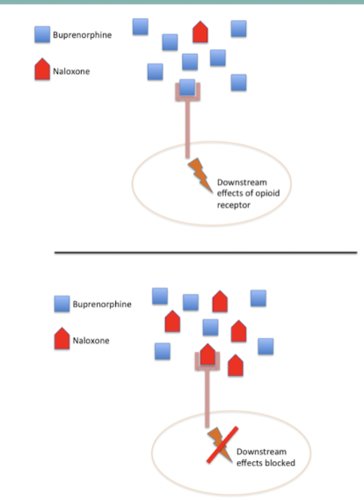
What is buprenorphine?
partial mu agonist with high potency
helps to wean pts off opioids by preventing severe withdrawal symptoms
can precipitate withdrawal if full agonist in pt's system
combined with naloxone to deter IV and intranasal abuse
helps to wean pts off opioids by preventing severe withdrawal symptoms
can precipitate withdrawal if full agonist in pt's system
combined with naloxone to deter IV and intranasal abuse
55
New cards
symptoms of opioid withdrawal?
anxiety, sweating, muscle aches, nausea
56
New cards
T/F physical dependence means addiction
false
57
New cards
What is addiction? how to treat?
lack of impulse control over taking a drug, seeking it despite negative consequences
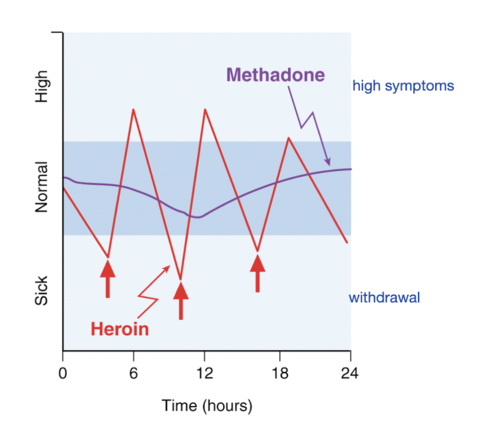
wean off drug using methadone (long acting agonist) and buprenorphine (partial agonist)
dost enough to withdrawal but not enough to cause intoxication
wean off drug using methadone (long acting agonist) and buprenorphine (partial agonist)
dost enough to withdrawal but not enough to cause intoxication
58
New cards
dentists write about __% of opioid prescriptions in US
6-7
59
New cards
before opioids, you should try __ for pain relief
NSAIDS
60
New cards
What does COX convert arachidonic acid to?
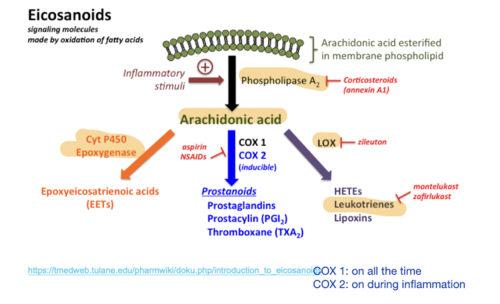
prostaglandins (increase pain/inflammation plus variety of other effects)
prostacyclin (platelet inhibitor and vasodilator)
thromboxane A2 (increases platelet aggregation)
prostacyclin (platelet inhibitor and vasodilator)
thromboxane A2 (increases platelet aggregation)
61
New cards
What is COX1?
generally considered constitutive (around all the time), performs "housekeeping" functions
62
New cards
What is COX2?
some constitutive, induced after tissue injury
63
New cards
What do prostaglandins do?
reduce activation threshold for nociceptors (peripheral sensitization)
increase blood flow, vascular permeability and leukocyte recruitment in injured area
in CNS, work as pain-increasing neuromodulators (central sensitization) and pyrogens
increase blood flow, vascular permeability and leukocyte recruitment in injured area
in CNS, work as pain-increasing neuromodulators (central sensitization) and pyrogens
64
New cards
how does aspirin work?
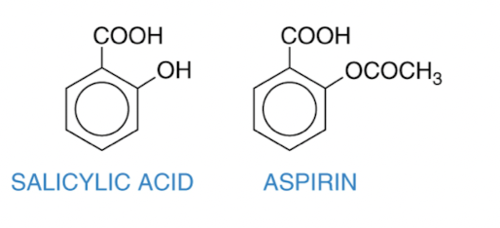
acetylsalicylic acid, modified from a component of willow tree bark
inhibits COX1/2 by irreversible acetylation
inhibits COX1/2 by irreversible acetylation
65
New cards
therapeutic uses of aspirin?
analgesic: effective for mild-moderate nociceptive pain, lower ability to relieve pain compared to opioids but lacks the unwanted effects
antipyretic: fevers due to prostaglandins, promote return to normal
antithrombotic: low-dose aspirin is an effective anti-platelet agent, irreversible
antipyretic: fevers due to prostaglandins, promote return to normal
antithrombotic: low-dose aspirin is an effective anti-platelet agent, irreversible
66
New cards
What are examples of nonselective NSAIDS?
ibuprofen, naproxen, ketorolac
67
New cards
side effects of NSAIDS?
GI irritation/bleeding due to: direct irritation, loss of protective effect of COX1 (usually stimulates mucus production), anti-platelet effects (less TXA2 leading to more bleeding)
reduction in renal blood flow (impairs kidneys ability to increase GFR)
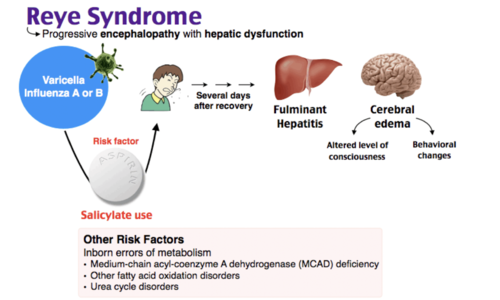
Reye's syndrome
reduction in renal blood flow (impairs kidneys ability to increase GFR)
Reye's syndrome
68
New cards
Why is aspirin contraindicated in children?
Reye's syndrome
69
New cards
What are COX-2 inhibitors?
initially "blockbuster drug"
advantage of reduced COX1 inhibition is 50-60% reduction in GI bleeding
analgesic and anti-inflammatory effects similar to nonselective NSAIDS
BUT risk of stroke and MI increased
advantage of reduced COX1 inhibition is 50-60% reduction in GI bleeding
analgesic and anti-inflammatory effects similar to nonselective NSAIDS
BUT risk of stroke and MI increased
70
New cards
The only cox2 inhibitor on the market?
celecoxib
71
New cards
NSAID CV risk may be due to
renal effects, reduced prostacyclins
72
New cards
What is acetaminophen?
not true NSAID - lacks anti-inflammatory activity
works as analgesic and antipyretic
only weak inhibitor of COX 1/2, activity further reduced by high peroxide concentration found in areas of inflammation
active metabolite activates TRPV1 and cannabinoid CB1 receptors
works as analgesic and antipyretic
only weak inhibitor of COX 1/2, activity further reduced by high peroxide concentration found in areas of inflammation
active metabolite activates TRPV1 and cannabinoid CB1 receptors
73
New cards
dosage and toxicity of acetaminophen?
3 g/day
7-10 g/day toxic
initial flu-like symptoms
liver failure - jaundice, decreased blood clotting, death possible
7-10 g/day toxic
initial flu-like symptoms
liver failure - jaundice, decreased blood clotting, death possible
74
New cards
antidote for acetaminophen toxicity?
N-acetylcysteine
replenishes glutathione
replenishes glutathione
75
New cards
When to use NSAIDS vs acetaminophen?
NSAIDS: pain associated with swelling/inflammation (but bleeding risk)
76
New cards
What is neuropathic pain?
pain arises from nerve damage or dysfunction
nerve compression, diabetic neuropathy, neurotoxic effects of cancer chemo, MS, stroke, postherpetic neuralgia
difficult to treat - NSAIDS minimally effective
nerve compression, diabetic neuropathy, neurotoxic effects of cancer chemo, MS, stroke, postherpetic neuralgia
difficult to treat - NSAIDS minimally effective
77
New cards
drugs used to treat neuropathic pain?
antidepressants
tricyclics (amitriptyline)
SNRI (venlafaxine)
anti-seizure drugs (gabapentin, carbamazepine)
NMDA antagonist (ketamine)
tricyclics (amitriptyline)
SNRI (venlafaxine)
anti-seizure drugs (gabapentin, carbamazepine)
NMDA antagonist (ketamine)
78
New cards
What does amitriptyline do?
tricyclics
increase serotonin and NE levels, also blocks Na channels
increase serotonin and NE levels, also blocks Na channels
79
New cards
What does venlafaxine do?
SNRI
inhibit NT release by activating alpha-2 receptors
inhibit NT release by activating alpha-2 receptors
80
New cards
How does gabapentin work?
anti-seizure drug
inhibit voltage gated Ca channels
inhibit voltage gated Ca channels
81
New cards
How does carbamazepine work?
anti-seizure drug
blocks Na channels
blocks Na channels
82
New cards
What is ketamine?
NMDA antagonist
83
New cards
What are topical anesthetics?
applied to skin or mucosa
penetrates 2-3 mm
penetrates 2-3 mm
84
New cards
What is infiltration anesthesia?
injection into subcutaneous tissue to numb a local region
works primarily on nerve endings in affected area
works primarily on nerve endings in affected area
85
New cards
What is a field block or nerve blocK?
used to provide larger area of anesthesia
injection proximal to site of concern
anything in that nerve distal to where you injected
injection proximal to site of concern
anything in that nerve distal to where you injected
86
New cards
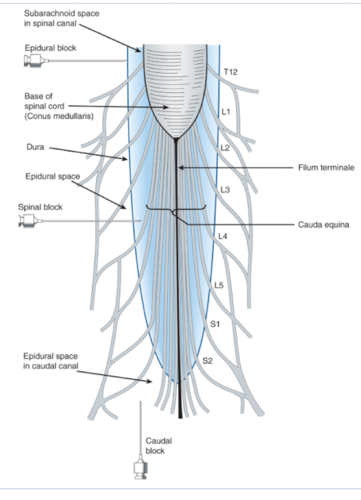
What is epidural anesthesia?
used for labor and some surgical procedures
allows for catheter placement and repeat infusions
most significant effects on nerve roots near infusion site
allows for catheter placement and repeat infusions
most significant effects on nerve roots near infusion site
87
New cards
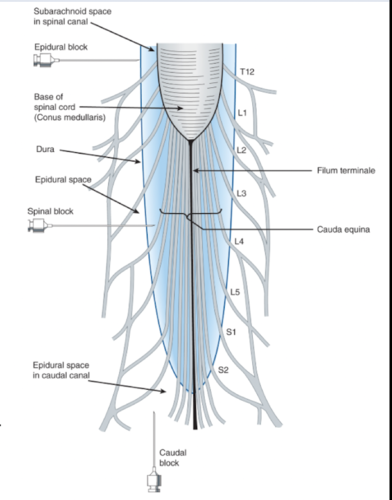
What is spinal anesthesia?
used for lower limb and pelvic surgery
injected into subarachnoid space caudal to L2
dependent on dose, can achieve full anesthesia of all distal structures
injected into subarachnoid space caudal to L2
dependent on dose, can achieve full anesthesia of all distal structures
88
New cards
All local anesthetics are
weak bases
become ionized as pH decreases (so can't cross membranes)
become ionized as pH decreases (so can't cross membranes)
89
New cards
functional consequence of local anesthetics being weak bases?
infected/inflamed tissues (which are more acidic) require higher dose of drug
90
New cards
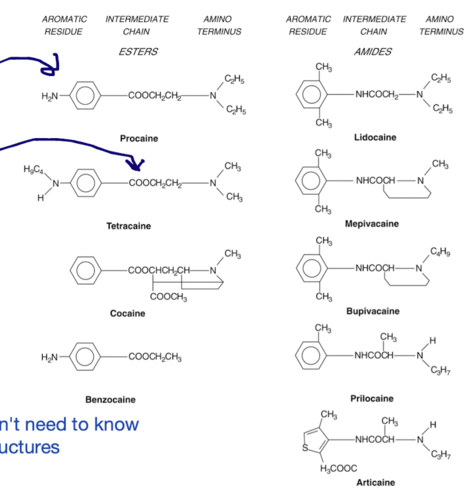
two chemical classes of local anesthetics?
esters - less commonly used, more easily broken down, generally short duration, higher risk of allergy
amides: medium to long acting, includes drugs such as lidocaine
amides: medium to long acting, includes drugs such as lidocaine
91
New cards
molecular structure of local anesthetics?
aromatic residue - provides lipid solubility
intermediate chain - separates aromatic and amino groups, gives chemical class (amide or ester), determines allergenicity and metabolism
amino terminus - provides water solubility and participates in acid-base reactions
intermediate chain - separates aromatic and amino groups, gives chemical class (amide or ester), determines allergenicity and metabolism
amino terminus - provides water solubility and participates in acid-base reactions
92
New cards
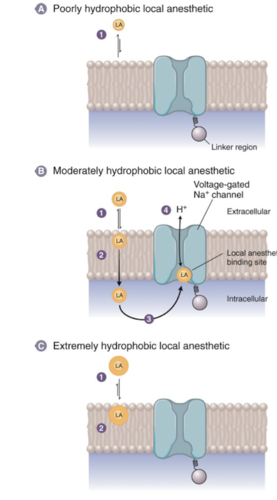
onset, duration and degree of anesthesia influenced by
lipid solubility (moderate best)
degree of ionization (pKa)
nerve bundle diameter (smaller = quicker to anesthetize)
degree of ionization (pKa)
nerve bundle diameter (smaller = quicker to anesthetize)
93
New cards
order of nerve function loss??
sympathetic - pain - cold - warm - touch - motor
94
New cards
how do local anesthetics work?
block voltage gated Na channels that carry action potentials down axon
95
New cards
LA preferentially binds what kind of channels?
open and inactive
96
New cards
what is a tonic block?
channel opens infrequently, drug diffuses away between action potentials
97
New cards
what is a phasic block?
channel opens frequently, number of channels bound to drug increases with each action potential
98
New cards
what is the critical length hypothesis?
in order to be effective, the field of action of a LA must include at least 3 nodes of an axon
99
New cards
examples of amide LA
lidocaine, artisane, bupivacaine, mepivacaine
100
New cards
examples of ester LA
benzocaine, tetracaine + oxymetazoline