🚦 Lecture 10: Signal Transduction + GPCR (G Protein-Coupled Receptors)

0.0(0)
studied byStudied by 0 people
0.0(0)
call kaiCall Kai
learnLearn
examPractice Test
spaced repetitionSpaced Repetition
heart puzzleMatch
flashcardsFlashcards
GameKnowt Play
Card Sorting

1/17

encourage image

There's no tags or description

Looks like no tags are added yet.

Last updated 7:48 PM on 2/2/26
Name
Mastery
Learn
Test
Matching
Spaced
Call with Kai

No analytics yet

Send a link to your students to track their progress

18 Terms

1
New cards

Signal Transduction – How Cells Sense External Signals

Overview
ā€ƒTranscription factors respond to extracellular signals from hormones and signaling peptides
ā€ƒSignal transduction connects external signals to changes in gene expression and metabolism

Hydrophilic Hormones
ā€ƒCannot cross the cell membrane
ā€ƒBind to plasma membrane receptors
ā€ƒActivate signal transduction pathways:
ā€ƒā€ƒā€¢ Some receptors activate G-proteins → trigger various intracellular pathways or generate second messengers
ā€ƒā€ƒā€¢ Tyrosine kinase receptors → sequential activation of downstream kinases

Hydrophobic Hormones
ā€ƒDiffuse through the cell membrane
ā€ƒBind cytosolic receptors directly

Outcome
ā€ƒBoth types of hormones initiate signal transduction
ā€ƒLead to changes in gene expression and cellular metabolism
<p><strong>Overview</strong><br>ā€ƒTranscription factors respond to extracellular signals from hormones and signaling peptides<br>ā€ƒSignal transduction connects external signals to changes in gene expression and metabolism</p><p><strong>Hydrophilic Hormones</strong><br>ā€ƒCannot cross the cell membrane<br>ā€ƒBind to plasma membrane receptors<br>ā€ƒActivate signal transduction pathways:<br>ā€ƒā€ƒā€¢ Some receptors activate G-proteins → trigger various intracellular pathways or generate second messengers<br>ā€ƒā€ƒā€¢ Tyrosine kinase receptors → sequential activation of downstream kinases</p><p><strong>Hydrophobic Hormones</strong><br>ā€ƒDiffuse through the cell membrane<br>ā€ƒBind cytosolic receptors directly</p><p><strong>Outcome</strong><br>ā€ƒBoth types of hormones initiate signal transduction<br>ā€ƒLead to changes in gene expression and cellular metabolism</p>
2
New cards

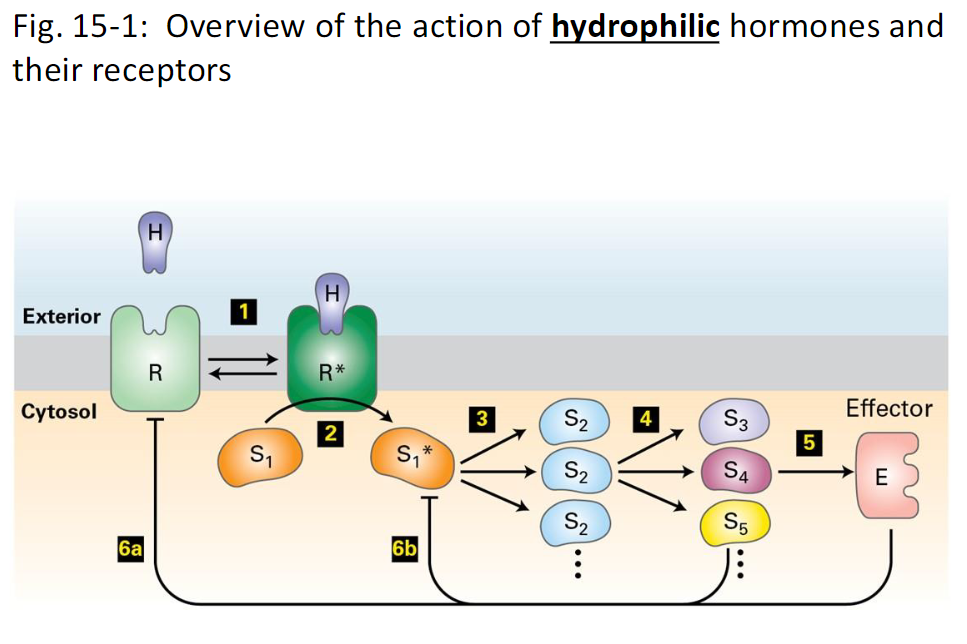
Signal Transduction Pathway – Hydrophilic Hormones *Don’t need to know

Step 1 – Ligand Binding
ā€ƒA receptor protein (R) on the plasma membrane binds a hydrophilic hormone (H)
ā€ƒBinding triggers a conformational change in the receptor

Step 2 – Receptor Activation
ā€ƒActivated receptor interacts with a signal transduction protein
ā€ƒOften a GTP-binding protein, kinase, or phosphatase

Step 3 – Signal Cascade
ā€ƒSignal transduction protein activates or inhibits other downstream signaling proteins
ā€ƒOne protein can activate multiple downstream targets → signal amplification

Step 4 – Further Signaling
ā€ƒActivated proteins continue to transmit the signal through the pathway
ā€ƒAmplifies and diversifies the cellular response

Step 5 – Effector Activation
ā€ƒSome signaling proteins activate effector proteins (E)
ā€ƒEffectors can be enzymes, transcription factors, transport proteins, or ion channels
ā€ƒEffectors carry out the cellular response

Step 6 – Feedback Control
ā€ƒProteins in the pathway or effectors can modify the receptor or early signaling proteins
ā€ƒInhibits or blocks early steps in the pathway
ā€ƒCan trigger receptor degradation → reduces receptor numbers → lowers cell sensitivity to the ligand

Key Points
ā€ƒSignal amplification ensures a small number of ligands produces a large cellular response
ā€ƒFeedback mechanisms maintain control and prevent overstimulation
<p><strong>Step 1 – Ligand Binding</strong><br>ā€ƒA receptor protein (R) on the plasma membrane binds a hydrophilic hormone (H)<br>ā€ƒBinding triggers a conformational change in the receptor</p><p><strong>Step 2 – Receptor Activation</strong><br>ā€ƒActivated receptor interacts with a signal transduction protein<br>ā€ƒOften a GTP-binding protein, kinase, or phosphatase</p><p><strong>Step 3 – Signal Cascade</strong><br>ā€ƒSignal transduction protein activates or inhibits other downstream signaling proteins<br>ā€ƒOne protein can activate multiple downstream targets → <strong>signal amplification</strong></p><p><strong>Step 4 – Further Signaling</strong><br>ā€ƒActivated proteins continue to transmit the signal through the pathway<br>ā€ƒAmplifies and diversifies the cellular response</p><p><strong>Step 5 – Effector Activation</strong><br>ā€ƒSome signaling proteins activate effector proteins (E)<br>ā€ƒEffectors can be enzymes, transcription factors, transport proteins, or ion channels<br>ā€ƒEffectors carry out the cellular response</p><p><strong>Step 6 – Feedback Control</strong><br>ā€ƒProteins in the pathway or effectors can modify the receptor or early signaling proteins<br>ā€ƒInhibits or blocks early steps in the pathway<br>ā€ƒCan trigger receptor degradation → reduces receptor numbers → lowers cell sensitivity to the ligand</p><p><strong>Key Points</strong><br>ā€ƒSignal amplification ensures a small number of ligands produces a large cellular response<br>ā€ƒFeedback mechanisms maintain control and prevent overstimulation</p>
3
New cards

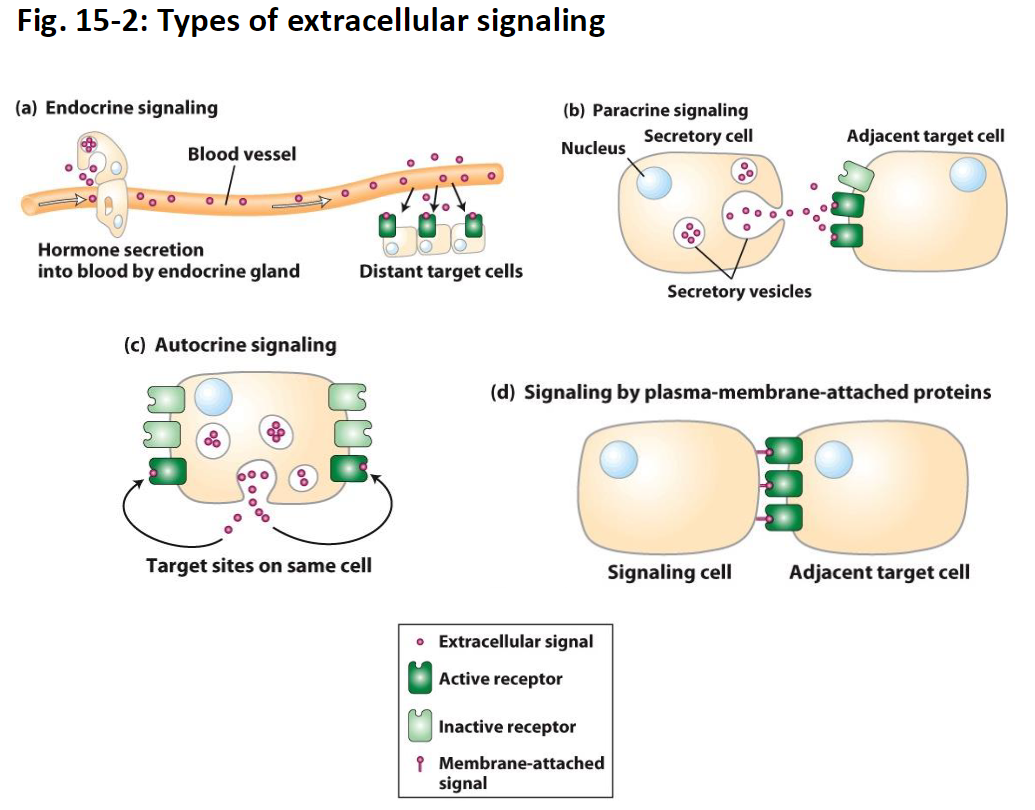
Cell-to-Cell Signaling – Types and Mechanisms

(a) Endocrine Signaling
ā€ƒHormones are secreted by endocrine glands into the blood
ā€ƒTravel long distances to reach distant target cells
ā€ƒEtymology: endo- = inside, crine = secrete → ā€œsecrete insideā€ (into the blood)

(b) Paracrine Signaling
ā€ƒSignaling molecules are released by a cell to act on nearby adjacent cells
ā€ƒShort-distance signaling
ā€ƒEtymology: para- = beside/near → ā€œsecrete besideā€ (affects neighboring cells)

(c) Autocrine Signaling
ā€ƒA cell secretes signaling molecules that act on itself
ā€ƒCan regulate its own activity or gene expression
ā€ƒEtymology: auto- = self → ā€œself-secretionā€ (acts on the same cell)

(d) Signaling by Plasma-Membrane-Attached Proteins
ā€ƒProteins on the plasma membrane of one cell interact directly with receptors on an adjacent cell
ā€ƒDoes not require secretion of molecules
ā€ƒAllows direct cell-to-cell communication

Key Points
ā€ƒSignaling distance varies: autocrine/paracrine = micrometers, endocrine = meters
<p><strong>(a) Endocrine Signaling</strong><br>ā€ƒHormones are secreted by endocrine glands into the blood<br>ā€ƒTravel long distances to reach <strong>distant target cells</strong><br>ā€ƒ<strong>Etymology:</strong> <em>endo-</em> = inside, <em>crine</em> = secrete → ā€œsecrete insideā€ (into the blood)</p><p><strong>(b) Paracrine Signaling</strong><br>ā€ƒSignaling molecules are released by a cell to act on <strong>nearby adjacent cells</strong><br>ā€ƒShort-distance signaling<br>ā€ƒ<strong>Etymology:</strong> <em>para-</em> = beside/near → ā€œsecrete besideā€ (affects neighboring cells)</p><p><strong>(c) Autocrine Signaling</strong><br>ā€ƒA cell secretes signaling molecules that <strong>act on itself</strong><br>ā€ƒCan regulate its own activity or gene expression<br>ā€ƒ<strong>Etymology:</strong> <em>auto-</em> = self → ā€œself-secretionā€ (acts on the same cell)</p><p><strong>(d) Signaling by Plasma-Membrane-Attached Proteins</strong><br>ā€ƒProteins on the plasma membrane of one cell interact directly with <strong>receptors on an adjacent cell</strong><br>ā€ƒDoes not require secretion of molecules<br>ā€ƒAllows direct cell-to-cell communication</p><p><strong>Key Points</strong><br>ā€ƒSignaling distance varies: autocrine/paracrine = micrometers, endocrine = meters</p>
4
New cards

Overview of Cell Signaling – Hormones and Receptors

Signal Reception
ā€ƒAll cells respond to extracellular signals or stimuli
ā€ƒSignals activate plasma membrane receptors or cytosolic receptors

Receptor Function
ā€ƒActivated receptors can:
ā€ƒā€ƒā€¢ Act as transcription factors → change gene expression
ā€ƒā€ƒā€¢ Activate G-protein switches → regulate multiple downstream pathways
ā€ƒā€ƒā€¢ Generate intracellular second messengers → amplify and transmit the signal

Signal Regulation
ā€ƒProtein activity is controlled by:
ā€ƒā€ƒā€¢ Phosphorylation by kinases
ā€ƒā€ƒā€¢ Dephosphorylation by phosphatases
ā€ƒThese modifications regulate signaling pathways and can amplify intracellular signals
<p><strong>Signal Reception</strong><br>ā€ƒAll cells respond to extracellular signals or stimuli<br>ā€ƒSignals activate <strong>plasma membrane receptors</strong> or <strong>cytosolic receptors</strong></p><p><strong>Receptor Function</strong><br>ā€ƒActivated receptors can:<br>ā€ƒā€ƒā€¢ Act as transcription factors → change gene expression<br>ā€ƒā€ƒā€¢ Activate G-protein switches → regulate multiple downstream pathways<br>ā€ƒā€ƒā€¢ Generate intracellular second messengers → amplify and transmit the signal</p><p><strong>Signal Regulation</strong><br>ā€ƒProtein activity is controlled by:<br>ā€ƒā€ƒā€¢ <strong>Phosphorylation</strong> by kinases<br>ā€ƒā€ƒā€¢ <strong>Dephosphorylation</strong> by phosphatases<br>ā€ƒThese modifications regulate signaling pathways and can amplify intracellular signals</p>
5
New cards

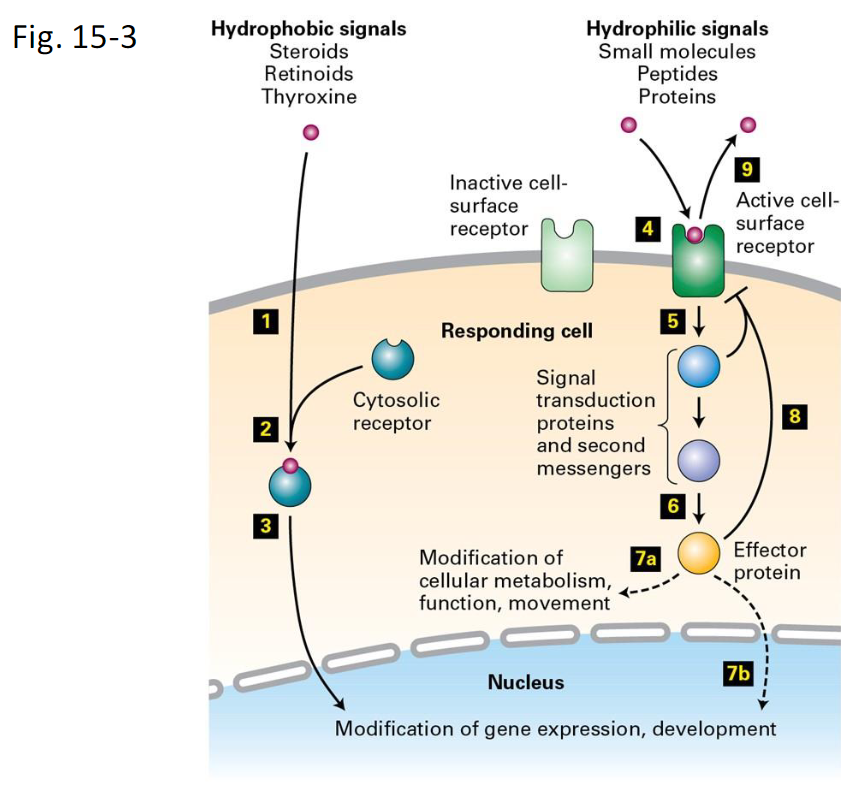
Overview of Cell Signaling – Hydrophobic vs Hydrophilic Signals

Hydrophobic Signals
ā€ƒExamples: steroids, retinoids, thyroxine

Steps:

  1. Signal molecule diffuses through the plasma membrane

  2. Binds to a cytosolic receptor → forms receptor-signal complex

  3. Complex moves into the nucleus

  4. Binds DNA transcription-control regions → activates or represses gene expression

Hydrophilic Signals
ā€ƒExamples: small molecules (adrenaline, acetylcholine), peptides (glucagon, yeast mating factors), proteins (insulin, growth hormone)

Steps:

  1. Signal binds to an inactive cell-surface receptor (4)

  2. Receptor undergoes conformational change → becomes active (4)

  3. Activated receptor activates downstream signal transduction proteins or generates second messengers (5)

  4. Signal transduction activates effector proteins (6)

  5. a. Effector proteins stay in cytosol → modify enzymes → short-term changes in metabolism, movement, or function (7a)

b. Effector proteins enter the nucleus → long-term changes in gene expression (7b)

Termination / Down-Modulation:
6. Negative feedback from intracellular signalling molecules (8)
7. Removal of the extracellular signal (9)

Key Points:
ā€ƒHydrophobic → cytosol receptor → nucleus → gene expression modification
ā€ƒHydrophilic → membrane receptor → signal transduction → effector → cytosol or nucleus
ā€ƒSignal amplification and feedback control regulate strength and duration of response
<p><strong>Hydrophobic Signals</strong><br>ā€ƒExamples: steroids, retinoids, thyroxine</p><p><strong>Steps:</strong></p><ol><li><p>Signal molecule diffuses through the plasma membrane</p></li><li><p>Binds to a cytosolic receptor → forms receptor-signal complex</p></li><li><p>Complex moves into the nucleus</p></li><li><p>Binds DNA transcription-control regions → activates or represses gene expression</p></li></ol><p><strong>Hydrophilic Signals</strong><br>ā€ƒExamples: small molecules (adrenaline, acetylcholine), peptides (glucagon, yeast mating factors), proteins (insulin, growth hormone)</p><p><strong>Steps:</strong></p><ol><li><p>Signal binds to an inactive cell-surface receptor (4)</p></li><li><p>Receptor undergoes conformational change → becomes active (4)</p></li><li><p>Activated receptor activates downstream <strong>signal transduction proteins</strong> or generates <strong>second messengers</strong> (5)</p></li><li><p>Signal transduction activates <strong>effector proteins</strong> (6)</p></li><li><p>a. Effector proteins stay in cytosol → modify enzymes → short-term changes in metabolism, movement, or function (7a)</p></li></ol><p>    b. Effector proteins enter the nucleus → long-term changes in gene expression (7b)</p><p><strong>Termination / Down-Modulation:</strong><br>6. Negative feedback from intracellular signalling molecules (8)<br>7. Removal of the extracellular signal (9)</p><p><strong>Key Points:</strong><br>ā€ƒHydrophobic → cytosol receptor → nucleus → gene expression modification<br>ā€ƒHydrophilic → membrane receptor → signal transduction → effector → cytosol or nucleus<br>ā€ƒSignal amplification and feedback control regulate strength and duration of response</p>
6
New cards

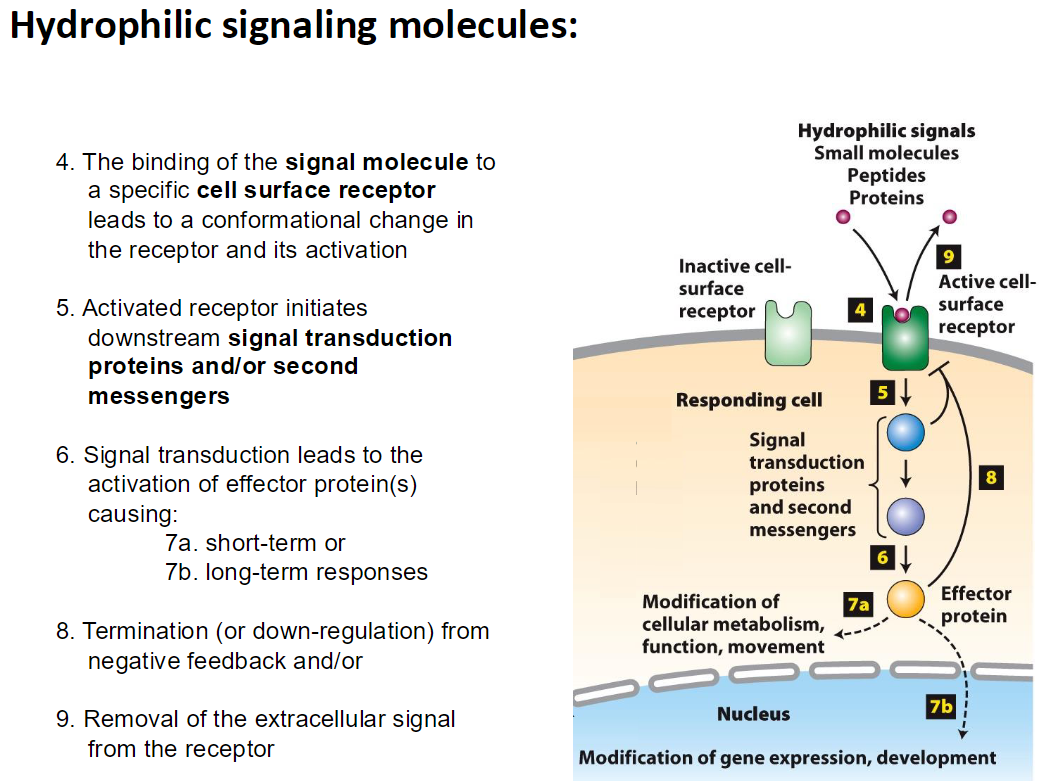
Hydrophilic Signaling – Stepwise Pathway

Steps:
4. Signal molecule binds to a specific cell-surface receptor → receptor undergoes conformational change → receptor becomes active
5. Activated receptor triggers downstream signal transduction proteins and/or generates second messengers
6. Signal transduction activates effector protein(s)
7a. Short-term response: cytosolic effectors modify enzymes → changes in metabolism, function, or movement
7b. Long-term response: effectors move into the nucleus → changes in gene expression
8. Termination / Down-regulation: negative feedback from intracellular signaling molecules inhibits early steps and/or:
9. Removal of the extracellular signal from the receptor ends the pathway

Key Points:
ā€ƒHydrophilic signals cannot cross the membrane → require membrane receptors
ā€ƒPathway can amplify the signal through multiple downstream proteins
ā€ƒFeedback ensures the response is controlled and reversible
<p><strong>Steps:</strong><br>4. Signal molecule binds to a <strong>specific cell-surface receptor</strong> → receptor undergoes <strong>conformational change</strong> → receptor becomes active<br>5. Activated receptor triggers <strong>downstream signal transduction proteins</strong> and/or generates <strong>second messengers</strong><br>6. Signal transduction activates <strong>effector protein(s)</strong><br>7a. <strong>Short-term response:</strong> cytosolic effectors modify enzymes → changes in metabolism, function, or movement<br>7b. <strong>Long-term response:</strong> effectors move into the nucleus → changes in gene expression<br>8. <strong>Termination / Down-regulation:</strong> negative feedback from intracellular signaling molecules inhibits early steps and/or:<br>9. <strong>Removal of the extracellular signal</strong> from the receptor ends the pathway</p><p><strong>Key Points:</strong><br>ā€ƒHydrophilic signals cannot cross the membrane → require membrane receptors<br>ā€ƒPathway can amplify the signal through multiple downstream proteins<br>ā€ƒFeedback ensures the response is controlled and reversible</p>
7
New cards

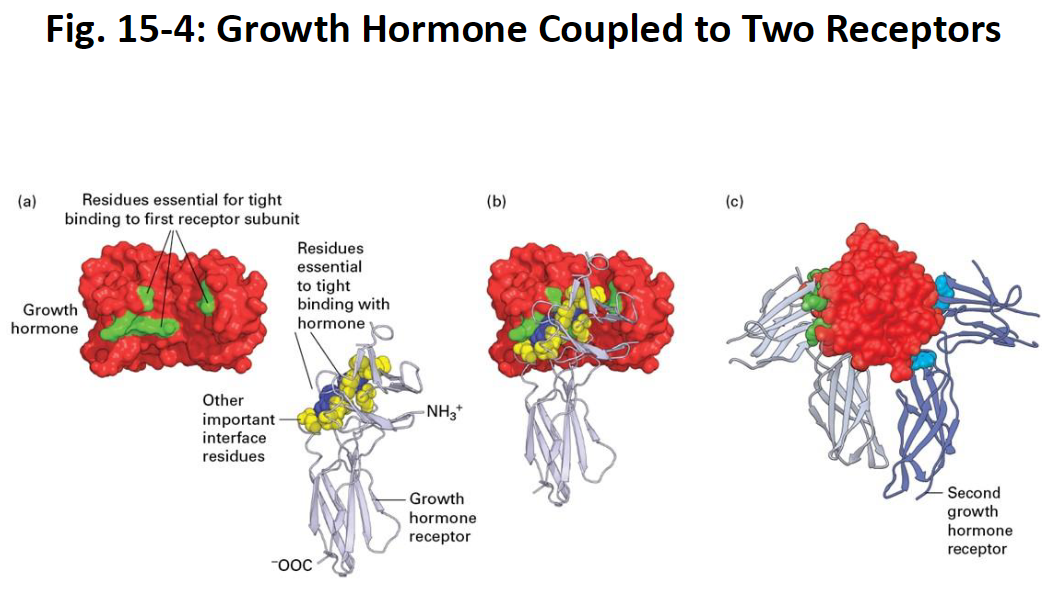
Growth Hormone Binding to Two Receptors (Steps from textbook, don’t need to know)

Overview
ā€ƒA single growth hormone (GH) protein binds simultaneously to two growth hormone receptors (GHRs)
ā€ƒBinding is mediated by multiple weak, noncovalent forces

Key Findings from Structural Studies

  • GH-Receptor Interface: 28 amino acids on GH interact with the first receptor

  • Critical Residues: Only 8 amino acids on GH contribute ~85% of the binding energy
    ā€ƒā€¢ These 8 residues are distant in the primary sequence but adjacent in the folded 3D structure

  • Receptor Contribution: Two tryptophan residues on the receptor provide most of the binding energy
    ā€ƒā€¢ Other receptor amino acids at the interface also contribute

Binding Sequence

  1. GH binds to the first receptor molecule (involving GH’s key residues and receptor interface residues)

  2. A second receptor molecule binds on the opposite side of GH
    ā€ƒā€¢ Uses the same critical amino acids on the receptor
    ā€ƒā€¢ Interacts with different residues on GH compared to the first receptor

Key Points
ā€ƒ- GH binding involves specific residues on both hormone and receptor
ā€ƒ- Multiple weak interactions combine to create strong and specific binding
ā€ƒ- Protein folding brings distant amino acids close together → essential for receptor interaction
<p><strong>Overview</strong><br>ā€ƒA single growth hormone (GH) protein binds <strong>simultaneously</strong> to two growth hormone receptors (GHRs)<br>ā€ƒBinding is mediated by <strong>multiple weak, noncovalent forces</strong></p><p><strong>Key Findings from Structural Studies</strong></p><ul><li><p><strong>GH-Receptor Interface:</strong> 28 amino acids on GH interact with the first receptor</p></li><li><p><strong>Critical Residues:</strong> Only <strong>8 amino acids</strong> on GH contribute ~85% of the binding energy<br>ā€ƒā€¢ These 8 residues are distant in the primary sequence but adjacent in the folded 3D structure</p></li><li><p><strong>Receptor Contribution:</strong> Two tryptophan residues on the receptor provide most of the binding energy<br>ā€ƒā€¢ Other receptor amino acids at the interface also contribute</p></li></ul><p><strong>Binding Sequence</strong></p><ol><li><p>GH binds to the <strong>first receptor molecule</strong> (involving GH’s key residues and receptor interface residues)</p></li><li><p>A <strong>second receptor molecule</strong> binds on the opposite side of GH<br>ā€ƒā€¢ Uses the same critical amino acids on the receptor<br>ā€ƒā€¢ Interacts with <strong>different residues on GH</strong> compared to the first receptor</p></li></ol><p><strong>Key Points</strong><br>ā€ƒ- GH binding involves <strong>specific residues on both hormone and receptor</strong><br>ā€ƒ- Multiple weak interactions combine to create <strong>strong and specific binding</strong><br>ā€ƒ- Protein folding brings distant amino acids close together → essential for receptor interaction</p>
8
New cards

Hormone Receptors – Activation of Effector Proteins

Overview
ā€ƒReceptors sense hormones and activate effector proteins inside the cell

Effector Proteins
ā€ƒSome are enzymes that make second messengers → carry and amplify the signal
ā€ƒSome are kinases or phosphatases → modify downstream proteins by adding or removing phosphate groups
ā€ƒSome are G-protein switches → directly activate downstream proteins

Outcome
ā€ƒReceptors transmit the hormone signal and control cellular responses like metabolism, function, or gene expression
<p><strong>Overview</strong><br>ā€ƒReceptors sense hormones and activate <strong>effector proteins</strong> inside the cell</p><p><strong>Effector Proteins</strong><br>ā€ƒSome are <strong>enzymes</strong> that make <strong>second messengers</strong> → carry and amplify the signal<br>ā€ƒSome are <strong>kinases or phosphatases</strong> → modify downstream proteins by adding or removing phosphate groups<br>ā€ƒSome are <strong>G-protein switches</strong> → directly activate downstream proteins</p><p><strong>Outcome</strong><br>ā€ƒReceptors transmit the hormone signal and control cellular responses like metabolism, function, or gene expression</p>
9
New cards

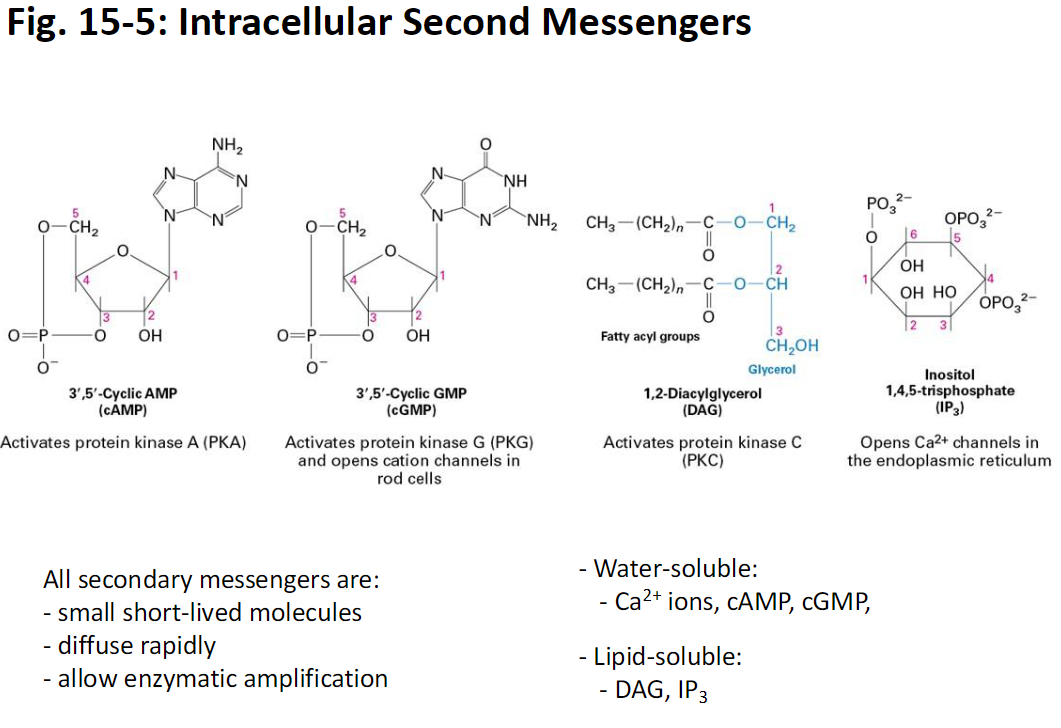
Intracellular Second Messengers

Overview
ā€ƒSecond messengers are small molecules produced by effector proteins
ā€ƒThey transmit and amplify signals from hormone-receptor complexes

Properties
ā€ƒSmall and short-lived
ā€ƒDiffuse rapidly within the cell
ā€ƒEnable enzymatic amplification of the signal

Types
ā€ƒWater-soluble: Ca²⁺ ions, cAMP, cGMP → move freely in cytosol
ā€ƒLipid-soluble: DAG, IPā‚ƒ → can interact with membrane-associated proteins

Outcome
ā€ƒCarry the signal from activated receptors to other proteins, amplifying the cellular response
<p><strong>Overview</strong><br>ā€ƒSecond messengers are small molecules produced by effector proteins<br>ā€ƒThey transmit and amplify signals from hormone-receptor complexes</p><p><strong>Properties</strong><br>ā€ƒSmall and short-lived<br>ā€ƒDiffuse rapidly within the cell<br>ā€ƒEnable <strong>enzymatic amplification</strong> of the signal</p><p><strong>Types</strong><br>ā€ƒWater-soluble: <strong>Ca²⁺ ions, cAMP, cGMP</strong> → move freely in cytosol<br>ā€ƒLipid-soluble: <strong>DAG, IPā‚ƒ</strong> → can interact with membrane-associated proteins</p><p><strong>Outcome</strong><br>ā€ƒCarry the signal from activated receptors to other proteins, amplifying the cellular response</p>
10
New cards

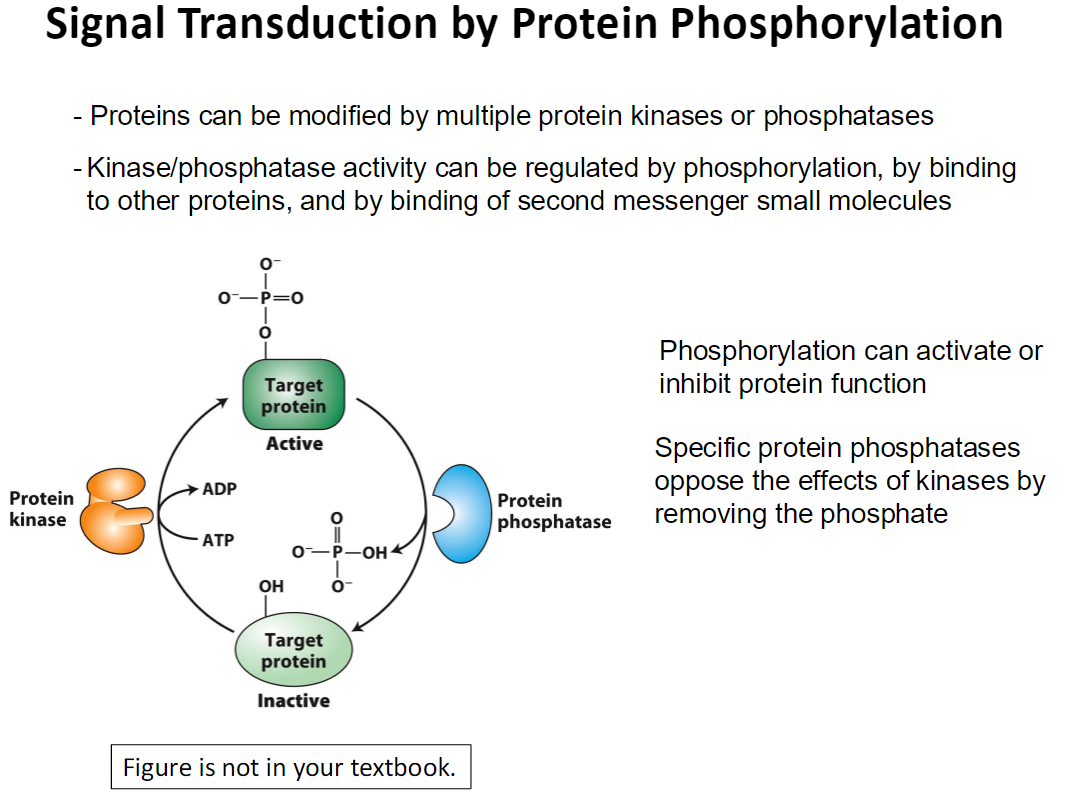
Signal Transduction by Protein Phosphorylation

Overview
ā€ƒProteins can be modified by multiple protein kinases or phosphatases
ā€ƒThese modifications regulate protein activity and propagate signals in the cell

Regulation of Kinases and Phosphatases
ā€ƒActivity can be controlled by:
ā€ƒā€ƒPhosphorylation of the kinase or phosphatase itself
ā€ƒā€ƒBinding to other proteins
ā€ƒā€ƒBinding of second messenger molecules

Effects of Phosphorylation
ā€ƒPhosphorylation can activate or inhibit a protein’s function
ā€ƒSpecific protein phosphatases remove phosphate groups to reverse kinase effects

Outcome
ā€ƒPhosphorylation and dephosphorylation allow fine control of signaling pathways and amplify cellular responses
<p><strong>Overview</strong><br>ā€ƒProteins can be modified by multiple <strong>protein kinases</strong> or <strong>phosphatases</strong><br>ā€ƒThese modifications regulate protein activity and propagate signals in the cell</p><p><strong>Regulation of Kinases and Phosphatases</strong><br>ā€ƒActivity can be controlled by:<br>ā€ƒā€ƒPhosphorylation of the kinase or phosphatase itself<br>ā€ƒā€ƒBinding to other proteins<br>ā€ƒā€ƒBinding of <strong>second messenger molecules</strong></p><p><strong>Effects of Phosphorylation</strong><br>ā€ƒPhosphorylation can <strong>activate or inhibit</strong> a protein’s function<br>ā€ƒSpecific <strong>protein phosphatases</strong> remove phosphate groups to <strong>reverse kinase effects</strong></p><p><strong>Outcome</strong><br>ā€ƒPhosphorylation and dephosphorylation allow fine control of signaling pathways and amplify cellular responses</p>
11
New cards

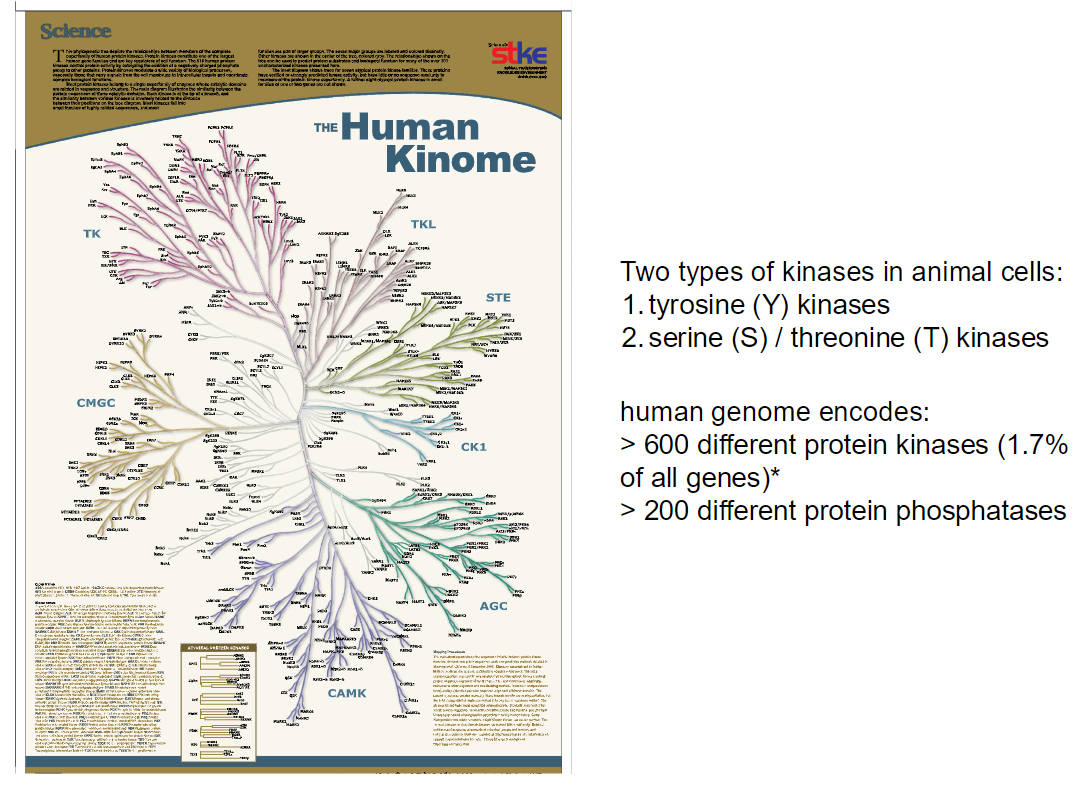
Protein Kinases and Phosphatases in Animal Cells

Kinase Types
ā€ƒTwo main types of protein kinases in animal cells:
ā€ƒā€ƒTyrosine (Y) kinases
ā€ƒā€ƒSerine (S) / Threonine (T) kinases

Human Genome
ā€ƒEncodes more than 600 different protein kinases (~1.7% of all genes)
ā€ƒEncodes over 200 different protein phosphatases

Overview
ā€ƒKinases add phosphate groups to proteins, regulating their activity
ā€ƒPhosphatases remove phosphate groups, reversing kinase effects
ā€ƒTogether, they control cellular signaling pathways precisely
<p><strong>Kinase Types</strong><br>ā€ƒTwo main types of protein kinases in animal cells:<br>ā€ƒā€ƒTyrosine (Y) kinases<br>ā€ƒā€ƒSerine (S) / Threonine (T) kinases</p><p><strong>Human Genome</strong><br>ā€ƒEncodes more than <strong>600 different protein kinases</strong> (~1.7% of all genes)<br>ā€ƒEncodes over <strong>200 different protein phosphatases</strong></p><p><strong>Overview</strong><br>ā€ƒKinases add phosphate groups to proteins, regulating their activity<br>ā€ƒPhosphatases remove phosphate groups, reversing kinase effects<br>ā€ƒTogether, they control cellular signaling pathways precisely</p>
12
New cards

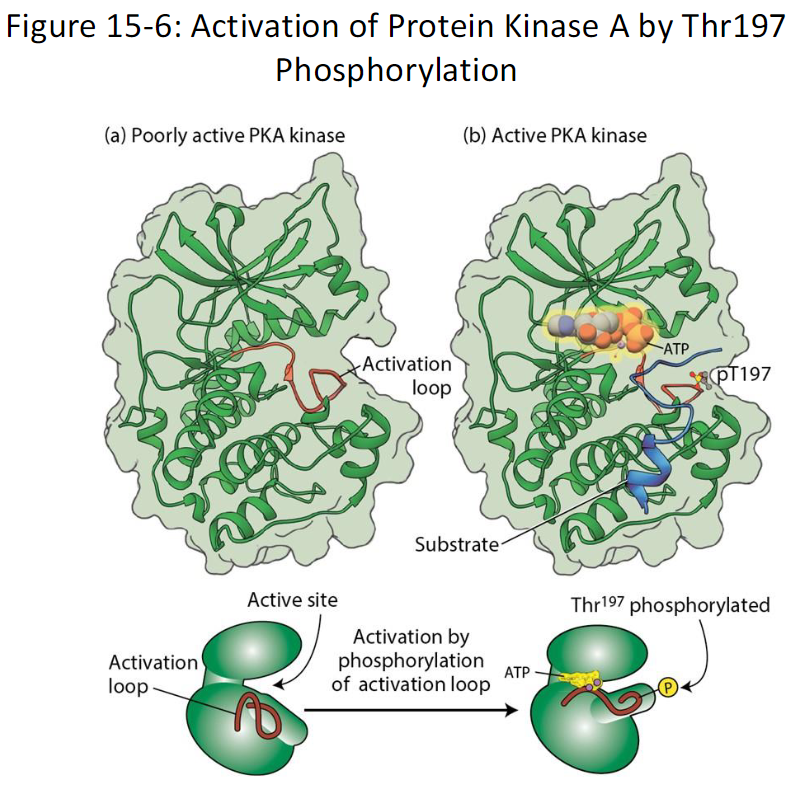
Activation of Protein Kinase A (PKA) by Phosphorylation *Don’t need to know

Overview
ā€ƒProtein kinase A (PKA) exists in an inactive, unphosphorylated form
ā€ƒActivation occurs through phosphorylation of a threonine residue (Thr197) in the activation loop

Mechanism
ā€ƒPhosphorylation at Thr197 causes a conformational change in the activation loop
ā€ƒThis change allows PKA to bind ATP and substrate proteins, enabling its kinase activity
ā€ƒPhosphorylation also allows PKA to bind its inhibitory subunit R, which regulates activity via cAMP

Additional Notes
ā€ƒPKA can autophosphorylate Thr197
ā€ƒOther cellular kinases can also phosphorylate this residue
ā€ƒSimilar phosphorylation-dependent activation occurs in many other protein kinases

Outcome
ā€ƒPhosphorylation of Thr197 switches PKA from inactive to active
ā€ƒEnables it to phosphorylate downstream target proteins and propagate cellular signals
<p><strong>Overview</strong><br>ā€ƒProtein kinase A (PKA) exists in an inactive, unphosphorylated form<br>ā€ƒActivation occurs through phosphorylation of a <strong>threonine residue (Thr197)</strong> in the activation loop</p><p><strong>Mechanism</strong><br>ā€ƒPhosphorylation at Thr197 causes a <strong>conformational change</strong> in the activation loop<br>ā€ƒThis change allows PKA to <strong>bind ATP and substrate proteins</strong>, enabling its kinase activity<br>ā€ƒPhosphorylation also allows PKA to <strong>bind its inhibitory subunit R</strong>, which regulates activity via cAMP</p><p><strong>Additional Notes</strong><br>ā€ƒPKA can <strong>autophosphorylate</strong> Thr197<br>ā€ƒOther cellular kinases can also phosphorylate this residue<br>ā€ƒSimilar phosphorylation-dependent activation occurs in many other protein kinases</p><p><strong>Outcome</strong><br>ā€ƒPhosphorylation of Thr197 switches PKA from inactive to active<br>ā€ƒEnables it to phosphorylate downstream target proteins and propagate cellular signals</p>
13
New cards

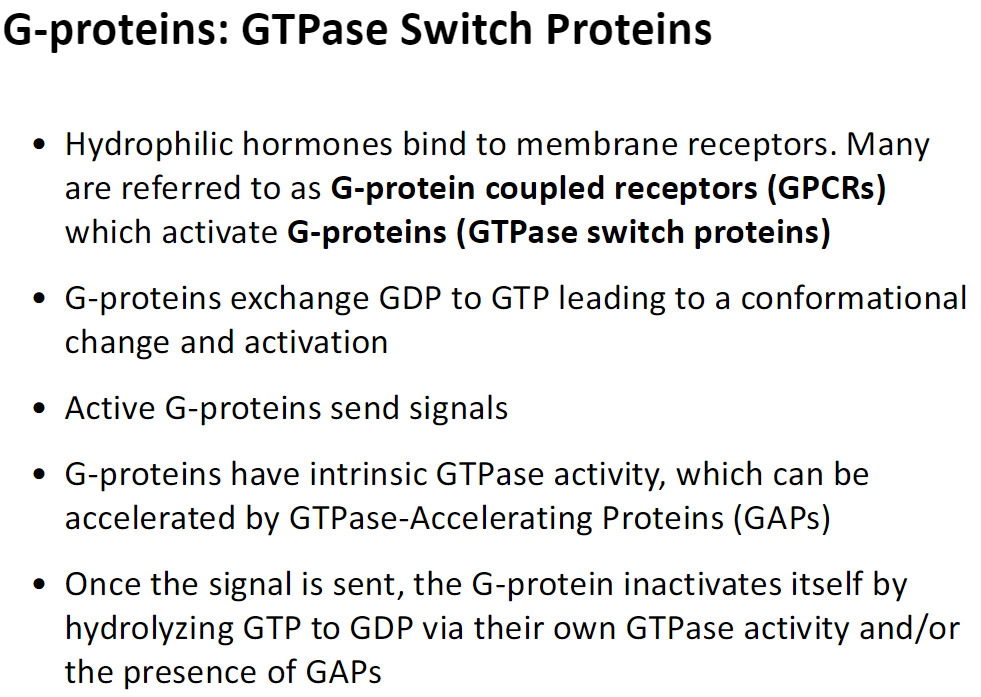
G-Proteins: GTPase Switch Proteins

Overview
ā€ƒHydrophilic hormones bind to membrane receptors, often called G-protein coupled receptors (GPCRs)
ā€ƒThese receptors activate G-proteins, which are GTPase switch proteins

Activation Mechanism
ā€ƒG-proteins exchange GDP for GTP, causing a conformational change and activation
ā€ƒActive G-proteins transmit signals to downstream effectors

Inactivation
ā€ƒG-proteins have intrinsic GTPase activity
ā€ƒGTPase-Accelerating Proteins (GAPs) can speed up GTP hydrolysis
ā€ƒHydrolysis of GTP to GDP inactivates the G-protein and stops the signal

Outcome
ā€ƒG-proteins act as molecular switches, turning signaling on when bound to GTP and off when hydrolyzing it to GDP
<p><strong>Overview</strong><br>ā€ƒHydrophilic hormones bind to <strong>membrane receptors</strong>, often called <strong>G-protein coupled receptors (GPCRs)</strong><br>ā€ƒThese receptors activate <strong>G-proteins</strong>, which are <strong>GTPase switch proteins</strong></p><p><strong>Activation Mechanism</strong><br>ā€ƒG-proteins exchange <strong>GDP for GTP</strong>, causing a <strong>conformational change</strong> and activation<br>ā€ƒActive G-proteins transmit signals to downstream effectors</p><p><strong>Inactivation</strong><br>ā€ƒG-proteins have <strong>intrinsic GTPase activity</strong><br>ā€ƒGTPase-Accelerating Proteins (GAPs) can speed up GTP hydrolysis<br>ā€ƒHydrolysis of GTP to GDP <strong>inactivates the G-protein</strong> and stops the signal</p><p><strong>Outcome</strong><br>ā€ƒG-proteins act as molecular switches, turning signaling <strong>on</strong> when bound to GTP and <strong>off</strong> when hydrolyzing it to GDP</p>
14
New cards

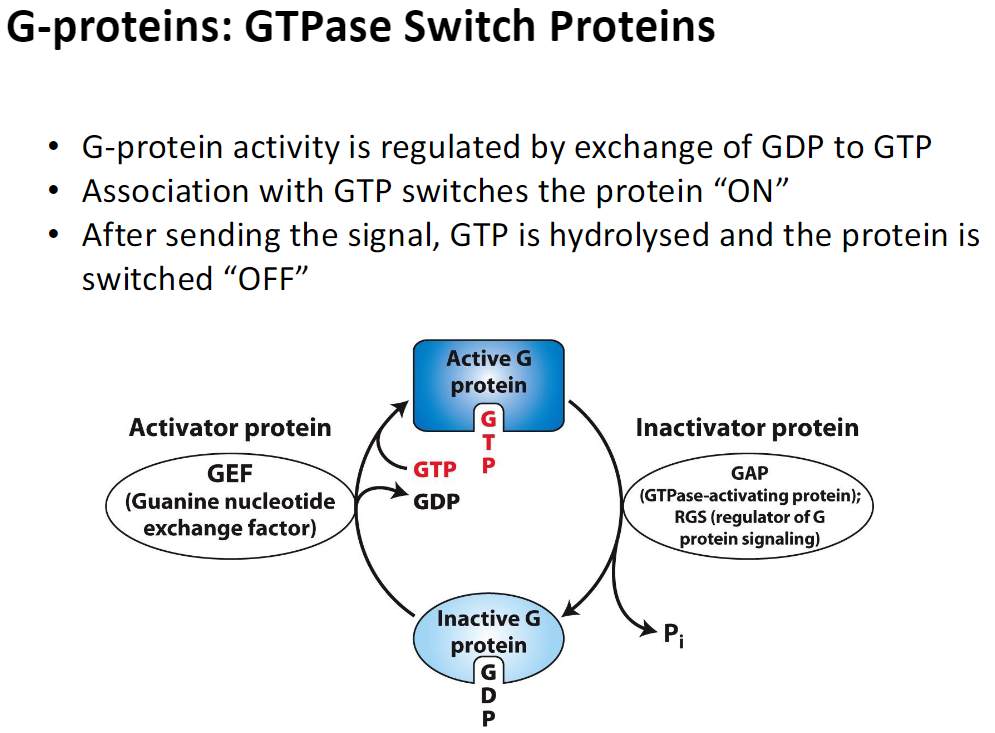
G-Proteins: GTPase Switch Proteins – Regulation

Overview
ā€ƒG-protein activity is controlled by the exchange of GDP for GTP

Activation
ā€ƒBinding of GTP switches the G-protein ON
ā€ƒActivator proteins called GEFs (Guanine nucleotide exchange factors) promote this GDP → GTP exchange
ā€ƒActive G-proteins transmit signals to downstream effectors

Inactivation
ā€ƒAfter signaling, GTP is hydrolyzed to GDP → switches the G-protein OFF
ā€ƒInactivator proteins such as GAPs (GTPase-activating proteins) or RGS (regulators of G-protein signaling) accelerate this hydrolysis

Outcome
ā€ƒG-proteins act as molecular switches, cycling between active (GTP-bound) and inactive (GDP-bound) states to regulate signal transduction
<p><strong>Overview</strong><br>ā€ƒG-protein activity is controlled by the <strong>exchange of GDP for GTP</strong></p><p><strong>Activation</strong><br>ā€ƒBinding of <strong>GTP</strong> switches the G-protein <strong>ON</strong><br>ā€ƒActivator proteins called <strong>GEFs (Guanine nucleotide exchange factors)</strong> promote this GDP → GTP exchange<br>ā€ƒActive G-proteins transmit signals to downstream effectors</p><p><strong>Inactivation</strong><br>ā€ƒAfter signaling, <strong>GTP is hydrolyzed</strong> to GDP → switches the G-protein <strong>OFF</strong><br>ā€ƒInactivator proteins such as <strong>GAPs (GTPase-activating proteins)</strong> or <strong>RGS (regulators of G-protein signaling)</strong> accelerate this hydrolysis</p><p><strong>Outcome</strong><br>ā€ƒG-proteins act as <strong>molecular switches</strong>, cycling between active (GTP-bound) and inactive (GDP-bound) states to regulate signal transduction</p>
15
New cards

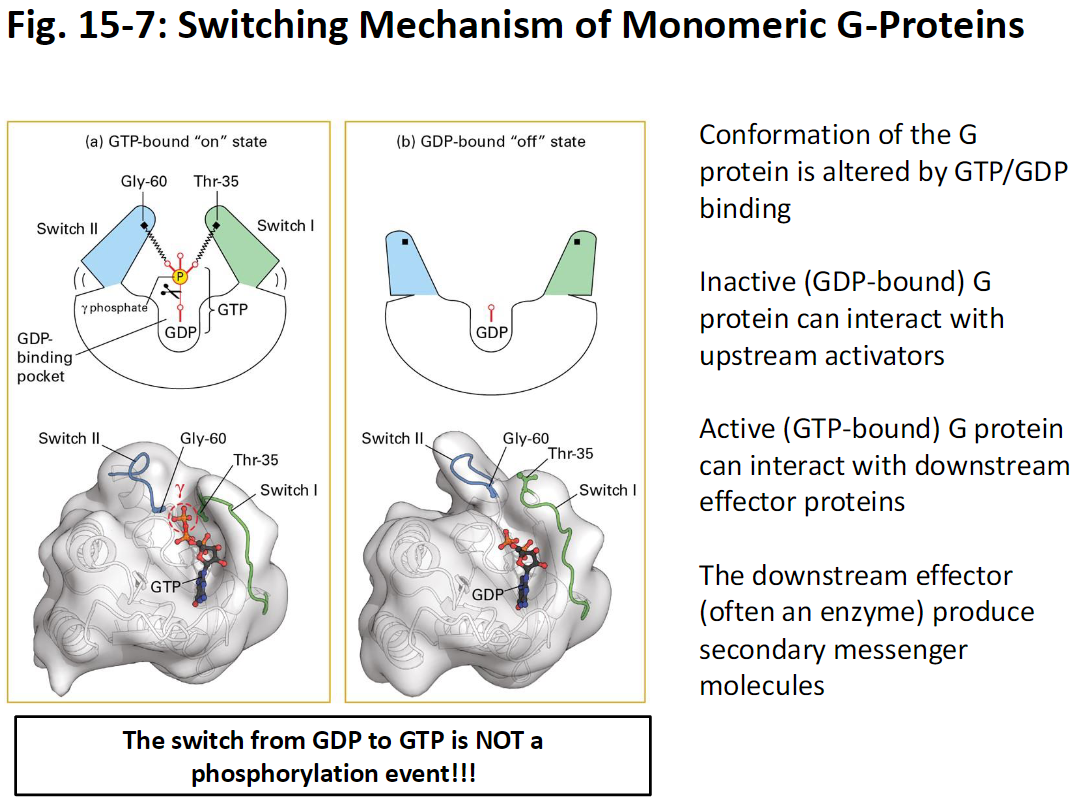
Switching Mechanism of Monomeric G-Proteins

Overview
ā€ƒG-protein conformation changes depending on whether GDP or GTP is bound

Inactive State
ā€ƒG-protein bound to GDP is inactive
ā€ƒCan interact with upstream activator proteins

Active State
ā€ƒG-protein bound to GTP is active
ā€ƒCan interact with downstream effector proteins, often enzymes
ā€ƒEffectors produce second messenger molecules to transmit and amplify the signal

Key Point
ā€ƒThe switch from GDP to GTP is not a phosphorylation event
ā€ƒIt is a conformational change caused by nucleotide exchange
<p><strong>Overview</strong><br>ā€ƒG-protein conformation changes depending on whether <strong>GDP or GTP</strong> is bound</p><p><strong>Inactive State</strong><br>ā€ƒG-protein bound to <strong>GDP</strong> is inactive<br>ā€ƒCan interact with <strong>upstream activator proteins</strong></p><p><strong>Active State</strong><br>ā€ƒG-protein bound to <strong>GTP</strong> is active<br>ā€ƒCan interact with <strong>downstream effector proteins</strong>, often enzymes<br>ā€ƒEffectors produce <strong>second messenger molecules</strong> to transmit and amplify the signal</p><p><strong>Key Point</strong><br>ā€ƒThe switch from <strong>GDP to GTP is not a phosphorylation event</strong><br>ā€ƒIt is a conformational change caused by nucleotide exchange</p>
16
New cards

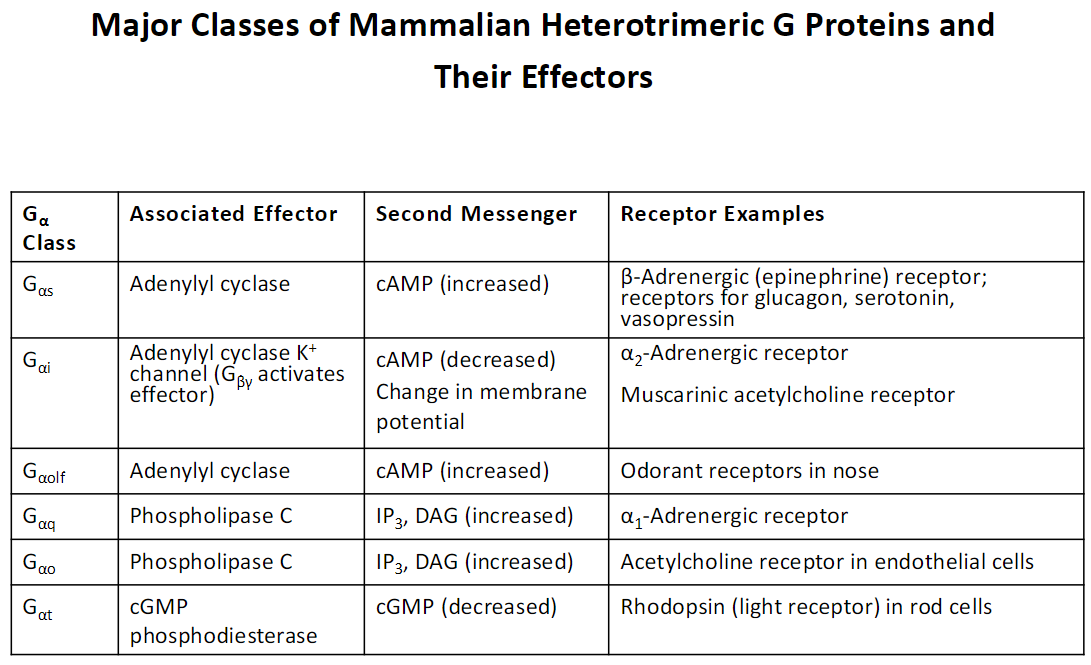
Major Classes of Mammalian Heterotrimeric G Proteins and Their Effectors *Just know if second messengers increase or decrease

Gαs
ā€ƒEffector: Adenylyl cyclase
ā€ƒSecond Messenger: cAMP (increased)
ā€ƒReceptor Examples: β-Adrenergic (epinephrine) receptor, glucagon, serotonin, vasopressin receptors

Gαi
ā€ƒEffector: Adenylyl cyclase, K⁺ channels (Gβγ activates effector)
ā€ƒSecond Messenger: cAMP (decreased), change in membrane potential
ā€ƒReceptor Examples: α2-Adrenergic receptor, muscarinic acetylcholine receptor

Gαolf
ā€ƒEffector: Adenylyl cyclase
ā€ƒSecond Messenger: cAMP (increased)
ā€ƒReceptor Examples: Odorant receptors in the nose

Gαq
ā€ƒEffector: Phospholipase C
ā€ƒSecond Messenger: IPā‚ƒ, DAG (increased)
ā€ƒReceptor Examples: α1-Adrenergic receptor

Gαo
ā€ƒEffector: Phospholipase C
ā€ƒSecond Messenger: IPā‚ƒ, DAG (increased)
ā€ƒReceptor Examples: Acetylcholine receptor in endothelial cells

Gαt
ā€ƒEffector: cGMP phosphodiesterase
ā€ƒSecond Messenger: cGMP (decreased)
ā€ƒReceptor Examples: Rhodopsin (light receptor) in rod cells
<p><strong>Gαs</strong><br>ā€ƒEffector: <strong>Adenylyl cyclase</strong><br>ā€ƒSecond Messenger: <strong>cAMP (increased)</strong><br>ā€ƒReceptor Examples: β-Adrenergic (epinephrine) receptor, glucagon, serotonin, vasopressin receptors</p><p><strong>Gαi</strong><br>ā€ƒEffector: <strong>Adenylyl cyclase, K⁺ channels (Gβγ activates effector)</strong><br>ā€ƒSecond Messenger: <strong>cAMP (decreased), change in membrane potential</strong><br>ā€ƒReceptor Examples: α2-Adrenergic receptor, muscarinic acetylcholine receptor</p><p><strong>Gαolf</strong><br>ā€ƒEffector: <strong>Adenylyl cyclase</strong><br>ā€ƒSecond Messenger: <strong>cAMP (increased)</strong><br>ā€ƒReceptor Examples: Odorant receptors in the nose</p><p><strong>Gαq</strong><br>ā€ƒEffector: <strong>Phospholipase C</strong><br>ā€ƒSecond Messenger: <strong>IPā‚ƒ, DAG (increased)</strong><br>ā€ƒReceptor Examples: α1-Adrenergic receptor</p><p><strong>Gαo</strong><br>ā€ƒEffector: <strong>Phospholipase C</strong><br>ā€ƒSecond Messenger: <strong>IPā‚ƒ, DAG (increased)</strong><br>ā€ƒReceptor Examples: Acetylcholine receptor in endothelial cells</p><p><strong>Gαt</strong><br>ā€ƒEffector: <strong>cGMP phosphodiesterase</strong><br>ā€ƒSecond Messenger: <strong>cGMP (decreased)</strong><br>ā€ƒReceptor Examples: Rhodopsin (light receptor) in rod cells</p>
17
New cards

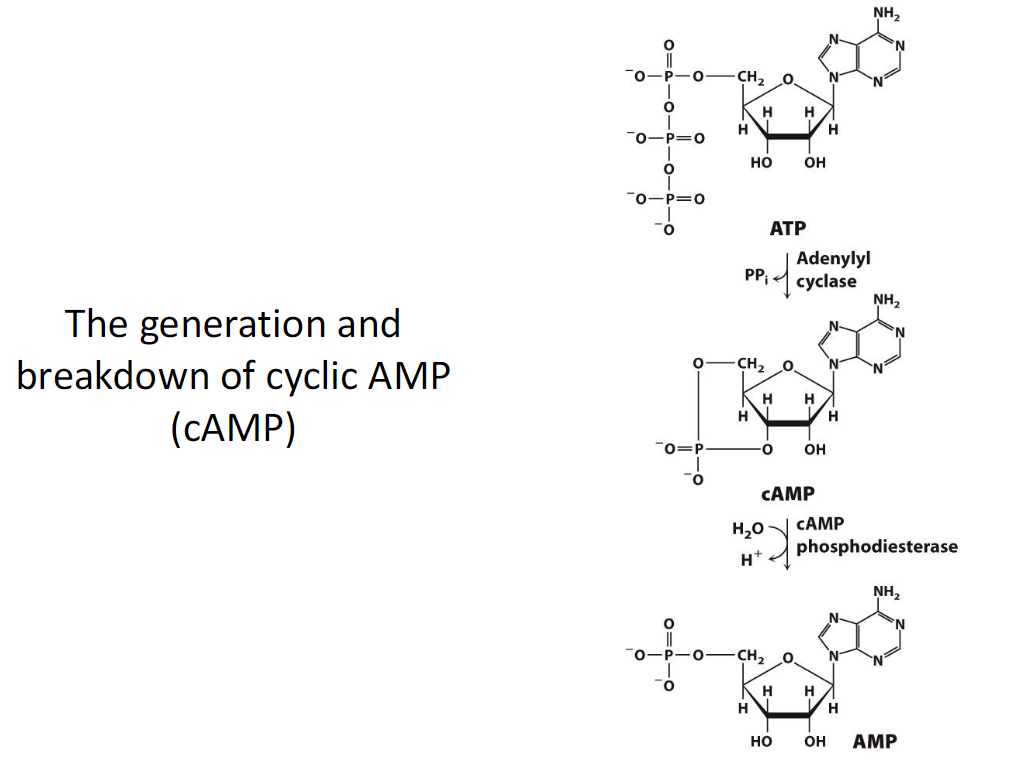
Generation and Breakdown of cAMP *Don’t need to know

Overview
ā€ƒcAMP (cyclic AMP) is a second messenger produced from ATP by the enzyme adenylyl cyclase

Generation
ā€ƒATP is converted into cAMP by adenylyl cyclase when a G-protein (Gαs) activates it
ā€ƒcAMP carries and amplifies the signal to downstream effectors

Breakdown
ā€ƒcAMP phosphodiesterase converts cAMP into AMP, terminating the signal
ā€ƒThis ensures that the signal is short-lived and tightly controlled

Outcome
ā€ƒcAMP levels regulate cellular responses by activating cAMP-dependent protein kinases (PKA) and other effectors
<p><strong>Overview</strong><br>ā€ƒ<strong>cAMP (cyclic AMP)</strong> is a second messenger produced from <strong>ATP</strong> by the enzyme <strong>adenylyl cyclase</strong></p><p><strong>Generation</strong><br>ā€ƒATP is converted into <strong>cAMP</strong> by adenylyl cyclase when a <strong>G-protein (Gαs)</strong> activates it<br>ā€ƒcAMP carries and amplifies the signal to downstream effectors</p><p><strong>Breakdown</strong><br>ā€ƒ<strong>cAMP phosphodiesterase</strong> converts cAMP into <strong>AMP</strong>, terminating the signal<br>ā€ƒThis ensures that the signal is <strong>short-lived</strong> and tightly controlled</p><p><strong>Outcome</strong><br>ā€ƒcAMP levels regulate cellular responses by activating <strong>cAMP-dependent protein kinases (PKA)</strong> and other effectors</p>
18
New cards

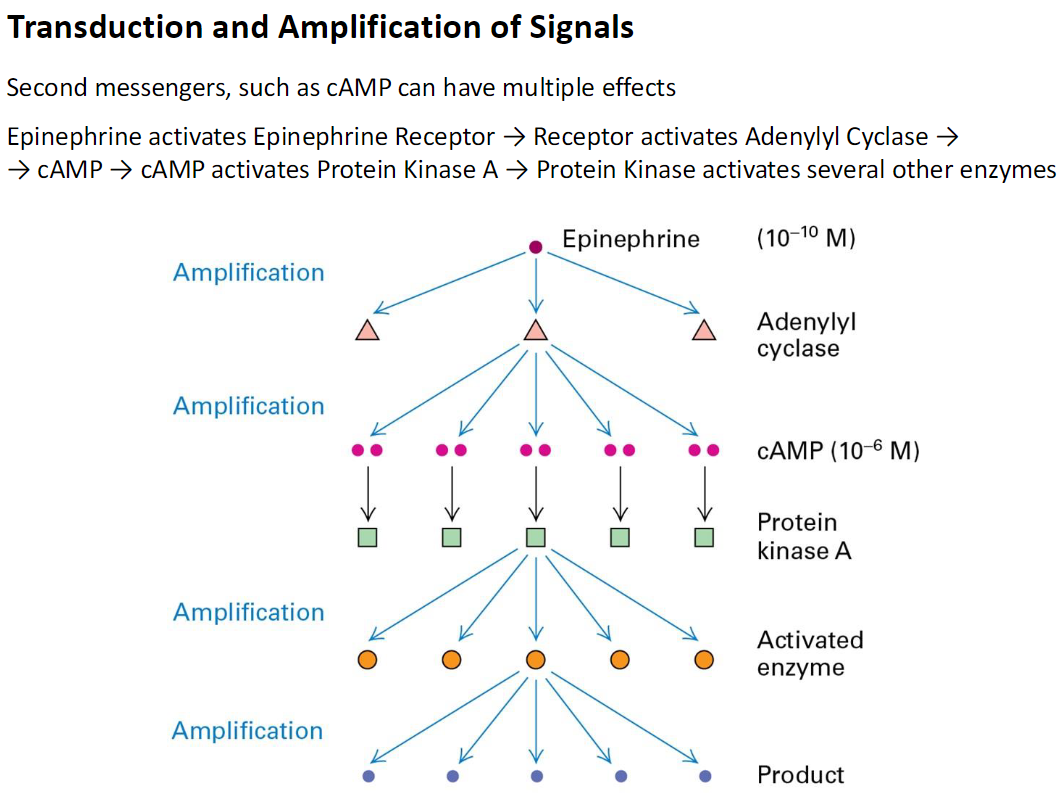
Transduction and Amplification of Signals

Overview
ā€ƒSecond messengers, like cAMP, transmit and amplify signals from hormones

Example: Epinephrine Signaling
ā€ƒEpinephrine binds to its receptor → activates adenylyl cyclase → produces cAMP
ā€ƒcAMP activates Protein Kinase A (PKA) → PKA activates multiple downstream enzymes

Amplification
ā€ƒOne epinephrine molecule (10⁻¹⁰ M) → many cAMP molecules (10⁻⁶ M)
ā€ƒEach PKA molecule can activate several enzymes → large-scale production of final products

Outcome
ā€ƒSignal amplification ensures that a small amount of hormone can trigger a strong cellular response
<p><strong>Overview</strong><br>ā€ƒSecond messengers, like <strong>cAMP</strong>, transmit and <strong>amplify signals</strong> from hormones</p><p><strong>Example: Epinephrine Signaling</strong><br>ā€ƒEpinephrine binds to its receptor → activates <strong>adenylyl cyclase</strong> → produces <strong>cAMP</strong><br>ā€ƒcAMP activates <strong>Protein Kinase A (PKA)</strong> → PKA activates multiple downstream enzymes</p><p><strong>Amplification</strong><br>ā€ƒOne epinephrine molecule (10⁻¹⁰ M) → many cAMP molecules (10⁻⁶ M)<br>ā€ƒEach PKA molecule can activate several enzymes → large-scale production of final products</p><p><strong>Outcome</strong><br>ā€ƒSignal amplification ensures that <strong>a small amount of hormone can trigger a strong cellular response</strong></p>