Astronomy Final
 Studied by 3 people
 Call Kai
 Learn
Learn Practice Test
 Spaced Repetition
 Match
Match Flashcards
 Knowt Play
1/82

There's no tags or description
Looks like no tags are added yet.
Name | Mastery | Learn | Test | Matching | Spaced | Call with Kai |
|---|
No analytics yet
Send a link to your students to track their progress
83 Terms
How do we observe the life histories of galaxies?
We know galaxies evolve because it takes time for light to reach us, the farther the galaxy the longer it takes
All galaxies formed at the same time, they just appear to be different ages to us because of distance
Farther galaxies are redshifted away from us
The farther ones look younger
Young galaxies are irregular, older have some structure (spiral, elliptical, some irregular)
Dotted line - after about 3. smth billion years galaxies started to have structure and evolve from the young irregular shapes
Observing galaxies at different distances shows us how they age
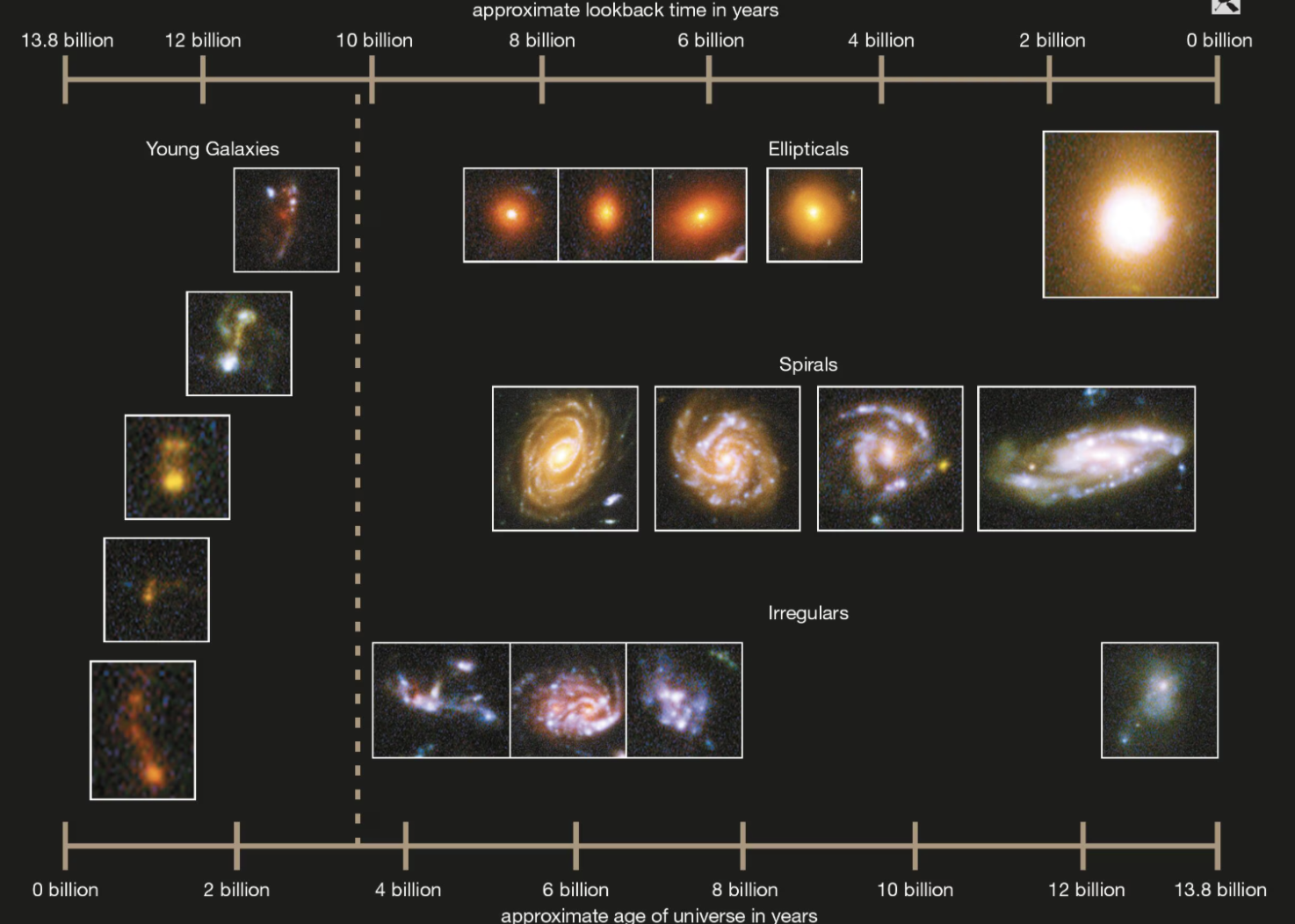
Lookback time
Linked to its age (age of universe - lookback time = age of galaxy)
How long it takes light to travel to us
Ex. a distant galaxy with a lookback time of 13 billion years means we are seeing the galaxy as if it was around a billion years old since the universe is 14 billion years old
Ex. a nearby galaxy with a lookback time of 1 billion years means the galaxy could be more than 13 billion years old
How do we know how galaxies are formed
We can’t directly observe the earliest galaxies
We still haven’t observed the faintest(earliest) galaxies
→ Our best models for galaxy formation assume:
Matter originally filled all of space almost uniformly
Gravity of denser regions pulled in surrounding matter
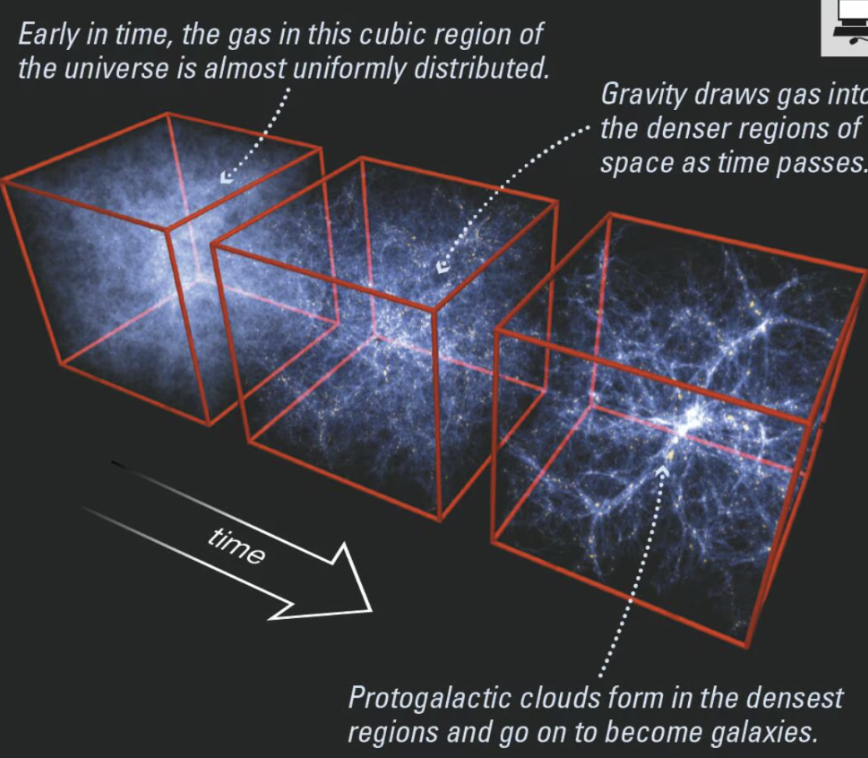
We start with mostly uniform universe and then we get clumpy structures (cuz gravity pulls matter ⇒ galaxies form where there is the most matter)
Galaxy formation steps
Initially gas in the universe was uniformly distributed
Gravity pulls in gas into denser regions of space(contracts gas), forming protogalactic clouds
Hydrogen and helium gas in these clouds formed the first stars
Supernova explosions from the first stars prevented a lot of star formation (disrupted material around them)
Leftover gas settled into a spinning disk due to the conservation of angular momentum
Recap:
1) How do we observe the life histories of galaxies?
2) How do we study galaxy formation?
1) Deep observations of the universe show us the history of galaxies because we are seeing galaxies as they were at different ages
2) Our best models for galaxy formation assume that gravity made galaxies out of regions in the early universe that were slightly denser than their surroundings
Why do galaxies differ?
Two initial things that dictate why galaxies differ - conditions in the protogalactic cloud
Spin
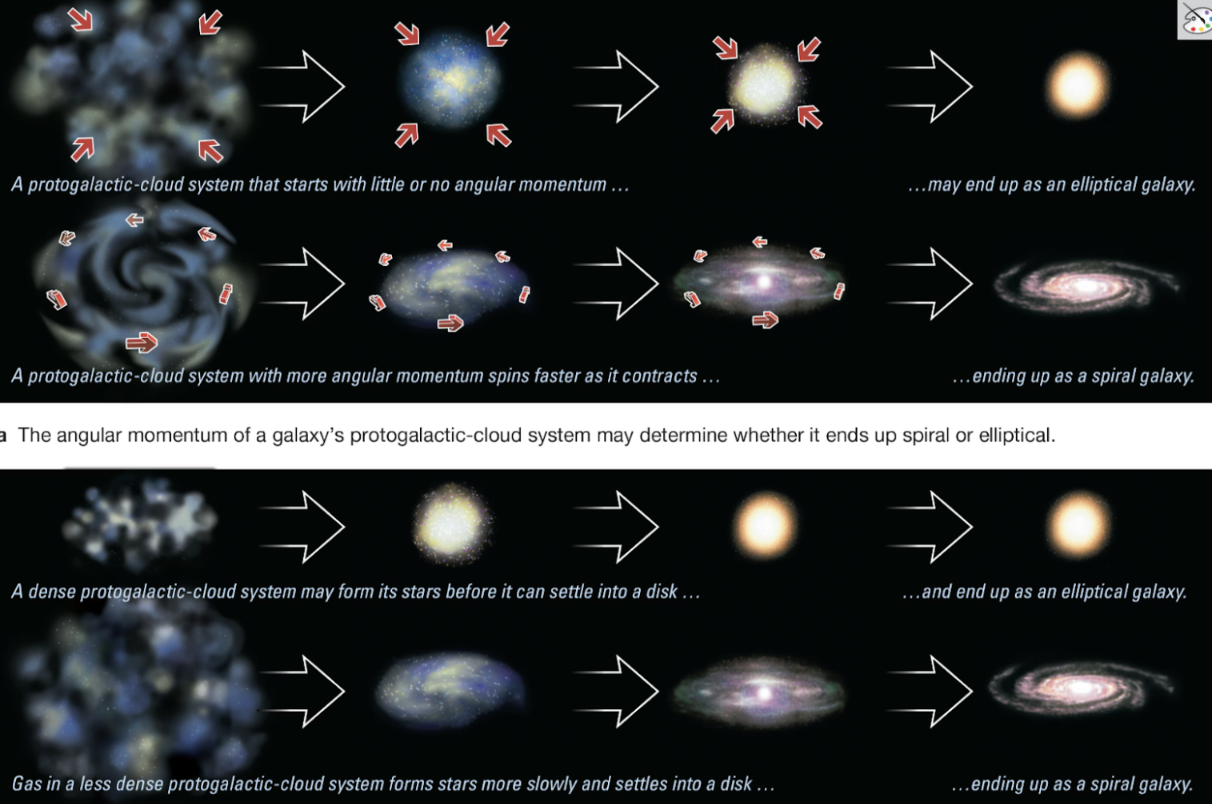
The initial angular momentum of the protogalactic cloud could determine the size of the resulting disk
More spin + higher angular momentum = Spiral galaxy
Less spin = lower angular momentum = Elliptical
Density
Elliptical galaxies could come from dense protogalactic clouds that were able to cool and form stars before gas settled into a disk
High density = Elliptical
Lower density = Spiral galaxy
Behavior of elliptical galaxies is like the bulge essentially
Distant red ellipticals
Observations of some distant red elliptical galaxies support the idea that most of their stars formed very early in the history of the universe
Because they lack blue/white stars, it indicates that new stars don’t form within them anymore, even though we are seeing them as they were when the universe was young
→ This suggests that the stars in these elliptical galaxies were formed at the same time, which is consistent with the idea that all the stars formed before a disk could develop
Elliptical galaxies appear yellow/orange, some are red because their stars formed very early in the universe
Mergers/collisions
Can lead to elliptical or irregular galaxies
Collisions were much more likely early in time because galaxies were closer together
There is a lot of star formation because the gas is being compressed after merging → collisions trigger bursts of star formation
Two spiral galaxies can merge to make an elliptical
Cuz when you look at clusters of galaxies you see more of them
Collisions may explain why elliptical galaxies tend to be found where galaxies are closet together (cuz theres more matter there and more mergers)
More collisions were happening in the past universe cuz it was smaller back then than today, which is why more irregular galaxies are seen
Starburst galaxies
Form stars so quickly that they would use up all their gas in less than a billion years
Undergo star formation at a very high rate
Haha burst
Depends critically on the rate at which hot gas in a galaxy’s halo can cool and resupply the cold clouds needed for star formation.
Very extreme star formation cuz they had a merger recently or are going to soon
Recap:
1) Why do galaxies differ?
2) What are starbursts?
1) Some of the differences between galaxies may arise from the conditions in their protogalactic clouds
→ Collisions can play a major role because they can transform two spiral galaxies into an elliptical galaxy
2) A starburst galaxy is transforming its gas into stars much more rapidly than a normal galaxy
How are quasars powered
If the center of a galaxy is unusually bright, we can call it an AGN = active galactic nucleus
Quasars are the most luminous examples of AGN’s
Very bright center (outshines the rest of the galaxy)
Sometimes have jets of material that shoot outward
Variability shows that all this energy comes from a region smaller than our solar system
Quasars have very high redshifts
→ Indicates large distances away from us, more common in the early universe
No Quasars at low redshifts
Only at very very high redshift, AGN is also but not as much
Quasars emit radiation at all wavelengths, which means they contain matter with a wide range of temperatures
Galaxies around quasars appear to be disturbed by collisions, (merging) because galaxies were close together in the early universe, which is also why quasars were more common in the early universe, things used to be closer together
It's the accretion disk around the black hole that emits radiation, black holes themselves don’t emit radiation, they just affect what's around them
The younger the galaxy, the more likely it is to have an accretion disk
AGN are a phase galaxies go through
Radio galaxies
Contain active galactic nuclei shooting out jets of plasma that emits radio waves coming from electrons that move at near light speed
The speed suggests the presence of a black hole, and that these jets are coming from the supermassive black hole in the center & its accretion disk
There's rotation of the jet coming out
Jets are pushed back as the galaxy moves forward (like the badminton thing)
Lot of energy being transferred to the jets and its moving fast
Radio galaxies don’t appear as quasars because dusty gas clouds block our view of the accretion disk
Characteristics of AGN
Very luminous
Luminosity can rapidly vary (come from a space smaller than the solar system)
They emit energy over a wide range of wavelengths (contain matter with a wide temperature range)
Some galaxies drive jets of plasma at near light speed
Energy from a black hole
Accretion of gas onto a supermassive black hole appears to be the only way to explain all the properties of quasars and radio galaxies (the supermassive black holes are at the centers of the galaxies)
Gravitational potential energy of matter falling into black hole turns into kinetic energy
Friction in an accretion disk turns kinetic energy into thermal energy (heat)
Heat produces thermal radiation (photons)
This process can convert 10-40% of matter into radiation E = mc^2, not all of it
Area near a black hole
We can measure the orbital speed and distance of gas orbiting the center of a galaxy to find the mass of the black hole in the center of the galaxy
Around the supermassive black hole, we just see the warped bent pathway of light around the black hole
Black holes in galaxies
Many nearby galaxies, perhaps all of them, have supermassive black holes at their centers
These black holes seem to be dormant(temporarily inactive- nothing falling in) active galactic nuclei
Many galaxies may have passed through a quasar-like stage earlier in time
Galaxies where you see more mass in the bulge is correlated with the mass of the black hole (= more mass of stars in the bulge) cuz the matter goes to the center of the galaxy, they formed along with the galaxy, which is linked to how much matter was initially in the intergalactic cloud
Random black hole deets
The orbital speeds of gas near the black hole yield its mass
Supermassive black holes probably exist at the centers of all galaxies
Normal galactic nuclei do not contain accretion disks
Material in the accretion disk is an AGN’s source of fuel, without it the black hole can only be found by gravitational effects
How do quasars let us study gas between the galaxies?
Accretion disk (material surrounding the BH) that gives us luminosity or smth
We can’t exactly measure the IGM, but we can use quasars to do so
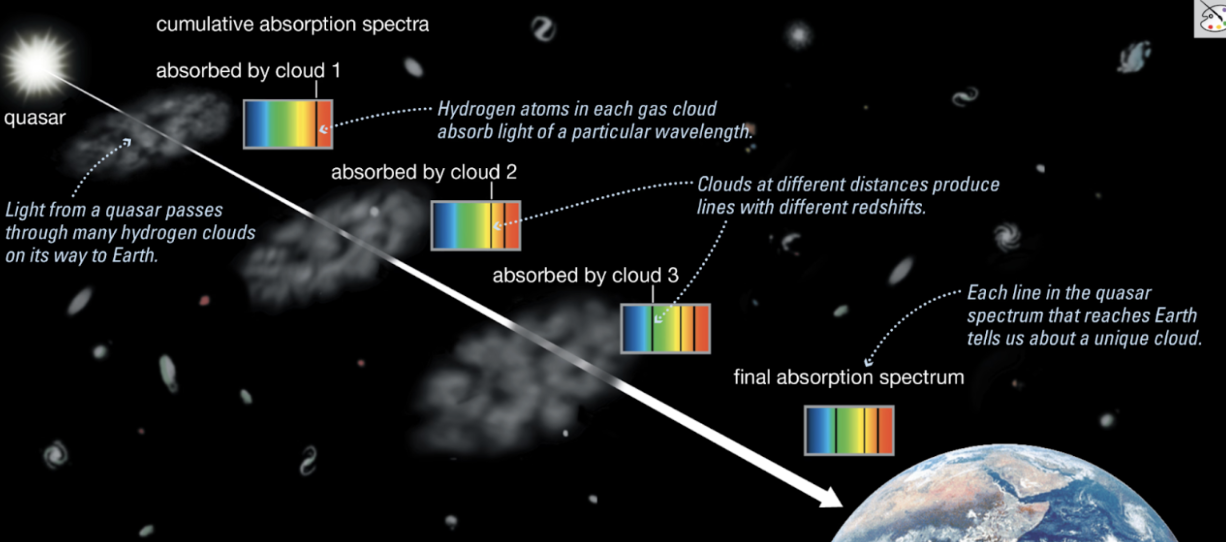
There’s gas between quasars and earth, so these intergalactic gas clouds absorb this light
When you take a spectrum from the earth of the quasar, you get the hydrogen absorption lines from the clouds between you and the quasar. Look for additional hydrogen absorption lines that didn’t come from the quasar itself.
We can learn about protogalactic clouds by studying the absorption lines they produce in quasar spectra (the intergalactic gas clouds absorb the quasar emission)
More importantly for quasar spectra, we see these hydrogen lines at different redshifts for gas clouds at different distances. The reason is cosmological redshift, which means that light from more distant clouds in our expanding universe is more highly redshifted.
Intergalactic medium/gas clouds between us and quasar, the ones further away are more pristine, and the ones closer have more than just basic ‘ol H and He, and now it has more metals.
By detecting absorption lines in the quasar's spectrum, where each specific line's wavelength and redshift reveal the chemical composition and distance of a particular gas cloud along the line of sight
Recap:
1) How are quasars powered?
2) Do supermassive black holes really exist?
3) How do quasars let us study gas between the galaxies?
4) What were conditions like in the early universe?
5) How did the early universe change with time?
1) Active galactic nuclei are very bright objects seen in the centers of some galaxies, and quasars are the most luminous type
The only model that adequately explains the observations holds that supermassive black holes are the power source
Powered by accretion disks around the supermassive black hole
2) Observations of stars and gas clouds orbiting at the centers of galaxies indicate that many galaxies, and perhaps all of them, have supermassive black holes
3) Absorption lines in the spectra of quasars tell us about intergalactic clouds between those quasars and Earth
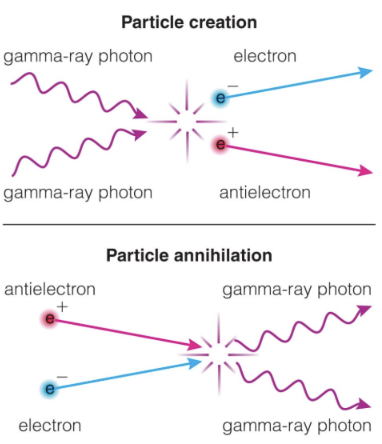
4) The early universe was so hot and so dense that radiation was constantly producing particle–antiparticle pairs and vice versa
5) As the universe cooled, particle production stopped, leaving matter instead of antimatter
Fusion turned remaining neutrons into helium
Radiation traveled freely after formation of atoms
What were conditions like in the early universe? (Detailed)
The early universe must have been extremely hot and dense
Photons converted into particle-antiparticle pairs and vice versa (proton + antiproton collision = 2 photons)
Energy and matter are being transferred constantly as the universe was created e=mc^2
The early universe was full of particles and radiation because of its high temperature
The universe has been cooling down since it was formed
Because the universe has been expanding, less density
Matter destroyed antimatter in the early universe
Thats why we have matter today
Four known forces in universe:
Gravity
Holds things together
Electromagentism
Electromagnetism keeps us together and preventing us from going down cuz it keeps our atoms together
Pos and neg charges
Works on the atomic scale
The force between particles in atoms and molecules
In between gravity and the two below
Weak force
Keeps nucleus of atom together, protons and neutrons together
Plays a role in fusion and fission - changing ‘em
Strong force
Binds protons and neutrons together in atomic nuclei
Do forces unify at high temperatures?
Yes, weak and electromagnetism become electroweak force
And strong force and electroweak may potentially make the GUT force
How the forces came to be:
We start with gut force and gravity and end up with these 4
GUT Force & Gravity came from super force
Forces were created from the Big Bang
The strong, weak, and electromagnetic force came from the GUT force
Forces split off
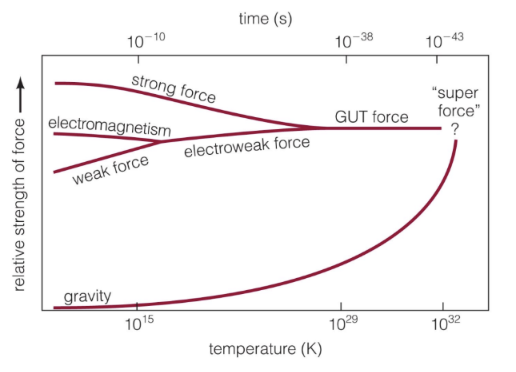
Early universe = first second
*After cosmic microwave, some structure appears as things start to form
*Universe has been cooling since big bang
*For the diagram, temp goes down as you scroll
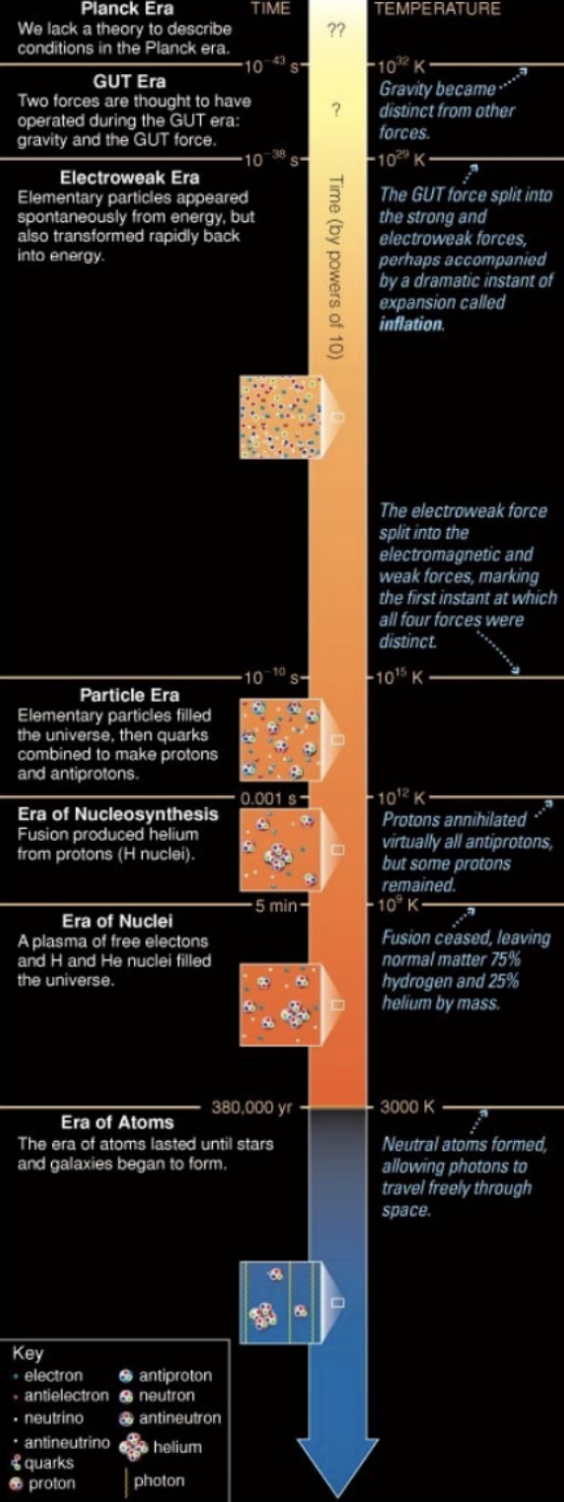
How did the early universe change with time? - Planck era
First 10^-43 seconds of the universe, we don’t know whats going on at this specific time, we don't know how gravity works here
How did the early universe change with time? - GUT era
Two forces
GUT and Gravity
From end of Planck time to beginning of Electroweak era/end of GUT force
Splits off into strong and electroweak forces
Sudden influx of energy from the GUT force splitting
Results in rapid expansion of the universe
End of GUT era, is the inflation era (in between) atom size to solar system size
This is within the first second of the universe formation
How did the early universe change with time? - Electroweak era
Lasts from end of GUT force to end of electroweak force
Still have the matter to energy conversion constantly transferring back and forth, cuz its still hot enough for this to happen
Electroweak era, inflation, split in forces again, end up with 4 forces
How did the early universe change with time? - Particle era
Roughly equal amounts of matter and antimatter, and matter won ig, set amounts of matter
Matter annihilates remaining antimatter
End up with the remaining matter, since it has won
The matter that survives makes protons and neutrons
How did the early universe change with time? - Era of nucleosynthesis
The matter that survives makes protons and neutrons
There is hydrogen fusion happening throughout the universe cuz the temp allows it (H→He)
Once you reach the temp where fusion stops, the era ends
Results in a universe with 75% hydrogen and 25% helium
Protons leftover, fusion H→ He, very hot. When temp drops a certain amount, fusion stops and we end up with a fixed number of H and He 75%H and 25%He
How did the early universe change with time? - Era of nuclei
~~~ THIS STARTS THE ERAS THAT HAPPENED AFTER THE FIRST SECOND
Helium nuclei form at universe age~3mins
Protons and neutrons are combined to make long lasting nuclei when universe was ~3mins old → This set the amount of protons and neutrons for the rest of time to work with
The composition of the universe would be 75% H and 25% He
Fusion stops by now
Main idea: Universe is becoming too cool for there to be any more changes, too cool to destroy helium so H and He are set
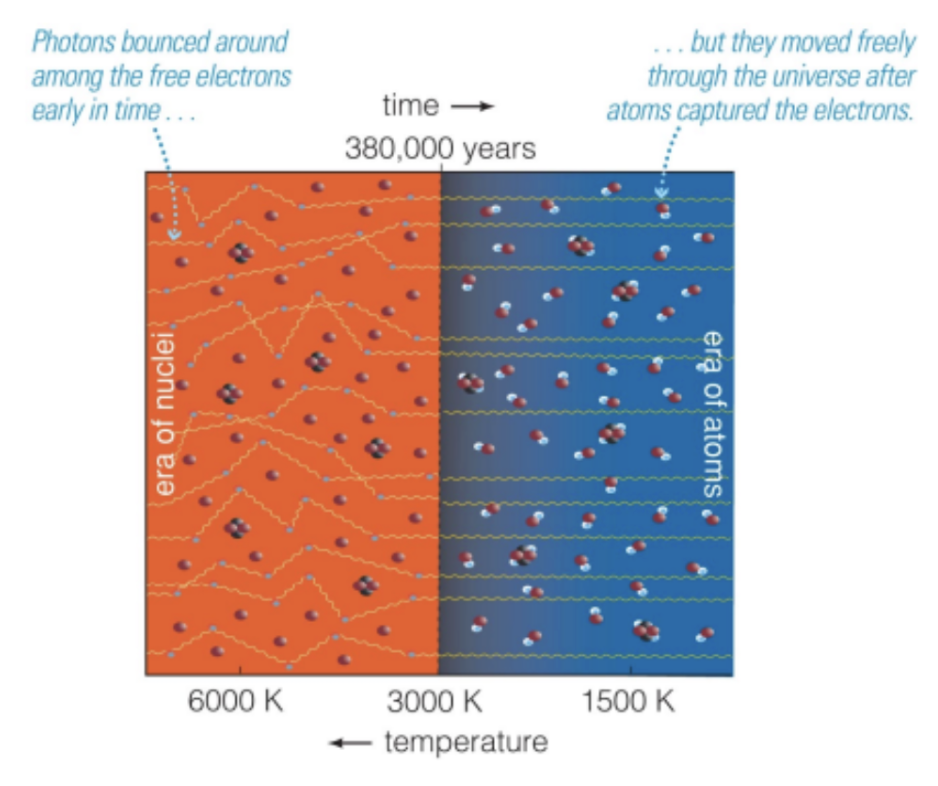
End of this era is when CMB is formed, 3000K, this temp is low enough for the universe to become transparent
End of this era was when CMB was formed at 380,000 years and 3000K
How did the early universe change with time? - Era of atoms
Atoms form at age - roughly 380,000 years
Background radiation released
Density of universe decreases and photons can be released and travel through
Fusion stops, the universe is cooling. When the temp is low enough, the electrons become bound to the atoms so the photons have more room to move freely
When the universe became transparent - 3000K
How did the early universe change with time? - Era of galaxies
Galaxies form at age roughly 1 billion years
Recap:
1) What were conditions like in the early universe?
2) How did the early universe change with time?
1) The early universe was so hot and so dense that radiation was constantly producing particle–antiparticle pairs and vice versa.
2) As the universe cooled, particle production stopped, leaving matter instead of antimatter
Fusion turned remaining neutrons into helium
Radiation traveled freely after formation of atoms.
How do observations of the cosmic microwave background support the Big Bang theory?
Primary evidence
1.) we have detected the leftover radiation from the Big Bang
2.) The Big Bang theory correctly predicts the abundance of helium and other light elements
The cosmic microwave background - the radiation left over from the Big Bang
Background radiation from Big Bang has been freely streaming across universe since atoms formed at temperature - roughly 3000K (when the CMB was first discovered)
The background has a perfect thermal radiation spectrum at temp. 2.73K
Peaks at a millimeter
Expansion of universe has redshifted thermal radiation from that time to 1000 times longer wavelength: microwaves
Weems law → relates temp to wavelength
We observe the universe at a different temperature today because of cosmological redshift
We have detected leftover radiation from CMB
CMB - had 3,000K temp but when we measure it now its like 3 so as the universe has been expanding, it causes it to be cosmologically redshifted, and so that's why the universe has been cooling
WMAP(captured the CMB) gives us detailed baby pictures of structure in the universe
Big ideas on universe creation
CMB is evidence for the big bang, the universe had objects touching at some point so they shared the same temperature
Matter has gravity, starts to attract more matter → structure in the universe, anything we can observe
Matter was unevenly distributed
If matter was perfectly, uniformly distributed, nothing would've ever come together, hydrogen and helium would've never come together to make dust and stuff
Random: At longer wavelengths we see the structure of the universe (far infrared)
How does the abundance of elements support the big bang theory?
Fusion again
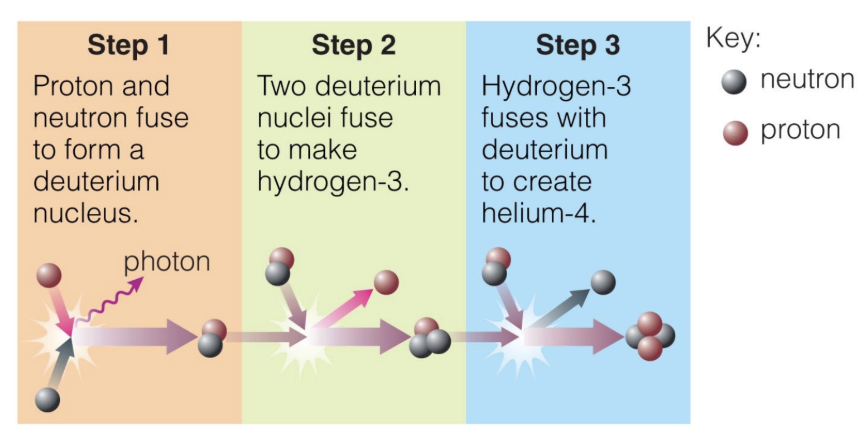
Protons and neutrons are combined to make long lasting nuclei when universe was ~3mins old → This set the amount of protons and neutrons for the rest of time to work with
The composition of the universe would be 75% H and 25% He
From 14 protons and 2 neutrons, you can get 1 helium(Atomic mass 4) and 12 hydrogen(Atomic mass 12) leftover which is the 75% to 25% ratio somehow
You can’t have above 75% H in the universe, its set already
Recap:
1) How do observations of the cosmic microwave background support the Big Bang theory?
2) How do the abundances of elements support the Big Bang theory?
1) Radiation left over from the Big Bang is now in the form of microwaves—the cosmic microwave background—which we can observe with a radio telescope
*At some point the universe was touching(had same temp) and then it spread out
2) Observations of helium and other light elements agree with the predictions for fusion in the Big Bang theory.
What key features of the universe were explained by inflation?
Where does structure come from
Why is the overall distribution of matter so uniform
Why is the density of the universe so close to the critical density
→ explains the uniformity of the CMB
Inflation of the universe
Inflation can make all the structure by stretching tiny quantum ripples to enormous size
These ripples in density allow for matter to come together
Period of inflation happened at the end of the GUT era, when the GUT force separated into the weak and strong forces → led to the inflation of the universe → why we have flat geometry cuz its expanding
End of gut era, when it split off, it's why we have some structure in the universe. On a BIG scale the universe looks equal but on smaller scales there's structure that makes galaxies, planets, stars
How can microwave temperature be nearly identical on opposite sides of the sky?
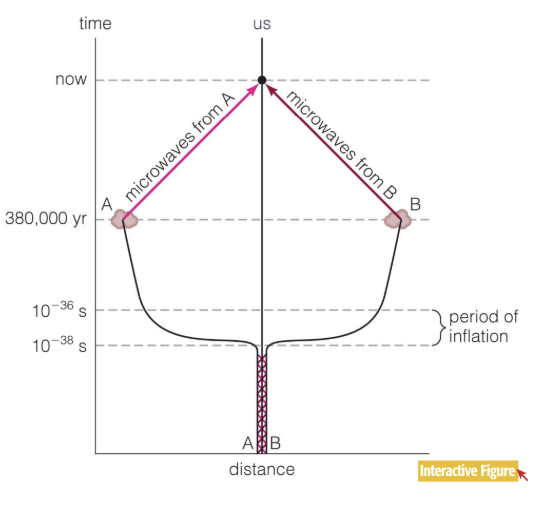
Regions now on opposite sides of the sky were close together before inflation pushed them far apart.
Bottom is big bang, when the universe was all touching, when the GUT force split off at 10^-38s, universe to solar system size, so then now we see them at the same temp
→ At 380,000yrs it emits photons, because that's when the universe became transparent, the universe reached 3000K. That's when photons were emitted
We cant see anything beyond 380,000yrs, thats where we see the CMB, emitted in infrared wavelengths
The CMB has the same temp wherever you look ~3K
Shape of the universe
Density corresponds to matter which corresponds to gravity
3 possible shapes:
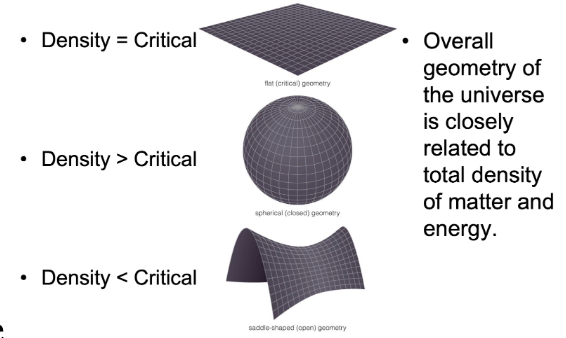
Critical density is the density of the flat universe that is slowly expanding with time
Flat geometry - critical geometry
Added up angles is 180 degrees
If density equal to critical density its flat
will expand but eventually stop
Spherical geometry
Added up angles is more than 180 degrees
If density is greater than the critical density its spherical
gravity is strong enough to stop expansion
Saddle shaped/open geometry
Add up angles is less than 180 degrees
If density is less than the critical density its saddle shaped
gravity is not strong enough to stop expansion, will expand forever
We think it's flat :)
Over time the universe has been cooling and expanding cuz things are getting further apart faster with time :(((((
Inflation of the universe flattens its overall geometry like the inflation of a balloon, causing the overall density of matter plus energy to be very close to the critical density
Seeds of structure & Inflation of universe
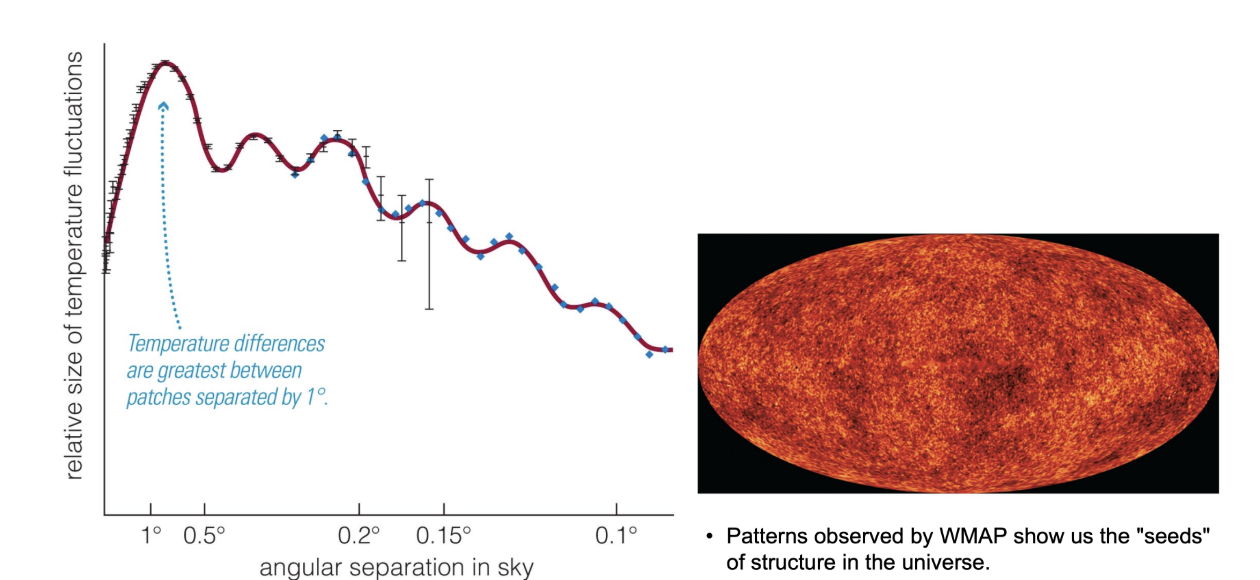
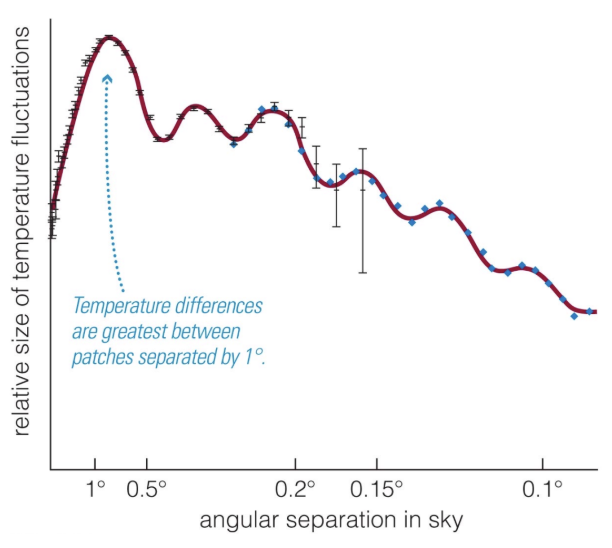
Y axis is changes in temp and x axis is how far apart things are in the sky
If you look at things very close together, the temp is essentially the same, things farther apart have greater differences on the CMB and overall its the same!!!
This is because when the universe grew, the ripples caused areas of different densities and so as it has aged, there are areas which are more dense and have different temperatures
What can be inferred from the CMB
Overall geometry is flat.
Total mass + energy has critical density.
Ordinary matter is ~ 4.4% of total.
Total matter is ~ 27% of total.
Dark matter is ~ 23% of total.
Dark energy is ~ 73% of total. (energy we know exists but cannot detect) there has to be some energy that's causing the accelerated expansion of the universe
Age is 13.7 billion years.
Recap:
1) What key features of the universe are explained by inflation?
2) Did inflation really occur?
1) The origin of structure, the smoothness of the universe on large scales, the nearly critical density of the universe.
Structure comes from inflated quantum ripples.
The observable universe became smooth before inflation, when it was very tiny.
Inflation flattened the curvature of space, bringing expansion rate into balance with the overall density of mass-energy.
2) We can compare the structures we see in detailed observations of the microwave background with predictions for the "seeds" that should have been planted by inflation.
So far, our observations of the universe agree well with models in which inflation planted the "seeds."
Olbers’ Paradox
There was a time where we thought the universe was infinite, not changing, it's been around forever, no big bang.
If the universe was infinite in size and infinitely full of stuff, and unchanging over time, everywhere we look we would see something in every direction that we looked, there would be stars everywhere
But it ain’t, when we look at the sky, there are gaps in the sky, because we cannot see the light in that area because there's a 14billion year limit to how far back we can see.
→ Evidence for the big bang, the universe changes with time and has been expanding. We can look back to a time when there were no stars.
Recap:
Why is the darkness of the night sky evidence for the Big Bang?
If the universe were eternal, unchanging, and everywhere the same, the entire night sky would be covered with stars
The night sky is dark because we can see back to a time when there were no stars
Dark matter
An undetected form of mass that emits little or no light, but whose existence we infer from its gravitational influence
How its gravity affects what's around it like black holes
Makes up the second most of the universe
Dark matter tends to be on large scales, around galaxies
There's more dark matter in a cluster, as you up the scale, there's more
→ Dark = no information about the matter, material, or energy
Dark energy
An unknown form of energy that seems to be the source of a repulsive force causing the expansion of the universe to accelerate
Dark energy makes up most of the universe
Visible matter makes up a minimal amount of the universe (things that emit light essentially)
Energy and mass convert E = mc^2
Recap:
What do we mean by dark matter and dark energy?
Dark matter is the name given to the unseen mass whose gravity governs the observed motions of stars and gas clouds.
Dark energy is the name given to whatever might be causing the expansion of the universe to accelerate.
Ordinary matter(stars, planets, etc) is less than 5% of everything we see
95% of our universe cannot be observed (dark matter + energy)
What is the evidence for dark matter in galaxies?
We measure the mass of the solar system using the orbits of planets:
Orbital period
Average distance
For circles:
Orbital velocity
Orbital radius
Evidence for dark matter in galaxies is rotation curves, the velocity of the matter on the outer of the galaxy is the same as the inner matter which means there's stuff we can't see there (dark matter)
The dark matter is 10x larger in mass and luminosity
Rotation curve - solar system (detailed)
Most of the mass is in the center of the solar system, the other masses (like planets) are not as significant to the total so they seem the same
The further you get away from the object that has the most mass, the slower you move (solar system image)
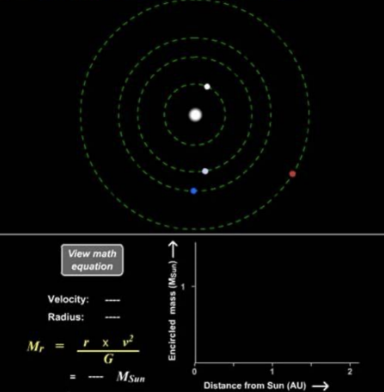
Rotation curve + 3 examples
Rotation curve + 3 examples
A plot of orbital velocity vs. orbital radius
The solar system's rotation curve declines with radius because the Sun has almost all the mass
The rotation curve of a merry-go-round rises with radius
The people on the merry go round is a rigid body movement thing cuz they're all on the same object
The rotation curve for the merry go round diff cuz this is just one object rotating and the mass is evenly distributed vs the sun one the mass is not evenly distributed, and is separate from the planets
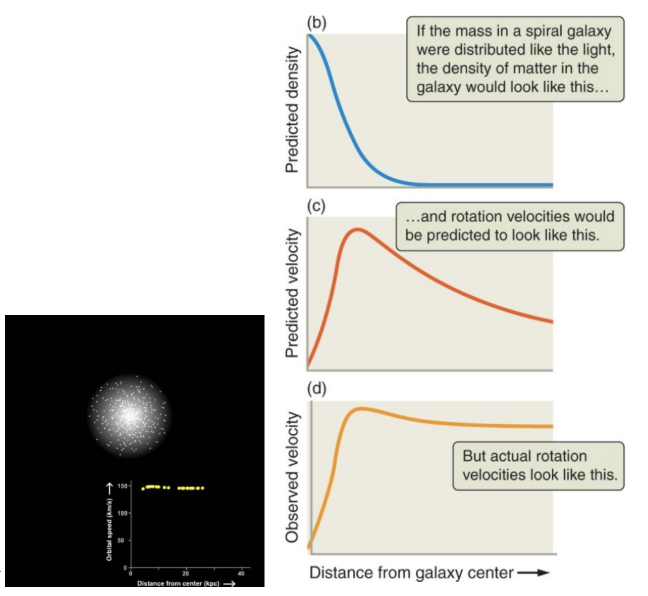
The rotation curve of a galaxy remains constant with radius
For a spiral galaxy, it starts increasing and then it flattens out because most of the mass is in the center and it decreases as it goes out. There's something that's keeping the stars on the edge of the galaxy rotating so the speed of that matter is still increasing → this is the result of dark matter, there's more we can't see on the edge.
Most of the spiral galaxy’s mass seems to be dark matter
Rotation curve - galaxy (detailed)
The rotation curve of the Milky Way stays flat with distance
Mass must be more spread out than in the solar system
Mass in the Milky Way is spread out over a larger region than its stars
Most of the Milky Way's mass seems to be dark matter!
If most of the mass is in the center of the galaxy, we would expect the velocity to decrease going outwards from the center of the galaxy, but we actually observe that the stars from the edge of the galaxy rotate at the same speed as the ones in the middle → so there's some mass there in order for that to happen which is the dark matter.
Most of the dark matter is further out in the galaxy (halo + beyond), it's not in the areas where we see luminous material
There's a lot of dark matter
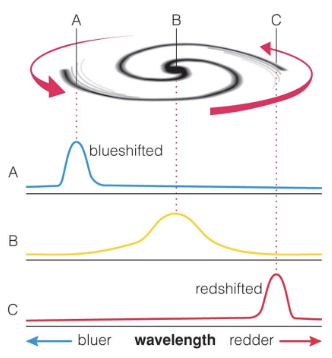
How to measure the rotation curves of other spiral galaxies
Use doppler shift of hydrogen spectrum → You can get the velocity of the stars rotating
The emission line will broaden based on how many stars are in the galaxy (cuz wider with more stars)
Spiral galaxies all tend to have flat rotation curves, indicating large amounts of dark matter
Rotation curves only work for spiral galaxies; for spiral when we can't resolve all the components we take a spectrum
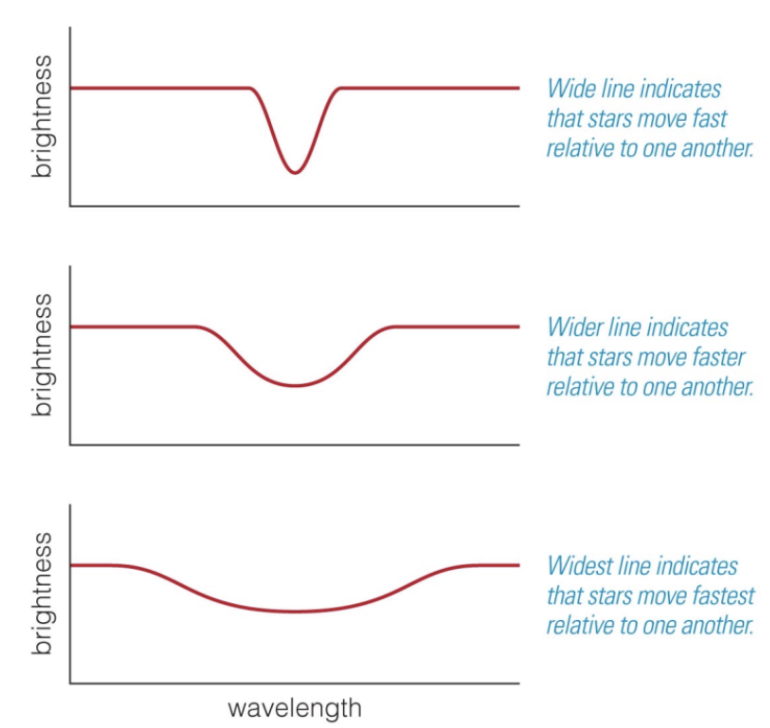
How to measure rotation curves of elliptical galaxies
The wider the width of the spectral line, the greater velocity
These galaxies also have dark matter
In elliptical galaxies, things are going around the center in random patterns so we have to use spectral lines again
Dark matter in clusters of galaxies: 3 ways to measure mass of clusters of galaxies
More matter
Tells us there's more matter we can measure than what we can see
We can measure the mass of galaxy clusters using orbital velocity law → doppler shift
We can measure the mass of galaxy clusters from the temperature of the gas
Gravitational lensing
So like if theres more mass further out in the galaxy it means theres dark matter
We can measure the mass of galaxy clusters using orbital velocity law → doppler shift
The mass we find from galaxy motions in a cluster is about 50 times larger than the mass in stars!
By getting a spectrum of how fast smth further out is moving → doppler shift
The mass that is measured in the cluster from orbital velocity of the stars on the outskirts is about 50 times larger than the mass measured using gravity, 50x more dark matter → The larger the scale you look at, the more dark matter there is
We can measure the mass of galaxy clusters from the temperature of the gas
X ray is high energy
There's a lot of gas in between galaxies that is moving around fast
Clusters contain large amounts of X ray-emitting hot gas
Temperature of hot gas (particle motions) tells us cluster mass
Temp has kinetic energy so that's how we can get mass by converting it to velocity
Gravitational lensing
The bending of light rays by gravity, can also tell us a cluster's mass
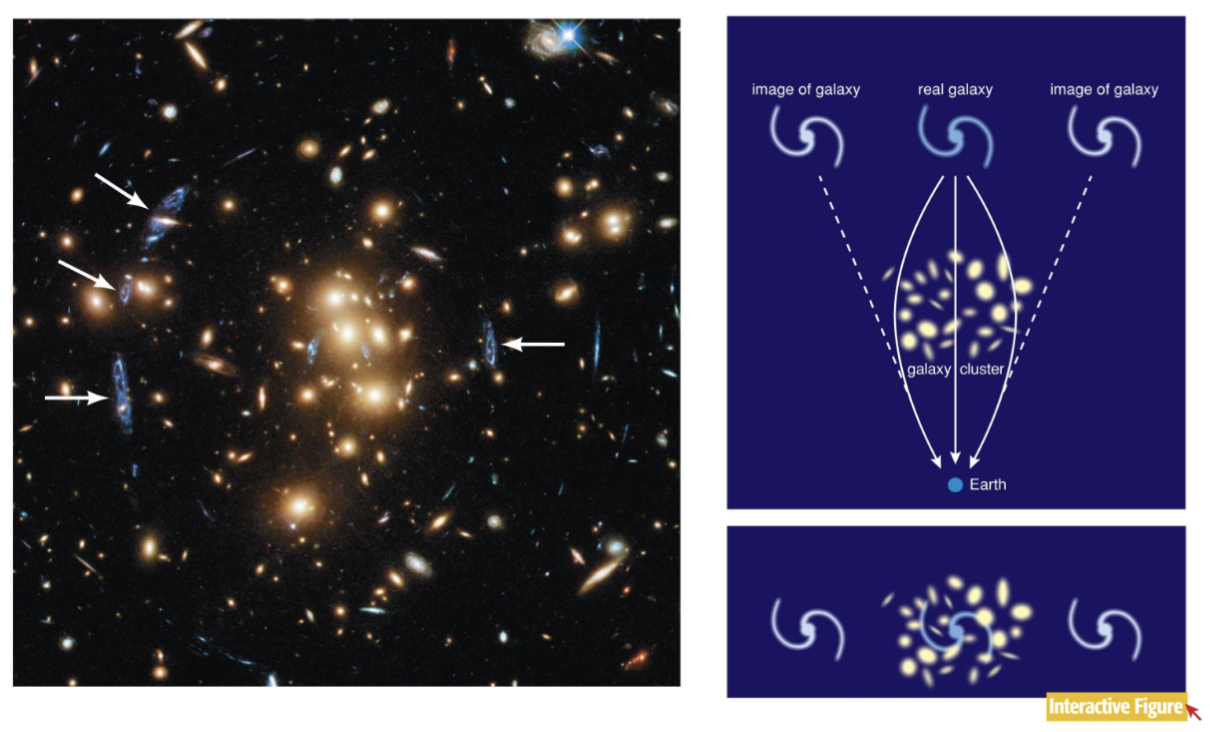
Mass warps the space around it, so a galaxy behind a cluster would appear warped around it cuz the light has to travel around the cluster to be visible to us, so it looks like its on the sides of the clusters in a weird einstein circle ring around the cluster, smeared out ring
If the cluster has more mass, the ring is bigger so you can tell the mass depending on how far out the galaxy is appearing from the cluster in its ring
More mass = more distortion in images
*You can't just add up all the mass of the stars
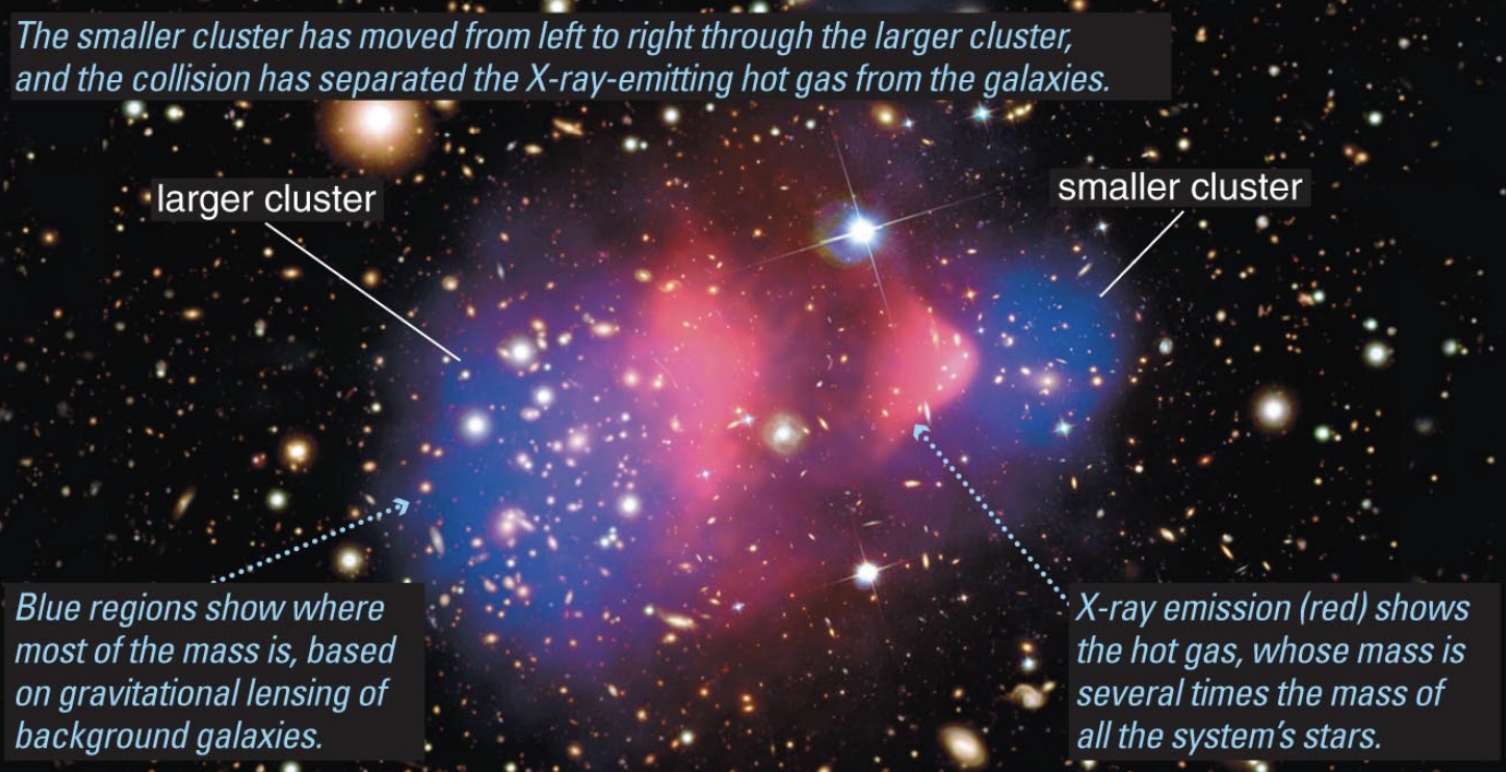
Bullet cluster
Most galaxies cluster together, lot of mass in those areas, bends space around it,
General relativity = mass bending space around it
Most of the mass is dark matter, and it gets separated from the hot gas after the collision
Blue is where most of the mass is, pink is where x-ray hot gas is, which is even more mass. The small cluster passed through the larger (they collided) and the pink gas is separated from the blue (galaxies)
What is dark matter made of? Either:
Ordinary dark matter
Made of protons, neutrons, electrons, but too dark to detect(not giving off enough light to be detected)
Extraordinary dark matter
Weakly interacting massive particles: mysterious neutrino-like particles
People went with this one ig
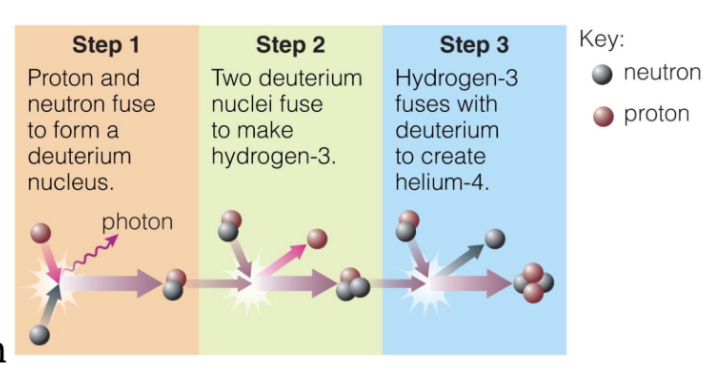
Deuterium
Protons → Deuterium (1 proton and 1 neutron) → Helium-3 (2 protons and 1 neutron) → Lithium-7 (3 protons and 3 neutrons)
Protons and neutrons combined to make longlasting helium nuclei when universe was ~ 3 minutes old
Happened when the universe was first forming, it was so hot and dense that everything (protons and neutrons) smashed together
Matter & deuterium
If there was more ordinary matter in the universe, there would be less deuterium
Measurements of light element abundances indicate that ordinary matter cannot account for all of the dark matter
Basically, as the previous slide shows, the big bang made deuterium, hydrogen, helium, lithium, which are all examples of ordinary matter. So the thing is, deuterium will become helium when it collides with protons/neutrons, and there will be less of it (prediction), but the fact that there is actually less ordinary matter means the deuterium supply will not deplete, so theres OTHER DARK MATTER MWAHAHHAH
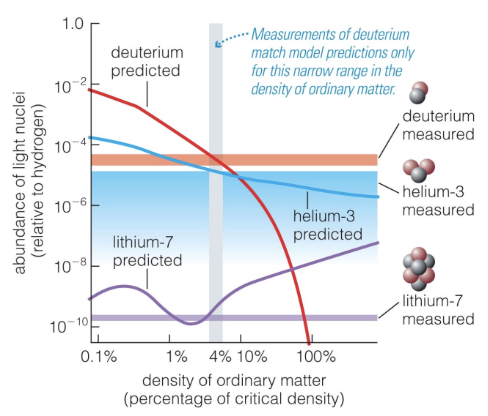
… So… dark matter evidence?
The way we can see the evidence of deuterium is by quasars (the clouds) really early in the universe, which tells us how much ordinary matter there is in the universe (not much)
So the best bet for evidence of dark matter is a weakly interacting massive particles(WIMPs): the mysterious neutrino-like particles, that could be left over from the Big Bang
Dark matter doesn’t interact with electromagnetic force(we don't see it interacting with light, no radiation) or strong force(we don’t see a change in the spectrum), so if we wanna detect it, it would have to interact with the weak force… neutrinos don’t have enough mass to be dark matter
→ Yeah we don't know what dark matter is
Recap:
1) What is the evidence for dark matter in galaxies?
2) What is the evidence for dark matter in clusters of galaxies?
3) Does dark matter really exist?
4) What might dark matter be made of?
1) Rotation curves of galaxies are flat, indicating that most of their matter lies outside their visible regions (most of it we don’t see)
2) Masses measured from galaxy motions, temperature of hot gas, and gravitational lensing all indicate that the vast majority of matter in clusters is dark → show that there is more mass than visible matter accounts for
3) Either dark matter exists or our understanding of our gravity must be revised
4) There does not seem to be enough normal (baryonic) matter to account for all the dark matter, so most astronomers suspect that dark matter is made of (non-baryonic) particles that have not yet been discovered
What is the role of dark matter in galaxy formation?
Dark matter caused the initial protogalactic gas cloud to contract.
But it didn’t collapse with the initial gas cloud because it does not radiate away energy
WIMP’s can't collapse to the center because they don’t radiate away their orbital energy
The dark matter is outside of where the luminous matter is.
Dark matter is pulling things together (including pulling luminous matter)
After correcting for Hubble's law, we can see that galaxies are flowing toward the densest regions of space
Galaxies are not evenly distributed, galaxies and galaxy clusters tend to cluster together, happens if there is dark matter that is attracting the luminous matter to itself, the universe is getting clumpier over time, as you get closer to present day (the milky way), (more time ) the universe is getting more structured
We don't see dark matter, we see its influence on luminous matter so we see the clusters of galaxies and clusters
Largest structures in the universe
Superclusters & Voids
Dark matter is not in the voids, it’s a magnet essentially, its where the yellow is, it draws in galaxies (so we see it as superclusters)

Recap:
1) What is the role of dark matter in galaxy formation?
2) What are the largest structures in the universe?
1) The gravity of dark matter seems to be what drew gas together into protogalactic clouds, initiating the process of galaxy formation
Models show that gravity of dark matter pulls mass into denser regions—the universe grows lumpier with time
2) Galaxies appear to be distributed in gigantic chains and sheets that surround great voids
Why is accelerating expansion evidence for dark energy?
Possibilities: The fate of the universe depends on the amount of dark matter
Recollapsing universe (too much dark matter)
Lots of dark matter → lot of gravity, eventually after expanding the universe will collapse on itself
Coasting universe (not enough dark matter)
Not enough dark matter for the universe to collapse, constant amount of dark matter
Critical universe
Expanding over time
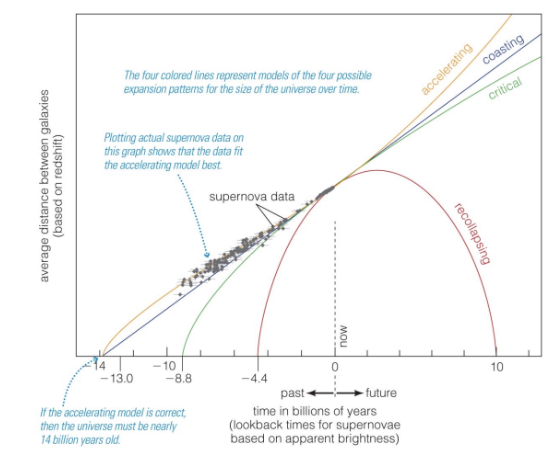
But actually our universe is accelerating (furthest right)
***If the Hubble Constant is larger at greater distances, that means that expansion of the universe is slowing. Because it is faster in the past since greater distance = farther back in time.
→ But it's actually the opposite, it’s accelerating in its expansion
→ Evidence for dark energy
Why we have more dark energy than matter

How does expansion rate of the universe tell us the age?
White dwarf supernova to get distances → to get rate
We are in an accelerating universe, H0
White dwarf supernovae allow the measurement of far away things
Velocity of galaxy = spectrum and the redshift
Age is the inverse of H0
Graph
→ White dwarf supernova, (from far away galaxies) shows that the accelerating universe is the most true, shows our universe is 14 billion years old
Why is flat geometry evidence for dark energy?
When you look at the CMB on large scales, there aren’t many differences, but small scales do have changes. The changes in the structure come from the time of inflation where the universe went from the size of an atom to the solar system
Measurements of the cosmic microwave background indicate that the universe has a flat geometry, thus dark energy is needed to fill out the remaining mass-energy
Inflation is evidence that we have a flat geometry and we need dark energy to fill in the remaining space
What is the fate of the universe?
The universe rapidly increases over time (not linear, accelerating)
The acceleration of the universe gets to a point where it cannot sustain itself (so much energy) can cause the “big rip” and end the universe. If the acceleration of the universe overcomes the gravity holding it together (not enough gravity to keep it together) → It's like slowly pulling apart a rubber band and it'll stretch vs if you yank it super fast it rips
OR (Two options for the end of the universe)
Star formation will stop eventually, as everything gets further away from each other, it will become dark because the final stage of the high and low mass stars don’t emit much (white neutron stars, black holes, white dwarfs), so the black holes will be the most massive things left behind, and so the black holes radiate away their mass, so even black holes will dissipate/disintegrate over time. → So the universe will end up as a very dark place.
Recap:
1) Why is accelerating expansion evidence for dark energy?
2) Why is flat geometry evidence for dark energy?
3) What is the fate of the universe?
1) In the absence of the repulsive force of dark energy the expansion of the universe would not be accelerating
2) Evidence from the CMB indicates that the universe is very near critical density(flat universe), requiring an additional contribution to the mass-energy of the universe. So we need dark energy
3) The universe should keep expanding indefinitely, the universe eventually consisting of a dilute sea of fundamental particles
Nuclear fusion in the sun
You need very high temperatures and pressure
Fission
Fusion
Why do we need high temperatures/pressures?
Protons are positively charged, so they repel each other
At low speeds, electromagnetic repulsion prevents the collision of nuclei, these protons can only come together with high pressure/temperature that is in cores that overcomes the electromagnetic force, the strong force then binds them together
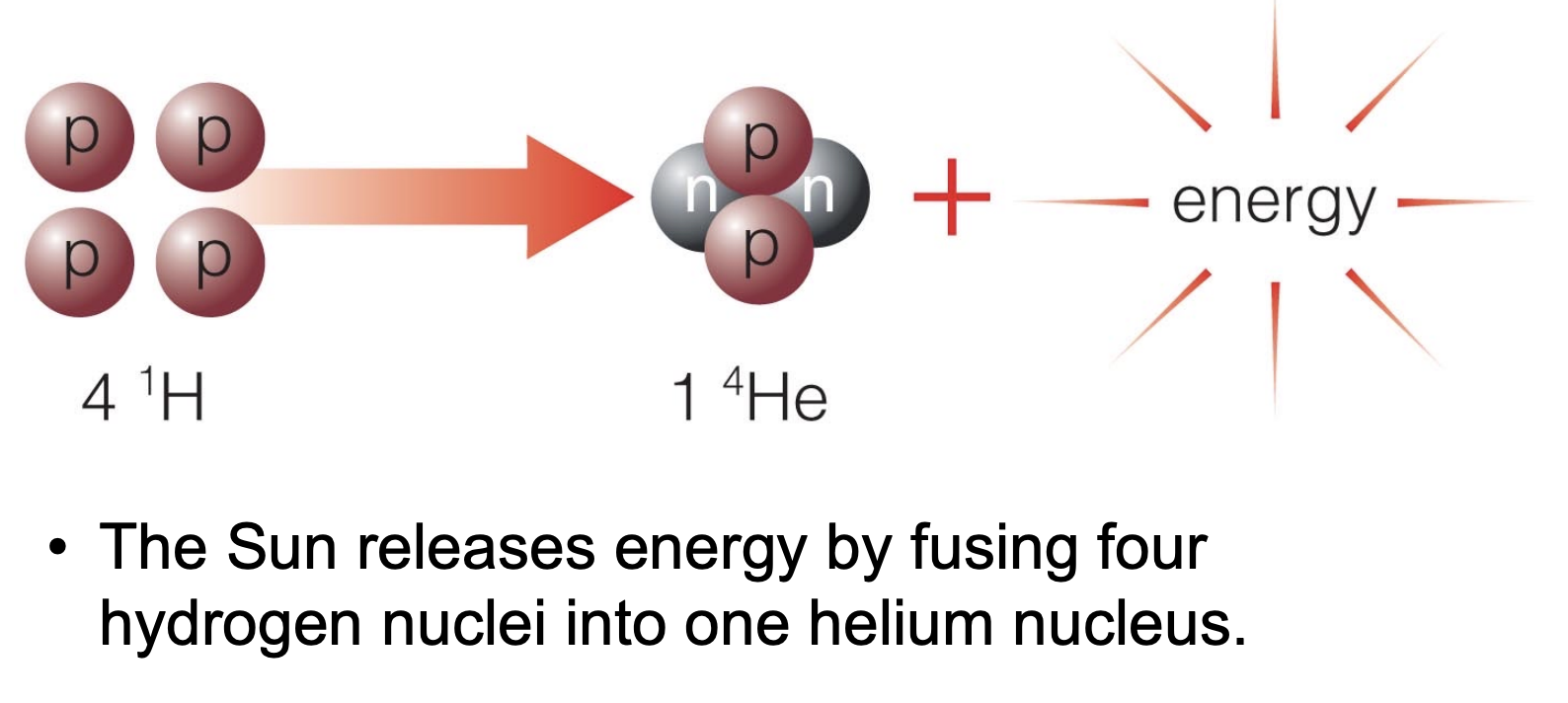
For every 4 protons (hydrogen) will form 1 helium (2 protons 2 neutrons) and energy - The sun releases energy by fusing four hydrogen nuclei into one helium nucleus
Fusion
Small nuclei stick together to make a bigger one (nucleus)
Only the sun and stars can do fusion
Powers sun, e = mc^2
Inputs 4 H → 1He + energy + neutrinos somewhere
The energy from the equation gives us the luminosity of the sun
X1000
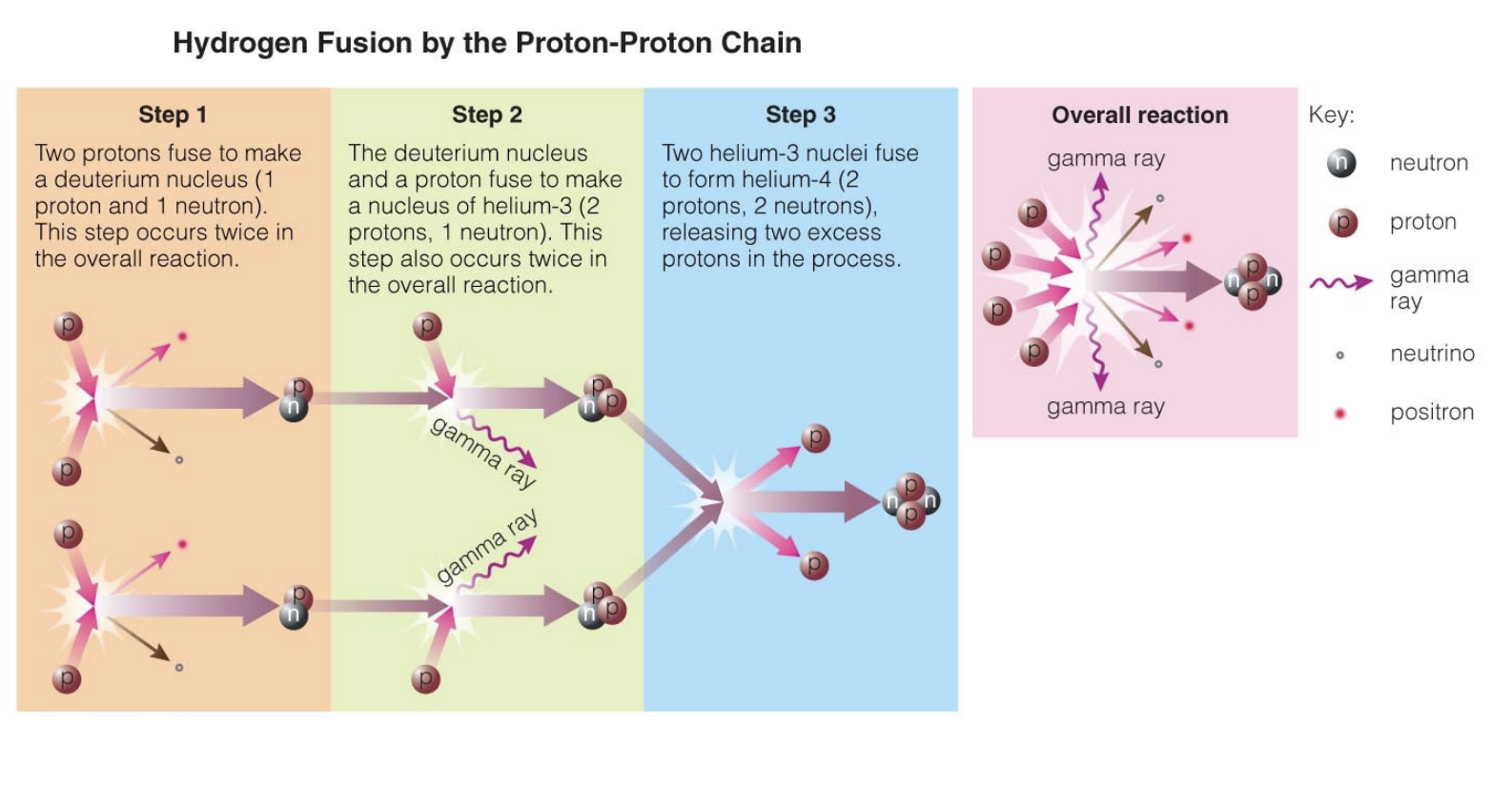
Proton-proton chain
= Nuclear fusion
How hydrogen fuses into helium in the sun
E = mc^2, the energy is released as gamma rays
Low mass stars
4 protons → helium + energy + neutrinos + positrons
Total mass is about 0.7% lower
Full (overall) reaction for proton-proton chain/nuclear fusion
Inputs: 4 Protons
Outputs: 4He nucleus, 2 gamma rays, 2 positrons, 2 neutrinos
The difference in mass between the protons (H) initially and the output (He) is the energy released, the mass of the He is 0.7% lower than the H

Luminosity
Total amount of power (energy per second = watts) the star radiates into space, what is the energy output of the star, it’s a measure of power.
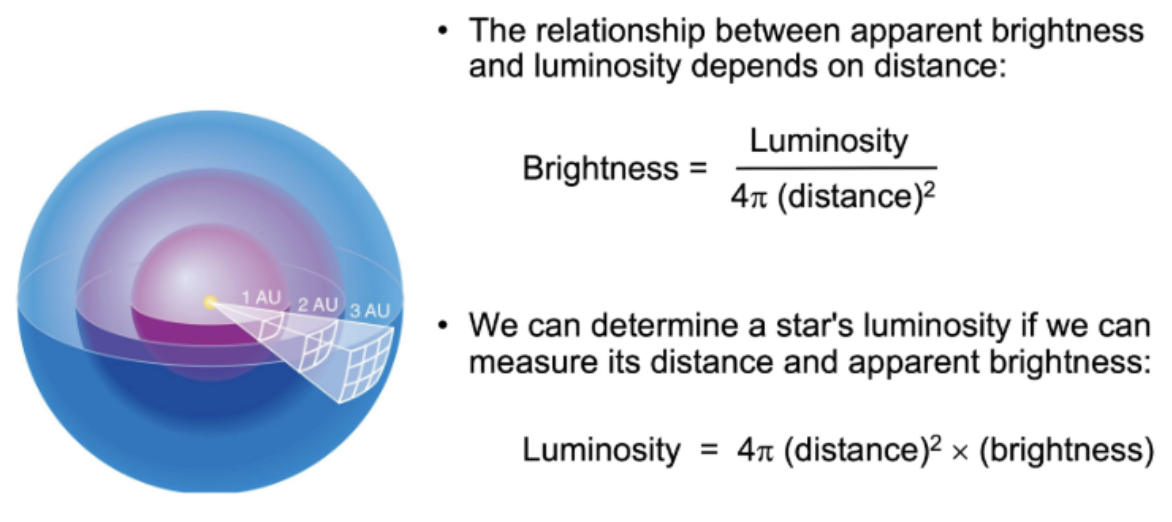
Apparent brightness/Flux
how bright does it appear to us in terms of power? → Depends on luminosity and distance, amount of starlight (power) that reaches Earth (in energy per second per square meter) = watts/m²
Inverse square law
An effect's intensity is inversely proportional to the square of the distance from its source
The amount of luminosity passing through each imaginary sphere around the star is the same, but each little square causes for the light to be divided among them so like at 3AU, each square receives 1/9 as much light as the 1AU square
→ The surface area of the sphere depends on its distance from the star
Area of sphere: 4pi (radius)^2
Radius of the sphere = distance from star to us or wtv
Example: If you double the distance from a star, the energy is spread over four times the area, making the star appear four times dimmer
Divide luminosity by area to get apparent brightness
Gamma-ray bursts
First detected coming from space
These bursts were coming from very distant galaxies
These are the most energetic explosions
Could be from the formation of blackholes/merging of neutron stars
Some gamma-ray bursts are produced by supernova explosions (big ones)
Others may come from collisions between neutron stars
Dims over time
Declines in optical emission
What causes gamma-ray bursts?
What happens when black holes merge?
Most gamma-ray bursts come from distant galaxies.
They must be among the most powerful explosions in the universe, probably signifying the formation of black holes.
They should produce gravitational waves that we may be able to detect in the near future.
Primary features of our galaxy
Sun is on the disk so we see out galaxy from the edge view
→ If we could see the milky way from above the disk, we could see the arms
Bulge: Stars, there's just so many there, older stars, few gas clouds
Disk: Surrounds the bulge, where red/yellow and blue stars in the spiral arms are, contains stars of all ages and many gas clouds
Halo: Surrounds the galaxy, blue young stars
Spiral arms: Where star formation happens, blue → evidence of young stars which is why we can tell that star formation is happening
Globular clusters: Red/yellow old stars
WHY tho (star formation) in the spiral arms
**The halo has no ionization nebula, all the nebula’s are in the disk, no star formation in the halo, all molecular clouds are in disk
Much of the star formation in the disk happens in the spiral arms of galaxies, which are located in the disk of the galaxy, molecular clouds are in the spiral arms, where stars are formed
→ Spiral arms are waves of star formation (blue)
The spiral arms themselves are tracing where there is an overdensity of gravity, material slows down here, so more material adds up here, so more density, so stars form JEANS MASS REMEMBER THAT
Stairwell analogy or traffic jam
Lots of people there, more density, narrow stairwell
Gas clouds get squeezed as they move into spiral arms
Squeezing of clouds triggers star formation
Young stars flow out of spiral arms
Hubble’s law
If smaller, slower rate, older universe
V = h0 x distance
Measures the expansion of the universe, how fast things are moving away, acceleration of the expansion of the universe
Points come from white dwarf supernova → gives us distance
We get velocities from spectrum (redshifts)
He was observing the redshifts of galaxies, hydrogen emission lines are redshifted to longer wavelengths. The majority of galaxies he noticed were redshifted and were moving away from us, the universe is expanding
Velocity = H0 x distance
Plot of recessional velocity (moving away from us) vs distance
He measured the redshift → velocity → got the distance
Using white dwarf supernova in the galaxy to get the distance to other galaxies
There's a correlation between velocity and distance
Hubble’s constant
How fast things are moving away from us and their distance, 22km/s/Mly, for every mega light year things are moving at 22km/s
The faster a galaxy is moving away from us, the greater its distance:
Velocity = H0 x distance
How does Hubble's law tell us the age of the universe?
Tells us how fast something is going related to distance ⇒ tells us the time
The expansion rate appears to be the same everywhere in space (H0 constant)
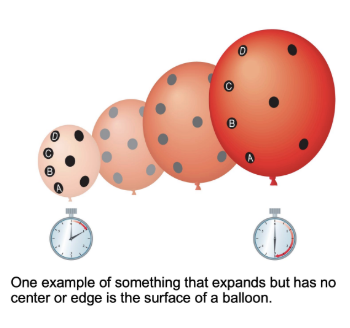
The universe has no center and no edge (as far as we can tell).
⇒ Balloon
Something that expands but has no center or edge is the surface of a balloon
Dots are like the galaxies, gravity maintains the galaxy’s shape but the space between them increases
⇒ Ants paper clip
It's going to look like the paper clips are moving away, ants observe that the furthest paper clips are moving away faster
 Note
Note  Flashcards (48)