Table Tennis Final
 Studied by 0 people
 Call Kai
 Learn
Learn Practice Test
 Spaced Repetition
 Match
Match Flashcards
 Knowt Play
1/45

There's no tags or description
Looks like no tags are added yet.
Name | Mastery | Learn | Test | Matching | Spaced | Call with Kai |
|---|
No analytics yet
Send a link to your students to track their progress
46 Terms
Which of the following was NOT a rule change in the previous 20 years?
A. Changing the length of a game
B. Changing the size of the ball
C. Changing rules about how to legally serve
D. All of the above were rules that have changed in the previous 20 years
E. None of the above are rules that have changed in the previous 20 years
D
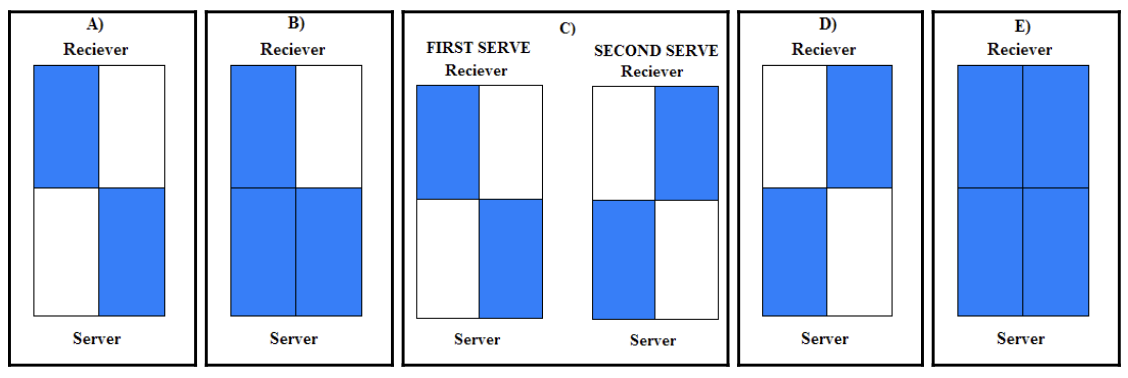
Which of the following is true about serving in doubles?
A. The ball must bounce to the right of the centerline for both the server and receiver.
B. The ball may bounce anywhere on the server’s side but must bounce to the right of the
centerline for the receiver.
C. The server alternates between serving to the right of the centerline for both server and
receiver, and subsequently serving to the left of the centerline for both server and receiver.
D. The serve must bounce to the left of the centerline for both server and receiver.
E. There are no restrictions on service location in doubles
A
Which of the following techniques aid in generating spin on a shot?
A. Grazing/brushing the ball
B. Making square, direct contact with the ball
C. Reducing racket speed at contact
D. Locking the wrist throughout the stroke
E. None of the above
A
Assume that Players A and B (Team 1) are playing against Players X and Y (Team 2) in doubles.
Assume that Player A begins by serving to Player X. Which option describes the first four serve
pairings in sequential order?
A. A serves twice to X, then X serves twice to A, then B serves twice to Y, then Y serves twice to
B.
B. A serves once to X, then A serves once to Y, then Y serves once to A, then Y serves once to B
C. A serves twice to X, then Y serves twice to B, then B serves twice to Y, then X serves twice to
A.
D. A serves twice to X, then X serves twice to A, then Y serves twice to B, then B serves twice to
Y.
E. None of the above.
E - maybe its 10-10, maybe its not, we don’t have enough information
Which of the following would be considered an expert level table tennis player?
A. A player with a rating of 7.0.
B. A player with a rating of 100.
C. A player with a rating of 2700.
D. A player designated Class “A”.
E. None of the above.
C - 2900 is the top bar, so 2700 is top 20 players
Assume that Players A and B (Team 1) are playing against Players X and Y (Team 2) in doubles.
The score is 10-10, and Player A is serving to player X. Which player will be serving next?
A. Player A
B. Player B
C. Player X
D. Player Y
E. Indeterminate given the above information
C
Assume that Players A and B (Team 1) are playing against Players X and Y (Team 2) in doubles.
Assume it is Game 1, the score is 4-1 in favor of Team 1, and Player A is serving to player X.
What is the serve-receive pairing next?
A. Player X serves to Player A
B. Player X serves to Player B
C. Player Y serves to Player A
D. Player Y serves to Player B
E. None of the above.
B
During a rally, Player A hits a forehand which hits the net and then lands on Player B’s side of
the table. Player B does not attempt a return and the ball bounces twice on his side of the table.
What happens?
A. The players must replay the point
B. Player A gets the point
C. Player B gets the point
D. The winner of the point is at the umpire’s discretion
E. None of the above
B
Which of the following is true about a timeout?
A. Play resumes when the player(s) who called the time out is ready, or when 2 minutes has
gone by, whichever happens first.
B. Players are allowed only 1 timeout per match.
C. Timeouts are not allowed during singles match play.
D. Timeouts are allowed in doubles, but not in singles.
E. None of the above.
B
The pendulum serve is typically performed from which part of the table?
A. The server’s forehand corner.
B. The server’s backhand corner.
C. The middle of the table.
D. It depends whether the opponent is right handed or left handed.
E. All of the above are acceptable.
B
When receiving a serve, a player should stand.
A. Close to the middle of the table.
B. At least 3 steps back from the table.
C. In the forehand corner.
D. In the backhand corner.
E. All of the above are acceptable.
D
T/F: Over 10 million players compete in tournaments each year.
T - in the world, not the US
T/F: Racket - What you hit the ball with. Can also be called a paddle or a bat.
T
T/F: Rally – Playing a point, beginning with the serve and ending when a point is won.
T
T/F: Volley-To hit the ball before it bounces on your side of the table. It results in an immediate loss
of the point.
T
T/F: Serve - The first shot, done by the server. It begins with the ball being thrown up from palm of
hand and struck by the racket.
T
T/F: Backhand - A shot from the left-hand side of a player’s body (for a right-hander), the reverse for
a lefthander.
T
T/F: NCTTA – National Collegiate Table Tennis Association, the governing body for intercollegiate play
in the United States
T
T/F: Forehand - A shot from the right-hand side of a player’s body (for a right-hander), the reverse for
a lefthander.
T
T/F: Drop Shot - A short topspin stroke played from over the table, using mainly the wrist and
forearm, typically against a short serve or push.
F - drop shot is for high ball close to net, short serve returned with a drop shot will go into net
T/F: Match – A two out of three, three out of five, five out of nine games contest
F - best of 3, 5, 7, or 9 (answer is missing best of 7)
T/F: Rating - A number that is assigned to all tournament players after their first tournament. The
better the player the higher the rating should be. The range is from 0 to about 2900.
T
T/F: It is legal to switch the racket between hands during the point.
T
T/F: Table tennis first became an Olympic sport in the early 1900’s.
F - it started in the Olympics in 1988
T/F: The grip for a forehand push is identical to the grip on a forehand loop.
T
T/F: Smash - A putaway shot. Ball is hit with very high speed to prevent a return.
T
T/F: A chop is a light backspin shot from close to the table often used to return serves.
F - chop is hit far from table
T/F: There are no color restrictions for each side of the paddle.
F
T/F: The maximum time allowed for the practice period before a match is 10 minutes.
F
T/F: A point is lost for a player who bumps or moves the table in any way.
T
T/F: For a forehand loop (right-handed player), the right foot should be placed slightly further back
than the left foot.
T
Which of the following shots generally has the most speed?
A. Chop
B. Lob
C. Loop
D. Pendulum Serve
E. Block
C. Loop
A forehand loop typically has which kind of spin?
A. Topspin
B. Backspin
C. No spin
D. Sidespin
E. None of the above
A. Topspin
For a forehand counterhit, which is the proper way to position the feet?
A. With the left foot slightly behind the right foot.
B. With the right foot slightly behind the left foot.
C. With both feet roughly parallel.
D. It depends on where the player is aiming the shot.
E. None of the above.
B. With the right foot slightly behind the left foot.
Which of the following shots commonly have backspin?
A. Loop
B. Smash
C. Block
D. Chop
E. None of the above
D. Chop
A situation where both players have reached at least 10 points each. Scores such as 10-10-, 11-11, 12-12, etc., can all be called _____ points.
A. Long
B. World Championship
C. Deuce
D. Penholder grip
E. Match
F. Down-the-line
G. World Cup
H. Empty Point
I. Two
J. Topspin
K. Three
L. Crosscourt
M. Shakehand
N. Let
O. ITTF Pro Tour Grand Finals
P. Short
Q. Flip
R. Spin
S. Backspin
T. Four
U. Sidespin
C. Deuce
____ The rotation of the ball.
A. Long
B. World Championship
C. Deuce
D. Penholder grip
E. Match
F. Down-the-line
G. World Cup
H. Empty Point
I. Two
J. Topspin
K. Three
L. Crosscourt
M. Shakehand
N. Let
O. ITTF Pro Tour Grand Finals
P. Short
Q. Flip
R. Spin
S. Backspin
T. Four
U. Sidespin
R. Spin
____ A type of grip popular in Asia, generally with a strong forehand and a weaker backhand.
A. Long
B. World Championship
C. Deuce
D. Penholder grip
E. Match
F. Down-the-line
G. World Cup
H. Empty Point
I. Two
J. Topspin
K. Three
L. Crosscourt
M. Shakehand
N. Let
O. ITTF Pro Tour Grand Finals
P. Short
Q. Flip
R. Spin
S. Backspin
T. Four
U. Sidespin
D. Penholder grip
____ A chop has this kind of spin.
A. Long
B. World Championship
C. Deuce
D. Penholder grip
E. Match
F. Down-the-line
G. World Cup
H. Empty Point
I. Two
J. Topspin
K. Three
L. Crosscourt
M. Shakehand
N. Let
O. ITTF Pro Tour Grand Finals
P. Short
Q. Flip
R. Spin
S. Backspin
T. Four
U. Sidespin
S. Backspin
____ A short topspin stroke played from over the table, using mainly the wrist and forearm, typically against a short serve or push.
A. Long
B. World Championship
C. Deuce
D. Penholder grip
E. Match
F. Down-the-line
G. World Cup
H. Empty Point
I. Two
J. Topspin
K. Three
L. Crosscourt
M. Shakehand
N. Let
O. ITTF Pro Tour Grand Finals
P. Short
Q. Flip
R. Spin
S. Backspin
T. Four
U. Sidespin
Q. Flip
____ Singles at this Tournament are played every other year.
A. Long
B. World Championship
C. Deuce
D. Penholder grip
E. Match
F. Down-the-line
G. World Cup
H. Empty Point
I. Two
J. Topspin
K. Three
L. Crosscourt
M. Shakehand
N. Let
O. ITTF Pro Tour Grand Finals
P. Short
Q. Flip
R. Spin
S. Backspin
T. Four
U. Sidespin
B. World Championship
____ A rally which is not scored because of a net serve or an interruption during the point.
A. Long
B. World Championship
C. Deuce
D. Penholder grip
E. Match
F. Down-the-line
G. World Cup
H. Empty Point
I. Two
J. Topspin
K. Three
L. Crosscourt
M. Shakehand
N. Let
O. ITTF Pro Tour Grand Finals
P. Short
Q. Flip
R. Spin
S. Backspin
T. Four
U. Sidespin
N. Let
_____The number of majors in a grand slam.
A. Long
B. World Championship
C. Deuce
D. Penholder grip
E. Match
F. Down-the-line
G. World Cup
H. Empty Point
I. Two
J. Topspin
K. Three
L. Crosscourt
M. Shakehand
N. Let
O. ITTF Pro Tour Grand Finals
P. Short
Q. Flip
R. Spin
S. Backspin
T. Four
U. Sidespin
K. Three - Olympics, World Championship, World Cup
____ A ball that will not bounce twice on the opponent's side of the table if given the chance.
A. Long
B. World Championship
C. Deuce
D. Penholder grip
E. Match
F. Down-the-line
G. World Cup
H. Empty Point
I. Two
J. Topspin
K. Three
L. Crosscourt
M. Shakehand
N. Let
O. ITTF Pro Tour Grand Finals
P. Short
Q. Flip
R. Spin
S. Backspin
T. Four
U. Sidespin
A. Long
____ A ball that is hit diagonally from corner to corner.
A. Long
B. World Championship
C. Deuce
D. Penholder grip
E. Match
F. Down-the-line
G. World Cup
H. Empty Point
I. Two
J. Topspin
K. Three
L. Crosscourt
M. Shakehand
N. Let
O. ITTF Pro Tour Grand Finals
P. Short
Q. Flip
R. Spin
S. Backspin
T. Four
U. Sidespin
L. Crosscourt
List 5 service rules in singles and/or doubles.
6 inch serve
Flat palm
Can do from far from table if you want
If the serve touches the net and then hits table → let
Ball must be behind the table when served
Ball must bounce once on your side, and once on opponents side
In doubles, serve must be crosscourt in the right side boxes
Alternate serving every two points
 Note
Note  Flashcards (20)