Data Structures
 Call Kai
 Learn
Learn Practice Test
 Spaced Repetition
 Match
Match Flashcards
 Knowt Play
1/33

Earn XP
Name | Mastery | Learn | Test | Matching | Spaced | Call with Kai | Chat |
|---|
No analytics yet
Send a link to your students to track their progress
34 Terms
What is pre-order traversal.
Starting from the root node of a binary tree traversing the left then the right subtree, draw the points on the left
What is in-order traversal?
Traverses the left subtree, root node and then the right subtree. The point is below.
What is post-order traversal?
Traverses left-subtree, right-subtree and then the root node
State two uses of pre-order traversal?
Copies the tree
Generates a prefix expression of the tree(Polish Notation)
State three uses of in-order traversal.
Puts data in alphabetical/numerical ascending order
Retrieve all items in a sorted list
(Generates an infix expression of the tree)
State two uses of post-order traversal
Generates a postfix expression of the tree (Reverse Polish Notation)
Delete data from a tree
Why are their different datatypes?
To enable related data to be efficiently organised in a variety of formats depending on the application and memory requirements for a certain task
Define all primitive data types
Integer = Stores whole numbers (+ve or -ve)
Real = Stores numbers that contain decimal places (and integers)
Character = stores a single character which can be a letter, number or symbol
String = Stores alphanumeric combinations and text, a sequence of characters
Boolean = Stores True or False (1/0)
Define static structure
A static structure is where the size of the structure does not change while the program is running
Define Dynamic structure
A dynamic structure is where the size of the structure can change while the program is running
Define Record
A record is a set of data items all related to a single entity
They can contain multiple data types and be accessed through a common name
One example of a record is a row in a database
Describe arrays
They are a static data structure used to store multiple items of the same data type under a single identifier
To add data, you search the array for an empty index to insert the data into
To delete data, you search the array for the requirement element, setting the index to null
Can be multi-dimensional
Is a random access data structure
How do you reference a data item in A 2D array
You give the row index, then the column index (down, then across)
Define random access data structure
Every element can be accessed as quickly as another
State the disadvantage of 3D arrays
It is complex to program
State how stacks and queues are represented
Using a circular array.
For stacks, there is a top pointer, inidicating the index of the last item added (where items should be pushed to and popped from)
For queues, there is a front pointer, = where to read/removed from and a rear pointer = where to write to
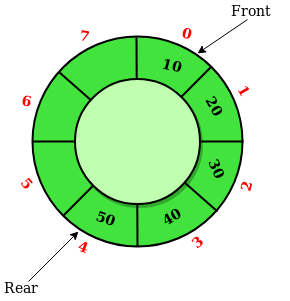
Describe Stacks
It is a data structure built on the concept of an array
They are Last in First Out (LIFO) data structures
It is only possible to push or pop an item from the top of the stack
A top pointer indicate the top of the stack
Static data structure
Sequential access data structure
A linear data structure which can be defined recursively
State when underflow and overflow occur for stacks
Underflow occurs when an attempt is made to pop an empty stack
Overflow occurs when an attempt is made to push to a full stack
Define recursive data structure
When the data structure can be broken down into smaller versions of the same data structure
Give the algorithm pseudo code for a stack
DECLARE stackArray as TYPE array of string
DECLARE stackpointer, maxLength as TYPE integer
DECLARE dataItem as Type stringh

FUNCTION push(dataItem):
	IF stackPointer < maxLenth then:
		stackPointer = stackPointer + 1
	ELSE output "Stack is full, data not saved"
	END IF
END FUNCTION

FUNCTION pop():
	IF stackPointer > 0 then:
		stackPointer = stackPointer + 1
	ELSE:
		output "Stack is empty, no data removed"
	END IF
END FUNCTIONState some uses for stacks
Store register values during subroutine execution
Reverse lists
Check syntax during compilation
Used for backtracking the users visited webpages (when back button pressed)
Describe queues
A First In First Out (FIFO) data structure
Items are added to the end of the queue (at the back pointer)
Items are removed/read at the front of the queue (front pointer)
Linear data structure
State how an item is removed from a queue and stack
Queue = Front pointer incremented by 1
Stack = Pointer decremented by 1
Describe linked lists
Dynamic data structure
The items are not necessarily held in contiguous (next to each other) data/memory locations
Sequential access data structure = A node cannot be directly accessed, each node must be traversed until correct node accessed
Each node contains a data field and the next address field (link/pointer field)
First node is called the head node
Pointer field in last item has Null value (-1)
Recursive data structure
Explain a disadvantage of linked lists
It uses more memory than an array because it needs to store the address for the next node, on top of the data
Describe binary trees
Dynamic data structure
0 or more nodes in hierarchal order
Each parent has a maximum of 2 children
Can be traversed in pre-order, in-order and post-order traversal
State the advantages and disadvantages of binary trees
Advantages
Faster to add a value
Faster to search for a value
Disadvantages
More complex to program/process
Processing + traversing may be slow if unbalanced
When are binary trees used
When there is a large number of items to be stored, which need to be accessed quickly, or when sequenced lists are needed
Representing arithmetic expressions
State the different parts of a binary tree
Left+Right subtrees
Root node = Has no parent
Parent node = Has at least one child
Branches connect nodes
Leaf nodes = Have no children
State the rules for a binary tree
Each parent has 2 children maximum
If the element is <= current node,the element is the left child node
If the element > current node, the element is the right child node
Describe Hash Tables
Static data structure and the fastest data storage method
Ideally will always match the data you are storing (uniformly distributed, minimal collisions, efficient)
The file memory location will be determined by passing the index/key value through an algorithm
If there is a collision, file stored in overflow area (serial file/linked list)
State a problems with hash files overflow area and the solution
Searching the overflow area is slow, and the more files the slower the program becomes → Larger hash file created + new hashing algorithm
Define masking
The process of setting each bit in a byte to either on/off using bitwise operators
Which bitwise operator is used for encryption
XOR