Lecture 8 - Sensory; LLT, Receptors, Modality/location/intensity
 Studied by 1 person
 Call Kai
 Learn
Learn Practice Test
 Spaced Repetition
 Match
Match Flashcards
 Knowt Play
1/21

There's no tags or description
Looks like no tags are added yet.
Name | Mastery | Learn | Test | Matching | Spaced | Call with Kai |
|---|
No analytics yet
Send a link to your students to track their progress
22 Terms
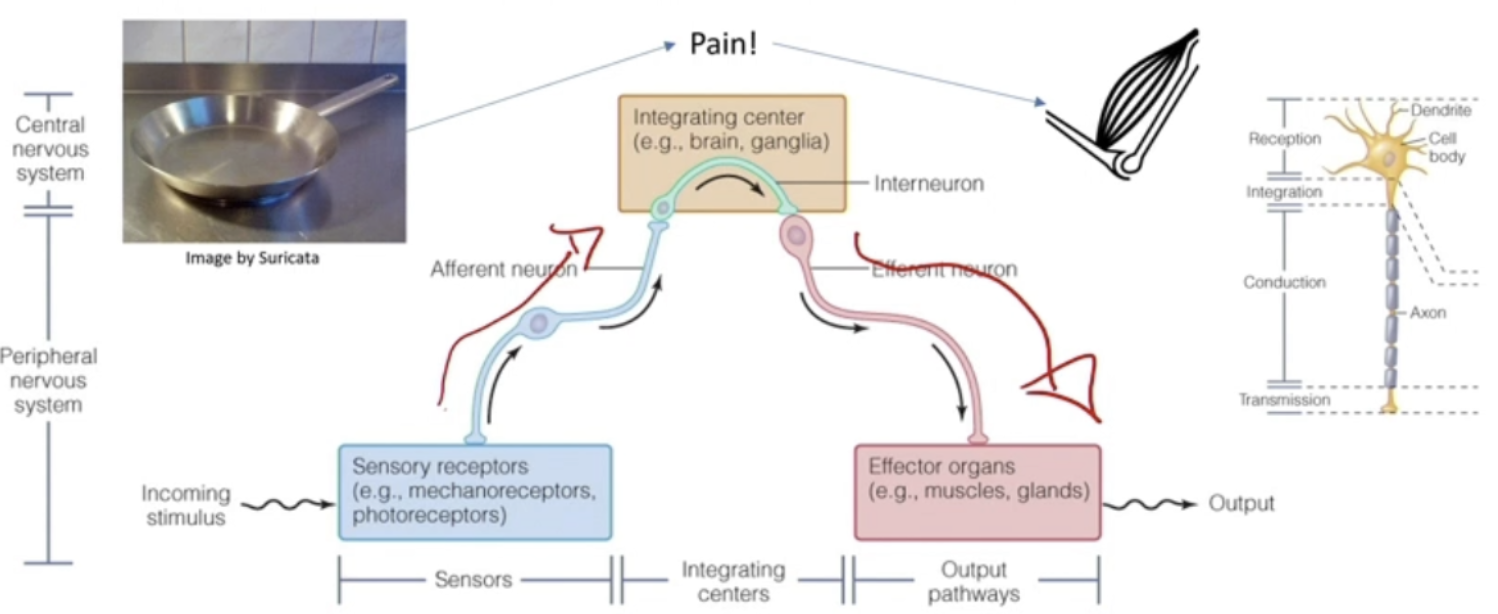
Sensory system
Stimulus activates a sensor
Afferent neuron stretches from that sensor to an integrating center (Interneuron), often in brain, spinal chord, or outside CNS (faster)
Sensory neuron = Afferent
Integrating center neuron = Interneuron
Decision is made (un/conscious), and message is sent to an effector, causing the effect occur
Motor neuron = Efferent
Sensory stimuli are detected where? (2)
Neurons
Accessory cells
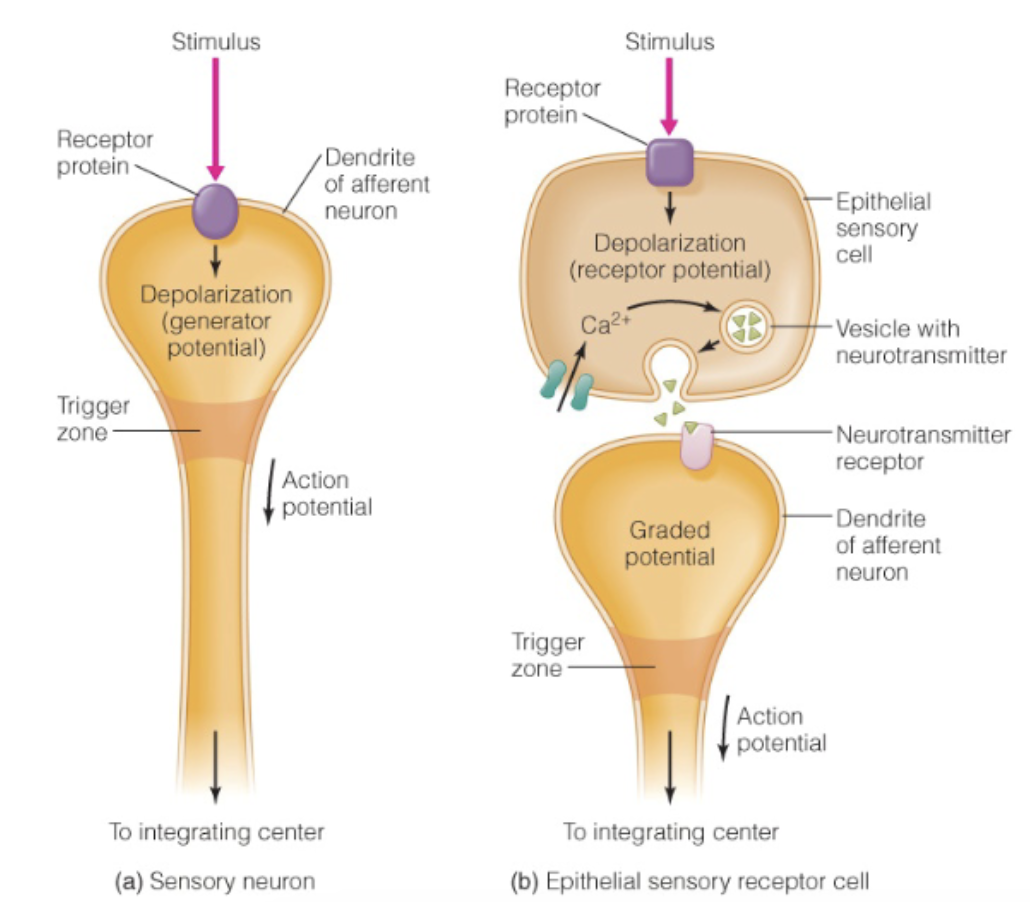
Sensory neuron
Sensory neuron
Dendrites replaced by sensors
Stimulus
→ received by receptor protein
→ produce a graded potential (generator potential)
→ reaches trigger zone (axon hillock), and if large enough, leads to an action potential
→ goes down axon
→ reaches synapse, sends message towards integrating center
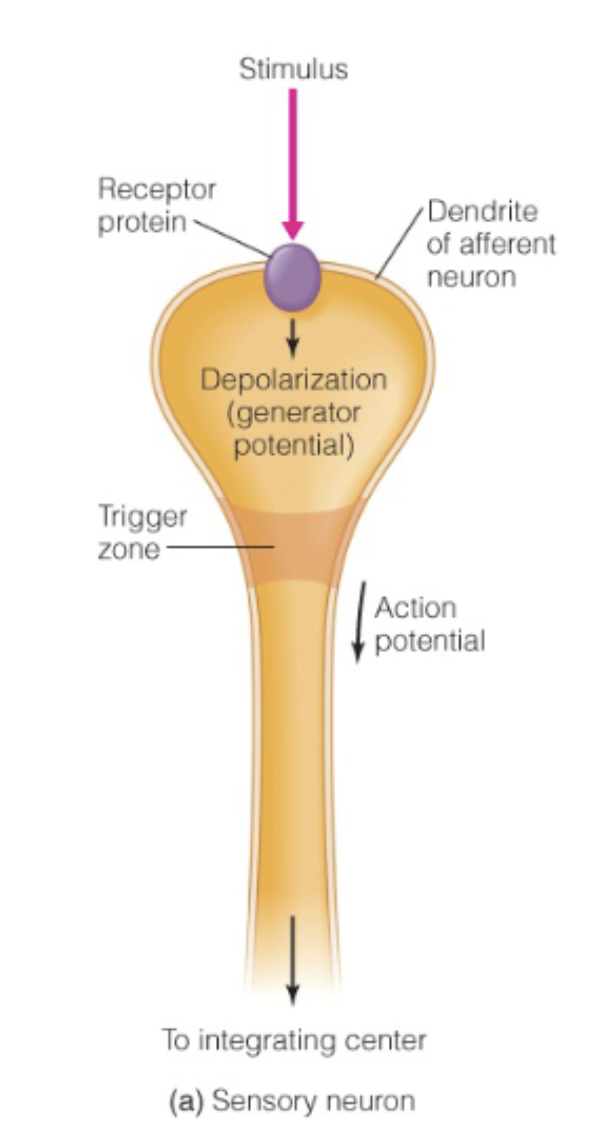
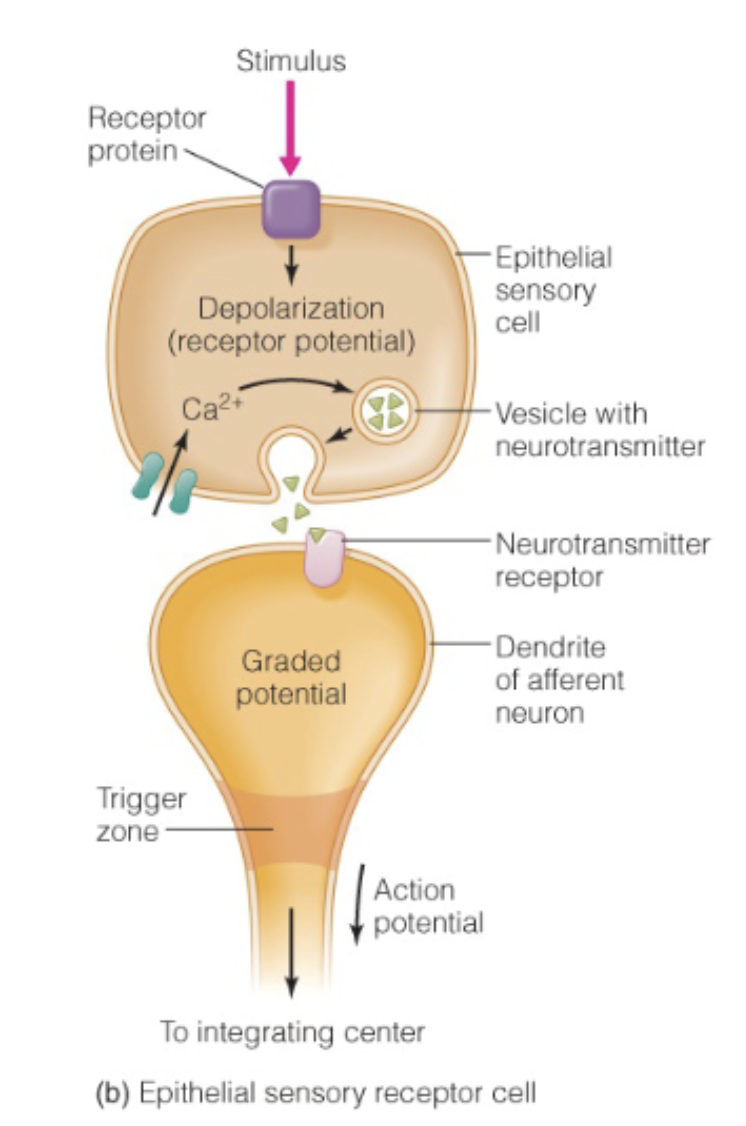
Sensory epithelial cells (accessory cells)
Completely separate from neuron, has a receptor on one end
Receptor of cell receives a stimulus
→ Stimulus causes pressure
→ Pressure opens Na+ and K+ channels, creating a generator potential in the sensory cell
→ At the synapse, Ca2+ channels open
→ Vesicle go towards synapse, fuses with PM, and releases neurotransmitters into the synapse
→ NT touch receptor on the sensor of an Afferent Neuron
→ Graded potential goes towards integrating center
Sensory receptors (3)
Convert incoming stimuli into changes in membrane potential
Chemoreceptors
Mechanoreceptors
Photoreceptors
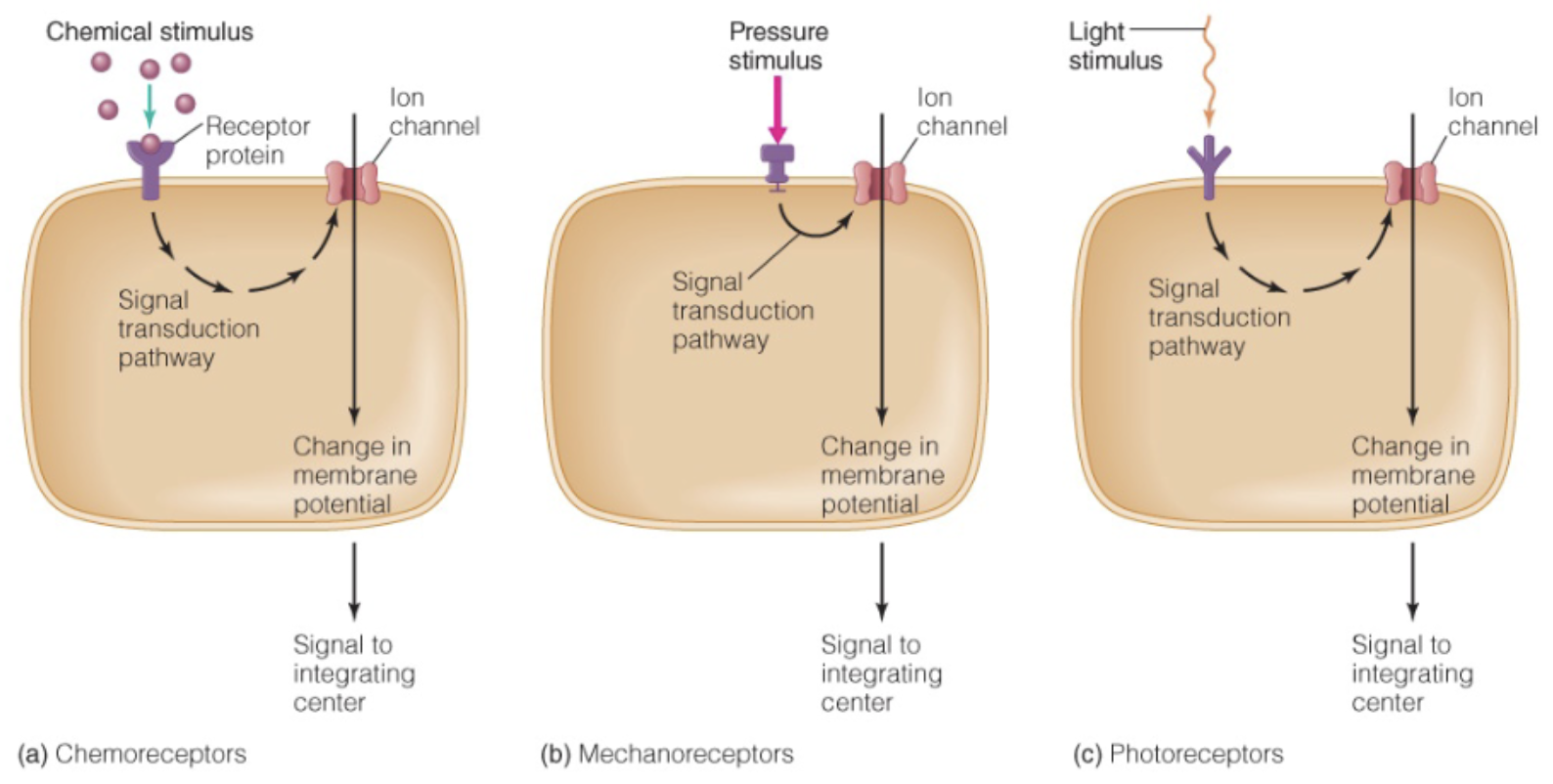
Chemoreceptor
Receives chemical stimulus
Taste, smell
Chemical attaches to receptor protein
Often GPCR
Opens ion channel
Creates generator potential
Sends message to integrating center
Response
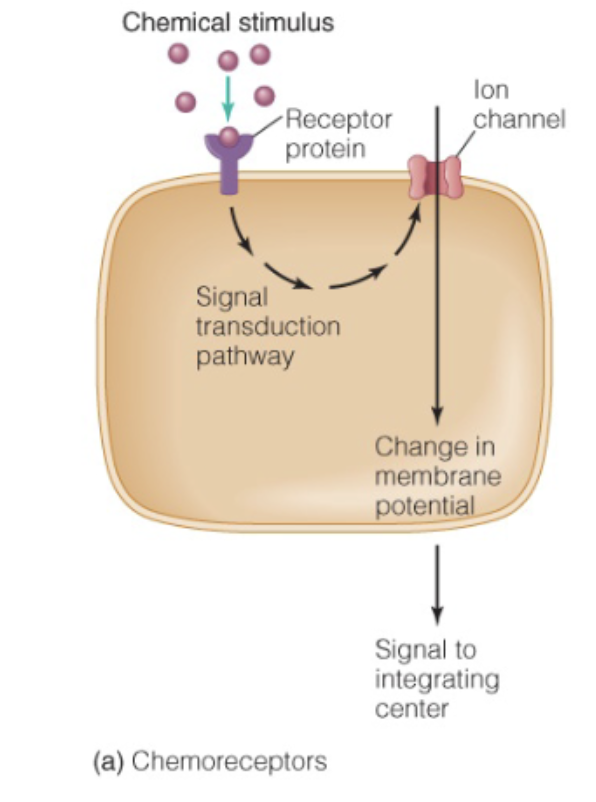
Mechanoreceptors
Often baroreceptors - change in pressure
Skin, kidneys, vagus nerve, ears
Instead of a ligand, a touch opens ion channel
Leads to generator potential
Sends message to integrating center
Response
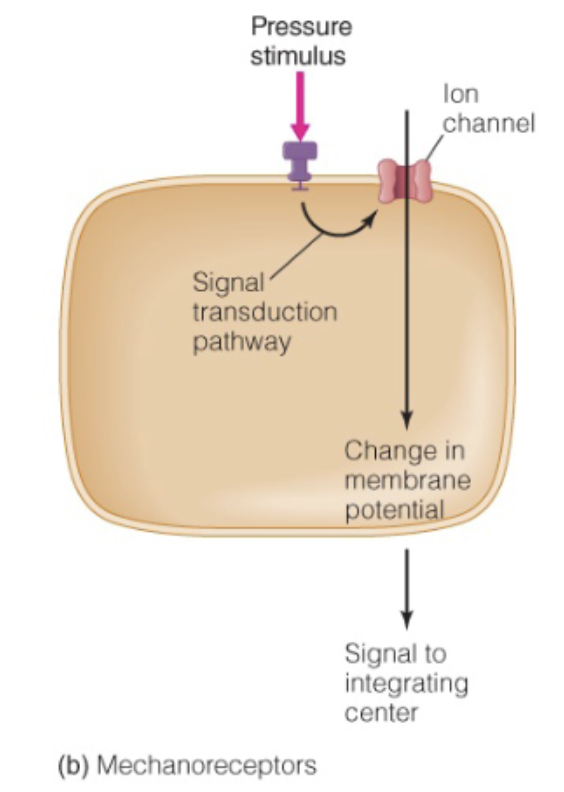
Photoreceptors
Light stimulus
Specific receptor - photoreceptor
Opens ion channel
Leads to generator potential
Sends message to integrating center
Response
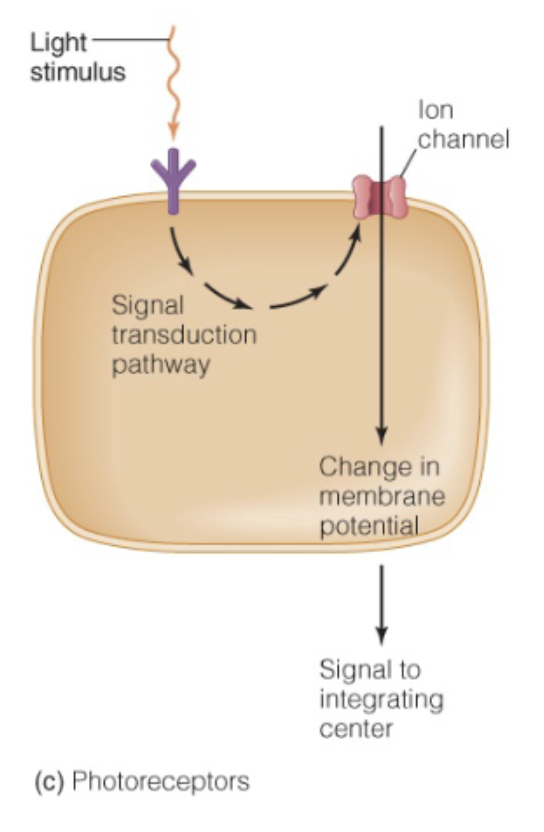
Sensory receptors - classified by stimulus modality
Chemoreceptors - presence of chemicals in environment
Mechanoreceptors - pressure and movement, including proprioception
Photoreceptors - light
Thermoreceptors - temperature
Electroreceptors - electrical fields
Magnetoreceptors - magnetic fields
Sensory receptors convert info about stimulus into - 4 features
Action potentials ; encode 4 important features:
Stimulus modality
Stimulus location
Stimulus intensity
Stimulus duration
[Modality] Sensory pathways and stimulus modality - Labeled Line Theory (LLT)
Generally, a particular afferent neuron is associated with one type of receptor ; one receptor recognizes one sense - Labeled Line Theory (LLT)
Each afferent neuron follows a particular pathway for integration - one receptor → message to integrating center → out effector ; always same sense
Brain recognizes the particular sense because it came from a particular receptor
The type of sensation you perceive is determined by which sensory pathway (line) is activated, not by the physical nature of the stimulus itself
Theory isn’t perfect, has issues
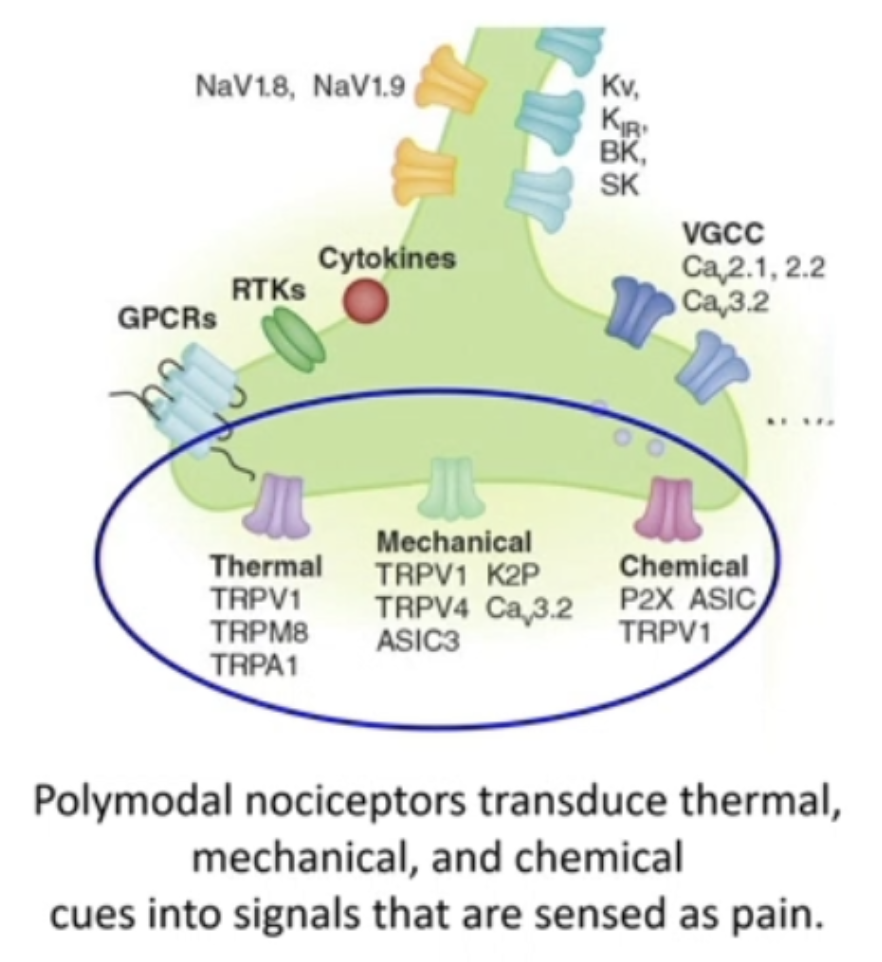
[Modality] Polymodal receptors
Sensitive to multiple sensory modalities - contradict LLT
Respond to more than one type of stimulus (modality) and produce the same type of sensory perception.
Thermal stimuli (heat/cold)
Mechanical stimuli (pressure, stretch)
Chemical stimuli (acids, capsaicin, irritants)
Despite different inputs, the same neuron fires.
Ex: Nocireceptors (pain)
They can detect:
Extreme heat or cold
Mechanical damage (pinch, cut)
Chemical irritants (acid, capsaicin, inflammatory mediators)
All of these:
Activate the same nociceptive neuron
Send signals to the same CNS pathways
Are perceived as pain
Different stimulus → same percept
[Location] Receptive fields
Touch - where is this sense coming from?
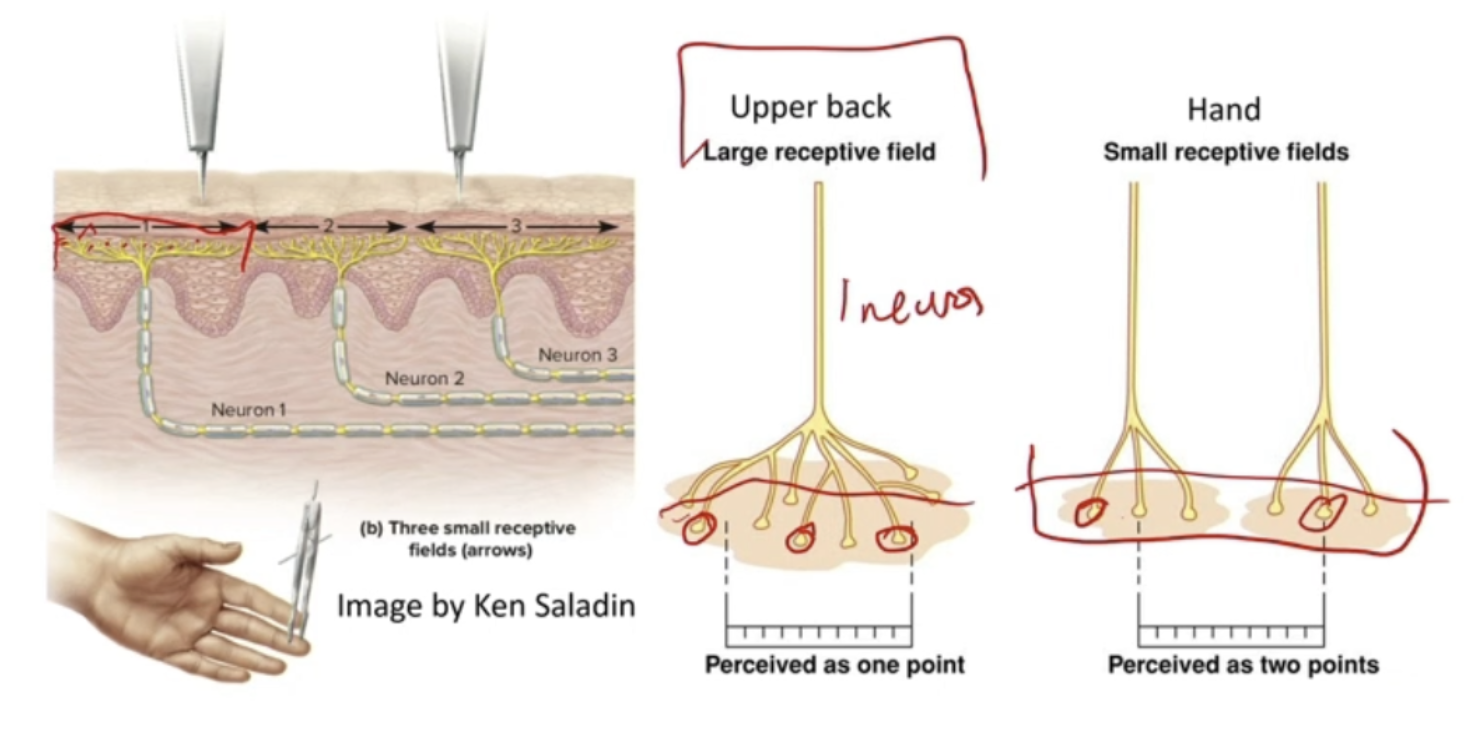
Touch sensors (neurons) have sensors on dendrites, which spread out
The spread of the sensors - Receptive field
[Location] Receptive fields sensors sizes
Receptive fields are big or small
Upper back - large receptive field
Less sensitive
Hand - small receptive field
Very sensitive
[Location] Receptive fields sensors overlap
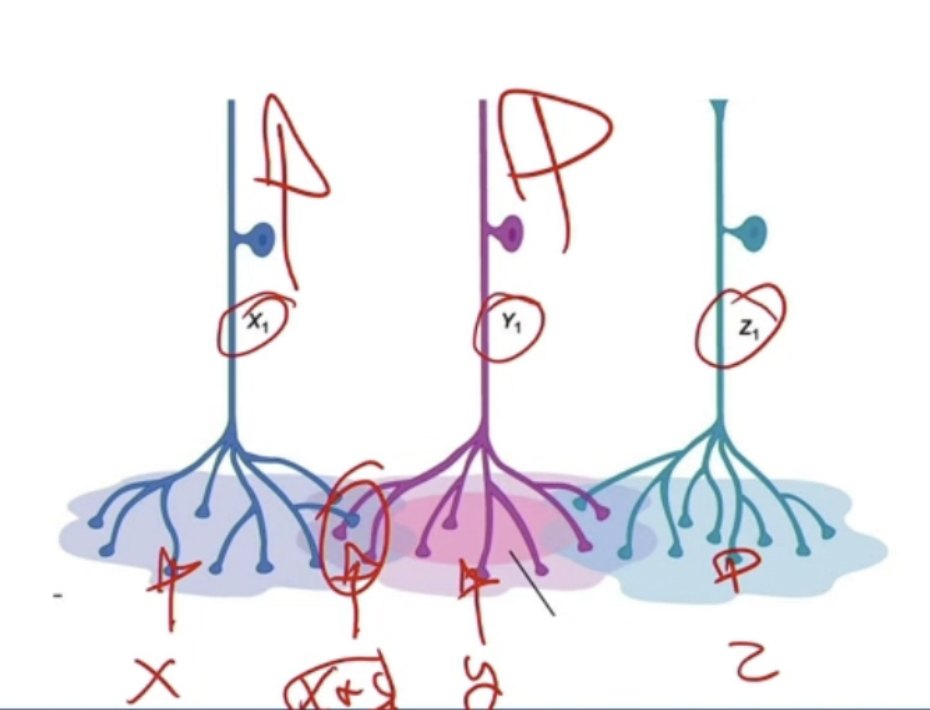
Receptive fields overlap to improve ability and to localize stimulus
Touch at one neuron - recognized for that neuron
Touch in between neurons - both neurons fire messages, brain recognizes touch in between the 2 neurons
Help increase acuity of recognizing touch
[Location] Lateral Inhibition
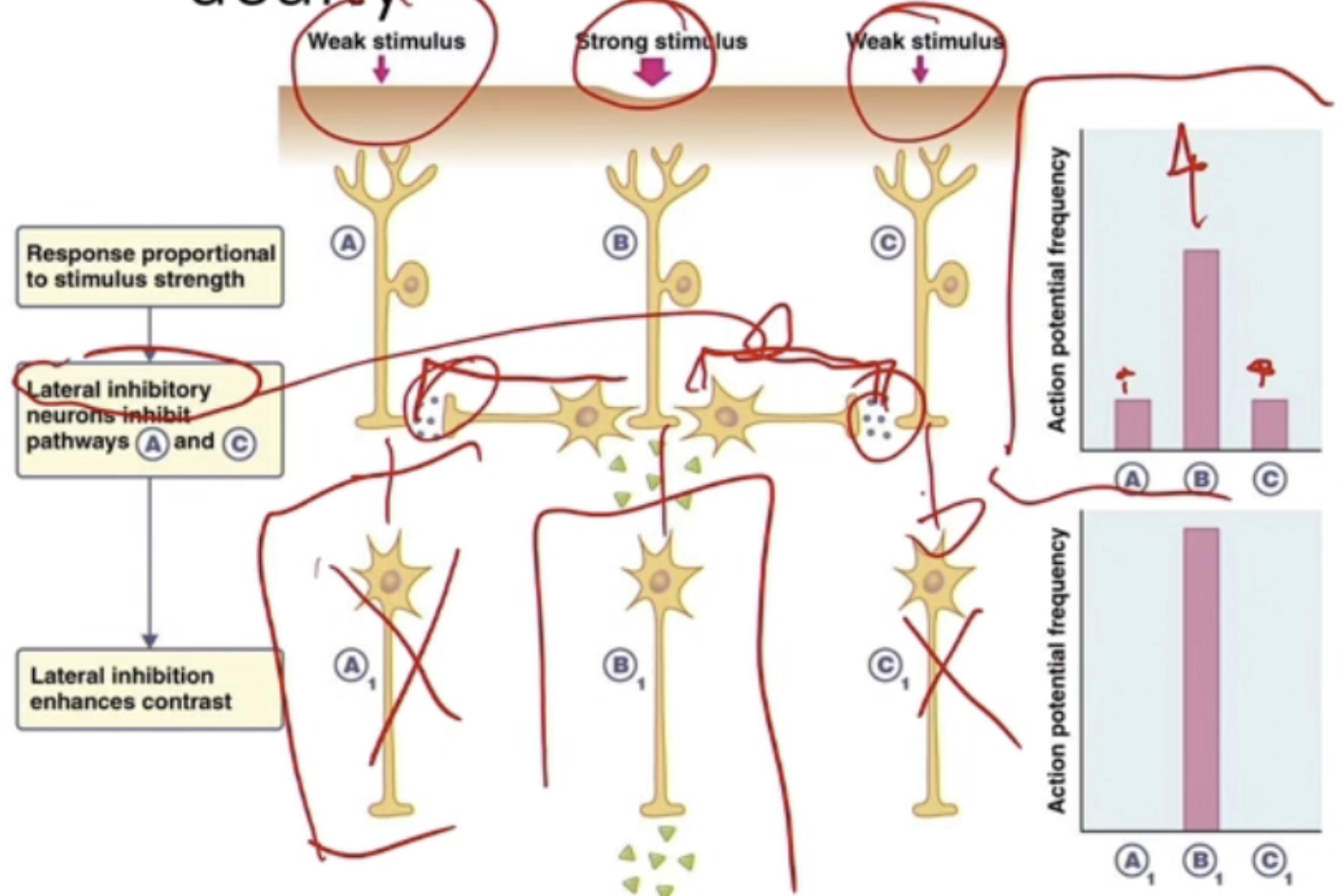
Some receptors have lateral inhibitory neurons
Strong stimulus can stimulate multiple neurons →
Lateral inhibitory neurons can inhibit pathways of weaker stimulus, pinpoint where strong touch is
Makes strong signal feel stronger, weak signals feel weaker
[Location] Things that improve acuity
Smaller spread
Receptive field overlap
Lateral inhibitory neurons contrasting signal strength
![<p>[Intensity] </p>](https://knowt-user-attachments.s3.amazonaws.com/65e5a8dd-65cd-4321-b74b-7a29bd27211c.png)
[Intensity]
Receptor potential - how strong a touch is (degrades)
Greater frequency in strong AP than weaker AP
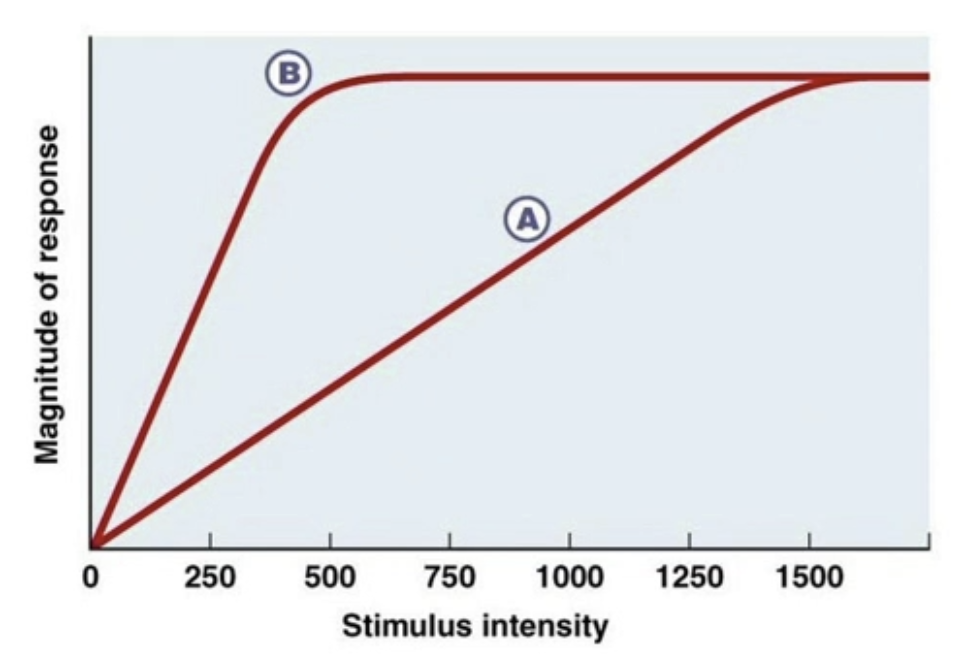
[Intensity] Receptor Dynamic range
Receptor will eventually get saturated ; can only sense so much [heat]
Dynamic range - sense differences in intensity until fully saturated
![<ul><li><p>Receptor will eventually get saturated ; can only sense so much [heat]</p><ul><li><p>Dynamic range - sense differences in intensity until fully saturated</p></li></ul></li></ul><p></p>](https://knowt-user-attachments.s3.amazonaws.com/f452081b-6f35-4f95-998c-af393293e210.png)
[Intensity] Receptor Dynamic range sizes
Small dynamic range - receptor is really sensitive within that range
B - can produce a stronger response at weaker stimuli intensity (more sensitive), and will also get saturated quicker
Large dynamic range - receptor is less within that range (but its
A
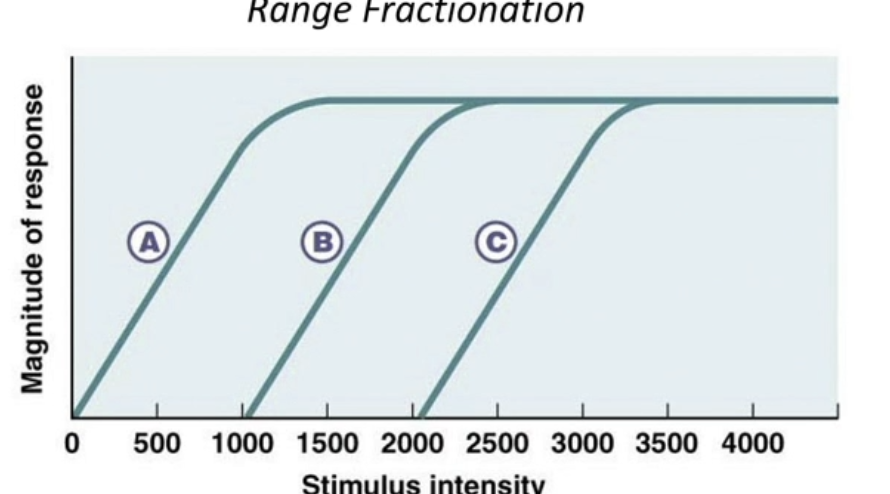
[Intensity] Range Fractionation
Discrimination improves by distributing sensitivity amongst the receptor population
Different receptors that exist within a family and work together that sense different magnitudes of stimulus intensity / have different Dynamic ranges
Recognize different intensities
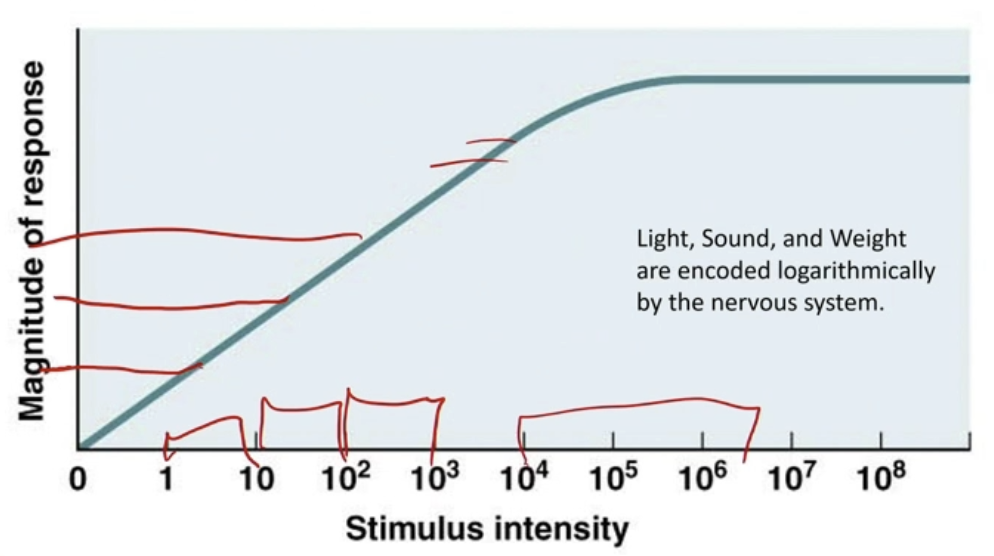
[Intensity] Logarithmic encoding
Allows for compromise between dynamic range and discrimination
Sensitive at low ends of scale, less sensitive at the higher ends
Allows for greater range, but sacrifices sensitivity on high end
Ex: Can EASILY recognize 1 lb from 2 lb from 10 lb, but not 100 lb from 200 lb, because they are too heavy, can’t really tell the difference
Light, sound, and weight are encoded logarithmically by the nervous system
 Note
Note  Flashcards (26)